

Nine million people duked it out for a mere 330,000 tickets to Celine Dion Paris concerts this fall. Most didn’t get in. The ones who did are already booking — and at 155 days out, Paris vacation rentals for concert dates are already pacing up to 30% ahead of last year on specific dates, with one-night bookings surging 50% in the last seven days alone. The event hasn’t started. The market already has.
Here is what early PriceLabs Market Dashboard data tells us about how this demand is shaping the market, and exactly how property managers need to react to capture the premium.
Why This Concert Is Different
This is not a routine stadium show. Celine Dion’s return to the stage is one of the most anticipated live music events in years — her first major concerts in nearly a decade following her diagnosis with Stiff Person Syndrome, a rare neurological condition that left her unable to perform and forced the cancellation of her entire world tour.
The scale of the comeback demand reflects that. When ticket pre-registration opened in late March, over 9 million fans registered globally for roughly 330,000 available seats — a ratio that forced organisers to implement a strict lottery system just to manage the frenzy. Lottery results went out April 6, access codes followed April 8, and presales opened April 9–10. Tickets sold out almost immediately.

The confirmed schedule spans 11 dates across nearly six weeks:
- September 2026: 12th, 16th, 18th, 19th, 23rd, 25th
- October 2026: 2nd, 7th, 9th, 16th, 17th
More dates are likely. Given the demand, additional shows are widely expected to be announced, which would extend the event window further into October and potentially beyond. For Paris property managers, that means the opportunity is larger than what the current schedule alone suggests.
Unlike a single-weekend festival, this extended residency creates sustained demand elevation across the entire September–October period — layering onto a Paris market already running at a healthy 72% occupancy with bookings and ADR (€184) both up year-over-year.
Occupancy Is Already Pacing Ahead — And the Gap Will Widen
The concerts are still five months away, which means occupancy is in early accumulation mode. Even so, the pacing advantage on concert dates is already visible.
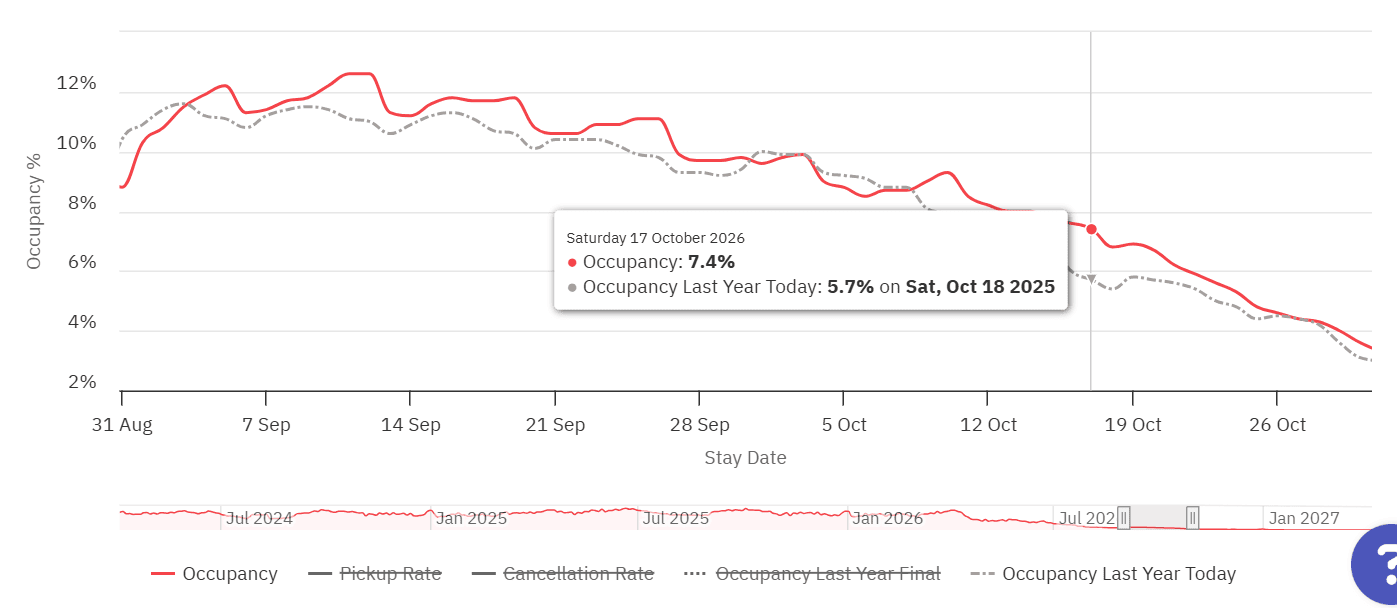
| Concert Date | Current Occupancy | Last Year Today | Point Difference | % Change |
| Sept 12 | 12.4% | 10.7% | +1.7 pts | +15.9% |
| Sept 16 | 11.6% | 11.0% | +0.6 pts | +5.5% |
| Sept 18 | 11.5% | 10.5% | +1.0 pts | +9.5% |
| Sept 19 | 11.5% | 10.4% | +1.1 pts | +10.6% |
| Sept 23 | 10.7% | 10.2% | +0.5 pts | +4.9% |
| Sept 25 | 10.9% | 9.7% | +1.2 pts | +12.4% |
| Oct 2 | 9.7% | 9.8% | -0.1 pts | Flat |
| Oct 7 | 8.6% | 8.7% | -0.1 pts | Flat |
| Oct 9 | 8.9% | 8.1% | +0.8 pts | +9.9% |
| Oct 16 | 7.4% | 6.0% | +1.4 pts | +23.3% |
| Oct 17 | 7.4% | 5.7% | +1.7 pts | +29.8% |
September 12 — the opening night — is already pacing 16% ahead of last year. That means inventory is tightening earlier than normal for what is typically a shoulder-season month. Operators who wait for the standard 60-day window to adjust pricing will have already missed the premium.
October 2 and October 7 are currently flat against last year. This is not unusual — in a multi-date residency, early demand tends to concentrate on the opening and closing shows before spreading to mid-run dates. Those flat dates will move.
October 16 and 17 are the sharpest signal in the table, pacing 23% and almost 30% ahead respectively. Guests are locking down specific dates five months in advance.
September Is Already the Fastest-Filling Month on the Chart
The individual date pacing tells part of the story. The booking curve tells the rest.
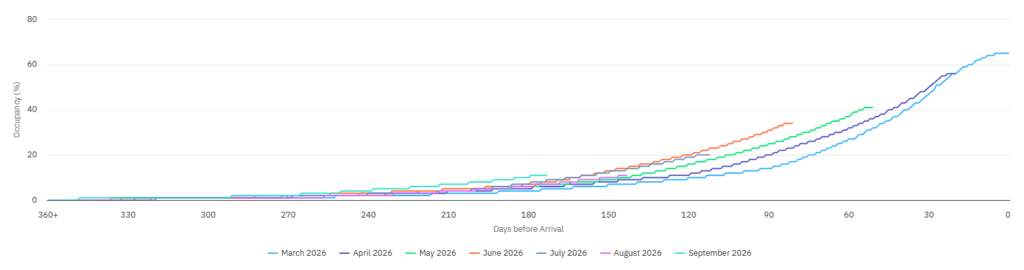
At approximately 210 days before September, the month was sitting at 7% occupancy — compared to 6% for September 2025 at the same point in last year’s booking cycle. That is a roughly 17% relative increase in pace. More tellingly, September is now pacing ahead of July and August — the months that typically dominate Paris tourism. That does not happen in a normal year.
Booking curves compound. Guests who book early lock in stays, which reduces available inventory, which pushes prices higher for whoever books next. September is already running 17% ahead of last year at the 210-day mark. By the 90-day mark, that gap is unlikely to be smaller.
Premium Listings Have Already Priced In the Event
The biggest price movements in event markets typically happen 30–90 days out. But the early signal is already there, and it is concentrated at the top of the market.
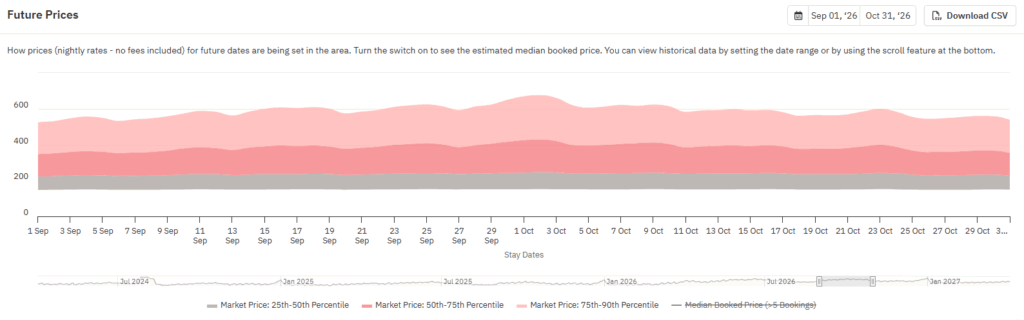
| Date | Median Booked Price | 50th Percentile Listed | 75th Percentile Listed |
| Sept 12 (concert) | €167 | €234 | €381 |
| Sept 13 (non-concert) | €162 | €230 | €371 |
| Sept 16 (concert) | €162 | €235 | €394 |
| Sept 18 (concert) | €166 | €237 | €395 |
| Sept 19 (concert) | €165 | €235 | €389 |
| Sept 23 (concert) | €165 | €237 | €398 |
| Sept 25 (concert) | €168 | €240 | €408 |
| Oct 2 (concert) | €167 | €245 | €429 |
| Oct 7 (concert) | €161 | €240 | €404 |
| Oct 9 (concert) | €168 | €243 | €412 |
| Oct 16 (concert) | €166 | €241 | €395 |
| Oct 17 (concert) | €168 | €239 | €390 |
At the median level, concert dates are running only €4–€8 per night above surrounding non-concert dates. The mid-market has not moved yet. But at the 75th percentile, late-September and October concert dates are consistently commanding €390 to €429 — a clear sign that premium operators have already adjusted.
That gap between the median and the 75th percentile is where the opportunity sits. The premium tier has proven that guests are willing to pay elevated rates for these dates today. The mid-market window to capture that pricing before inventory tightens further is closing.
Two Types of Guests Are Already Booking — and They Need Different Strategies
When comparing the 30-day booking window to the last 7 days specifically for concert dates, a clear split emerges between two distinct demand types.
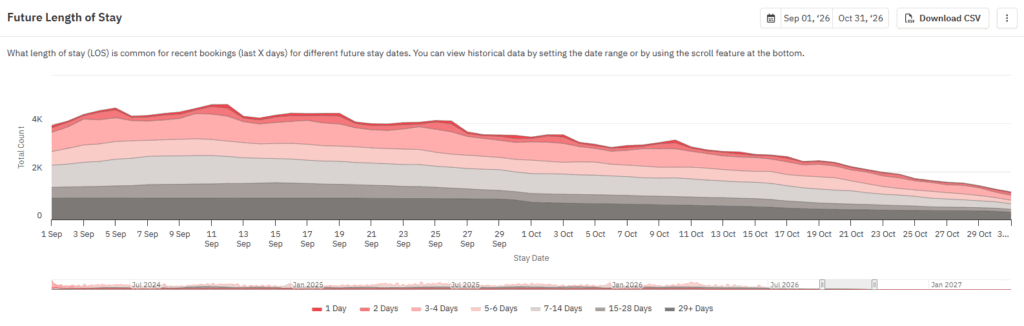
| Length of Stay | 30-Day Window (%) | 7-Day Window (%) | Relative Change (%) |
| 1 Day | 3.6% | 5.4% | +50.0% |
| 2 Days | 7.7% | 8.5% | +10.4% |
| 3-4 Days | 23.5% | 22.7% | -3.4% |
| 5-6 Days | 15.7% | 15.0% | -4.5% |
| 7-14 Days | 24.2% | 22.6% | -6.6% |
| 15-28 Days | 10.7% | 11.5% | +7.5% |
| 29+ Days | 14.6% | 14.3% | -2.1% |
The 30-day window is likely dominated by vacation builders — international travelers constructing longer Paris trips around the concert, booking 4–14 day stays well in advance. One-night stays make up just 3.6% of that mix.
The last 7 days tell a different story. That window coincides almost exactly with the April 6–10 ticket lottery and presales. In it, one-night stays have surged to 5.4% — a 50% relative increase. Two-night stays accelerated too. While not every short booking can be attributed directly to the concert, the timing is not a coincidence: local and regional fans are snapping up the nearest available night the moment they secure a ticket.
These two demand types require different responses. Vacation builders reward longer minimum stays and early rate adjustments. Concert fans — arriving in the last 7–14 days before the show — will pay a premium for whatever is left. A calendar that has been chopped up by one-night bookings in the months prior will not be able to capture that late surge. Adjusting minimum stays now protects inventory for the higher-value international traveler and preserves the ability to flex down closer to the date if needed.
What We Will Track Next
This is an early read on a market that will evolve significantly over the next five months. We will return to this data as the concert dates approach — tracking whether the occupancy gap widens, when mid-market prices begin to move, whether additional dates are announced, and how booking windows compress in the final 30 days. The signal is already there. The operators who act on it earliest will be the ones who look back on this as the window they did not miss.
Related RSU by PriceLabs coverage:

Related Articles:
 Easter 2026: Affordable Cities Are Winning. And It’s Not Close.
 PriceLabs’ 2026 Revenue Accelerator, in Context: Why Revenue Is No Longer One Person’s Job — and How AI Is Reshaping That Job in Two Directions at Once
 2026 Winter Olympics Milano: Why Fewer Bookings Are Making Hosts More Money
 Croatia Signals Rental Limits, Maui Rejects Rezoning Lifeline, and Evanston Shifts to Discretion-Based Oversight