Executive brief
- Airbnb is asking some hosts to offer 20% off in exchange for higher ranking.
- The promotion targets 4.8+ rated guests.
- Hosts fully fund the discount.
- This follows Brian Chesky confirming Airbnb is trialing loyalty components.
- The structure resembles Booking.com’s Genius model — a highly successful discount-for-visibility system.
- It’s not formal enrollment yet — but it is clearly a pay-to-play test.
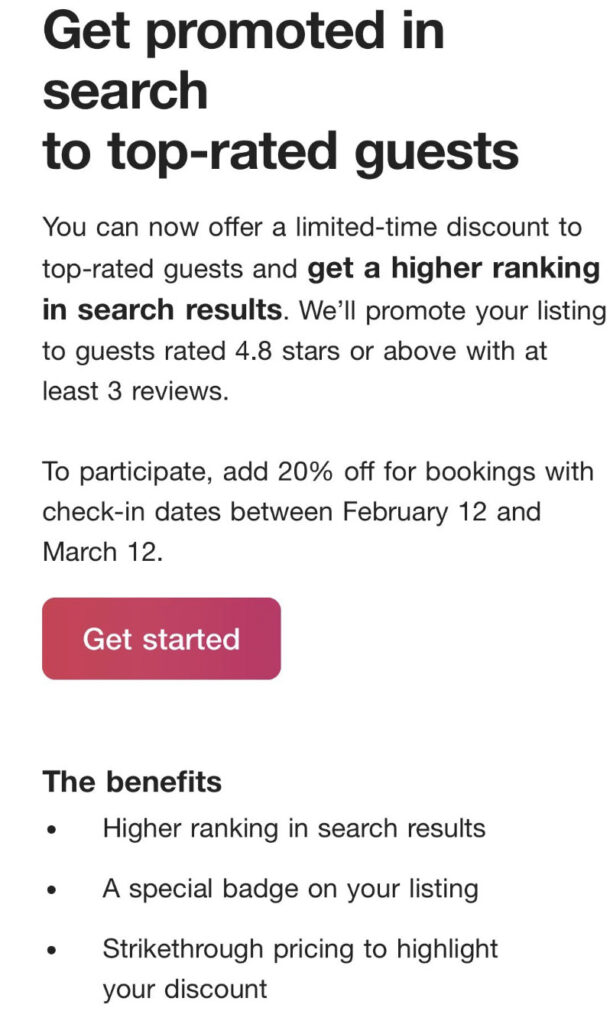
Some Airbnb hosts are receiving a new message:
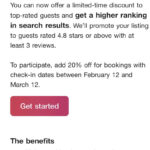
Offer 20% off to top-rated guests and get higher ranking in search results.
What Airbnb offers:
- Higher search placement
- Promotion to 4.8+ rated guests
- A badge
- Strikethrough pricing
What hosts give:
- 20% discount
- Fully funded
- For a defined booking window
The trade: Lower ADR → Higher exposure.

Why this matters
Last week, during the Q4 2025 earnings call, Brian Chesky confirmed Airbnb is trialing loyalty components.
For years, Airbnb resisted loyalty programs.
No tiers.
No elite discounts.
No formal guest status.
This message suggests that stance is evolving.
Why bring up Booking.com Genius?
Because Genius is the most successful loyalty program in the alternative accommodation space.
It:
- Drives repeat bookings
- Segments guests
- Increases conversion
- Normalized discount-for-visibility
Over time, Genius became a structural part of Booking’s marketplace.
It reshaped pricing expectations in many markets.
So when Airbnb begins linking:
- Discounting
- Guest segmentation
- Ranking boosts
It’s reasonable to compare it to Genius.
Not because they are identical.
But because Genius shows what this kind of mechanism can evolve into.
Key structural difference
Booking Genius:
- Requires qualification
- Requires formal enrollment
- Is ongoing
- Sets a permanent minimum discount
Once you join, you’re in the program.
Airbnb’s test:
- Some hosts are being invited
- Applies to specific listings
- Is time-limited
- Has no formal enrollment
This is not yet a structured loyalty program.
It is a controlled, campaign-based experiment.
But it uses the same economic lever:
Margin in exchange for visibility.
How Airbnb defines “best guests”
Eligible guests:
- 4.8+ rating
- At least 3 reviews
Behavior-based segmentation.
Booking’s Genius:
- Frequency-based segmentation
- Tiered (Level 1–3)
- Loyalty-driven
Different definition of “best.”
Similar ranking logic.
Not the same as the new-listing promotion
Airbnb already applies a 20% discount to new listings until they receive three reviews.
That program:
- Solves the cold-start problem
- Ends automatically
- Helps launch a property
This new test:
- Applies to established listings
- Ties discounting directly to ranking
- Targets a defined guest segment
Different objective entirely.
The bigger shift
For years, Airbnb’s ranking was primarily performance-driven.
This introduces a new dimension:
Ranking influenced by economic participation.
That’s the Genius playbook.
And Genius proved that once discount-for-visibility becomes normalized, it becomes structural.
What managers should watch
- Does this expand beyond test markets?
- Does Airbnb formalize enrollment?
- Does guest tier branding appear?
- Does 20% become a recurring expectation?
Today: limited test.
Tomorrow: possible marketplace shift.
The bottom line
This isn’t Airbnb Genius.
Not yet.
But Booking.com’s Genius program shows how powerful — and structural — discount-driven loyalty can become.
That’s why this test matters.
Because if Airbnb follows that path, ranking may increasingly depend on how much margin you’re willing to trade.

Thibault Masson is a leading expert in vacation rental revenue management and dynamic pricing strategies. As Head of Product Marketing at PriceLabs and founder of Rental Scale-Up, Thibault empowers hosts and property managers with actionable insights and data-driven solutions. With over a decade managing luxury rentals in Bali and St. Barths, he is a sought-after industry speaker and prolific content creator, making complex topics simple for global audiences.