Two quiet announcements this week reveal how Airbnb’s lifestyle platform is actually taking shape, and how fast.
Airbnb can now get you from the airport.
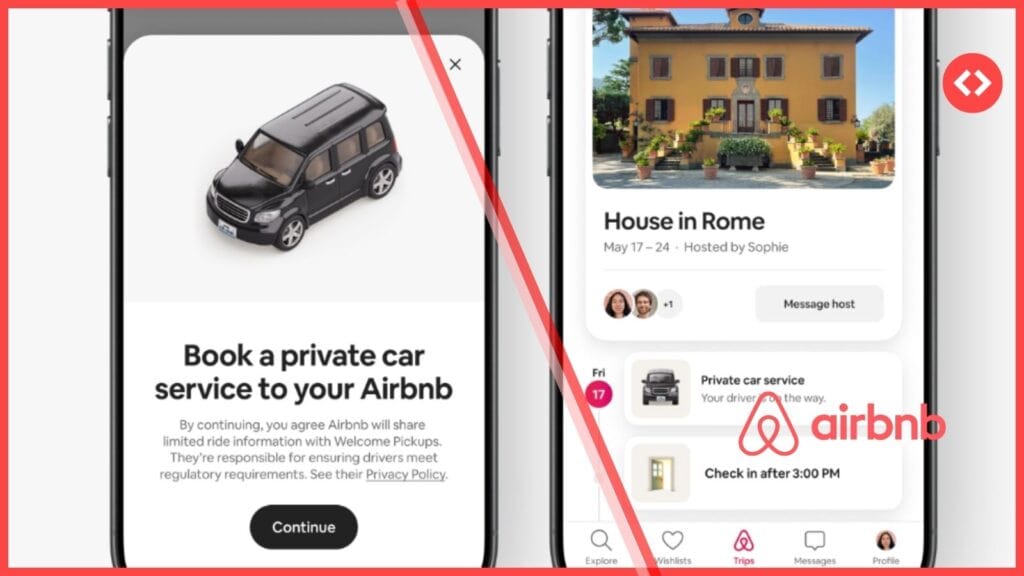
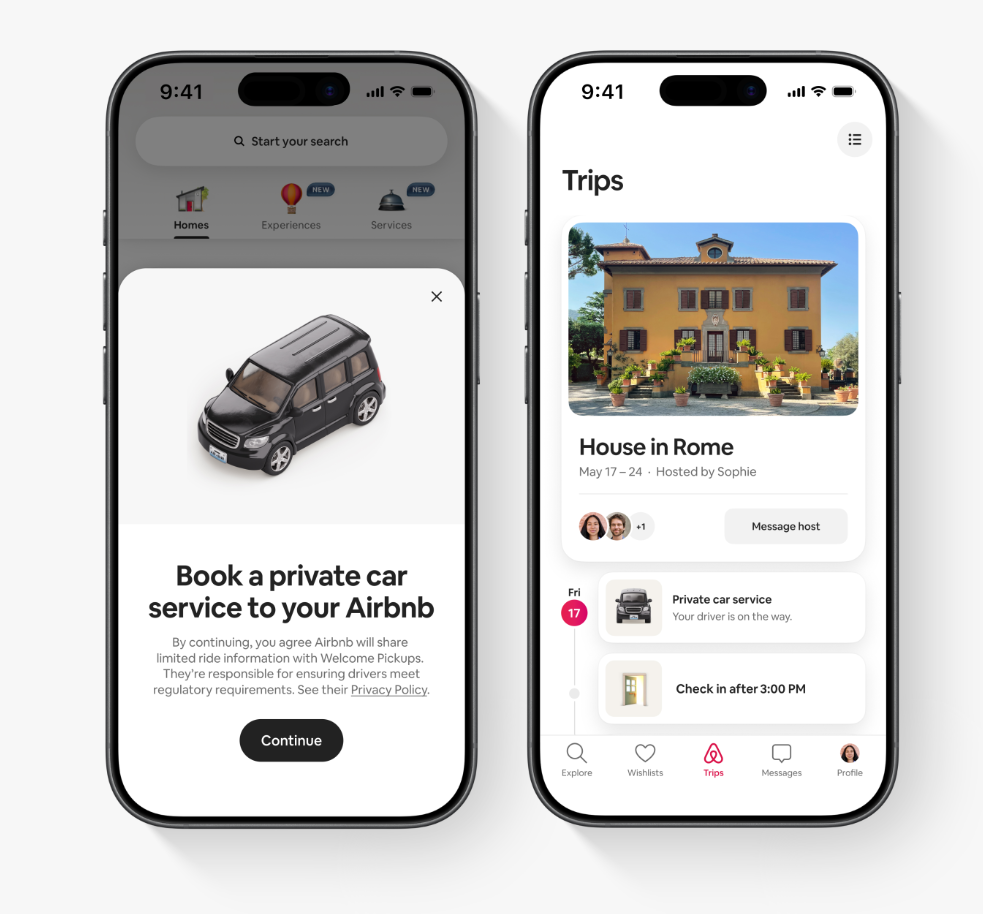
Starting this week, guests in over 125 cities across Europe, Asia, and Latin America can book a private transfer directly through the Airbnb app, powered by Welcome Pickups. Fixed price, professional driver, no separate app required. It follows a pilot the two companies ran quietly across Europe and Asia, which apparently went well enough to trigger an immediate multi-continent rollout.
The US, Canada, and Africa aren’t included yet, though Welcome Pickups already operates in New York, Las Vegas, and Chicago, and Airbnb has signaled expansion is coming as they scale the feature through 2026.

On the same week, a second announcement landed with even less fanfare: Timeleft, a social app that organizes dinners between strangers, is now live as an Airbnb Original experience in Paris.
Taken individually, neither announcement is earth-shattering. Taken together, they’re a useful window into how Airbnb’s much-discussed lifestyle platform ambition is actually materializing — not through one big product launch, but through a steady accumulation of moves that are quietly reshaping what the platform is.
Airbnb Welcome Pickups Service: Why Transportation Was Always The Next Step
The gap between landing at an airport and arriving at an Airbnb has always been someone else’s problem to solve. Guests figure it out themselves: Uber, Bolt, a local taxi app, a train. That spend leaves the Airbnb ecosystem entirely, and Airbnb gets no data, no margin, and no engagement from it.
Welcome Pickups closes that gap. The integration sits inside the existing booking flow, which means Airbnb captures a transaction that previously happened elsewhere, at exactly the moment a guest is already inside the app.
We flagged transportation as the obvious adjacent move in our 2025 strategy analysis, and it showed up in the Q4 2025 earnings read too — Airbnb quietly testing airport pickups alongside grocery delivery as part of what management described as a push to own more of the trip itinerary. The Welcome Pickups partnership is that test, now named and scaled.
The platform logic here mirrors what Airbnb has done with Experiences: curate and distribute, don’t operate. Welcome Pickups brings the supply — over 125 cities of it, already running. Airbnb brings the distribution and the booking moment. It’s a low-risk expansion that adds a meaningful new revenue line without the operational complexity of building a ground transportation product from scratch.
The Phased Rollout Is a Signal in Itself (and Why the US Isn’t Included Yet)
The absence of the US in this launch is worth pausing on. This isn’t a global rollout — it’s a deliberate, phased approach that started with the markets where the pilot ran (Europe and Asia) and expanded from there. Latin America is included; North America is not yet.
That sequencing matters because it tells you something about how Airbnb is managing the expansion of its platform beyond accommodation. They’re not announcing a vision and hoping execution follows. They’re piloting, validating, then scaling — city by city, region by region. The US will almost certainly follow, given Welcome Pickups’ existing footprint in New York, Las Vegas, and Chicago. But Airbnb appears willing to wait until the integration is ready to scale properly rather than rush a global launch.
That’s a more methodical approach than the Amazon-speed rollout Chesky once described — launching new services simultaneously in over 100 cities. What we’re seeing in practice looks more iterative, which is probably the right call when you’re adding a category (transportation) that involves real-world logistics and partner dependency.
The Timeleft partnership: a different kind of bet
The second announcement is quieter but points somewhere more interesting.
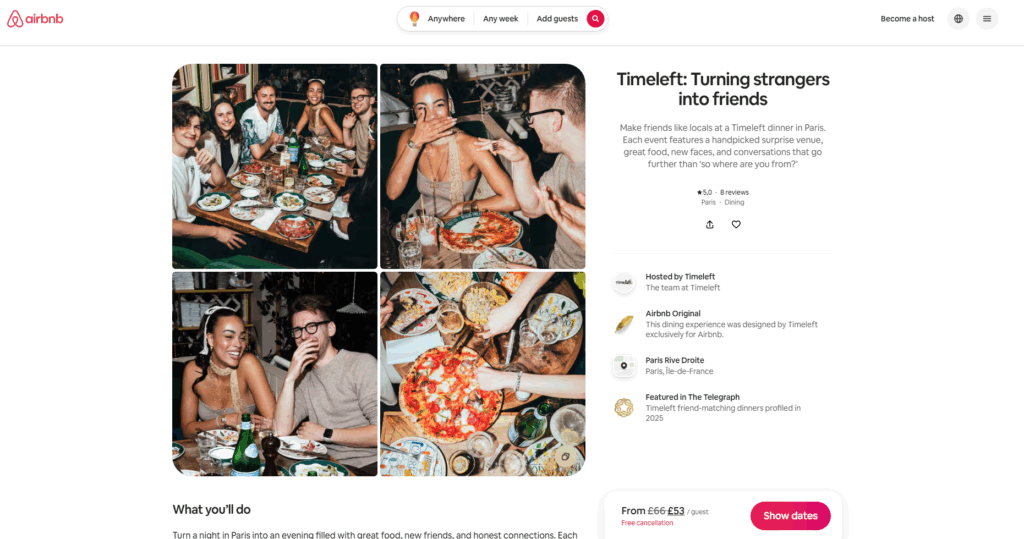
Timeleft: Turning Strangers Into Friends is now an Airbnb Original in Paris — a dinner for four to seven people, travelers and locals mixed, at a surprise venue revealed the day before. Timeleft is a social app built around intentional in-person meetups, and the Airbnb partnership turns it into a bookable experience.
Airbnb Originals aren’t just third-party listings. They’re co-developed, exclusively branded products — which means Airbnb put its name on an experience whose primary value proposition is human connection with strangers. That’s a deliberate product choice, not a passive listing decision.
In our coverage of Airbnb’s longer-term ambitions, we noted that Chesky has repeatedly returned to themes of belonging and loneliness — the idea that Airbnb could do something meaningful about social disconnection, not just travel booking. At the time, we (half)jokingly floated the possibility of something adjacent to a social network or matchmaking service. What actually emerged is more grounded: a structured dinner product built on interest-matching, bookable through the app, available to locals as much as visitors.
That last point matters. Our 2026 strategy analysis noted that nearly half of Airbnb Experience bookings in Q4 2025 came from people not simultaneously staying at an Airbnb property. Experiences are becoming a top-of-funnel product — a way people engage with the Airbnb brand outside of travel. A Timeleft dinner is as useful to a Parisian resident on a Wednesday as it is to a tourist. That’s the use case Airbnb is deliberately cultivating.
What it means for property managers
Both of these moves reduce the blank space around a stay — the time before check-in, the evenings not spent at the property. A guest who books a Welcome Pickups transfer through Airbnb, attends a Timeleft dinner through Airbnb, and books a cooking experience through Airbnb has now routed a significant portion of their trip budget through a single ecosystem. Airbnb collects the data, the engagement, and eventually the margin on all of it.
This doesn’t threaten hosts in the way a commission change or a listing purge does. But it does reinforce a direction of travel worth understanding. As Airbnb builds out the infrastructure around a stay, the logical response for professional managers is to focus on what that infrastructure can’t replicate: the character of the property, the quality of local knowledge, the personal touches that distinguish a stay from a commodity booking.
The accumulation is the story
In 2025, Airbnb launched three new business lines. In early 2026, they’ve formalized airport transfers across three continents and co-branded a social dining experience in Paris. Neither announcement individually justifies a headline about transformation. But Chesky’s stated ambition — to evolve Airbnb from an annual-use travel app into something people interact with weekly — requires exactly this kind of steady, unglamorous accumulation.

Uvika Wahi is the Editor at RSU by PriceLabs, where she leads news coverage and analysis for professional short-term rental managers. She writes on Airbnb, Booking.com, Vrbo, regulations, and industry trends, helping managers make informed business decisions. Uvika also presents at global industry events such as SCALE, VITUR, and Direct Booking Success Summit.