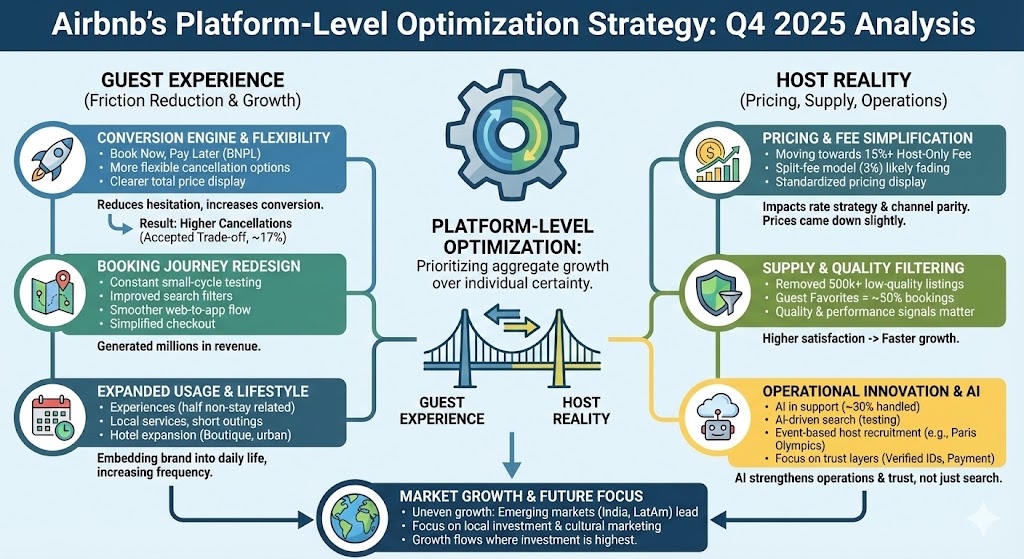
Airbnb is optimizing at platform level. Understanding that perspective helps you anticipate where pressure — and opportunity — will appear next. The 2005 Q4 call showed that Airbnb is:
- Simplifying fees.
- Increasing guest flexibility.
- Accepting slightly higher cancellations.
- Engineering conversion.
- Filtering supply.
- Expanding hotels.
- Building lifestyle usage.
- Investing in operations through AI.
- Growing aggressively in emerging markets.
1) The 3% Host Fee Model Is Likely Going Away
If you use a property management system, you already operate under the 15% host-only commission model.
Historically, Airbnb used a split-fee model:
- Around 3% paid by the host.
- A variable service fee paid by the guest.
In October, Airbnb moved U.S. PMS-connected listings to a single 15.5% host-only fee structure. On this earnings call, they confirmed they are now testing extending that model to more hosts in several markets.

The key detail: when PMS listings migrated, many hosts did not fully increase prices to offset the new fee structure. As a result, guest-facing prices came down slightly — and Airbnb directly linked that to stronger conversion in Q4.
Airbnb’s view is that the split structure makes pricing harder, especially when listings are cross-listed across platforms. The direction is clear: simplify the pricing display, reduce confusion, and standardize how listings compete.
For managers, this affects:
- Rate strategy.
- Channel parity.
- How your listing appears in search.
- How competitive you look next to Booking.com.
The traditional 3% model does not look like it will survive long term.
2) Airbnb’s Growth Strategy Is to Remove Guest Hesitation — Even If It Means More Risk for Hosts
The main driver of Airbnb’s recent acceleration was reducing friction at booking.
They highlighted three changes:
- Book Now, Pay Later (guests can reserve without paying upfront).
- More flexible cancellation options.
- Clearer total price display.
Each of these makes it psychologically easier for a guest to commit.
When guests feel:
- Less financial pressure upfront,
- Less risk if plans change,
- Less confusion about pricing,
conversion increases.
But flexibility for guests means more uncertainty for hosts.
Longer booking windows, higher cancellation risk, and less rigidity in policies all shift some risk toward the supply side.
Airbnb is optimizing at platform level. If overall bookings increase, the strategy continues.
3) Cancellation Rates Increased — And Airbnb Still Calls It a Success
Reserve Now, Pay Later has done what you would expect: it has increased cancellations.
Airbnb disclosed that the platform’s overall cancellation rate moved from roughly 16 per cent to 17 per cent. Within the pay-later group, cancellations are higher still.
For an individual host, that may not feel trivial. But Airbnb does not evaluate the feature at listing level. It evaluates it at platform level.
The internal test is simple:
Do incremental bookings exceed incremental cancellations before check-in?
If more stays ultimately happen, the feature is considered a success.
That is precisely what Airbnb says is occurring. Although cancellations have increased, bookings have increased by more. The net result is higher completed stays and higher gross booking value.
This is classic marketplace logic. Reduce friction, accept some fallout, measure the aggregate effect.
For managers, the signal is clear: Airbnb is prepared to tolerate a modest rise in cancellations if it increases total booking velocity. The priority is system-wide growth, not certainty at individual property level.
At scale, that trade-off appears to be working.
4) Airbnb Is Actively Redesigning the Booking Journey
Brian Chesky described an internal initiative launched two years ago.
Airbnb felt innovation had slowed as the company scaled. They created a small focused team whose job was simple: identify friction in the booking journey and remove it.
This team works in cycles:
- Identify a problem.
- Ship a change.
- Measure results.
- Scale what works.
Under this approach, Airbnb has:
- Improved search filters.
- Made discovery more flexible.
- Redesigned checkout.
- Improved how guests move from web to app.
- Simplified pricing presentation.
Chesky said this approach generated hundreds of millions of dollars in revenue in 2025.
For managers, this means Airbnb is not waiting for large feature launches. They are constantly testing small changes that affect how guests behave inside the platform.
5) Airbnb Is Managing Supply More Aggressively
Airbnb removed over 500,000 low-quality listings.
At the same time, Guest Favorites now represent nearly half of all bookings.
Chesky directly linked repeat booking behavior to listing quality and customer support experience.
Higher satisfaction → stronger repeat rate → faster growth.
This means supply growth is happening — but it is being filtered.
Managers should expect:
- Quality signals to matter more.
- Performance metrics to influence visibility.
- Guest experience consistency to remain central.
6) Growth Is Not Even Across Markets
Overall nights grew 10%.
But regional growth varied.
North America and Europe:
- Mid-single-digit growth.
Latin America:
- High teens.
India:
- Around 50% year-over-year growth.
Brazil:
- Moved into Airbnb’s top five markets.
- Became one of the largest sources of first-time bookers.
Airbnb explained that this growth comes from focused local investment:
- Local payment methods.
- Installment options.
- Cultural marketing.
- Dedicated local teams.
This means the headline growth number may not reflect your specific market.
Investment is flowing heavily toward emerging markets where growth is faster.
7) Events Are Being Used to Recruit New Hosts
Airbnb is treating major events as structured supply moments.
For the Paris Olympics:
- Over 40,000 new listings were added.
- Many continued hosting afterward.
Events allow Airbnb to:
- Recruit first-time hosts.
- Increase brand goodwill with cities.
- Demonstrate that Airbnb helps absorb peak demand.
From global events like the World Cup to local festivals, this has become part of their supply strategy.
8) Hotels Are Expanding — Carefully
Hotels currently represent a small share of total nights but are growing faster than the overall platform.
Airbnb is starting with:
- Boutique hotels.
- Independent properties.
- Major urban markets.
They emphasized personalization to avoid disrupting the homes experience.
For managers, this means:
- More inventory competition in urban markets.
- A broader demand funnel inside the same app.
- Guests who might otherwise leave the platform staying within Airbnb.
9) Experiences and Services Are About Increasing How Often Guests Open the App
Airbnb shared a revealing detail.
Roughly half of experience bookings are not attached to a home stay.
In cities like Paris, many experiences are booked by local residents.
This matters.
Airbnb is trying to increase usage frequency beyond travel.
If guests use Airbnb for:
- Local experiences,
- Services,
- Short outings,
the brand becomes more embedded in daily life.
More frequent use leads to:
- Stronger brand attachment.
- More direct traffic.
- Higher repeat behavior.
- Greater platform defensibility.
This is what Airbnb refers to as the “Airbnb Trip” — homes, hotels, experiences, and services reinforcing one another.
10) AI Is Being Applied First to Operations, Not Just Search
Airbnb is not rushing into flashy AI features.
They started with customer support.
Currently:
- Around 30% of North American English support tickets are handled by AI.
- They plan to expand this globally and into voice support.
They are also testing AI-driven search with a small percentage of traffic.
Chesky’s argument against AI disintermediation is operational:
A chatbot can show listings.
It cannot replicate:
- Verified identities.
- Messaging between guest and host.
- Payment processing.
- Insurance programs.
- Dispute resolution.
- 18 years of trust data.
AI may reshape discovery.
Airbnb is strengthening the layers that happen after discovery — payment, support, and trust.

Thibault Masson is a leading expert in vacation rental revenue management and dynamic pricing strategies. As Head of Product Marketing at PriceLabs and founder of Rental Scale-Up, Thibault empowers hosts and property managers with actionable insights and data-driven solutions. With over a decade managing luxury rentals in Bali and St. Barths, he is a sought-after industry speaker and prolific content creator, making complex topics simple for global audiences.