
If you are a short-term rental property manager in the EU, you likely have May 20, 2026, circled in red on your calendar. You have probably been preparing for months to ensure your registration numbers are verified across all online booking platforms.
If you haven’t, it is time to start.
May 20 is the date that, on paper, changes the underlying infrastructure of how short-term rentals operate in Europe. But the reality of how and when the EU Regulation 2024/1028 hits your portfolio is a little more European.
Whether your properties face delisting threats on May 20th, three months later, or sometime in 2027 depends entirely on the country. Here is the honest map of the new EU data-sharing regulation, how the enforcement loop actually works, and exactly what professional property managers need to do right now.

📍 What the EU Regulation 2024/1028 Regulation Actually Is (And What It Isn’t)
First, we need to clear up a major industry misconception: this is not an “EU Short-Term Rental Registration Rule.” It is officially Regulation (EU) 2024/1028, and it is a data collection and sharing regulation.
The EU is not forcing everyone to register. That decision stays with each member state. Instead, the regulation standardizes the framework for jurisdictions where registration already exists.
Under this law, if a member state has a registration scheme, platforms like Airbnb, Booking.com, and Vrbo must do three things:
- Make best efforts to verify: Platforms must randomly check your registration number against a national database (the Single Digital Entry Point).
- Display the number: They must ensure the registration number is clearly visible on your listing.
- Share activity data: Every month, platforms must automatically send a report to the national authority. This includes your identity as the host, the specific address, the registration number, the number of nights booked, and the number of guests.
💡 The Enforcement Loop: Not Instant, But Inevitable
It may sound like that due to EU Regulation 2024/1028, a bad data ping would trigger an instant, automated machine-deletion of your Airbnb listing. That is not how it works.
- Human review is required: The machine-to-machine reporting handles the data sharing. But delistings are triggered by human authority orders after review.
- The timeline: If an authority spots a problem (e.g., no registration number, a mismatched address, or a revoked safety certificate), they issue an order to the platform to remove or disable access to the listing.
- Platform compliance: Once the order is issued, the platform has 10 working days to comply, or just 48 hours for serious violations like wilful misconduct.
📢 Housing Data vs. Tax Data (DAC7)
Another critical distinction: Regulation 2024/1028 is explicitly not about tax enforcement.
Your tax office is already getting your income data through a separate EU directive called DAC7, which has been live since 2023. What this new regulation adds is a second data stream focused purely on activity—nights and guests—which goes directly to housing, zoning, and tourism authorities.
🛠️ The “Why”: Building the Enforcement Plumbing
For years, local governments across Europe have been trying to regulate short-term rentals and failing. They failed, they believe, because they did not have the data.
Amsterdam, for example, set a 30-night limit. Paris reduced its primary residence cap to 90 nights, but enforcing that was impossible when authorities were just guessing how many nights a property was actually booked across multiple platforms.
Regulation 2024/1028 is not a ban on short-term rentals, nor does it set night caps or zoning rules. It builds the enforcement infrastructure—the “plumbing” and the data rails. When a city says “30 nights maximum,” they can now actually check.
🌍 The “Honest Map”: Country-by-Country Rollouts
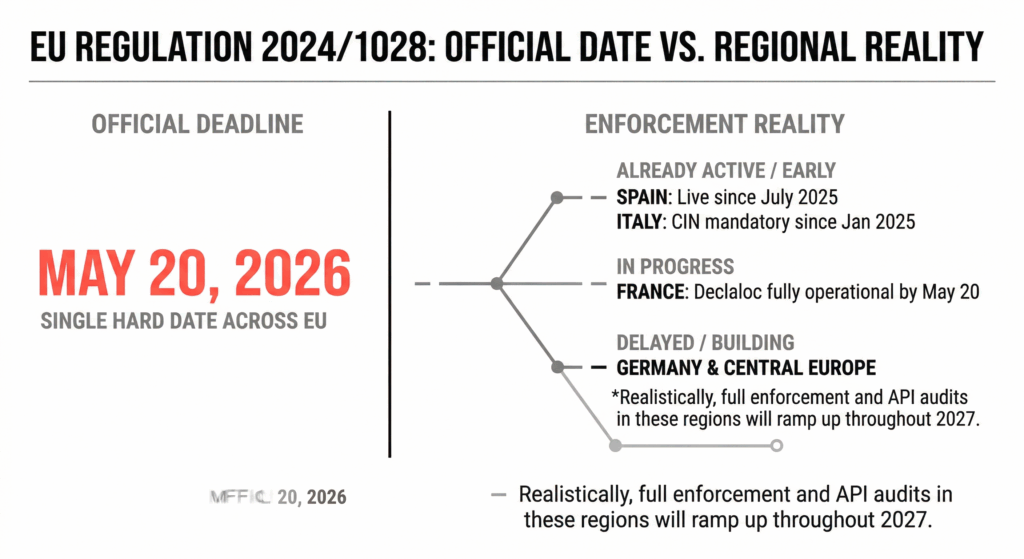
The EU law sets a hard date of May 20, 2026, but actual enforcement relies on Member States building their Single Digital Entry Points. Here is the reality on the ground:
- Spain & Italy (You are already late): They didn’t wait for the EU. Spain’s enforcement has been live since July 2025 (recently resulting in a €64 million fine for Airbnb). Italy made its CIN (national identification code) mandatory in January 2025. If you operate here without a number, you are already non-compliant.
- France (The clock is ticking): The national portal, Declaloc, is live in many communes and will be fully operational by May 20. Fines are stiff: €10,000 for missing registrations, and €50,000 per listing for platforms hosting non-compliant properties.
- Germany & Central Europe (The waiting game): The law says May 2026, but the digital infrastructure is still being built. Realistically, full enforcement and API audits in these regions will ramp up throughout 2027.
🛠️ What Property Managers Should Do Now
If you manage properties on behalf of owners, your liability under this regulation depends heavily on how the EU defines a “host.”
- Understand your legal status: The regulation defines the “host” as whoever provides the accommodation service for remuneration through the platform. This varies by country. In France, the PM can often register using their own SIRET number, making the PM the legal host. In Spain, registration is strictly tied to the property owner and the land registry.
- Update your owner contracts: If you operate in a country where the owner holds the registration, your business is at risk. If the owner fails to renew a safety certificate, the authority suspends the number, and your listing comes down. Update your owner contracts today to ensure owners are financially liable for lost revenue if their negligence causes an OTA suspension.
- Use the rollout window: If you operate in Germany or the Netherlands, use the current infrastructure delay to your advantage. Audit your PMS to ensure you have hyper-specific addresses and bed capacities ready so you can register the moment your country’s portal opens.
🔮 What’s Next: The Affordable Housing Act
Professional property managers need to view Regulation 2024/1028 as the foundation. The housing policy layer is being built directly on top of it.
The European Commission has signaled that an affordable housing act, expected later in 2026, will go further. This could potentially let local authorities in housing-stressed areas strictly limit or even phase out short-term rentals entirely.
Strategic insight: While this sounds threatening, there is a silver lining for compliant businesses. Stricter data enforcement means fewer competitors operating illegally. A compliant portfolio in a restricted market typically benefits from reduced supply and better pricing power
✅ Final Thoughts
The EU regulation is not a ceiling; it is a floor. It is the minimum digital infrastructure required to make local rules enforceable. Once the data starts flowing from the OTAs to the governments, it will not stop. Do not wait for an automated API to flag your portfolio—audit your compliance data today.

Uvika Wahi is the Editor at RSU by PriceLabs, where she leads news coverage and analysis for professional short-term rental managers. She writes on Airbnb, Booking.com, Vrbo, regulations, and industry trends, helping managers make informed business decisions. Uvika also presents at global industry events such as SCALE, VITUR, and Direct Booking Success Summit.
Related Articles:
 Pittsburgh Moves Toward Licensing, Cape Town Tightens Enforcement, and Kentucky Bill Seeks to Override Local Rules
 Croatia Signals Rental Limits, Maui Rejects Rezoning Lifeline, and Evanston Shifts to Discretion-Based Oversight
 Indiana Sides With Landlords, Pennsylvania Eyes Baseline Rules, Montréal Faces Event Crunch
 Airbnb tests pay-to-play visibility for “best guests” (LOYALTY PROGRAM TEST?)