The race to chase the ‘commitment-phobic’ guest is truly on.
Just days after Airbnb took its “Reserve Now, Pay Later” (RNPL) feature global on February 17, Vrbo countered with a partnership with WeatherPromise, a data-driven “weather guarantee” designed to kill booking hesitation during shoulder seasons.
This isn’t a new playbook for Vrbo; the platform has spent years successfully converting 70% of guests from damage deposits to high-margin damage waivers. WeatherPromise is simply the next iteration of this ‘cash machine,’ transforming uncontrollable weather into a predictable, resalable insurance product.
The strategic split here is glaring. While Airbnb’s Brian Chesky is betting on liquidity to drive volume, Vrbo’s leadership is betting on certainty. For professional managers, the split is clear: Airbnb wants to solve the guest’s wallet problems today, while Vrbo, already leveraging its Affirm partnership, wants to monetize their environmental anxieties tomorrow.

Vrbo is betting that in a crowded market, the “unique selling point” isn’t just how you pay, but the promise that your beach week won’t be a total wash.
What is WeatherPromise?
Through WeatherPromise, Vrbo is integrating a parametric performance guarantee that treats a rainy beach day like a broken contract. Unlike traditional travel insurance, a product category defined by bureaucratic friction and “covered reason” loopholes, this partnership with WeatherPromise is a data-driven play that pays out based on atmospheric facts, not damage claims.
For the uninitiated, “parametric” is industry-speak for “no-hassle”. The payout is triggered by a cold, hard data point rather than a subjective loss.
The Mechanics of the Guarantee:
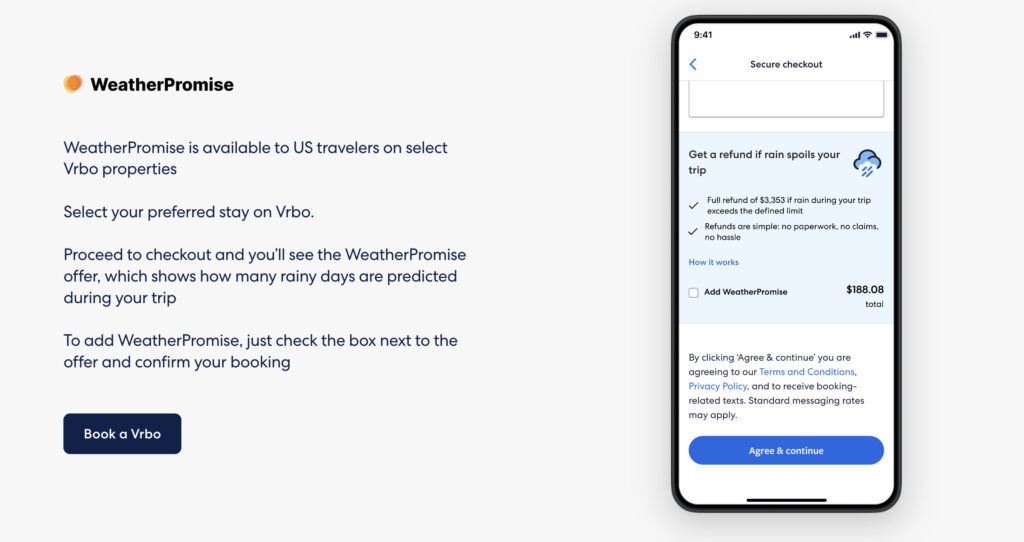
- Checkout Integration: Guests see the “WeatherPromise” option as a seamless add-on for select, high-value inventory.
- Hyper-Local Thresholds: A proprietary machine-learning algorithm digests 20 years of historical weather data to set a custom “rain threshold” specific to the property’s GPS coordinates.
- The “Two-Day” Trigger: Payouts are highly specific; for example, a guest might be reimbursed if it rains for more than four hours between 8 AM and 8 PM for at least two days of their stay.
- The Stay-and-Pay Bonus: In a rare win for the consumer, if the rain threshold is met, the guest receives a refund but retains the right to stay at the property.
Monitoring via NASA, Not Claim Adjusters
The tech stack here is formidable. WeatherPromise tracks the sky using 2.5 million global grid points, pulling high-fidelity imagery from NASA and NOAA.
When the clouds open up, the automation kicks in:
- Frictionless Payouts: Unlike existing ‘sun guarantees’ offered by some US property managers, which often go unclaimed due to the manual effort required, this integration is truly automatic. The moment the technical threshold is reached, guests are notified automatically, with funds typically hitting their accounts within two to three business days.
- Manager Immunity: The most critical “feature” for the professional manager is revenue neutrality. WeatherPromise cuts the check to the guest, while the host keeps 100% of the booking revenue. It effectively acts as a shield against the “it rained, give me my money back” phone call and the retaliatory 1-star review that often follows it.
The Limits of the Rollout
Don’t expect this in every urban studio just yet. As of the February 2026 launch, Vrbo is surgically targeting U.S.-based travelers booking “outdoor-centric” inventory like beach houses and mountain cabins, the exact type of high-stakes bookings where a bad forecast usually kills a conversion.
The Business Case: Why Vrbo is Betting on the Clouds
Vrbo’s tie-up with WeatherPromise isn’t just a win for travelers who forgot their umbrellas; it’s a calculated move to patch the leaks in the vacation rental booking funnel. By transforming weather from an “act of God” into a manageable financial variable, the platform is attempting to rewrite the rules of guest expectations.
Here is why this partnership matters for the bottom line:
- Killing “Booking Hesitation”: Weather remains the ultimate uncontrollable variable that keeps travelers from pulling the trigger on high-ticket beach or mountain stays months in advance. By introducing a “Weather Guarantee,” Vrbo provides the psychological safety net needed to move guests from “browsing” to “booked,” effectively lengthening the booking window.
- The Anti-Airbnb Differentiator: In the relentless arms race for market share, Vrbo is using this ancillary service to stake out a unique value proposition that Airbnb hasn’t matched at this level of integration. It’s a targeted play for the “risk-averse” demographic, specifically families, who want to know their vacation fund is protected even if the sun stays home.
- Replacing Friction with Physics: Traditional travel insurance is where dreams of a refund go to die, buried under mountains of paperwork and “covered reason” loopholes. Vrbo’s parametric approach sidesteps the claims adjuster entirely, using NASA and NOAA data to trigger automatic payouts the moment the rain hits a predefined threshold.
- The Review Shield for Hosts: Historically, a week of rain meant a lose-lose choice for managers: issue a painful refund or brace for a retaliatory 1-star review. This model shifts that financial risk to WeatherPromise, ensuring the guest is made whole while the host’s payout remains untouched.
- A High-Margin Betting House: Make no mistake, this is a strategic play to increase the ‘take rate’ per transaction. Just as Airbnb has quietly grown its margins by reselling travel insurance, Vrbo is finding new ways to extract more cash from every booking by adding perceived value through third-party partnerships, all while doing very little of the heavy lifting themselves.
The Verdict: Airbnb Bets on Wallets, Vrbo Bets on Weather
The tactical divide between the two giants has never been sharper. According to a recent survey by Airbnb and Focaldata , while 60% of travelers now label flexible payment options as “essential,” a significant portion of the market remains paralyzed by the unpredictability of “shoulder season” travel.
The industry is watching a fascinating split in conversion philosophy:
- Airbnb’s Liquidity Play: After a US pilot for Reserve Now, Pay Later (RNPL) delivered a staggering 70% adoption rate, Brian Chesky’s mandate is clear: the primary barrier to a booking is the immediate hit to the guest’s bank account. By deferring payment until the “free cancellation” window closes, Airbnb is effectively turning “maybe” into “reserved.
- Vrbo’s Certainty Play: In contrast, Vrbo is betting that the real friction isn’t just the price tag, but the risk of a “ruined” experience. By layering WeatherPromise on top of its existing Affirm installment partnership, Vrbo is attempting a pincer movement: solving the guest’s wallet concerns today and their environmental anxieties tomorrow.
For professional property managers, the distinction is purely strategic. Airbnb is betting that lowering the cost of entry drives volume, while Vrbo is betting that insuring guest satisfaction is the only way to drive long-term loyalty. In a market where supply is high and guest patience is low, the platform that removes the most “friction” whether financial or atmospheric will likely win the 2026 booking season.

Uvika Wahi is the Editor at RSU by PriceLabs, where she leads news coverage and analysis for professional short-term rental managers. She writes on Airbnb, Booking.com, Vrbo, regulations, and industry trends, helping managers make informed business decisions. Uvika also presents at global industry events such as SCALE, VITUR, and Direct Booking Success Summit.