
Cleaning has never been the easy part of running short-term rentals, especially around same-day turnovers. Tight check-out windows, scattered locations, and high guest expectations have always made housekeeping a pressure point.
But in 2025, staffing problems began turning that pressure into visible consequences. Industry surveys show that more than a third of short-term rental operators lost bookings or received negative reviews this year due to staffing or contractor issues.
For some, that has meant stepping in to cover last-minute cleans themselves. For others, it’s meant juggling emergency replacements, fielding guest complaints, or absorbing revenue losses tied directly to staffing gaps. And when you zoom out to look at staffing shortages across the wider hospitality sector, there’s little evidence this pressure is easing.
Staffing Issues Are Already Costing Managers Bookings
This isn’t a hypothetical risk. Short-term rental operators are already absorbing the fallout.

According to a press release from Hospitable, based on findings from its upcoming 2026 Short-Term Rental Industry Report:
- More than one-third of hosts and property managers say they lost bookings or received negative reviews in 2025 due to staffing or contractor issues.
- Nearly 40% reported difficulty finding dependable local cleaning staff, with the problem becoming more pronounced as portfolios grow.
The survey was conducted between November and December 2025 and included 554 hosts and property managers, spanning a mix of portfolio sizes and markets.
A similar picture emerges from Key Data’s 2026 Vacation Rental Industry Outlook. The report is based on an online survey of 244 professional property managers across the United States, collectively representing more than 43,000 properties in 142 markets. In that survey:
- 73% of property managers identified operations and staffing as one of the most immediate constraints on their business, placing it on par with revenue pressure and market competition.
- Larger and extra-large managers were significantly more likely to flag staffing as a limiting factor, underscoring how scale amplifies the problem.
Taken together, the message is clear: staffing, and cleaning in particular, is already shaping guest experience, review performance, and revenue outcomes.
Why Cleaning Takes the Hit First
In hospitality, and increasingly in short-term rentals, conversations about staffing shortages often become shorthand for one thing: cleaning staff shortages.
That’s because when labor is tight, cleaning is usually the first function to feel it, and the hardest to shield. Cleaning work is also uniquely exposed to labor pressure:
- It is physically demanding and repetitive
- Schedules are tight and largely non-negotiable
- Missed shifts are difficult to backfill at short notice
- Tasks can’t be postponed without immediate guest impact
When a cleaner doesn’t show up, there are few graceful workarounds. Even small disruptions can cascade into late check-ins, guest complaints, or negative reviews, turning what might look like a minor staffing gap into a visible operational failure.
Turnovers Leave Little Room for Error
One reason staffing shortages hit cleaning so hard is that the work itself isn’t evenly distributed.
Aggregated data shared by Doinn suggests that mid-stay cleans account for just 3–4% of total cleaning volume across key European markets.
It means most cleaning work is compressed into narrow turnover windows, often leaving just a few hours to prepare a property for the next guest. There’s little flexibility to spread work out, reschedule tasks, or catch up later.
When staffing is thin, these compressed windows become brittle. There are few buffers, and little time to recover once something goes wrong.
Cleaning Breaks When Knowledge Lives in People, Not Systems
Staffing pressure exposes another vulnerability that often goes unnamed: how much cleaning knowledge lives in people’s heads instead of in systems.
When teams are stable, a lot of know-how goes undocumented — what “good enough” looks like, which details matter most, how a specific property should be staged. But when turnover rises, that undocumented knowledge becomes operational debt.
When cleaning isn’t fully systemized, managers often find themselves:
- Re-explaining expectations to every new cleaner
- Re-sending instructions buried in chats or emails
- Re-checking work more frequently than they’d like
- Carrying quality control in their own heads
That interest is also visible in search behavior. So far this year, “cleaning staff training manual PDF” has ranked among the top ten organic Google search queries driving traffic to Rental Scale-Up by PriceLabs – a signal that many operators are actively looking for ways to formalize and stabilize cleaning standards amid ongoing staffing churn.
This Pressure Isn’t Isolated to Short-Term Rentals
The wider hospitality sector offers useful context for why staffing issues aren’t resolving themselves.
In the U.S. hotel industry, roughly 65% of hotels reported staffing shortages in early 2025, with housekeeping cited as the most critical gap. About 9% described themselves as severely understaffed, and overall hotel employment remains below pre-pandemic levels, even as travel demand has largely recovered.

UK government data shows that employee growth in accommodation and food service activities has turned negative year-on-year as of November 2025—highlighting the growing labor shortage impacting short-term rental cleaning staff and other hospitality roles.
Source: UK Office for National Statistics (ONS)
(Source: https://www.ons.gov.uk/employmentandlabourmarket/peopleinwork/earningsandworkinghours/bulletins/earningsandemploymentfrompayasyouearnrealtimeinformationuk/december2025#industry-data)
In the UK, official government data from the Office for National Statistics shows that employment growth in accommodation and food service activities has turned negative year-on-year, based on the most recent seasonally adjusted figures. While this data doesn’t isolate short-term rentals or cleaning roles specifically, it reinforces a broader reality: the labor pipeline feeding hospitality isn’t expanding fast enough to ease existing shortages.
Why Higher Pay Doesn’t Automatically Solve the Problem
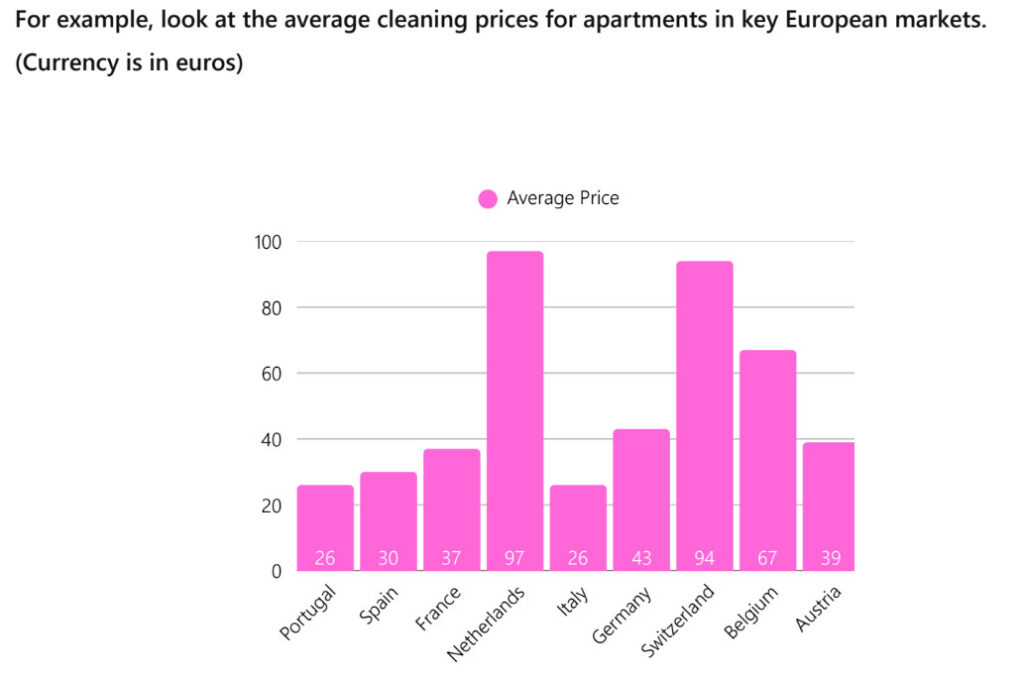
Average Cleaning Prices Across Europe (2025): Short-term rental cleaning costs vary dramatically by country, with the Netherlands (€97) and Switzerland (€94) topping the list. This highlights how higher wages alone don’t guarantee staffing availability in high-cost markets.
Source: Doinn platform data
(Source: https://doinn.co/reports/unlock-the-str-cleaning-market-scale-your-business-with-data/)
It’s tempting to assume staffing issues come down to pay. In practice, the picture is more complicated.
Cleaning rates already vary widely by market. Platform data shows average prices hovering around €25–€30 per clean in parts of Southern Europe, compared with €90 or more in markets like Switzerland and the Netherlands. Those differences reflect local labor conditions, competition from other sectors, and the cost of coordination, not a single industry standard.
In higher-cost markets, wages compete not only with other hospitality roles but with construction, logistics, healthcare support, and other sectors drawing from the same workforce. In lower-cost markets, even modest wage increases can be difficult to sustain once coordination costs, turnover, and last-minute coverage are factored in.
The result is a frustrating reality for many managers: paying more doesn’t always unlock reliable capacity. Even well-capitalized operators struggle to secure consistent coverage for work that is physically demanding, time-bound, and offers limited flexibility.
What Helps, Even If It Doesn’t Fix the Problem
No tool can make cleaners show up on time, guarantee quality, or solve labor shortages outright. But some platforms are gaining traction because they address a different part of the problem: coordination.
Tools like Doinn and Hospitable’s Cleaner Marketplace focus on centralizing how managers find, schedule, and communicate with cleaning teams. For operators managing dozens, or hundreds, of properties, that alone can remove a significant amount of friction.
At a minimum, these platforms can help:
- Reduce time spent coordinating across calls, texts, and WhatsApp threads
- Centralize scheduling and availability across multiple properties
- Create a single point of reference for cleaning instructions and expectations
- Connect managers with local cleaning providers more efficiently
What they can’t do is ensure labor availability where it doesn’t exist, or guarantee that every clean meets a manager’s standards. Quality control, training, and accountability still sit with operators.
But in an environment where staffing pressure isn’t going away, reducing coordination overhead matters, especially for larger portfolios, where operational complexity compounds quickly.
It’s not just operators and vendors feeling the squeeze around cleaning and operations — booking platforms are clearly paying attention too. One idea Airbnb has been circling over the past year is a Host Services Marketplace.
In simple terms, this would be an in-platform way for hosts and property managers to find cleaners, book maintenance help, and tap into other operational services linked directly to their listings.
For operators, the value is obvious: fewer WhatsApp threads, less time chasing availability, and less friction when working in new or stretched markets.
For Airbnb, the upside goes further. It would give the platform better visibility into how listings are actually being run, more say over quality and consistency, and another lever to influence the guest experience beyond just pricing and photos.
What This Means Heading Into 2026
Cleaning hasn’t suddenly become more complicated. But the environment around it has changed.
Sustained staffing pressure, concentrated turnover windows, and rising coordination costs have turned cleaning into a strategic fault line; one that touches guest experience, revenue, and daily stress for managers.
As the industry heads into 2026, the operators who fare best won’t necessarily be the ones who simply try harder to hire. They’ll be the ones who rethink cleaning as a system: how standards are documented, how knowledge is transferred, and how operations stay resilient when people inevitably cycle in and out.
The next question isn’t whether cleaning will remain difficult. It’s how managers redesign systems around that reality.

Uvika Wahi is the Editor at RSU by PriceLabs, where she leads news coverage and analysis for professional short-term rental managers. She writes on Airbnb, Booking.com, Vrbo, regulations, and industry trends, helping managers make informed business decisions. Uvika also presents at global industry events such as SCALE, VITUR, and Direct Booking Success Summit.