
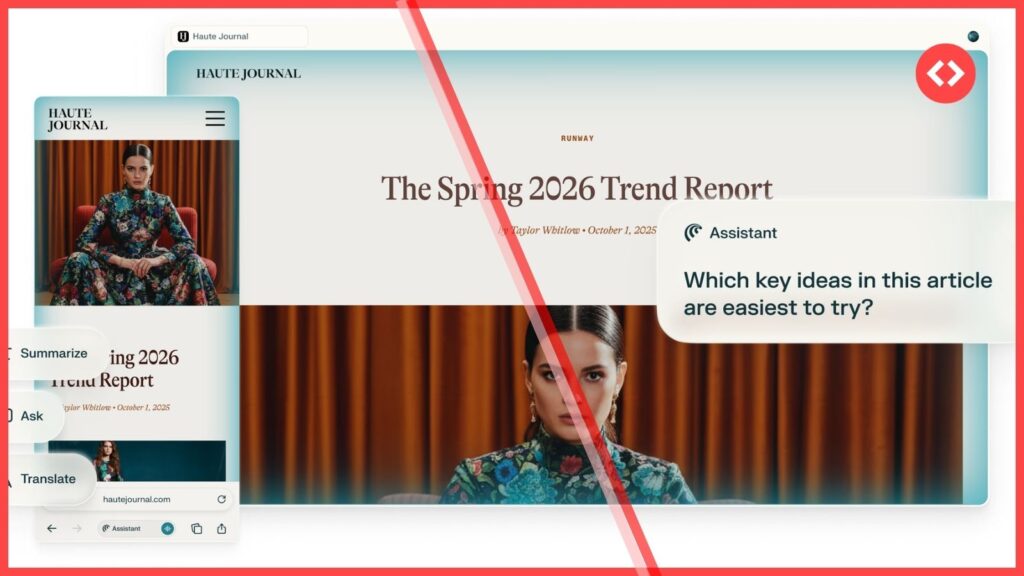
For years, the vacation rental industry has mapped the guest journey along a predictable, multi-step funnel. A traveler goes to Google, types in a few keywords, clicks on a few blue links, lands on an OTA like Airbnb or Booking.com, and applies filters. They open a dozen tabs, cross-reference pricing, check Google Maps for the exact location, and read reviews across multiple platforms. According to Expedia data, the average traveler visited 141 web pages in the 45 days leading up to a booking.
But what happens when the web browser itself learns how to do all of that searching for them?
In a recent live session, Thibault Masson of RSU by PriceLabs demonstrated a fundamental shift in how guests will soon discover stays. The rise of AI travel booking agents and “autonomous browsers” is set to remove the manual labor from trip planning. Instead of browsing, the internet is moving toward synthesis, and that shift threatens to bypass traditional OTA filters entirely.
From Manual Browsing to Hands-Free Synthesis
During the session, Masson highlighted a critical difference between simply asking a chatbot for advice and utilizing a true autonomous agent. To demonstrate, he bypassed standard search engines entirely and opened Comet, a web browser developed by the AI company Perplexity.

Comet operates with a built-in AI assistant capable of taking over the browser’s navigation. Masson gave the agent a complex, outcome-based prompt that would typically take a human hours to research:
“Act as my travel agent. Find and compare 5 apartments for a 4-night stay in April. I want a maximum cost of €250 per night. I want a sunny place where I can work remotely, and it must be within a 3-hour flight from Amsterdam.”
Notice what is missing from this prompt: The destination.
What happened next was a glimpse into the future of AI travel booking agents. Masson took his hands off the keyboard. On the screen, the Comet browser autonomously began calculating flight durations from Amsterdam, identifying sunny destinations like Lisbon, Malaga, and Valencia, navigating to booking platforms, and extracting property details.
The 141-page manual search was compressed into a few seconds of autonomous processing. The final output was a clean, synthesized table comparing five distinct apartments, including their Wi-Fi speeds, flight durations, and nightly prices.
The “Compression” of the Travel Funnel
This demonstration highlighted a massive shift in internet behavior: Compression.
In the traditional model, the guest is responsible for aggregating data. They are the ones holding the mental load of comparing the cancellation policy on a direct booking site against the pricing on an OTA.
AI travel booking agents compress this process into a single interface. The agent acts as a personalized travel planner that understands flight logistics, weather patterns, and accommodation budgets simultaneously. It does the aggregating, the filtering, and the reading.
For short-term rental managers, this means the “top of the funnel” is drastically changing. They are no longer just competing to rank on page one of Google or to be on the first page of an OTA search result. They are competing to be included in the synthesized table generated by an AI agent that just read 50 websites in three seconds.
The Danger (and Opportunity) of the “Default Bias”
While this technology is incredibly powerful, Masson pointed out a strategic warning for property managers: The Default Bias.
During the hands-free search, the Comet browser autonomously navigated to Airbnb and Booking.com to source its apartment recommendations. Because Masson’s prompt was relatively broad (asking for “apartments”), the AI defaulted to the most common, data-rich aggregators it knew.
However, Masson noted that when he has run similar searches with more specific constraints—such as demanding “great design” or highly curated experiences—the AI agents bypass the standard OTAs and pull inventory directly from niche platforms like Plum Guide or localized direct-booking portals.
This reveals a massive opportunity for direct booking websites. If your website contains highly detailed, machine-readable expertise—such as descriptive blog posts about your neighborhood, perfectly formatted amenities, and hyper-specific property details—you give AI travel booking agents the “signals” they need to bypass the OTAs and recommend your direct site.
Conclusion: Are You Ready for Autonomous Discovery?
The transition from 100 open tabs to a single, autonomous browser is happening faster than the industry realizes. As tools like Perplexity, ChatGPT, and Google’s own AI agents become deeply integrated into how travelers plan their trips, the traditional methods of driving visibility will no longer be enough.
Understanding that an autonomous browser is doing the shopping for guests is only the first step. The real work is ensuring property data is structured in a way that these bots can read, trust, and confidently recommend.
How do you break out of the “OTA default bias” and ensure your direct website is visible to these autonomous tools? We will be diving into the tactical aspects of Answer Engine Optimization (AEO) and machine-readable content in our upcoming follow-up webinar on March 26th.
Related Reads:
- Are You Listing a Property or Solving a Problem? The Reality of AI Short-Term Rental Marketing
- The Google Goliath: Guests Are Using AI Vacation Rental Search (Even If They Didn’t Ask To)

Uvika Wahi is the Editor at RSU by PriceLabs, where she leads news coverage and analysis for professional short-term rental managers. She writes on Airbnb, Booking.com, Vrbo, regulations, and industry trends, helping managers make informed business decisions. Uvika also presents at global industry events such as SCALE, VITUR, and Direct Booking Success Summit.