

On May 20, 2026, the European Union’s Regulation (EU) 2024/1028 officially goes into full effect. The headline is dramatic: EU-wide standardization, platforms enforcing rules, and direct orders to remove non-compliant properties.
But for professional property managers operating across multiple borders, the reality is messier. Enforcement depends entirely on when your specific country finishes building its national registration portal (the “Single Digital Entry Point” or SDEP). If your properties are in Spain or Italy, you are already late. If you are in France, you need to act now. If you are in Germany, your deadline is essentially “whenever the government finishes the IT build.”
Here is the checklist for professional property managers, structured around the actual mechanics of the new law.
📍 Phase 1: Triage Your Portfolio by Country
Before auditing your tech stack, you must map your exact exposure based on local realities. The regulation applies to all Member States, but establishing a registration procedure is optional. If a country chooses to require registration, it must use the standardized tools and SDEP infrastructure EU Regulation 2024/1028 provides.

Action items:
- Code Red (Spain, Italy, Greece, Portugal): If you operate here, stop planning and start auditing. The deadlines have passed or systems are actively enforcing. Ensure every listing has a verified number live on the OTAs today.
- Code Yellow (France): The national portal (service-public.fr) is live. The registration requirement will be mandatory across all of France by May 2026. Audit your French portfolio this week and begin pushing registration numbers to your channel manager.
- Code Green (Germany, Netherlands, Central Europe): The law says May 2026, but the infrastructure says “we’re working on it.” Use this window to gather your required data (exact addresses, bed capacities) so you can register the moment the portals open.
💡 Phase 2: The Tech & Data Parity Audit (For Active Markets)
If you operate in a “Code Red” or “Code Yellow” market, having a registration number is no longer enough. Platforms like Airbnb and Vrbo are legally obligated to regularly and randomly check the validity of your registration numbers by pinging the government’s SDEP.
What Property Managers Should Do Now:
- Match specific addresses exactly: The regulation requires highly precise unit identification. Verify that your PMS pushes the exact address registered with the city, including the unit number, letterbox number (if different), and the floor the unit is on. Apt 3B” on Airbnb must match “Floor 3, Letterbox B” in the local registry.
- Prepare for the human-in-the-loop enforcement: Mismatched data does not trigger an “automatic machine deletion.” Instead, SDEP data discrepancies flag listings for human review by competent authorities. If the authority confirms the information is incomplete, incorrect, or missing, they issue an order to the platform.
- Track the delisting clock: Once an authority issues a removal order, it is not instant. Platforms typically have 10 working days to remove or disable access to the listing. For serious violations—like wilful misconduct, unauthentic information, or a revoked registration —the platform must comply within 48 hours.
⚖️ Phase 3: The Liability Audit & Owner Contracts
The regulation attaches all data accuracy obligations to the “host”. Crucially, the law defines a host as any natural or legal person providing the service through the platform. Whether that is you (the PM) or the owner depends on the contracting party and local laws.
What Property Managers Should Do Now:
- Understand your exact legal status: In France, a property management company can often legally file in its own name using its SIRET number, making the PM the legal host. In Spain, registration is strictly tied to the property owner’s land registry record.
- Update Property Management Agreements (PMAs): If you operate where the owner holds the registration, your business is at risk. If the owner fails to submit updated documentation (like an expiring safety certificate), the authorities will suspend the registration number. Because you manage the OTA channel, your listing comes down. Update your PMAs today to state that owners are financially responsible for lost revenue if their failure to provide compliance documentation causes an OTA suspension.
📊 Phase 4: Prepare for Housing & Tourism Data Audits
Do not confuse this regulation with DAC7. Your tax office is already getting your income data through the DAC7 directive. Regulation 2024/1028 creates an entirely separate data stream focused purely on activity.
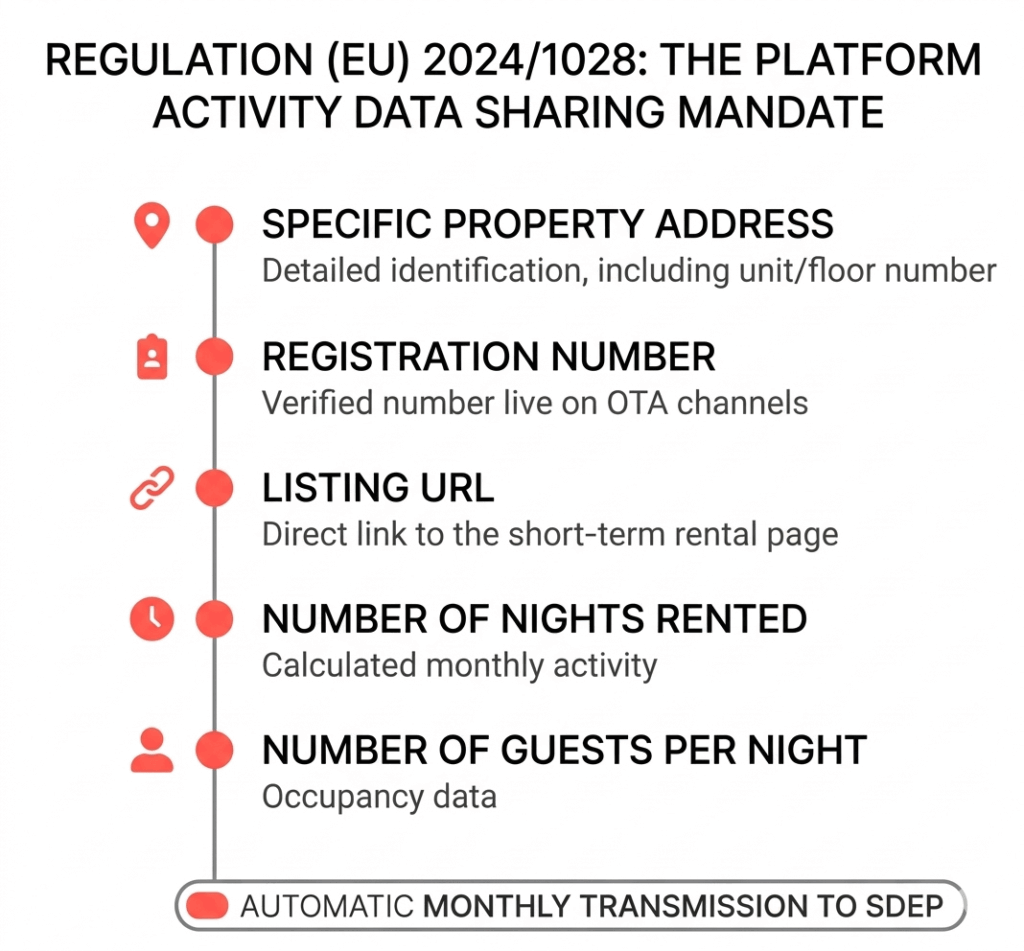
What’s new: Platforms must automatically transmit activity data to the SDEP every month. This includes the specific address, the registration number, the listing URL, the number of nights rented, and the number of guests per night. This data goes to competent authorities tasked with enforcing local housing and tourism rules.
What Property Managers Should Do Now:
- Audit against local night caps: Authorities finally have the exact data needed to enforce municipal limits. If you operate in a market with strict night caps (like Amsterdam’s upcoming 15-night limit or Paris’s 90-night limit), set up PMS blocks to prevent overbooking. The moment your monthly OTA data hits the government SDEP and shows you breached the cap, authorities will issue an enforcement order against your portfolio.
✅ Final Thoughts
The May 20, 2026 deadline transforms STR compliance from localized guesswork into a standardized, data-backed enforcement infrastructure. The professional property managers who will thrive under Regulation 2024/1028 are those who understand their local timelines, treat PMS-to-OTA data parity as a core operational metric, and update their owner contracts to reflect the new liability landscape.

Uvika Wahi is the Editor at RSU by PriceLabs, where she leads news coverage and analysis for professional short-term rental managers. She writes on Airbnb, Booking.com, Vrbo, regulations, and industry trends, helping managers make informed business decisions. Uvika also presents at global industry events such as SCALE, VITUR, and Direct Booking Success Summit.
Related Articles:
 Pittsburgh Moves Toward Licensing, Cape Town Tightens Enforcement, and Kentucky Bill Seeks to Override Local Rules
 Croatia Signals Rental Limits, Maui Rejects Rezoning Lifeline, and Evanston Shifts to Discretion-Based Oversight
 Indiana Sides With Landlords, Pennsylvania Eyes Baseline Rules, Montréal Faces Event Crunch
 The May 20 EU Data Deadline: Should Property Managers Expect Mass Delistings?