For the last twenty years, the internet has trained travelers to behave in a very specific way. When planning a trip, a guest would go to Google, type in a fragmented phrase like “Florida villa for 5,” and hit enter. They would be greeted by a list of blue links, click the top OTA result, and begin the arduous process of filtering, tab-jumping, and comparing.
But as the digital landscape evolves, the illusion of choice is fading. The adoption of conversational artificial intelligence is not something guests are actively opting into—it is being pushed upon them by the biggest search engine on earth.
During a recent live session, RSU by PriceLabs Editor Uvika Wahi broke down the undeniable reality of AI vacation rental search: Google is the 800-pound gorilla in the room. With query volumes roughly 200 times larger than standalone tools like ChatGPT, Google possesses the power to unilaterally change the “Search Culture” of the internet. And if the Search Culture changes, the short-term rental industry must change its “Listing Culture” to survive.
The Death of the “Ten Blue Links”: Welcome to the AI Overview
To understand the magnitude of this shift, we have to start where the vast majority of your future guests start: the standard Google search bar.

During the live walkthrough, Wahi typed a simple, scenario-based prompt into Google: “Villa for 5 in Florida in June for one week.” In the old internet, this would yield a page dominated by Booking.com, Airbnb, and Vrbo links. Today, the very first thing that populates, inevitably, and above all organic links, is the AI Overview.
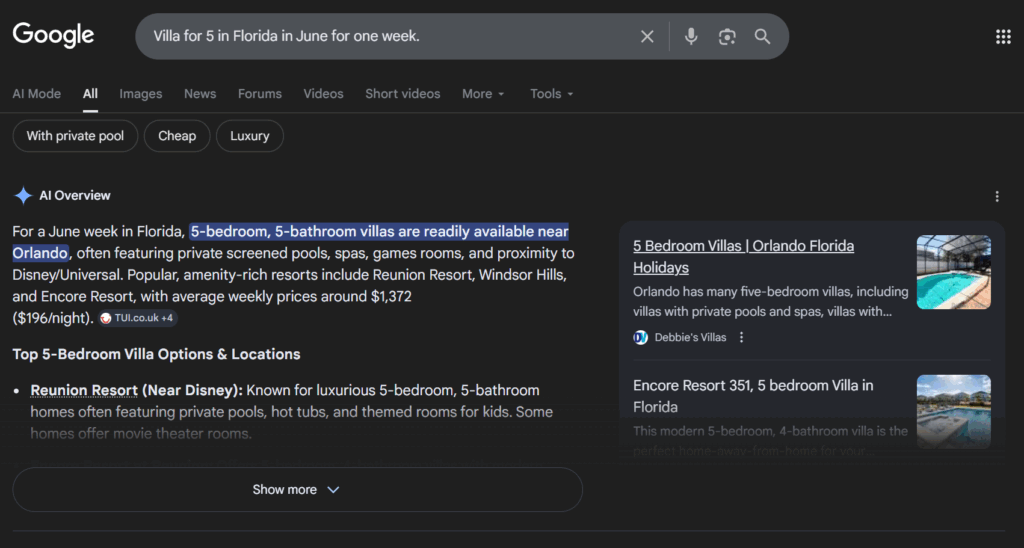
“This is not me looking for an AI helper,” Wahi explained. “This is not me seeking up AI help. This is something that Google is forcing me to do in terms of AI adoption.”
The AI Overview instantly synthesizes a massive amount of information. For the Florida query, it immediately provided recommendations on which coast to visit, the typical price ranges for 5-bedroom villas, the amenities that families should prioritize, and basic travel tips.
The traveler hasn’t clicked a single link, yet they have already bypassed the top of the traditional discovery funnel. Google has effectively retrained the user to expect a synthesized, conversational answer before they ever consider browsing a direct booking website or an OTA.
Ecosystem Compression: The “Dive Deeper” Shift
The disruption accelerates when a traveler decides to continue this AI-mediated journey. By clicking the “Dive Deeper” button, users are transported into Google’s dedicated AI Mode.
This is where the concept of “Compression” takes center stage. In the past, a thorough traveler would have to open an OTA to check property availability, open a separate tab for Google Maps to verify the neighborhood, and open TripAdvisor or a direct website to cross-reference reviews.
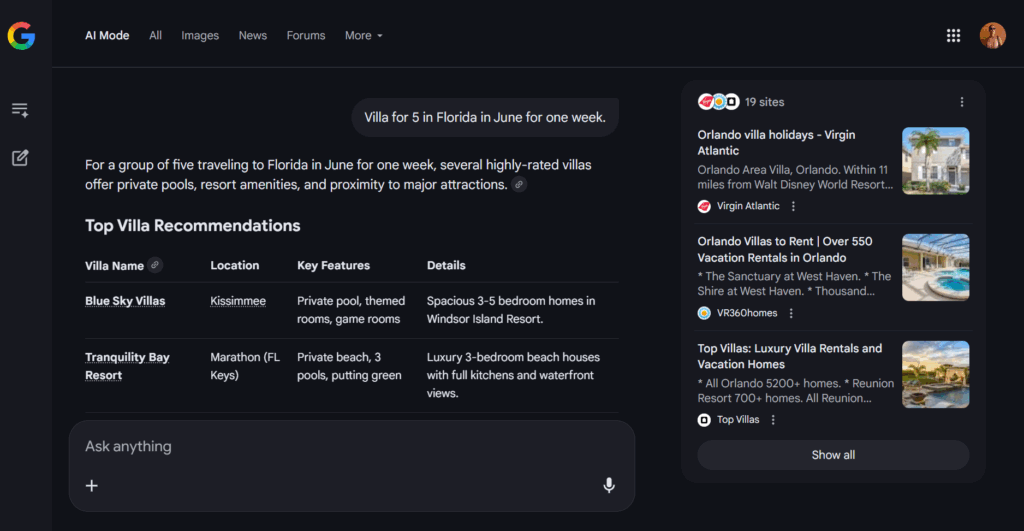
In AI Mode, Google is throwing its entire ecosystem into a single, compressed view. When the AI recommends a specific villa, the listing displayed is actually a Google Maps listing. It pulls in the Google Business Profile, the aggregated reviews, the geographical data, and the availability links all at once.
Instead of forcing the guest to open ten different tabs, AI vacation rental search opens those tabs behind the scenes, reads them, and presents a finalized summary. For property managers, this means the quality, completeness, and connectivity of your Google Business Profile and Maps listing are now just as critical—if not more so—than your traditional website meta tags.
Dynamic Intent: How OTAs are Following Suit
It isn’t just search engines forcing this behavioral shift; the major Online Travel Agencies (OTAs) are also deploying AI to change how guests interact with their platforms. The focus is shifting rapidly from keyword matching to “Intent Inference.”
Wahi shared a striking example of this dynamic behavior observed on Vrbo. While casually researching a 5-night stay in Santa Clara, California, for a specific week in March, she navigated to the platform’s filter menu. At the very top of the list, Vrbo had autonomously generated a highly specific filter: Proximity to the UConn Huskies vs. Santa Clara Broncos Baseball Match.
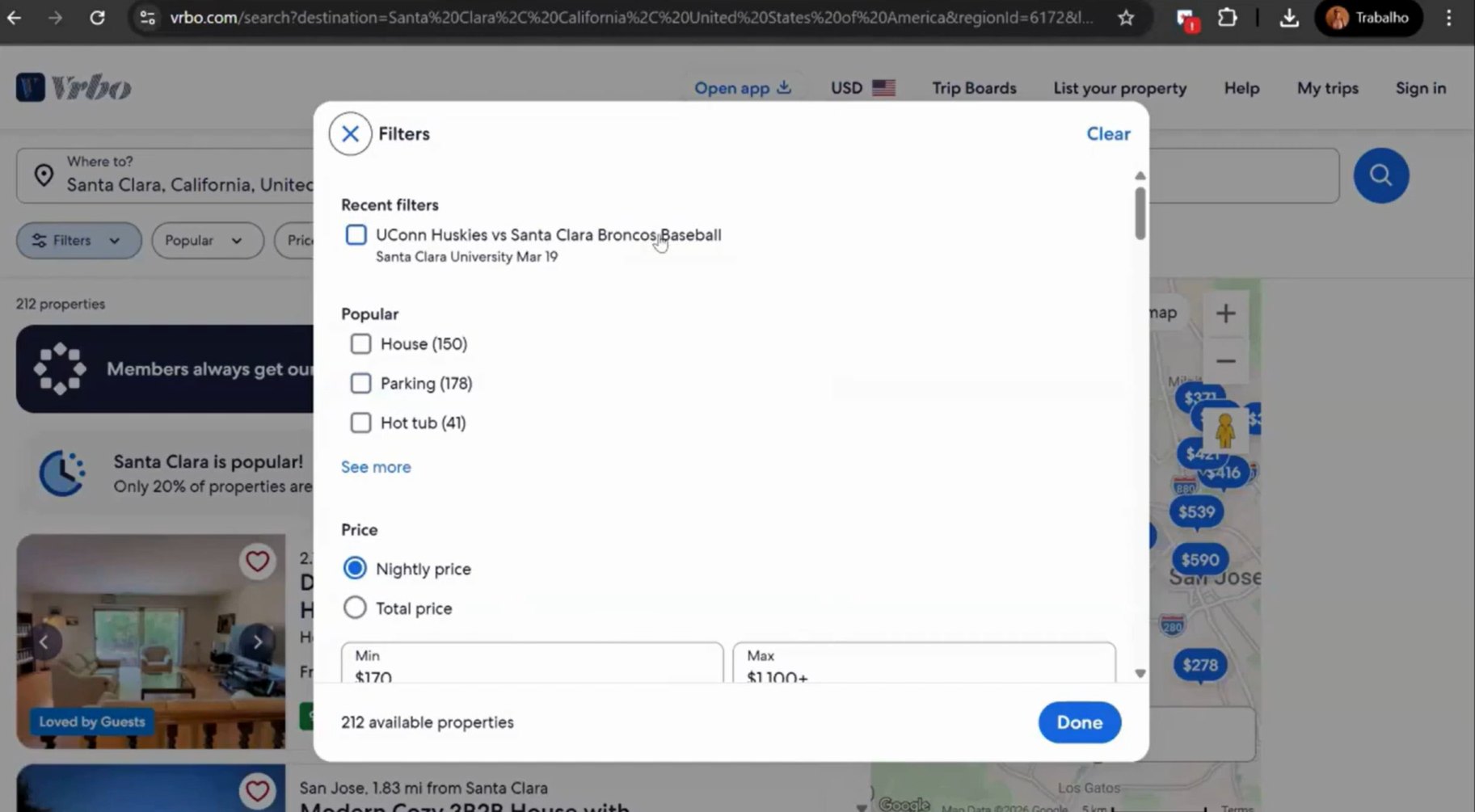
Wahi had never mentioned baseball in her search. She simply input dates and a location. However, Vrbo’s AI layer recognized that a major sporting event was occurring in that city on those exact dates, inferred that this might be the intent behind the sudden travel demand, and dynamically updated the user interface to offer a relevant filter.
When AI can dynamically alter the very filters a guest uses based on real-world events, static property descriptions lose their edge. If a listing’s location data and event proximity aren’t structured properly, it will be filtered out before the guest even knows it exists.
The Takeaway: Visibility Means “Synthesis-Ready”
The overarching theme of Wahi’s segment is a wake-up call for the short-term rental industry. You cannot opt out of AI vacation rental search because the platforms that control your distribution, Google, Airbnb, Vrbo, have already opted in for you.
Visibility used to mean playing the SEO game to rank #1 on a search results page. Today, visibility means being the primary, most reliable source of data for an AI agent’s synthesis. If your property data, reviews, policies, and localized expertise aren’t easily readable by a machine, Google’s AI Overview will simply pull the information from a competitor who is.
The “Search Culture” has officially changed. The question now is: how quickly can your business change its “Listing Culture” to keep up?
Related Reads:
- The Browser is the New OTA: How AI Travel Booking Agents Are Killing the 100-Tab Trip Plan
- Are You Listing a Property or Solving a Problem? The Reality of AI Short-Term Rental Marketing

Uvika Wahi is the Editor at RSU by PriceLabs, where she leads news coverage and analysis for professional short-term rental managers. She writes on Airbnb, Booking.com, Vrbo, regulations, and industry trends, helping managers make informed business decisions. Uvika also presents at global industry events such as SCALE, VITUR, and Direct Booking Success Summit.
Related Articles:
 ChatGPT Ads Are Live and They’re Changing How Guests Find Vacation Rentals
 What Happens When AI Becomes the First Step in Booking a Stay?
 Are You Listing a Property or Solving a Problem? The Reality of AI Short-Term Rental Marketing
 The Browser is the New OTA: How AI Travel Booking Agents Are Killing the 100-Tab Trip Plan