Most property managers assume that slower Airbnb bookings mean pricing is off.
In reality, at scale, it’s usually listing quality, not price, that limits visibility, conversion, and ultimately revenue.
As portfolios grow, small quality gaps quietly compound across dozens or hundreds of listings, and they’re easy to miss.That was the focus of a recent live workshop hosted by Thibault Masson, Head of Product Marketing at PriceLabs and Founder of RSU by PriceLabs.
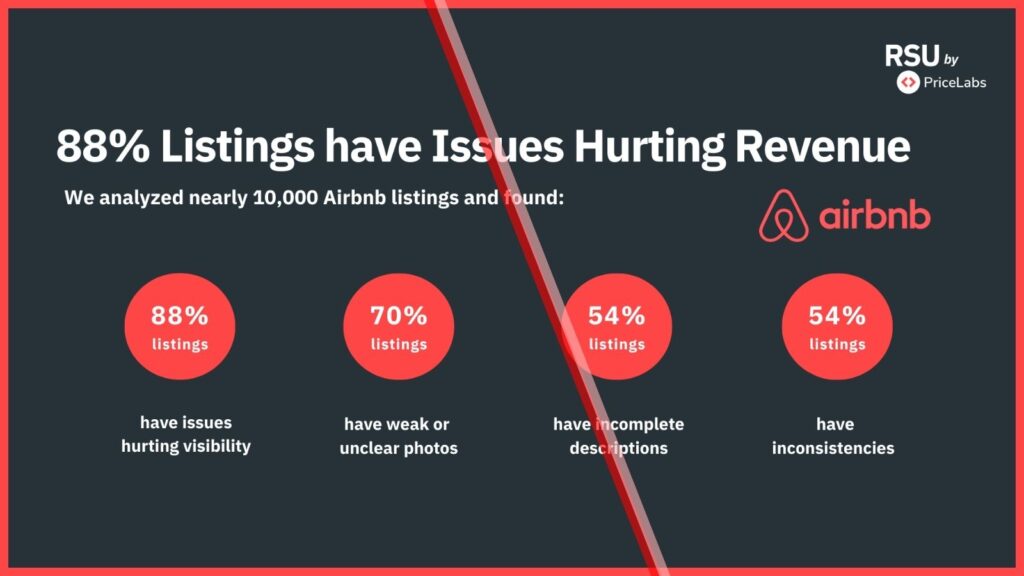
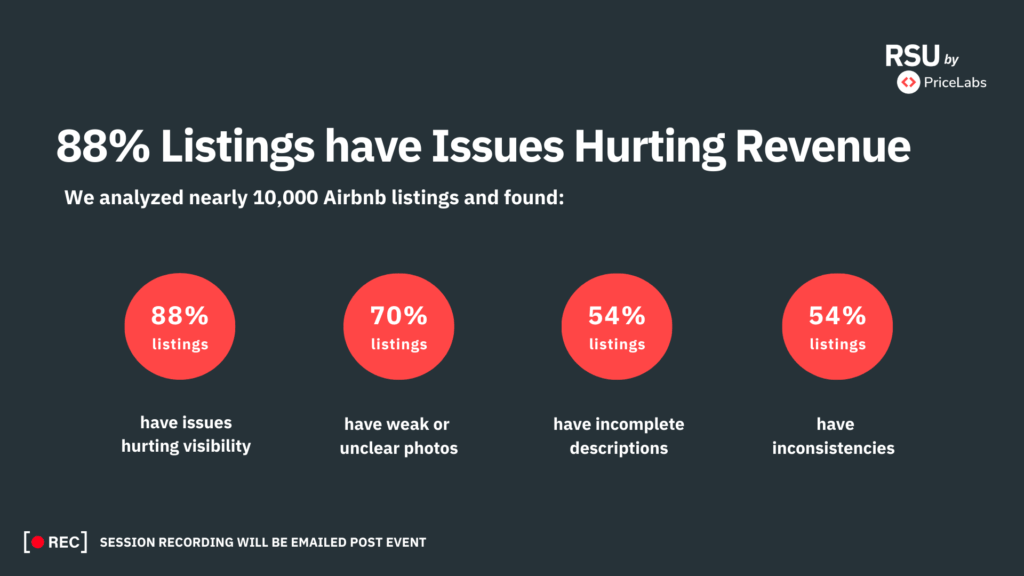
The discussion was grounded in a PriceLabs’ analysis of 10,000+ Airbnb listings, which found that 88% of listings had at least one listing quality issue impacting performance, even among professional operators.
Using real Airbnb listings (including his own), Thibault audited listings live to show:

- how Airbnb actually evaluates listings beyond price,
- why listing quality issues become harder to detect as portfolios scale, and
- how teams can identify and fix these issues systematically using PriceLabs’ newly launched Listing Optimizer.
Below are the key takeaways from the session.
1) How Airbnb decides what gets shown in search (and why “quality” matters)
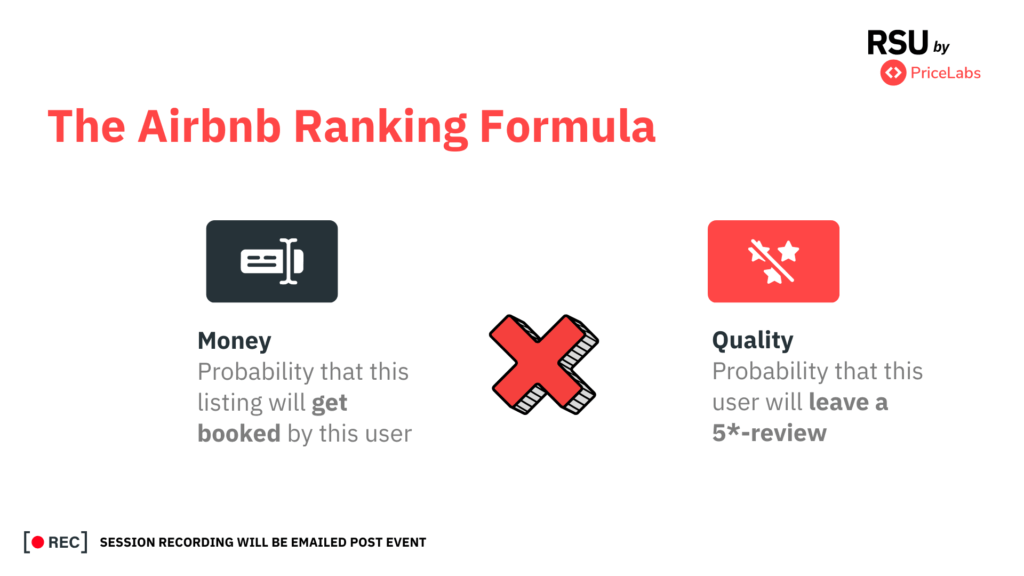
Airbnb has been clear in conversations with property managers: search visibility largely comes down to two big questions:
1) Will this listing get booked by this guest?
Airbnb isn’t showing random homes to guests. It’s trying to surface listings that are likely to convert based on availability, fit, and booking behavior.
2) If it gets booked, is it likely to end in a 5-star experience?
This isn’t only “operational quality” (cleanliness, check-in, etc.). It’s also whether the listing sets expectations clearly, so guests feel confident booking and don’t end up disappointed.
Over time, these listings help Airbnb turn guests into loyal users and advocates, which is why listing clarity is now a ranking signal, not just a best practice.
The implication: listing content and accuracy affect both conversion and trust, which affects visibility.
2) Why quality gets harder (and more expensive) as you scale
Thibault pointed to an issue many larger operators feel: as they grow, quality becomes harder to maintain consistently across the portfolio.
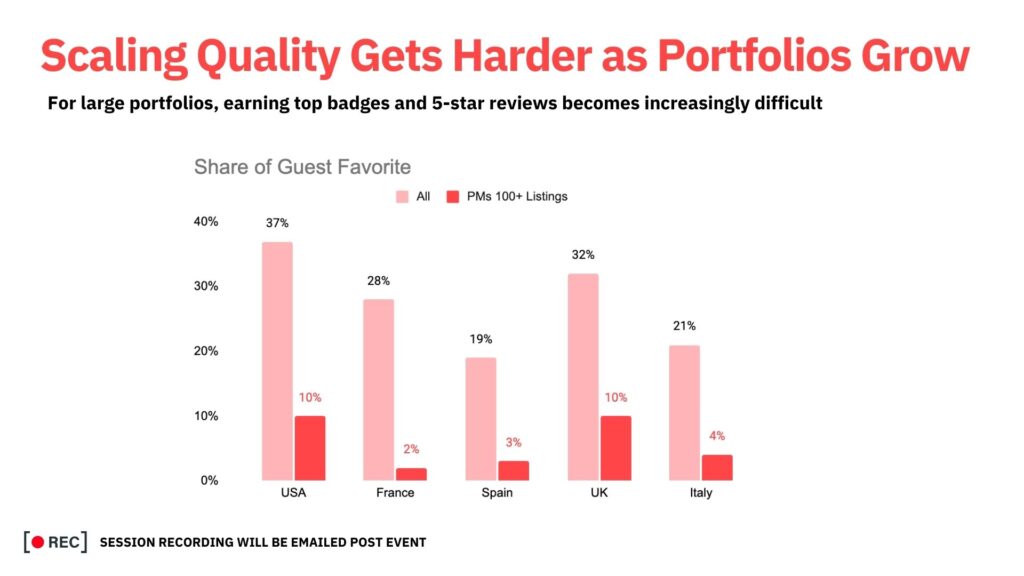
He used Airbnb’s Guest Favorite badge as an example. In the webinar, he cited that:
- In the US, about 37% of listings are Guest Favorites overall
- But for property managers with 100+ listings, only about 10% of listings are Guest Favorites on average
- This drops even further in some markets (he referenced to France as being especially low for large operators)
Scale makes consistency harder, and Airbnb’s quality signals become harder to maintain when dozens of listings have been edited over time by different people (team turnover, rushed updates, old content that quietly persists, etc.).
3) Listing Quality Is a Revenue Driver: Insights From 10,000 Airbnb Listings
PriceLabs did a deep research before building the product.
What PriceLabs studied
- 10,000 Airbnb listings across markets
- They looked at what drives performance (bookings/revenue) across things like location, size, minimum stays, cancellation policy, amenities, and content (photos/title/description).
The big takeaway
Even when controlling for other factors (like location and property size), listing content still had a clear impact on performance.
What was “breaking” performance most often
- 88% of listings had listing quality issues
- 70% had weak / unclear photos
- 54% had incomplete descriptions
- 54% had inconsistencies (details that don’t match across photos, title, description, and amenities)
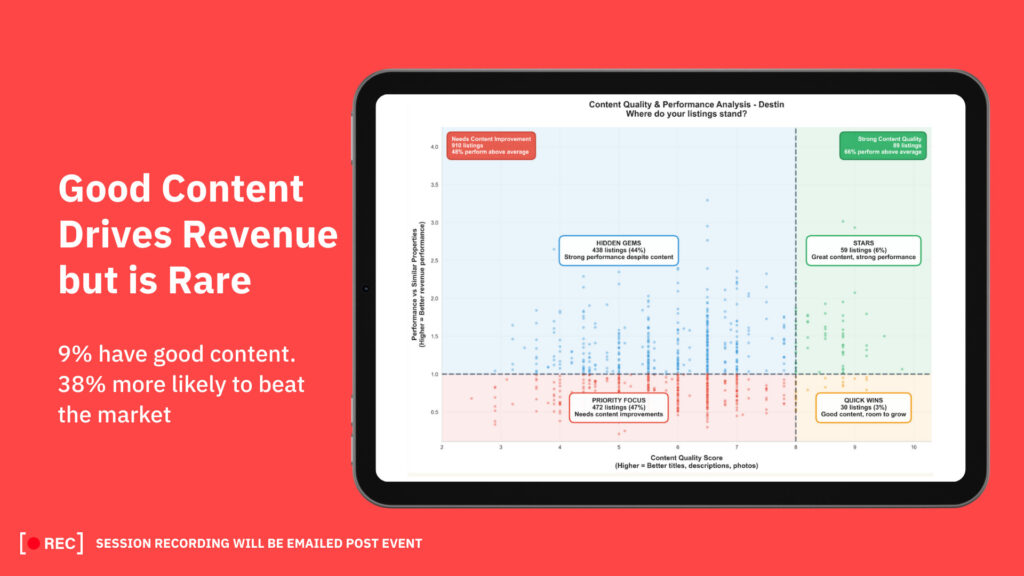
- Only 9% of listings had genuinely strong, “money-making” content
- Listings with strong content were 38% more likely to outperform competitors (more bookings / revenue)
4) Why “just using ChatGPT” doesn’t solve the real problem
You can use ChatGPT to rewrite a title or description.But it won’t tell you what actually matters in your market and versus your competitive set.
- ChatGPT can improve writing style and structure.
- But it can’t reliably tell you:
- which amenities are most associated with higher bookings in that area
- what your top competitors emphasize
- what you’re missing that’s costing you clicks
- what’s inconsistent across your listing content (and therefore breaks trust)
In other words: a beautiful description is not the same as a high-performing listing.
Enter Listing Optimizer: A Tool to Optimize Airbnb Listings at Scale
Thibault shared that internally at PriceLabs, they’d often see something like this when reviewing customer cases:
Pricing setup looks solid. Minimum stays look fine. Strategy looks reasonable.
…and the listing still underperforms.
When they clicked into the listing, they’d find the culprit wasn’t pricing—it was content: weak photos, missing info, mismatched amenities, unclear positioning, or repeated issues highlighted in reviews.
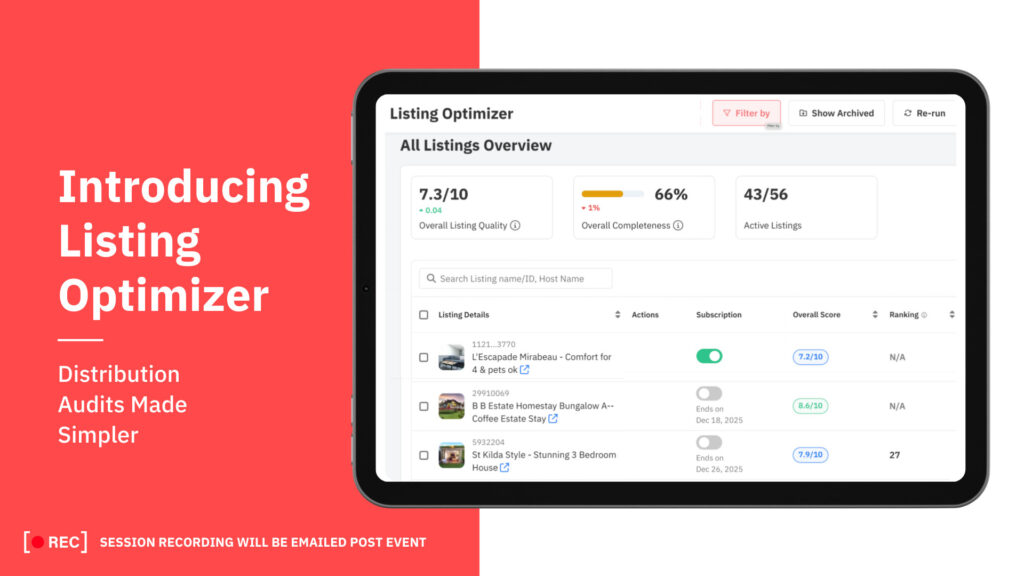
That’s the gap Listing Optimizer is meant to cover—turn listing quality into something you can measure and prioritize, especially at portfolio scale.
The tool outputs an overall score and then breaks it down into factors including:
- Listing title
- Images
- Listing description
- Amenities
- Review count
- Star ratings
- Review summary
- Guest Favorite label
- Consistency
- Sentiment insights
- Plus ranking trend and competitor comparisons
And importantly for scale: you can see which listings are weakest first, instead of guessing where to start.
6) What Thibault found when he audited real listings live (including his own)
Multiple listings were reviewed by Thibault, using Listing Optimizer and also his own.
His own listing score: 7.9 / 10
Despite being a strong listing with great reviews and a high-end experience, the tool still flagged issues that.
- Title: his original title leaned heavily into storytelling and personality (romance/brand tone).
The tool suggested being more concrete and scannable (especially for mobile) and removing emojis (Airbnb doesn’t like them). - Photos: he had one lower-resolution image (a drone shot) that dragged the score down, something many managers relate to when they’re forced to mix professional shots with “best available” images.
- Description: he’s a storyteller, and the tool actually praised that—but still flagged issues like:
- readability / scannability (shorter sections)
- clarity and structure
- calling out high-impact amenities more explicitly
- Consistency: this was a major theme.
In his case, the tool picked up a “beach access / beachfront” type mismatch because the home is on a cliff above the sea—guests often ask about access, and the listing signals can unintentionally create confusion.
Some recurring patterns that are incredibly common at portfolio scale are:
- duplicate images
- low-resolution photos mixed in
- titles that don’t clearly communicate differentiators
- amenities mentioned in text but not shown in photos
- review themes (like safety concerns or recurring maintenance points) that the listing doesn’t proactively address
7) The core lesson: don’t treat listing quality like “cosmetic work”
If a listing underperforms, don’t assume pricing is the lever.
Sometimes the fastest win is fixing the leaks that reduce:
- click-through (people don’t choose you in search)
- conversion (people hesitate)
- trust (inconsistencies)
- and ultimately visibility (Airbnb favors listings likely to book + likely to deliver 5-star stays)
At scale, listing quality doesn’t fail loudly, it fails quietly. And when it does, revenue teams are often asked to fix a visibility or conversion problem with price cuts.
The operators who outperform are the ones who treat listing quality as a revenue lever, not a cosmetic exercise, reviewing it proactively, managing it systematically, and fixing it before pricing becomes the fallback.

Snigdha Parghan is a Content Marketer at RSU by PriceLabs, where she creates articles, manages daily social media, and repurposes news and analysis into podcasts and video content for short-term rental professionals. With a focus on technology, operations, and marketing, Snigdha helps property managers stay informed and adapt to industry shifts.