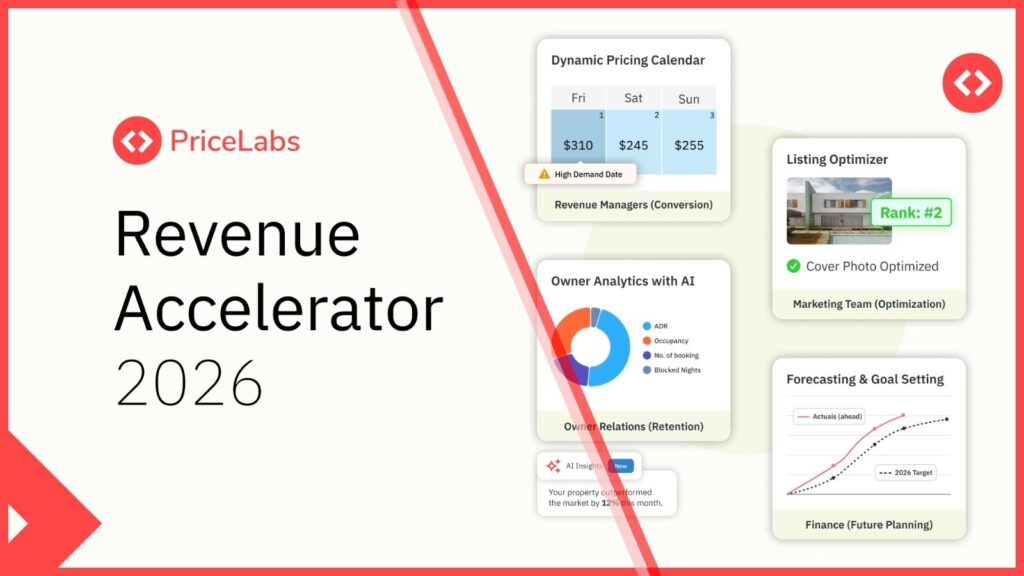
Vacation rental revenue management is no longer a solo sport; it is a whole-company discipline. As portfolios grow, the complexity of STR revenue management software must evolve. The recent launch of the PriceLabs 2026 Revenue Accelerator provides a masterclass in how AI in vacation rentals is making experts deeper and teams more self-sufficient.
Key takeaways
- Revenue is no longer one person’s job at a property management company of any meaningful scale. Business development, marketing, distribution, operations, finance, owner relations, and revenue management all make daily decisions that directly affect revenue.
- AI is reshaping revenue work in two directions, not one. It is making the revenue manager’s analytical depth deeper, and it is making revenue data wider — accessible to teams who used to wait in line for her.
- The PriceLabs 2026 Revenue Accelerator is a useful illustration of both shifts happening inside one platform. It is not the only example in the category, and it is not an endorsement — but it is the most explicit current attempt to ship depth and access as one product.
- The hardest part is not the software. Adopting this model requires organizational change most PMCs have not made yet.
Two scenes, same company, same Tuesday
Scene one. An owner rings the office on a Tuesday morning and asks how her cabin is doing. The owner relations rep does not have the answer. She pings the revenue manager on Slack. The revenue manager is mid-strategy review for a different market. She says she will get back by end of day.
At 6pm, the revenue manager pulls data from three screens, drops it into a spreadsheet, cleans it up, writes a two-paragraph narrative, and sends it to owner relations, who forwards it to the owner. Total time spent: two to four hours of senior talent. Total value created: one email that could have been a dashboard.
Scene two. That same revenue manager, an hour earlier, was staring at a market dashboard trying to decide whether a pacing dip on a coastal portfolio was a local softness, a pricing error, a visibility problem on Airbnb, a competitor promotion she could not see through the all-inclusive display, or a length-of-stay distortion she could not isolate.

Her company has 480 listings across nine markets. She is one person. The number of signals she is expected to parse on any given Tuesday has quietly doubled in the last three years, and nobody has built her a larger brain.
Both scenes are the same story. Running a PMC at scale has become a more complicated job than the tools were built to handle, and the answer is not to hire more revenue managers.
The two shifts this piece is about
There are two things the industry has been slow to say out loud, and this piece is going to name both.
The first: revenue is no longer one person’s job.
It cannot be. A modern PMC is a system in which business development, marketing, distribution, operations, finance, owner relations, and revenue management all make daily decisions that affect revenue. Those decisions are so interdependent that isolating “the revenue person” is a fiction that only worked when portfolios were small enough to hold in one head.
The second: AI is reshaping that job in two directions simultaneously.
It is making the analytical depth expected of revenue managers deeper, giving a single analyst the ability to process signals and portfolios that would have required a team a few years ago. And it is making access to revenue data wider, giving owner relations, marketing, finance, and business development direct, self-serve access to the numbers and narratives they used to beg the revenue manager for.
We are going to use the 2026 PriceLabs Revenue Accelerator launch as the concrete illustration, because it is the most visible recent release to put both shifts in one place. A second reminder, because it matters: RSU is published by PriceLabs, so read what follows as an attempt at honest industry analysis using a parent-company product as the example, not as an independent review.
The complexity is structural. It is not a staffing problem.
Before we get to AI, it is worth naming exactly what is complicated — because the complexity is often treated as a bandwidth issue when it is actually something deeper.
What has to happen for a single booking
Consider what has to happen for a single booking to materialize at a well-run PMC:
- Business development has to sign the owner with a credible, localized revenue projection. Too optimistic and the owner churns within a year. Too conservative and a competitor wins the contract.
- Marketing and distribution have to photograph the property, write the listing, and distribute it across Airbnb, Vrbo, and the direct site. The quality of that work determines whether the listing converts.
- Someone has to make sure the listing is actually seen. Airbnb’s ranking algorithm rewards conversion, review quality, response rate, and dozens of signals that have little to do with price.
- The revenue manager prices the property dynamically, adjusts for events, manages minimum stays, and responds to demand signals — but she is downstream of every decision above.
- Operations sets cleaning fees that distort the all-inclusive price guests actually see.
- Finance sets targets, reviews performance, and flags shortfalls — often too late to change the outcome.
- Owner relations is paid to keep owners happy but typically has no structured access to the data that would let them prove value proactively.
Every one of these roles touches revenue. None of them can solve it alone.
The interdependencies are where revenue leaks
The loops between these roles are not bugs to be fixed. They are the structure of running a PMC at scale.
- Marketing ↔ Pricing. If a listing is buried on Airbnb, no amount of dynamic pricing saves it. The revenue manager eventually cuts the rate to buy visibility the algorithm cannot grant.
- BD ↔ Revenue Management. A BD rep who overpromises a projection hands the revenue manager a loss they cannot avoid. The owner churns within six months.
- Owner Relations ↔ BD. Every owner who leaves is a ghost contract BD has to win back. Retention is acquisition’s quietest lever.
- Finance ↔ Revenue Management. When finance and revenue live in different spreadsheets, forecasts become accusations.
The reason revenue cannot be one person’s job is not that the revenue manager is overworked — though she is. It is that revenue is produced by a network of decisions no single role can see, much less optimize, in isolation.
Property managers have always known this. The tools are just starting to admit it.
AI changes the depth. And it changes the access. Those are different things.
The easy version of the AI-in-STR story is that AI will replace the analyst. It will not. What it will do — what it is already doing — is reshape the analyst’s job in two directions that are often conflated but should be separated.
Direction 1: Depth — a bigger brain for the expert
A revenue manager in 2020 was expected to monitor nightly rates, occupancy pacing, minimum stays, competitor prices, and a handful of local events.
A revenue manager in 2026 is expected to do all of that plus:
- Parse length-of-stay dynamics
- Isolate all-inclusive pricing distortions on Airbnb
- Track Airbnb search ranking volatility
- Integrate direct-booking search intent signals
- Reconcile PMS revenue definitions with accounting
- Monitor pacing against finance-set targets
- Do it across more markets, channels, and listings than ever before
The volume of signals has grown faster than human analytical capacity. AI is the only reason a single revenue manager can still be responsible for a 500-listing portfolio without hallucinating the numbers. This is where the PriceLabs 2026 Revenue Accelerator shines, providing power tools like market-driven occupancy adjustments that allow a single manager to handle 500+ listings.
Depth features are not about democratizing access. They are about making the expert more powerful. The revenue manager’s job is not going away; her job is getting deeper, and AI is the reason she can do it at all.
Direction 2: Access — self-serve doors for everyone else
A revenue manager in 2020 was also the only person in the building who could translate raw data into a story. Owners wanted performance summaries; the revenue manager built them. BD wanted projections; the revenue manager generated them. Marketing wanted to know why a listing was underperforming; the revenue manager diagnosed it. Every request queued behind one person.
AI changes this because the translation is now a prompt.
- A branded owner performance summary used to require the revenue manager. It does not anymore.
- A professional-looking pitch deck used to require her Excel skills. It does not anymore.
- A natural-language question like “which listings saw the biggest drop in RevPAR last month” used to require a custom report. It does not anymore.
The grunt work of translation — turning numbers into narratives non-specialists can act on — is exactly what large language models are good at. And it is exactly what used to clog the revenue manager’s calendar.
Access features are democratizing by design. The revenue manager gets her Tuesday back; the rest of the company gets answers on Tuesday instead of Thursday.
Depth and access pull in different directions
This is the important point. Depth and access are not the same set of features.
A tool that does only one is an incomplete answer to what is actually happening in modern PMCs. A tool that does both — genuinely, not as marketing copy — is rare, and it is what the industry is slowly moving toward.
The PriceLabs 2026 launch illustrates both shifts at once
This is where the concrete example matters. PriceLabs shipped the 2026 Revenue Accelerator in early April. On paper it is 30+ features across seven pillars. Strip away the marketing structure and you see a release that tries to advance both axes simultaneously.
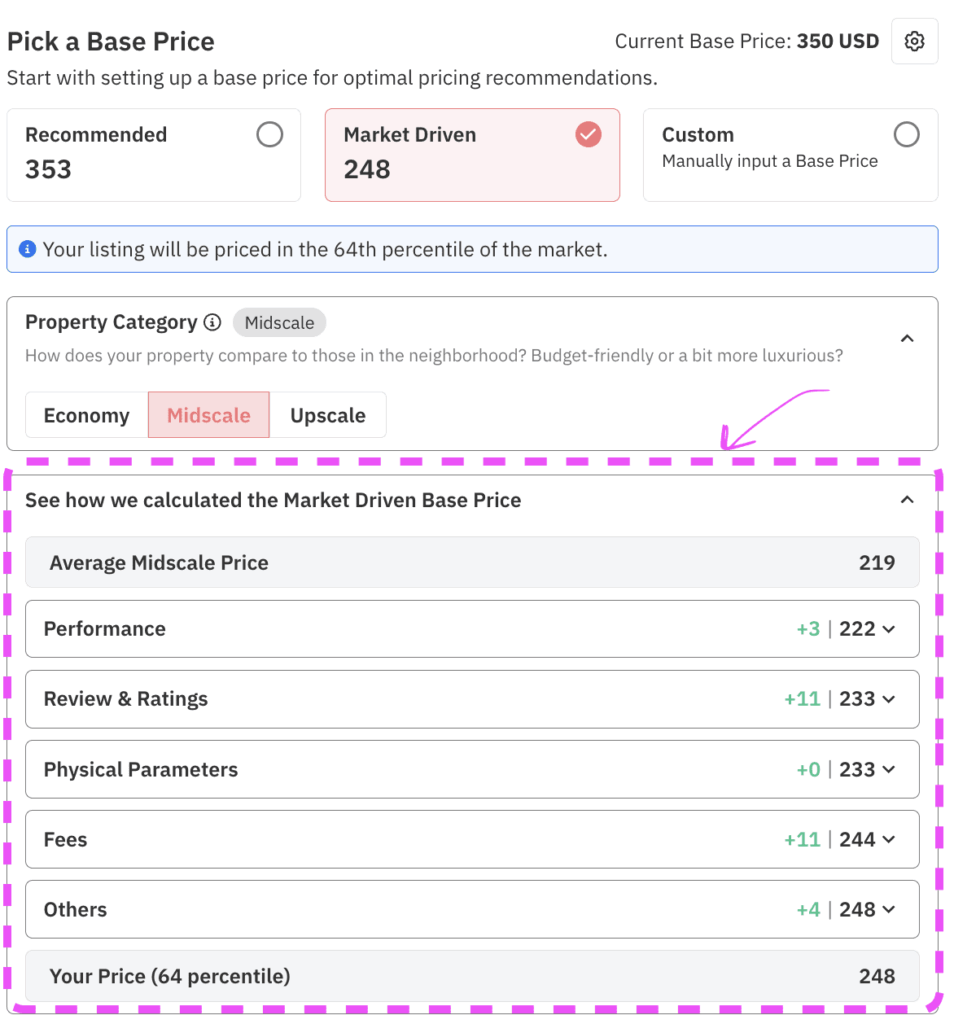
The depth features (power tools for the expert)
- Market-Driven Base Price Helper. Evaluates amenities, reviews, quality signals, cleaning fees, and PMS markups against the local comp set to generate a defensible cold-start base price.
- Market-Driven Occupancy-Based Adjustments. Applies short-term pacing corrections — up to 15% premiums when outperforming, up to 20% discounts over 60 days — without touching the base price. Protects peak-season revenue from the usual overreaction to slow stretches.
- Improved Competitor Calendar. Strips cleaning fees from up to 10 rivals over 365 days, restoring the all-inclusive visibility Airbnb’s display change broke.
- Group-Level Preview Prices. Lets a revenue manager simulate a global pricing rule across an entire portfolio before pushing it live.
- Ongoing Base Price Recommendation. Uses a rolling 60-day performance window weighted toward recent performance plus future calendar.
These are not democratization features. They are power tools for the expert, and they address the depth problem directly.
The access features (self-serve doors for everyone else)
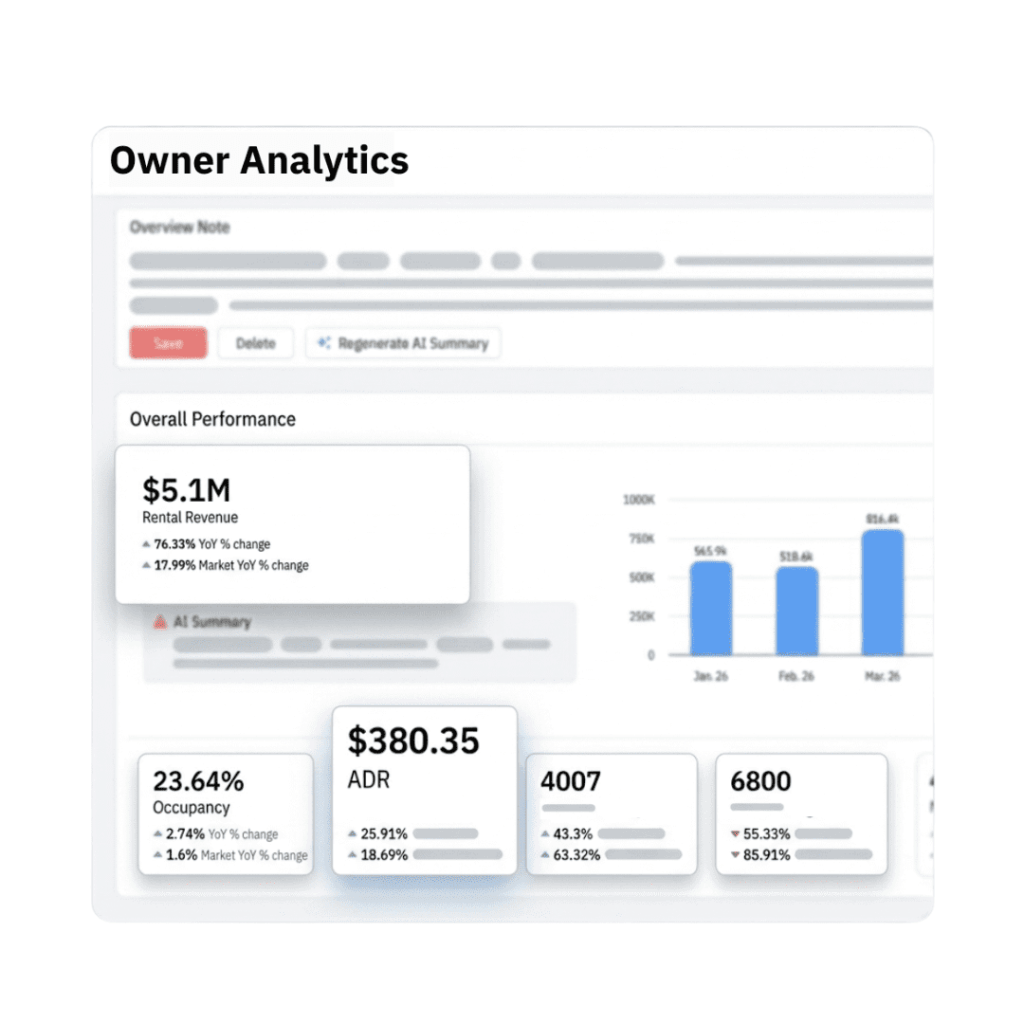
Owner Analytics (Coming Soon). AI-written, branded, editable owner reports the owner relations rep can send directly, without a handoff.
Revenue Estimator Pro. Turns Airbnb and Booking.com data into branded pitch decks for business development.
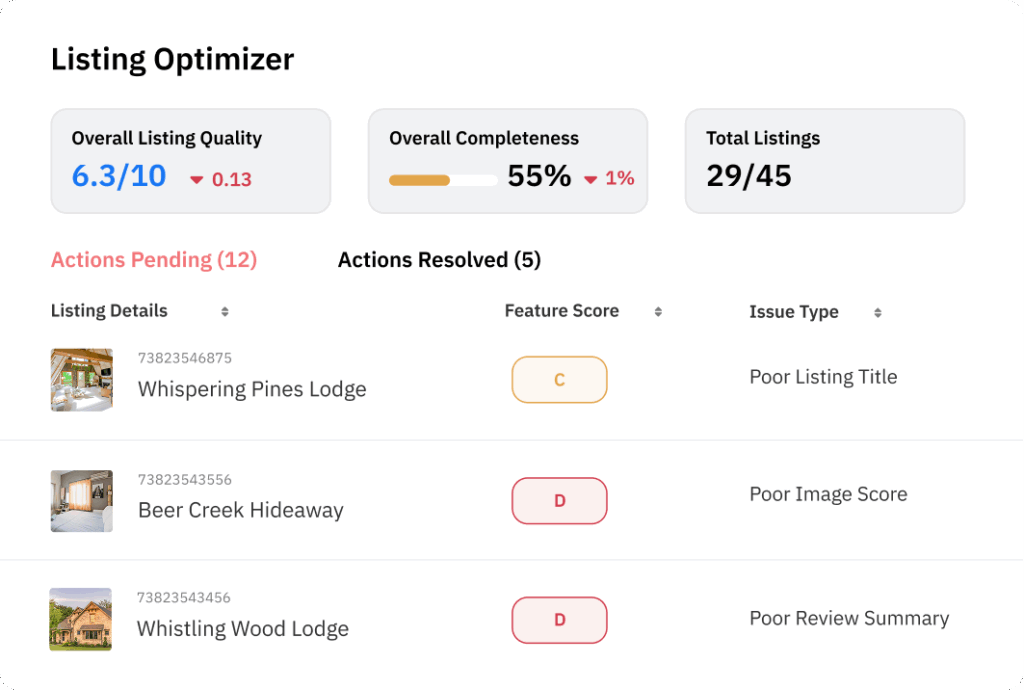
Listing Optimizer. Scans every listing, grades it against competitors, and drafts higher-converting titles and descriptions — aimed at marketing, not pricing.
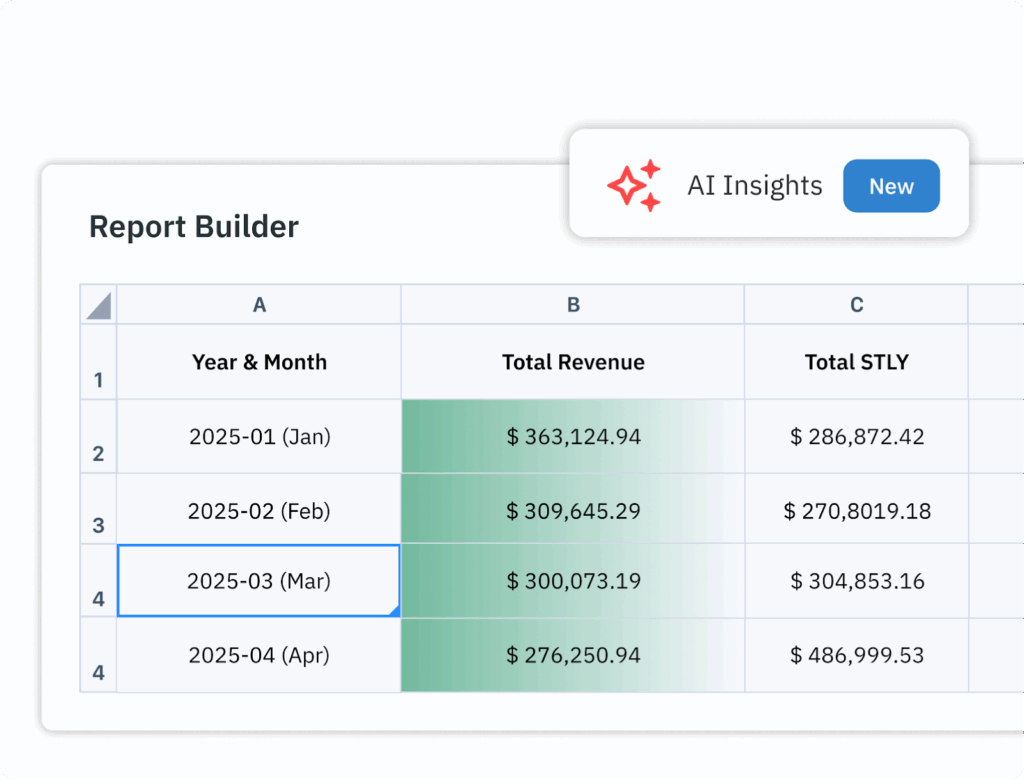
Natural Language Analysis in Report Builder. Lets anyone query revenue reports in plain English.
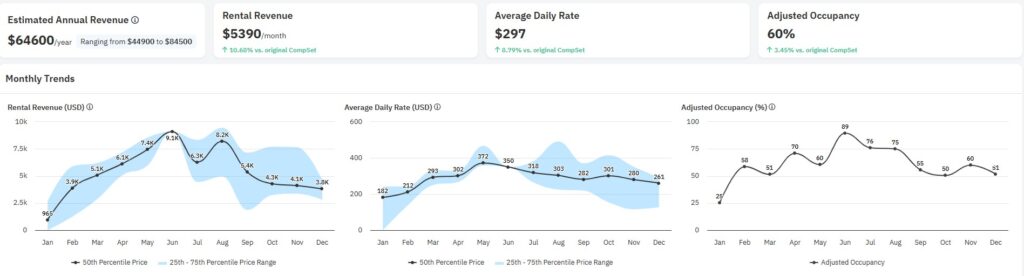
Forecasting & Goal Tracking. Gives finance a weekly-refreshed view of pacing against targets.
These are aimed at people who have never opened PriceLabs before. They address the access problem directly.
Why this launch matters as an illustration
PriceLabs is not the only vendor moving in this direction. Other tech companies are all circling related ideas.
The reason to point at this particular launch is that it is the most explicit current attempt to ship both axes as a single platform, with the argument that the connection between them is the product. PriceLabs is betting that the company that wins the next decade of STR revenue management is the one that makes the expert deeper and the non-experts more self-sufficient at the same time, using the same underlying data layer.
Whether that bet pays off depends on execution, adoption, and sustained investment. But the bet itself is correctly aimed.
The caveats worth flagging
Four of them, plus a fifth disclosure that is really the first.
1. Software does not change org charts. A PMC whose owner relations team lives in email and screenshots will not suddenly start using AI reports because they exist. Adoption requires management to restructure workflows and resist the instinct to keep routing everything through the revenue manager. The harder problem is organizational, not technological.
2. The “team sport” framing does not apply at every scale. A 15-listing operator with a founder in every role does not need a five-persona platform. Smaller operators should not feel pressured by framing built for companies at 100+ listings.
3. RSU is owned by PriceLabs. You are right to read us with a raised eyebrow. We would rather you do that explicitly than pretend the relationship does not exist.
Two questions to leave you with
If your revenue manager left tomorrow, how much of what she knows is actually in your tools?
If the answer is “not much,” the problem is not which platform you buy next. The problem is that your company is running on one person’s head — and no vendor, ours included, can fix that without you making some uncomfortable organizational choices first.
Is your revenue function getting deeper and wider at the same time, or only one?
A property management company that gives its revenue manager better AI tools but keeps owner relations stuck on spreadsheets has solved half the problem. A PMC that gives owner relations self-serve reporting but still expects the revenue manager to parse nine markets with last decade’s tools has solved the other half.
The shift worth preparing for is the one that does both. Depth without access leaves your revenue manager a bottleneck. Access without depth leaves her underequipped for the job that actually got harder.
Ask yourself which half you are currently missing. The honest answer is probably “both, a little.” The useful answer is “which one first.”

Thibault Masson is a leading expert in vacation rental revenue management and dynamic pricing strategies. As Head of Product Marketing at PriceLabs and founder of Rental Scale-Up, Thibault empowers hosts and property managers with actionable insights and data-driven solutions. With over a decade managing luxury rentals in Bali and St. Barths, he is a sought-after industry speaker and prolific content creator, making complex topics simple for global audiences.
Related Articles:
 Easter 2026: Affordable Cities Are Winning. And It’s Not Close.
 2026 Winter Olympics Milano: Why Fewer Bookings Are Making Hosts More Money
 Croatia Signals Rental Limits, Maui Rejects Rezoning Lifeline, and Evanston Shifts to Discretion-Based Oversight
 Missouri Sides With Rental Owners, Sacramento Targets Non-Resident Hosts, Alabama City Sets Hard Cap