

For decades, the short-term rental (STR) industry has operated on a simple, inventory-first logic: you have a house with four bedrooms and a pool; you list those features on a platform; a guest searches for those features and books the house. But in the age of conversational AI and autonomous agents, this model is rapidly becoming obsolete.
In a recent live session, David Ciccarelli, CEO of Lake.com, revealed a fundamental shift in traveler behavior that property managers can no longer ignore: guests are moving away from searching for “properties” and are instead using AI to find “outcomes”.
By applying the “Jobs-to-be-Done” (JTBD) framework to vacation rentals, Ciccarelli argues that to remain visible in an AI-driven world, managers must stop marketing physical assets and start marketing the specific “jobs” their properties are hired to perform.
The “Milkshake” Moment: Understanding the Jobs-to-be-Done Framework
To understand why STR marketing needs to change, one first has to understand why people buy anything at all. Ciccarelli introduced the audience to a classic business theory popularized by Harvard Professor Clayton Christensen: the Jobs-to-be-Done (JTBD) framework.

As Ciccarelli recounted, a major fast-food chain once struggled to sell more milkshakes. They improved the flavors, lowered the price, and made them thicker – standard “inventory” improvements – but sales didn’t budge. It wasn’t until researchers observed when and why people bought milkshakes that they found the answer. A huge percentage were sold between 7:00 AM and 9:00 AM to solo commuters. These customers weren’t looking for a dessert; they were “hiring” the milkshake to do a specific job: keep them occupied during a long, boring drive and keep them full until lunch.
In the world of AI short-term rental marketing, a listed property is the milkshake. A traveler isn’t just looking for a “three-bedroom house”; they are hiring that house to solve a problem or fulfill an outcome – whether that is “providing a safe, fenced space for a toddler” or “offering a high-speed workspace for a remote-working digital marketing manager”.
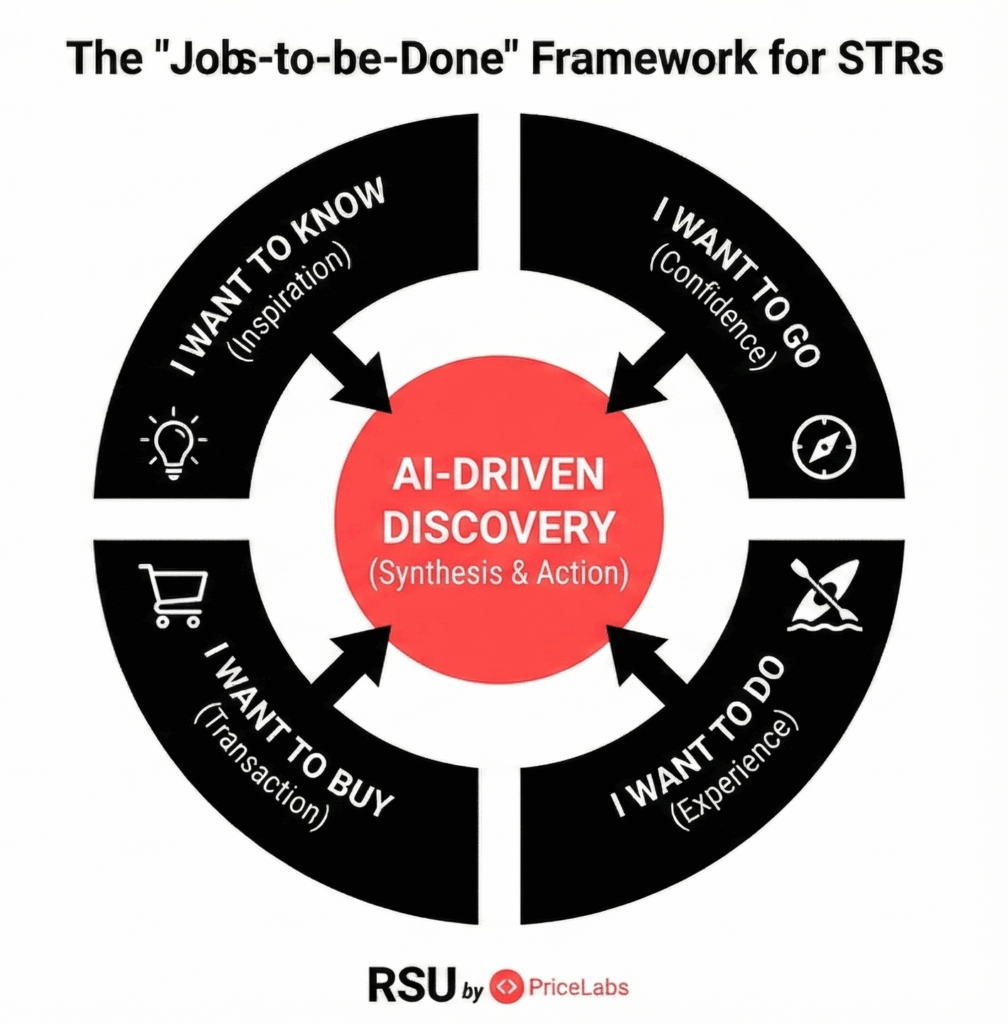
This framework breaks down into specific “micro-moments” within the traveler’s journey:
- “I want to know”: The guest is seeking inspiration and discovering destinations that match their lifestyle.
- “I want to go”: They are looking for the right stay, requiring increased confidence through clear policies and pricing.
- “I want to do”: The traveler is rounding out their trip with specific activities.
- “I want to buy”: They want to book with confidence and be rewarded for their loyalty.
The Conversational Shift: From Keywords to Intent
The rise of AI search is making this “Job” more explicit than ever. In the traditional funnel, a traveler typed 3–4 keywords into Google, like “Lake house Ontario,” and spent hours clicking through 141 pages of links to find what they needed.
Today, AI is compressing that journey. Google recently reported that AI-driven queries are now 3 to 5 times longer than traditional searches. Instead of fragments, travelers are using voice or text to describe full, detailed scenarios:
“We are a family of six with two toddlers. We need a place with warm weather in March, beach access, and a flexible cancellation policy under $400 a night”.
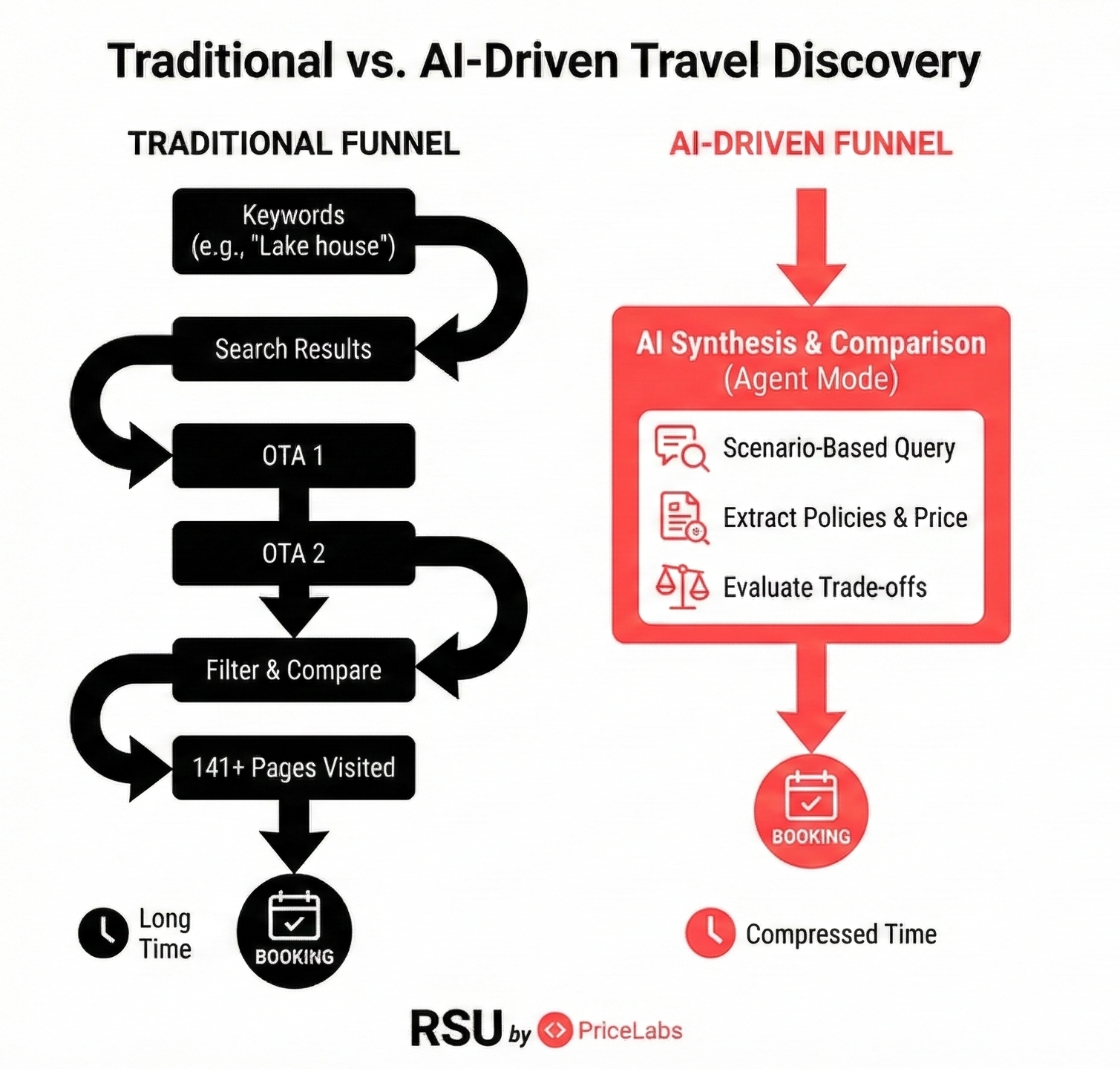
This is the shift from Keyword Search to Intent-Based Discovery. If a listing only emphasizes “4 Bedrooms,” it might miss the guest who is actually searching for “Toddler-safe outdoor space.” AI agents appear to be scanning listings specifically to see if they fulfill the “Job” described in the guest’s prompt.
The “Agent Mode” Audit: Why Your Data Integrity is Your New SEO
One of the most tactical takeaways from Ciccarelli’s segment was the distinction between Chat Mode and Agent Mode within tools like ChatGPT.
- Chat Mode: Provides summaries and suggestions based on pre-existing knowledge.
- Agent Mode: Acts as an autonomous assistant that goes out to the live web, visits specific URLs, and performs tasks.
Ciccarelli demonstrated how an AI “Agent” can now visit a property manager’s direct website to “Mystery Shop” on behalf of a guest. The agent can navigate a site, enter specific dates, and – most importantly – evaluate trade-offs.
How to Audit Your Own Presence
Property managers should perform an “Agent Audit.” Point ChatGPT or Perplexity toward their direct booking URL and ask:
- “What is the cancellation policy for this property for a stay in July?”
- “Find me a cheaper version of this property on another site.”
- “Does this house have a dedicated workspace suitable for video calls?”
If the AI Agent cannot extract the cancellation policy or identify amenities because they are buried in an image or a poorly formatted text block, listings are effectively invisible to the autonomous traveler.
Accessing the “Mind of the Traveler” via Search Console
How do managers know which “Jobs” travelers are trying to solve when they find their listings? Ciccarelli suggests looking at Google Search Console (GSC, a free tool that tracks the organic queries leading to websites.
Standard SEO practice is to look at high-volume keywords. However, in an AI world, you should filter your GSC data for long-tail queries (10+ words). These longer phrases act as a “conversation log” between the guest and the AI.
Ciccarelli shared an example from Lake.com where a traveler searched for: “scenic fall foliage train ride across the U.S. for memorable experiences”. That traveler wasn’t looking for a “lake house”; they were looking for a “memorable fall experience.” Because David had content addressing that specific “Job,” his site surfaced as the solution. Property managers can use this data to create specific marketing campaigns or landing pages centered around outcomes rather than bedroom counts.
Bottom Line
Mastering AI short-term rental marketing means realizing that the travelers of today are no longer just browsing; they are delegating complex tasks to AI agents. To stay competitive, property managers must move beyond a simple inventory-based mindset and begin proving to these agents that their properties are the best fit for a guest’s specific intended outcome.
While understanding this shift is the first step toward visibility, the question remains: How do you actually optimize your listings for an AI-first world? We will be diving deep into what we have learned in matters of Answer Engine Optimization (AEO) during our follow-up webinar on March 26th.
What’s next? In our next deep dive, we’ll look at Thibault Masson’s segment on the “Autonomous Browser” and how AI is taking over the actual navigation of the web, potentially making the traditional OTA search experience a thing of the past.
Related Reads:
- The Browser is the New OTA: How AI Travel Booking Agents Are Killing the 100-Tab Trip Plan
- The Google Goliath: Guests Are Using AI Vacation Rental Search (Even If They Didn’t Ask To)

Uvika Wahi is the Editor at RSU by PriceLabs, where she leads news coverage and analysis for professional short-term rental managers. She writes on Airbnb, Booking.com, Vrbo, regulations, and industry trends, helping managers make informed business decisions. Uvika also presents at global industry events such as SCALE, VITUR, and Direct Booking Success Summit.
Related Articles:
 ChatGPT Ads Are Live and They’re Changing How Guests Find Vacation Rentals
 What Happens When AI Becomes the First Step in Booking a Stay?
 The Browser is the New OTA: How AI Travel Booking Agents Are Killing the 100-Tab Trip Plan
 The Google Goliath: Guests Are Using AI Vacation Rental Search (Even If They Didn’t Ask To)