

Are we witnessing the possible death of big booking platforms like Airbnb, Expedia, and Booking.com?
For the past two decades, the “click-through” has ruled travel. The entire industry was built on a familiar habit: a traveler searched, clicked a link, compared a few options, and eventually booked. If you wanted real-time availability or pricing, there was only one place to go: a booking platform.
But that era is ending with the arrival of the Universal Commerce Protocol (UCP). This new open-source standard from Google is designed to turn AI conversations into instant bookings, fundamentally changing how travelers move from “dreaming” to “doing.”
The End of the “Inspiration Gap”
The urgency behind UCP comes from a massive shift in how people use the internet. Recent data shows that ChatGPT has captured nearly 18% of the global query market, marking the first time in two decades that Google has faced a double-digit competitor.

Even more telling is the engagement: users are now spending over 13 minutes per session in these AI interfaces, double the time they spend on a standard search.
Until now, this 13-minute window was an “Inspiration Gap.” Travelers would spend significant time planning a trip with AI tools like ChatGPT, the Perplexity Travel Hub, GuideGeek, or even Google’s own AI Mode, but they couldn’t actually finish the transaction.
Because there was no shared language between the AI and a property’s booking system, users were forced to leave the chat to find a “Book” button elsewhere. This led to a “read-only” frustration where AI could suggest a perfect stay but couldn’t guarantee the price or availability in real time.
UCP is the bridge across that gap. By creating a direct, live connection between the AI agent and the booking engine, it allows travelers to complete their purchase without ever clicking away.
UCP: From Chat to Live Commerce
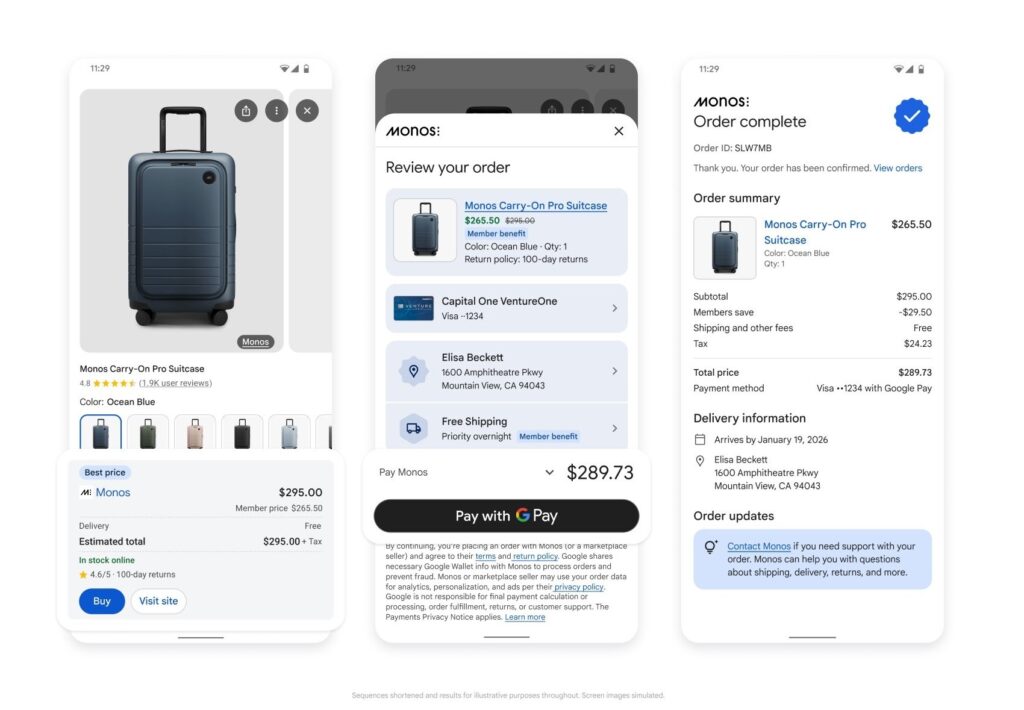
The protocol shifts the focus from static listings to live commerce through several key features:
- Live Negotiation: Unlike old search engines that showed cached prices, UCP allows an AI to ask a property’s system: “What is the live price for this guest, for these dates, right now?”.
- Dynamic Pricing Ready: This ensures that real-time rates from tools like PriceLabs are pulled directly into the AI conversation.
- Frictionless Checkout: An agent like Gemini can now check availability, apply loyalty discounts, and complete a payment without the user ever visiting a traditional website.
- Merchant of Record: A critical feature of UCP is that the business remains the Merchant of Record. The guest data, the direct relationship, and the control over the transaction stay with the provider
The Early 2026 Reality: Eligibility and Access
While the protocol is an open standard designed for global scale, the “Buy Now” capability is currently in a phased rollout. For users to access native checkout today, three specific criteria must be met:
- Merchant Eligibility: Only eligible retailers are currently live.
- Geographic & Account Requirements: Direct UCP checkout is currently limited to users in the U.S., with global expansion planned for later in 2026. Furthermore, travelers must have payment and shipping info already saved in their Google Wallet, as the system relies on Google Pay (with PayPal support coming soon).
- Surface Compatibility: Native checkout is currently enabled specifically on Google’s AI-powered surfaces: AI Mode in Search and the Gemini app.
The Battle for the Journey: AI Engines vs. OTAs
This development adds fuels to an already existing massive tension between AI “Answer Engines” and traditional OTAs. For years, OTAs have owned the “search and compare” phase of travel. UCP threatens to sideline them by moving the “decision and buy” part upstream into the AI chat.
If a traveler can find a property and pay via Google Wallet or Apple Pay without leaving the conversation, the traditional OTA search page becomes an unnecessary extra step. While OTAs like Booking.com are building their own “Specialist Agents” to fight back, UCP gives independent managers a vendor-neutral way to compete for those direct bookings.
The Luxury Exception and Accountability
Despite the rush toward automation, high-value travel remains human-centric. According to Expedia’s 2026 trends, 76% of luxury travelers still say a human advisor is essential to their planning.
In the luxury segment, travelers aren’t just buying a room; they are buying accountability. While an AI can handle the “transaction” of a $10,000 villa booking, it cannot handle a travel emergency or a highly personalized local request. In this context, UCP is an efficiency tool, not a replacement for hospitality. It handles the logistics of discovery and payment so that professional teams can focus on high-touch service.
The Risk Factor: Hallucinations and the Trust Gap
However, this “agentic” future is not without its pitfalls. The industry’s biggest concern remains the AI hallucination, where an agent confidently recommends a business that is closed, a destination that doesn’t exist, or a price that hasn’t been updated.
For the traveler, a failed AI booking creates a high-stress “uncertainty” that a standard website does not. If the AI promises a specific amenity like a pet-friendly room, but the property backend doesn’t confirm it, trust is lost instantly.
Expert Perspective: The Branding & Reputational Shift In a recent discussion, Benjamin Rhatigan, Co-Founder and Strategy Director at Arrival Projects, highlighted a critical shift in how travelers perceive brands in this new era. Rhatigan, who specializes in branding and strategy for travel-tech and hospitality, notes that we are moving from “visually-stimulating” brand websites to the relatively “dull” interface of a ChatGPT or Gemini chat box.
According to Rhatigan, this shift creates a massive reputational risk for property managers. If an AI “hallucinates” a detail or a price point during the booking process, the traveler is far more likely to blame the property—the host—rather than the AI tool itself. In the agentic era, your brand’s reputation lives or dies by the accuracy of the data you feed into the machine.
This makes data hygiene the new priority; if a property’s rules and details aren’t perfectly machine-readable, an AI agent might misinterpret them, leading to a disastrous guest experience.
The Fragmentation Wall
The travel industry is a “cobbled together” mess of siloed data.
- Data Hygiene: While giants like Marriott can adopt UCP easily, the millions of independent B&Bs, boutique hotels, and local tour operators lack the tech talent to make their inventory “machine-readable”.
- The OTA Value Add: OTAs currently win because they do the “dirty work” of standardizing this fragmented data. Google’s protocol relies on the merchants doing that work themselves, a massive hurdle for the “mom and pop” segment of hospitality.
The “Standard Wars”
Google isn’t the only one building a “live pipe” for commerce.
- Fractured Ecosystems: OpenAI (with Stripe and Shopify) and Microsoft (with PayPal) are building their own checkout layers. We may end up with a “Betamax vs. VHS” situation where a hotel has to choose which AI “language” to speak, leading to the same integration bottleneck UCP was supposed to fix.
The Dynamism Challenge: Why Travel is Not a Suitcase
A common critique of early commerce protocols is that they treat every transaction like a retail purchase. Buying a suitcase is relatively static; buying a stay in a short-term rental is anything but. In hospitality, the price can change based on the number of guests, the specific room configuration, or even a sudden spike in local demand.
Google appears to have anticipated this “dynamism gap”. The Universal Commerce Protocol (UCP) is not just a digital price tag; it is an orchestration layer designed for live negotiation.
- Real-Time Negotiation: Unlike old search engines that showed cached prices, the protocol allows an AI agent to query a property’s system directly to ask: “What is the live price for this specific guest, for these specific dates, right now?”.
- Dynamic Session Updates: The technical architecture is built around three core REST endpoints: creation, update, and completion. This “update” capability is where the complexity of travel lives, allowing the AI to adjust the total cost as a traveler adds guests or selects a different residency configuration without breaking the booking flow.
- Architected for Complexity: While UCP launched with retail partners like Shopify and Walmart, its modular framework was explicitly built to scale into travel, where bookings involve multiple components and constraints.
The Rise of the “Middleman” Optimizer
While the architecture supports this complexity, actually implementing it is a “high lift upfront”. To make inventory truly “agent-ready,” a business must have the technical talent to manage deep API integrations and maintain perfectly consistent metadata.
This technical barrier is creating a new class of industry winners: middleware agentic platforms. These companies act as the technical glue, bundling the complex requirements of protocols like UCP with existing property management systems and payment processors.
For many professional managers, the path to becoming “AI-ready” will likely involve these intermediaries. They specialize in making “messy” hospitality data machine-readable and secure, ensuring that a property is not just visible, but correctly bookable during a traveler’s 13-minute AI session.
The New Standards of Visibility
As the “agentic” era matures, the requirements for staying visible are changing for short-term rental operators:
- The New Storefront: To be “bookable” in these new interfaces, an active Google Merchant Center account is the primary requirement.
- Machine-Readable Trust: Success now depends on “clean” data. If an AI cannot easily read a cancellation policy or fee structure, it will likely ignore a property in favor of a more “understandable” competitor.
- Answering Intent: The focus is shifting from ranking for keywords to answering intent. The winners of 2026 will be the brands that provide the clearest, most frictionless answers to the questions asked during a traveler’s 13-minute session.
Conclusion: The Platform or the Protocol?
The arrival of the Universal Commerce Protocol marks a crossroads for the travel industry. For two decades, we lived in the Search Era, where platforms like Booking.com and Airbnb were the indispensable gatekeepers. Today, we are entering the Agentic Era, where the “front door” of travel is shifting from a website to a conversation.
This shift raises an existential question for the giants of the industry: Does UCP spell the end of the traditional travel platform?
If travelers can now “decision and buy” within an AI session, the traditional search model is effectively being bypassed. While Booking.com and others are racing to build their own “Specialist Agents” to save their ecosystems, they are now competing against a neutral, open-source protocol that empowers the merchant directly.
For scaling managers, the choice is clear: those who master machine-readable trust will thrive in the AI chat, while those who cling to the old “click-through” model risk becoming invisible.

Uvika Wahi is the Editor at RSU by PriceLabs, where she leads news coverage and analysis for professional short-term rental managers. She writes on Airbnb, Booking.com, Vrbo, regulations, and industry trends, helping managers make informed business decisions. Uvika also presents at global industry events such as SCALE, VITUR, and Direct Booking Success Summit.