
Guest discovery is quietly shifting from keyword search and browsing to AI-mediated conversations. In a recent live session,led by Thibault Masson (RSU by PriceLabs), joined by Uvika Wahi and David Ciccarelli (Lake.com), ran real prompts across Google AI Mode, Perplexity, and ChatGPT to observe how vacation rentals are surfaced, summarized, compared, and evaluated.
AI tools are synthesizing reviews, cancellation policies, amenities, and pricing before guests ever click into Airbnb or Booking.com.
If discovery changes, visibility changes, and property managers need to understand this layer before deciding how to respond.
The Three Observable Shifts
1️⃣ From Keywords → Intent
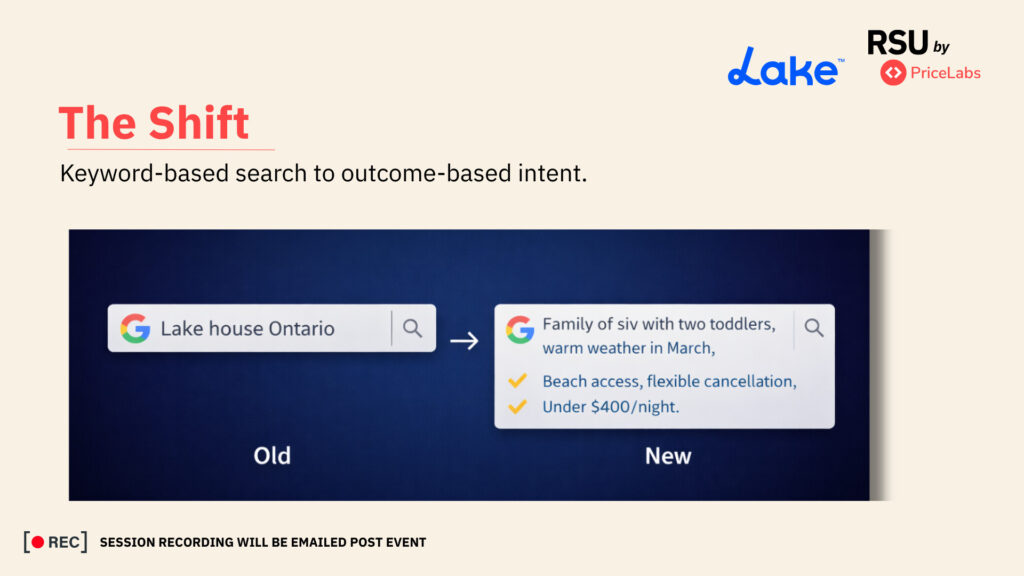
Guests now describe full scenarios instead of typing short fragments.

Instead of:
“Lake house Ontario”
They ask:
“Family of six with two toddlers, warm weather in March, beach access, flexible cancellation, under $400 per night.”
Search is becoming outcome-based, not keyword-based.
2️⃣ From Browsing → Synthesis
AI tools aggregate:
- Reviews
- Amenities
- Pricing
- Policies
Into one compressed response.
Instead of opening 10 tabs and comparing manually, the system synthesizes.
3️⃣ From Clicking → Delegated Evaluation
Agents now:
- Compare cancellation flexibility
- Evaluate trade-offs
- Check availability
- Move toward execution
A chatbot answers. An agent acts.
The Old Funnel vs The New Flow
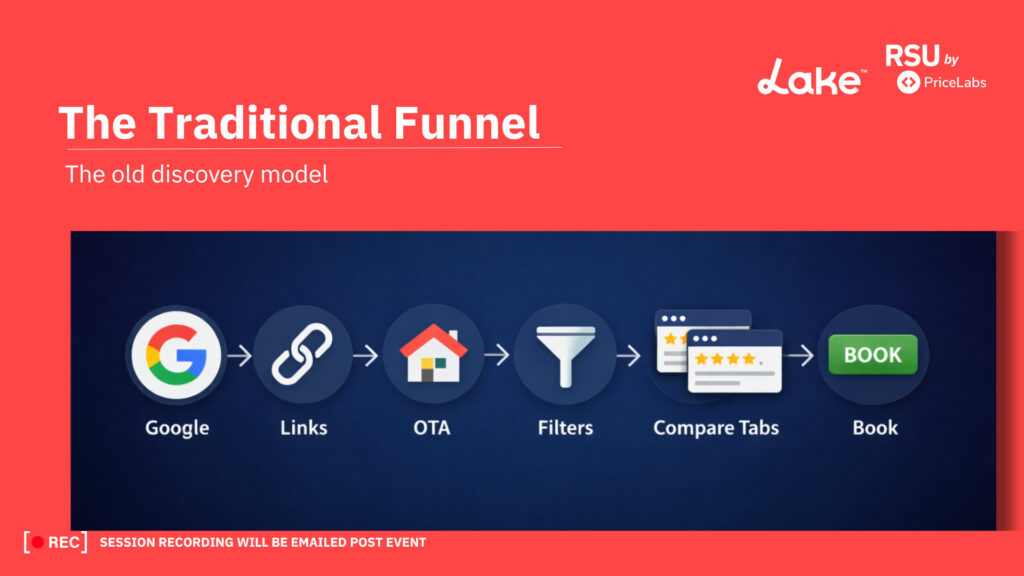
For years, the discovery funnel looked like this:
Google → Links → OTA → Filters → Compare Tabs → Book
Now, the journey is becoming conversational and compressed.
Inspiration → Consideration → Planning → Booking
Guests refine, compare, and evaluate within a single AI-driven interface.
Jobs To Be Done: What Travelers Are Actually Trying to Solve
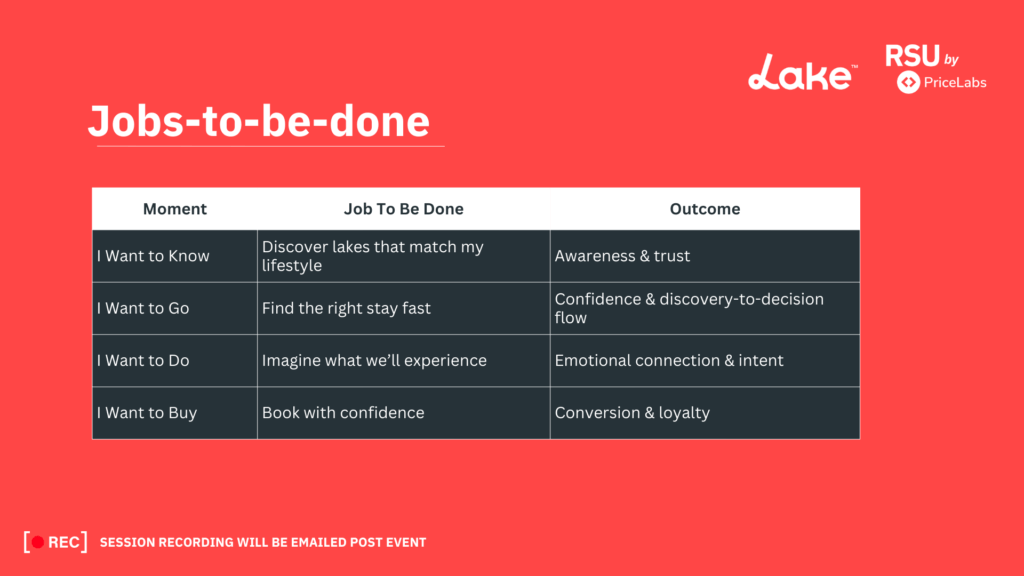
The session framed discovery through a Jobs-To-Be-Done lens:
“I want to know” → Awareness and trust
“I want to go” → Find the right stay quickly
“I want to do” → Imagine the experience
“I want to buy” → Book with confidence
AI tools increasingly address multiple jobs at once.
Instead of moving across different platforms for each stage, guests can compress discovery, evaluation, and validation into one interaction.
The Data Confirms This Isn’t Hypotical
This isn’t just experimentation at the edges.
The adoption is already massive.
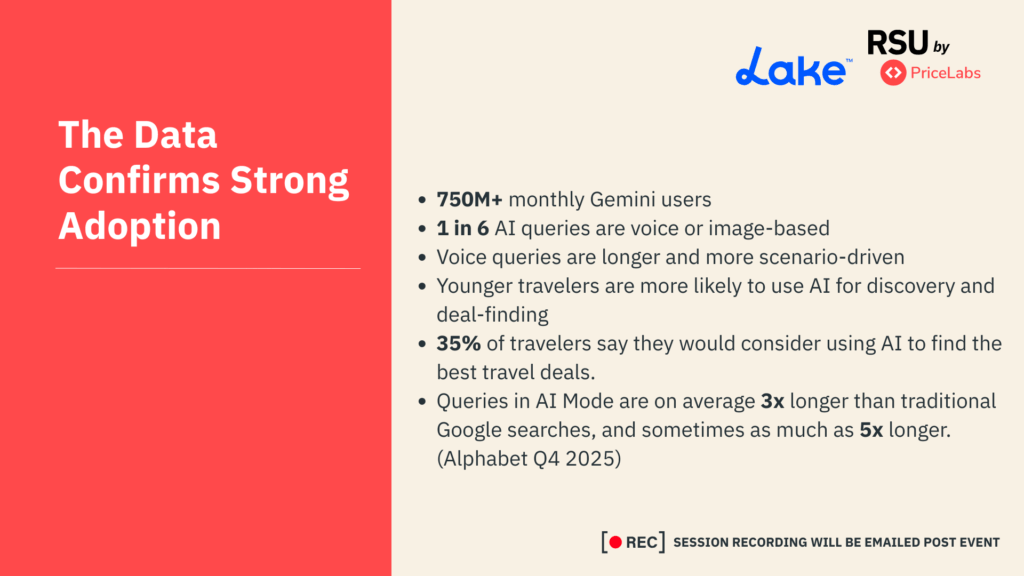
Alphabet reported 750M+ monthly Gemini users, and 1 in 6 AI queries are now voice or image-based. That matters because voice queries tend to be longer, more conversational, and more scenario-driven.
Even more importantly, Alphabet shared that queries in AI Mode are on average 3x longer than traditional Google searches — and sometimes up to 5x longer (Q4 2025).
That’s a structural shift.
Add to that:
- 35% of travelers say they would consider using AI to find the best travel deals
- Younger travelers are already using AI tools for trip planning and deal discovery
This isn’t fringe behavior.
It’s mainstreaming, quickly.
And when query behavior changes, visibility rules eventually follow.
Real-World Signals: VRBO, ChatGPT Ads & Platform Evolution
One key theme from the session was how fast this is moving.
Not long ago, ChatGPT acted like an enhanced search box, you asked, it answered. That was it.
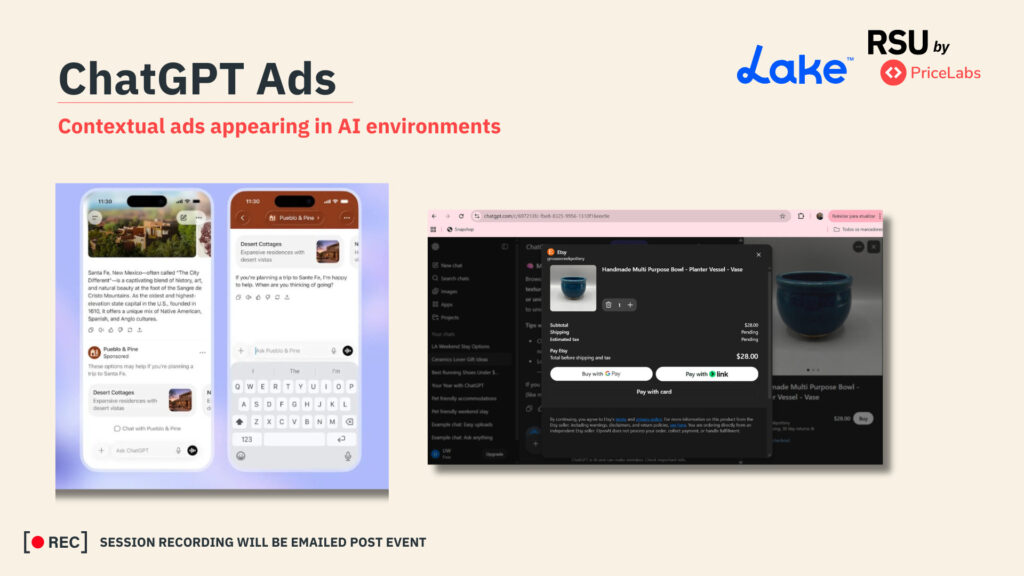
Now, it includes contextual ads (with travel used as the rollout example), and checkout capabilities are beginning to appear inside AI interfaces in the US. In just months, we’ve moved from answers → recommendations → early-stage transactions.
OTAs are evolving too. In Uvika’s Vrbo example, a simple date search surfaced a contextual filter tied to a live baseball game happening during those dates. The platform inferred intent and adjusted recommendations dynamically.
The speed of that shift matters.
The Live Demos: What We Actually Observed
Google Search → AI Overview → AI Mode
Uvika searched: “Villa for 5 in Florida in June for one week.”
Instead of the traditional list of blue links, Google surfaced an AI Overview by default. It immediately summarized:
- Suggested areas and villa types
- Typical price ranges
- Amenities to consider
- Booking tips
When she clicked into AI Mode, the experience deepened. Google pulled in:
- Actual villa listings
- Google Maps profiles
- Reviews
- Source links
Everything was synthesized in one place. The key change: guests no longer need to click through multiple sites to start comparing options.
Perplexity + Comet (Agent Browser)
Thibault first showed how Perplexity handles travel queries, including its dedicated travel vertical. For broader prompts, it defaulted to major platforms. As queries became more specific, it surfaced more localized sources.
Then he moved to Comet, Perplexity’s browser with an embedded assistant.
He prompted it to act as a travel agent:
Find and compare 5 apartments for a 5-night stay, under €250 per night, within a 3-hour flight from Amsterdam, without specifying a destination.
What happened next was the shift:
- The assistant chose destinations
- Navigated Airbnb and Booking
- Entered filters
- Compared listings
- Evaluated options
All without additional input.
The browser took over. The search became autonomous.
ChatGPT: Chat Mode vs Agent Mode
David demonstrated the distinction inside ChatGPT.
In chat mode, the system:
- Suggested listings
- Summarized options
- Provided information
But the user still had to do the comparison work.
In agent mode, the system:
- Visited property URLs
- Entered dates
- Extracted pricing
- Compared cancellation policies
- Evaluated which option was more favorable
A chatbot informs.
An agent performs tasks.
What You Can Check Today: Search Console & Analytics
The session also encouraged operators to observe early signals inside their own data.
Look at:
Start with Google Search Console.
Look specifically at:
- Are queries getting longer (6–10+ words instead of 2–3)?
- Are you seeing more question-style searches (“best villa for family of 5 in Florida June”)?
- Are impressions rising for highly specific, intent-heavy phrases?
Then move to Google Analytics (or GA4).
Check:
- Is organic traffic shifting toward deeper landing pages instead of just your homepage?
- Are users spending more time on fewer pages (suggesting pre-qualified traffic)?
- Is direct traffic increasing (possibly from AI tools summarizing and linking)?
- Are referral sources changing (e.g., new AI-related referrers appearing)?
You can also manually test:
- Paste your listing URLs into ChatGPT Agent Mode.
- Ask it to compare cancellation policies or summarize reviews.
- See what it extracts, and what it misses.
How to Prepare Listings for This Shift (Part 2 in March)
This session was not about tactics. It was about awareness.
If AI becomes the first layer of discovery, then visibility may depend on how well listings can be interpreted, synthesized, and evaluated by machines, not just humans.
Understanding the shift comes first.
In Part 2 (March), the focus will shift to preparation:
- What makes listing data machine-readable
- How structured information influences AI summaries
- What “Answer Engine Optimization” actually means for STRs
- And how to test whether your properties are AI-ready
Understanding the shift comes first. Strategy follows.
Related Reads:
- The Browser is the New OTA: How AI Travel Booking Agents Are Killing the 100-Tab Trip Plan
- The Google Goliath: Guests Are Using AI Vacation Rental Search (Even If They Didn’t Ask To)
- Are You Listing a Property or Solving a Problem? The Reality of AI Short-Term Rental Marketing

Snigdha Parghan is a Content Marketer at RSU by PriceLabs, where she creates articles, manages daily social media, and repurposes news and analysis into podcasts and video content for short-term rental professionals. With a focus on technology, operations, and marketing, Snigdha helps property managers stay informed and adapt to industry shifts.
Related Articles:
 Are You Listing a Property or Solving a Problem? The Reality of AI Short-Term Rental Marketing
 The Browser is the New OTA: How AI Travel Booking Agents Are Killing the 100-Tab Trip Plan
 The Google Goliath: Guests Are Using AI Vacation Rental Search (Even If They Didn’t Ask To)
 Airbnb tests pay-to-play visibility for “best guests” (LOYALTY PROGRAM TEST?)