Airbnb has reworded how it explains its November 20 house rules, but it says the rules themselves haven’t changed.
- What changed: “Requests” are being renamed “Additional rules,” contracts required by a host’s insurer are now allowed, and the appeal process is spelled out.
- Who it impacts: Hosts and managers whose listings rely on checkout tasks, waivers or building rules.
- What to watch: Airbnb starts reviewing listings on November 20. Additional rules still don’t carry the cancellation right that standard house rules do.
Two weeks after announcing the house rules changes that take effect on November 20, Airbnb updated its Resource Center article and reworded several of its help pages on November 3, acknowledging that hosts were concerned about losing control over the rules they set for their homes and that it “could have done a better job explaining why and how” it was making the changes. The policy itself has not changed, Airbnb told us, but the vocabulary around it has, and one word has now disappeared from the policy page altogether, as part of Airbnb additional rules.
For property managers, the rewrite matters because those labels are what the November 20 listing review will be run against. We compared the pages as they stood on October 21 with the versions live on November 10, put the questions our earlier coverage left open to Airbnb by email, and set out here what changed, what Airbnb confirmed, and what is still unanswered.
What Changed on Airbnb’s House Rules Pages Between October 21 and November 10
| What | Before (October 21) | After (November 10) |
|---|---|---|
| Policy page title | Reasonable House Rules and requests | Reasonable house rules |
| Policy page introduction | Guests must follow house rules and are encouraged to comply with requests | That sentence is gone; the introduction refers only to house rules |
| Expectations of guests | Guests comply with house rules, and are encouraged to respect requests | Guests are expected to comply with house rules, and hosts can cancel without fees if a guest breaks one |
| Listing how-to article | Add house rules and requests to your listing | Add house rules to your listing |
| Contracts policy | Four grounds: law or homeowners association rules, an optional amenity, stays of 28 nights or more, Airbnb Luxe | The same four, with the host’s insurance provider added inside the first |
| Appeals | An opportunity to submit an appeal | Four steps, one submission, supporting files allowed, at least 20 days to act |
| Checkout instructions | No longer appear in a separate tab | Can be added back as additional rules under Before checkout |
The change hosts will notice first is a name. What you set up as “Requests” is becoming “Additional rules,” because hosts told Airbnb the old label was confusing, and the new one will appear in the app over the coming weeks. The Resource Center article also ties the Events rule to Airbnb’s Community Disturbance Policy and tells you to list local government or homeowners association fines at the bottom of the house rules section, through an Add details link in the host app where you pick who charges the fine and get 140 characters to describe it. Airbnb limits that field to rules beyond your control that could lead to fines.
The Word “Requests” Has Left the Policy Page, and the Right to Cancel Has Moved Into It
The October version of the Reasonable House Rules policy described two kinds of instruction on the same page: guests had to follow house rules, and they were encouraged to respect requests. Both halves of that sentence have been deleted. The November page is titled Reasonable house rules, its introduction mentions house rules only, and its Expectations of guests section now says guests are expected to comply with a listing’s house rules, followed by the line that gives hosts the right to cancel without fees when a guest breaks one or says before check-in that they intend to.

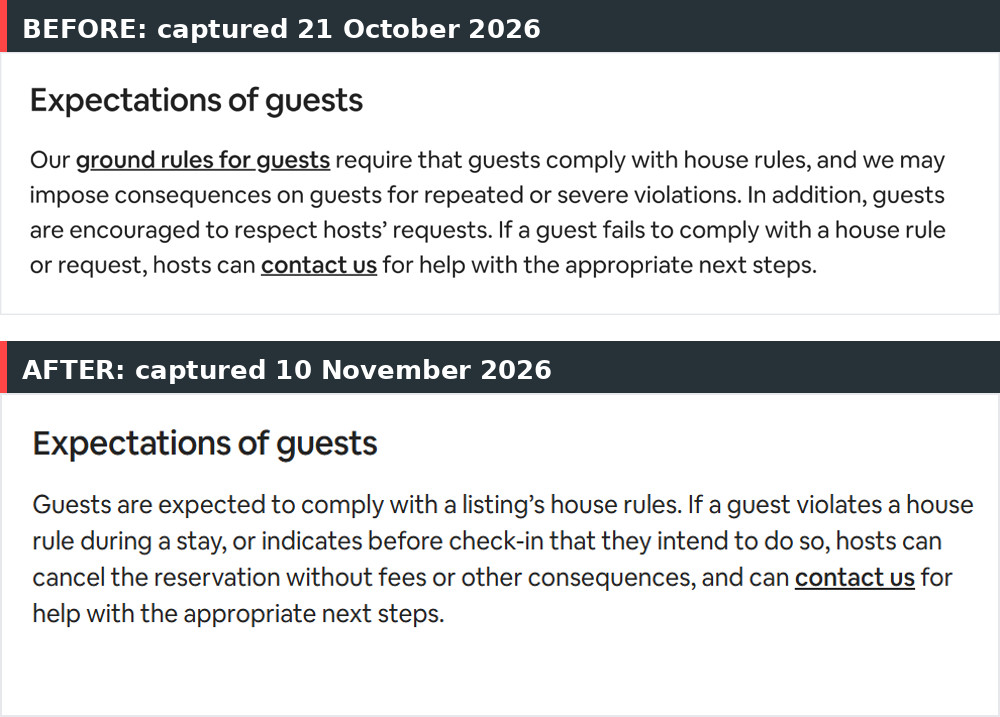
Read on its own, the policy page now describes a single category of rules, while the two-tier split lives on the Resource Center article and the how-to page, where hosts choose from the standard house rules and then write additional rules beneath them. That creates a wording problem Airbnb has not finished with: the limits on the policy page, including the much-discussed line about not asking guests to wash and put away dishes, can only sensibly apply to additional rules, because none of the standard rules is a chore. The label in the app is still catching up too, so expect the pages to keep moving for a few more weeks.
Additional Rules Still Do Not Give You the Right to Cancel a Booking
We asked Airbnb by email to confirm what the new wording means in practice. Airbnb told RSU that the standard house rules, such as maximum overnight guests and lock up at checkout, are required, while additional rules are strongly encouraged, and that only the standard rules carry the right to cancel. If a guest ignores an additional rule, hosts can contact Airbnb support. The policy has not changed, Airbnb said, and the pages have only been made clearer.
That is the same line our October explainer drew between the two tiers. The names are new and the enforcement is not. One detail worth noting for anyone counting: the Resource Center article refers to seven standard house rules, while the how-to page lists eight areas, because it includes the choice of which Airbnb Services categories you allow in your home.
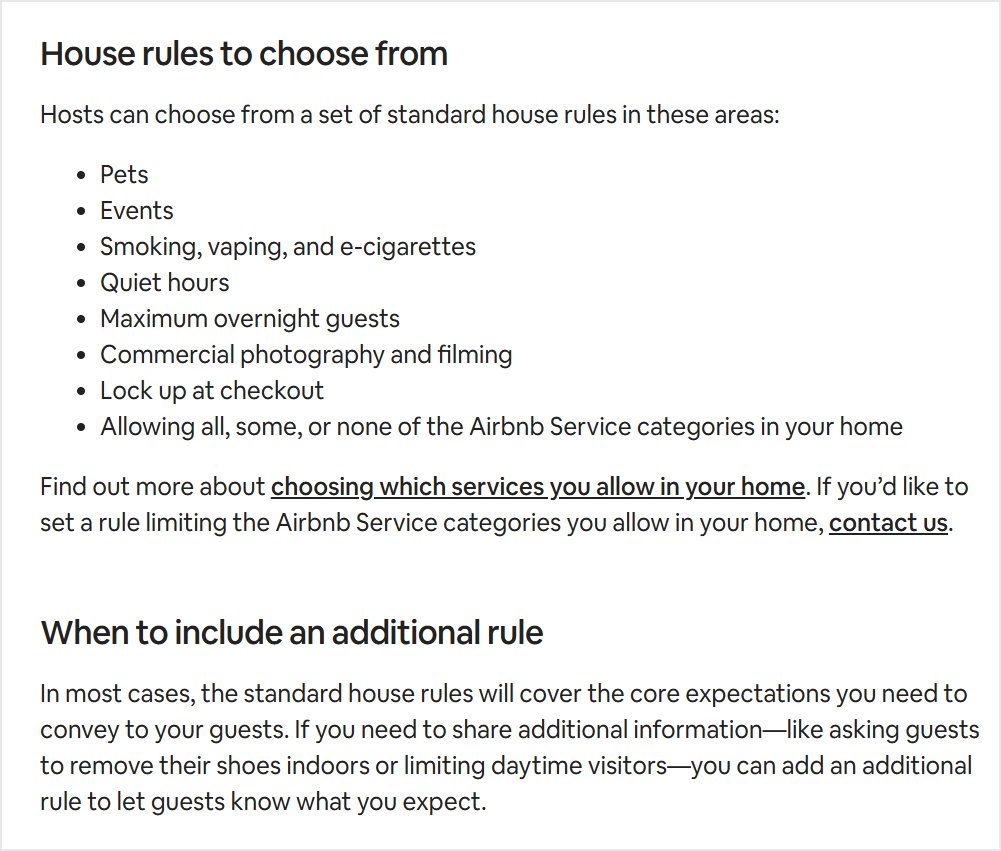
For managers, the practical position is unchanged. Anything a turnover depends on sits on firmest ground inside one of the standard rules, or inside operations rather than inside a rule at all: bins left by the door, a cleaner booked close behind checkout, and a cleaning fee priced for a full reset.
Airbnb Now Allows the Contracts Your Insurance Provider Requires
The contracts policy is where the update has immediate practical value. On October 21, a separate agreement was allowed only when required by law or homeowners association rules, when it gave access to an optional amenity, for stays of 28 nights or more, or for an Airbnb Luxe listing. The November version keeps all four and adds the host’s insurance provider to the first of them, so a manager whose insurer requires a signed waiver for a pool, a hot tub or a dock now has a route that did not exist three weeks ago.
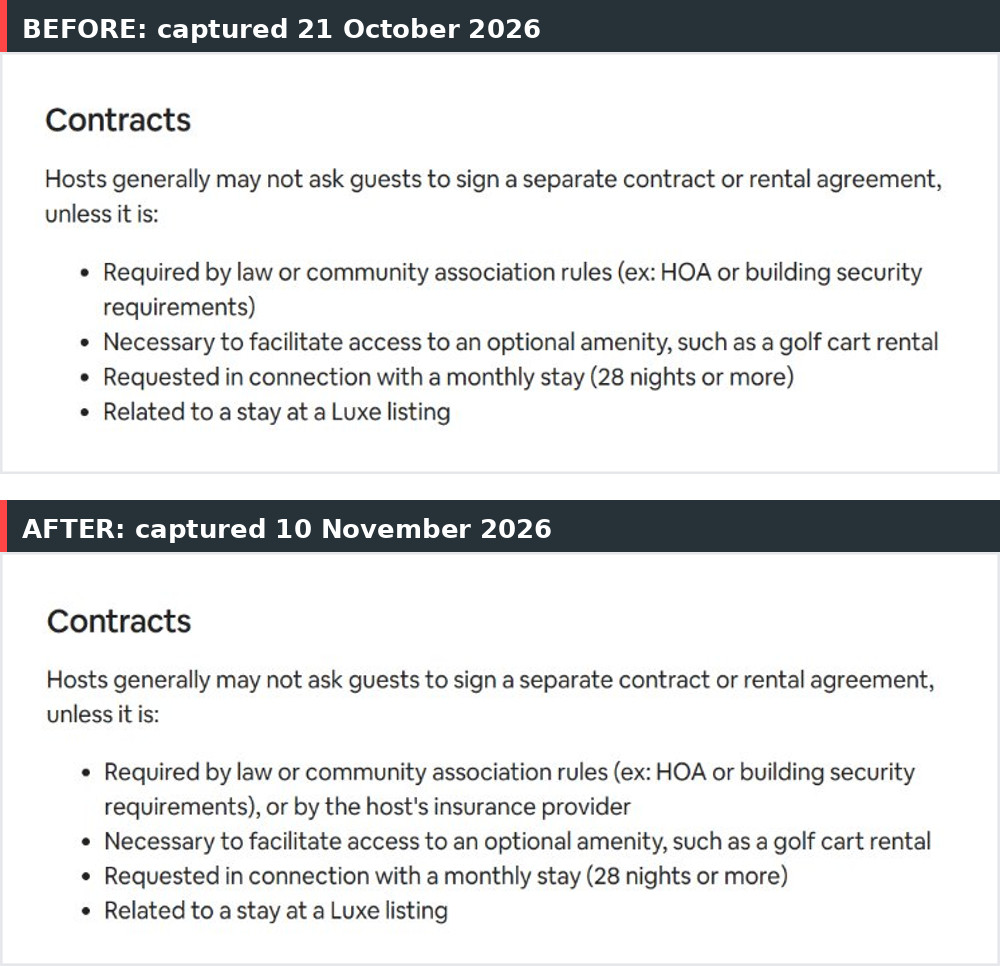
What the page does not do is make that contract any easier to enforce. Airbnb still says it does not require guests to sign host-imposed contracts and does not help enforce their terms, and it has not said whether AirCover responds differently to a pool or hot tub incident when a waiver was signed than when it was not.
What Airbnb Answered, and the Three Questions It Left Open
In October we listed five questions managers and vendors were raising. The November 3 update answers two of them in part and leaves three open.
| Question managers raised | Status | What the November pages say |
|---|---|---|
| Pool, hot tub and dock waivers that no law or homeowners association requires | Partly answered | Contracts required by a host’s insurer are now allowed. Whether AirCover responds the same way without a signed waiver is not addressed. |
| What proof Airbnb accepts for a building rule | Partly answered | Appeals accept supporting photos or files, and one worked example is a building that requires guests to register at the front desk. Confidential building documents are not mentioned. |
| Why a bear-proof bin request was flagged as a chore | Open | Bear-country bins are now one of Airbnb’s own example appeals, and appeals are read by a human team. Whether the Listing editor still flags the request is not addressed. |
| Whether safety signs such as No diving count as rules added after booking | Open | The policy still bars new rules communicated through signs in the home. Safety signage is not mentioned. |
| Whether hosts can ask guests not to set the air conditioning below a set temperature | Open | The utilities example is unchanged: guests can be asked to turn the air conditioning off when they leave, but not to avoid using a listed amenity. |
One question we had not listed, whether a host can cancel over an additional rule, Airbnb answered directly, and the answer is no.
The appeal examples are the most useful part of the update, because they show the kind of reason Airbnb expects to see: local conditions such as bears, building requirements such as front desk registration, stay length such as bins on collection day during monthly stays, and the type of property such as a co-op with a shared kitchen.
How the November 20 Listing Review and the Appeal Process Work
The policy applies to reservations booked on or after November 20, 2026, and the November 3 update adds the schedule behind it.
- From November 20: Airbnb starts reviewing listings, with the first round running through March 2027 and reviews continuing after that.
- If a rule does not meet the policy: the host gets an email and an in-app notice, with at least 20 days to update the rule or appeal.
- The appeal: submitted once, through the link in the email or the Required action card in the Listing editor, with a written explanation and any supporting files such as a local ordinance or a homeowners association rule.
- If the appeal is rejected: Airbnb sends a deadline to update or remove the rule, and a host who keeps it may see a notice on the listing page.
Because the appeal can only be submitted once, the managers I would expect to come out of this well are the ones who assemble the supporting documents before the first emails land, especially where the same building or homeowners association rule covers many listings and one rejected appeal would set the precedent for all of them.
What This Means for Property Managers and Single-Property Hosts
For property managers, the work is a portfolio audit rather than a listing edit. Every additional rule that a turnover, an insurer or a building depends on needs to be sorted into one of three buckets before November 20: it maps onto a standard house rule, it has a document behind it that will survive an appeal, or it moves out of the rules and into operations and pricing. The contracts change is worth a call to your insurance broker this month, because a written insurer requirement is now the cheapest route to keeping a waiver on a pool or hot tub listing.
For single-property hosts, the practical exposure is smaller and more specific. A checkout list that reads as chores is the thing most likely to be flagged, and the appeal route is built for the host who can point at something outside their control, such as bear-country waste rules or a front desk that registers every guest.
The caveats. The case for reading this as Airbnb responding to its community is reasonable: it admitted the explanation was poor, renamed a label hosts found confusing, added an exception that came straight from operator feedback, and published an appeal path with worked examples. A sceptical manager will answer that none of this changes what anyone can actually enforce. Additional rules were unenforceable on October 20 and they are unenforceable now, a renamed label does not give a rule weight, the insurer exception still ends with Airbnb declining to require a signature, and the three open questions are precisely the ones that cost money when a guest ignores a safety sign or floods a utility bill. Both readings fit the evidence, and the one that turns out to be right will be settled by how the first appeals are decided rather than by anything on the pages today.
Airbnb begins reading listings on November 20, and the appeal can be filed once.
Go deeper
- Airbnb’s new house rules policy: our explainer on the seven standard rules, what additional rules can include, and fines and contracts.
- What the November 20 rules change for property managers: the questions managers raised and what the Listing editor flagged in our tests.
- Airbnb’s temporary phone numbers: how hosts reach guests when they cannot ask for a phone number.

Uvika Wahi is the Editor at RSU by PriceLabs, where she leads news coverage and analysis for professional short-term rental managers. She writes on Airbnb, Booking.com, Vrbo, regulations, and industry trends, helping managers make informed business decisions. Uvika also presents at global industry events such as SCALE, VITUR, and Direct Booking Success Summit.
Related Articles:
 The UK Gets Airbnb-Friendly, HomeToGo Partners with FlixBus, Hospitable Upgrades Guest Messaging with Touch Stay
 Airbnb Q1 2025: What Vacation Rental Managers Should Know
 Booking Holdings Is Almost as Big as Airbnb in Homes
 Airbnb debuts lowest price guarantee, and what looks like a loyalty mechanism – but only for hotels