
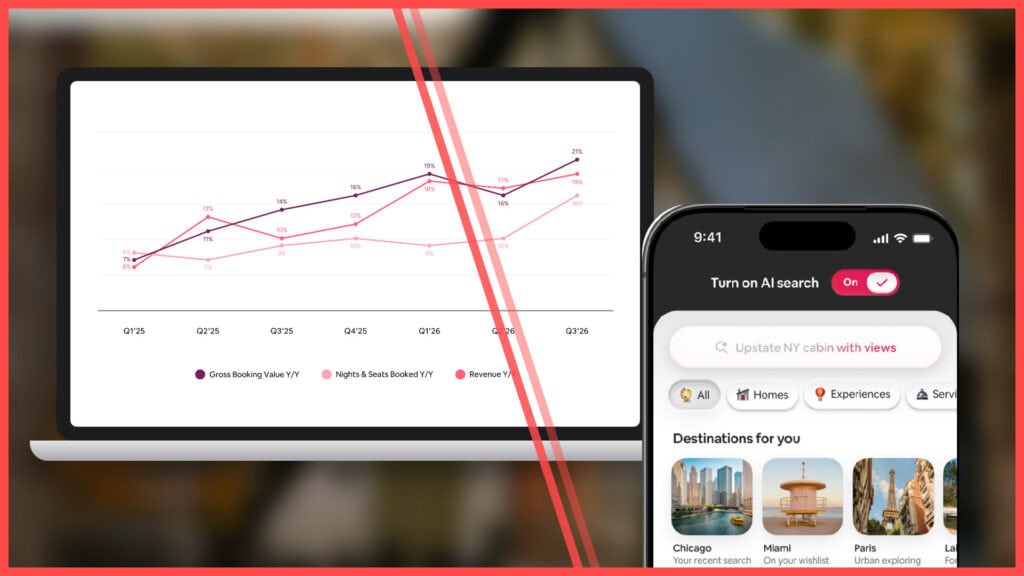
Airbnb’s growth picked up speed in Q3 2026, helped by Reserve Now, Pay Later, which wins more bookings but also brings more cancellations.
- What changed: Airbnb opened Reserve Now, Pay Later to Limited and Firm listings. Even after cancellations, it added about 3 points to nights growth, while the cancellation rate climbed to about 19%. Airbnb also launched its own dynamic pricing tool and said it is working on sponsored listings and a loyalty program.
- Who it impacts: Managers on Airbnb, especially those with Limited or Firm cancellation policies and those who price with their own tools.
- What to watch: How cancellations hit your calendar in Q4, and what sponsored listings and loyalty will cost hosts.
Airbnb is picking up momentum again. According to the company, guests booked 16% more nights in Q3 2026 than a year earlier, and revenue grew at its fastest pace in more than three years.
Part of that boost came from Reserve Now, Pay Later, which lets guests book with nothing paid upfront. It’s winning Airbnb more bookings overall. But more of those bookings get cancelled, which can leave some hosts with less predictable calendars. Airbnb also wants a bigger say in what hosts charge: it launched its own pricing tool and called pricing its next big growth lever.
Here’s what Airbnb’s Q3 2026 results mean for your vacation rentals, and what to check in your own numbers.
Airbnb’s Bookings Grew 16% in Q3, With Every Region in Double Digits
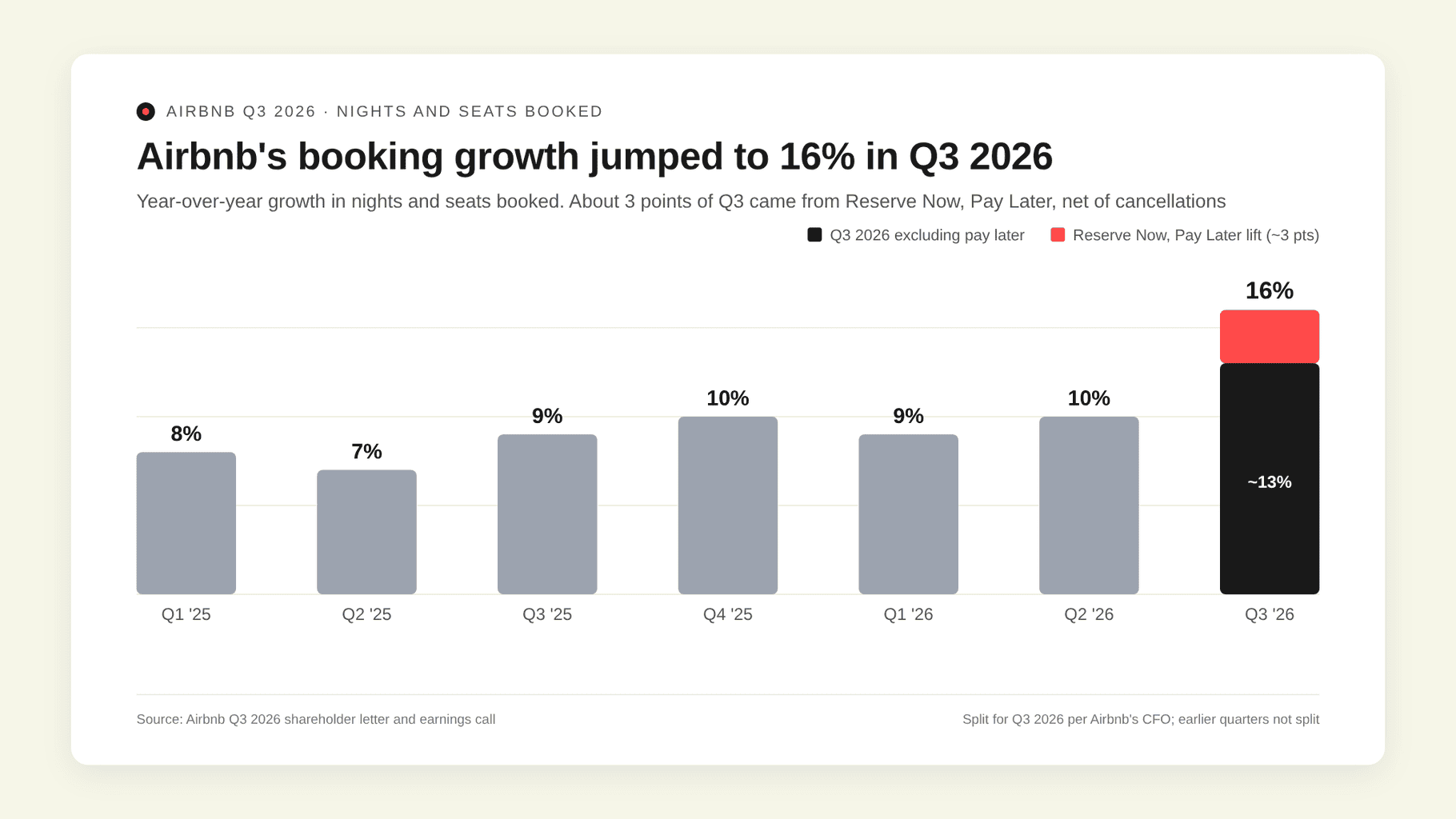
Guests booked 16% more nights on Airbnb in Q3 2026 than a year earlier, up from 10% growth in Q2, according to Airbnb’s Q3 2026 shareholder letter. Bookings were worth $27.7 billion, up 21%, and revenue rose 19% to $4.9 billion.

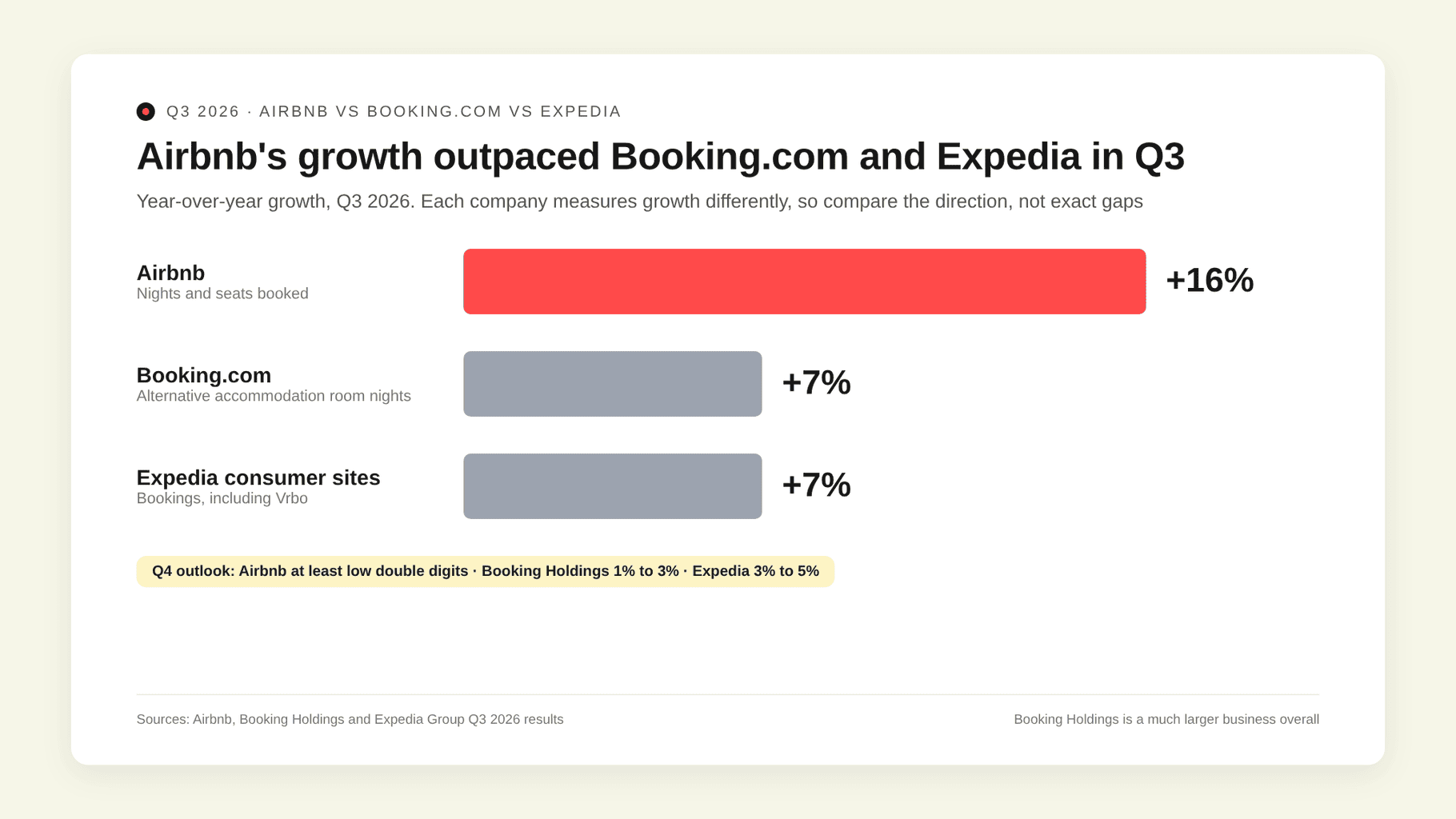
That’s well ahead of its two biggest rivals this quarter, though each measures growth a little differently. Booking.com’s alternative accommodations, which include short-term rentals, grew room nights 7%, and Expedia’s consumer sites, including Vrbo, grew bookings 7%. Part of the gap comes down to size: Booking Holdings is a much bigger business overall, with more than $24 billion in revenue in 2025, compared with about $14 billion for Airbnb over the past 12 months, so its percentages start from a larger base.
Airbnb’s biggest markets are speeding up
Growth sped up in all five of Airbnb’s core markets: the US, France, the UK, Canada and Australia. North America had its strongest quarter in four years, with nights booked up at a low-double-digit rate. Europe, the Middle East and Africa grew in the mid-teens, and Latin America and Asia Pacific each grew more than 20%.
Guests also paid more per night. The average rate rose 4% to $179, and 6% in North America. Airbnb puts that down partly to rising prices and partly to guests choosing bigger homes: entire homes with four or more bedrooms are growing fastest.
Demand is outpacing supply
Airbnb’s active listings grew at a high-single-digit rate, slower than nights booked, and Airbnb says hosts also opened up more nights on their calendars. In other words, there was more demand to go around per listing this quarter, though your own market may tell a different story. On Booking.com, it was the other way around: alternative accommodation listings grew 9%, faster than room nights.
Airbnb expects a stronger Q4 than Booking Holdings or Expedia Group
For October to December, Airbnb expects nights booked to grow at least at a low-double-digit rate. Booking Holdings expects room nights to grow 1% to 3%, and Expedia expects bookings to grow about 3% to 5%. The three companies measure growth differently, so read the gap as a direction rather than an exact comparison.
Airbnb’s CFO, Ellie Mertz, said the forecast doesn’t assume unrest in Europe, “specifically France,” or the conflict in the Middle East will have a lasting effect. If you manage homes in France, check your own winter bookings rather than leaning on Airbnb’s forecast.
About 3 points of Q3’s growth came from Reserve Now, Pay Later, and that’s the change most likely to show up on your calendar.
Reserve Now, Pay Later Is Working for Airbnb. For Hosts, It Means Less Predictable Calendars
Reserve Now, Pay Later lets guests book with nothing to pay upfront. Airbnb launched it in the US in 2025, rolled it out worldwide for Flexible and Moderate listings at the start of 2026, and widened it to Limited and Firm listings at the start of Q3.
Why Airbnb made the bet
Airbnb’s goal is to turn more browsers into bookers by making trips easier to afford. As Mertz put it on the earnings call, “this product makes traveling more affordable. You don’t need to pay upfront.”
So far, the bet is paying off for Airbnb. More than 40% of its booking value is now eligible, and pay later added a net 3 points to nights growth in Q3, after cancellations, at least one point more than in Q2. Without it, nights would have grown about 13%. Mertz also said guests using it book earlier and choose more expensive homes.
The trade-off: more cancellations
Higher cancellations were always part of the deal: Airbnb’s filings say pay later bookings cancel more often than bookings paid upfront. Its cancellation rate now stands at about 19%, up from about 16% a year ago, Mertz said. When we covered Airbnb’s Q4 2025 results, it was about 17%.
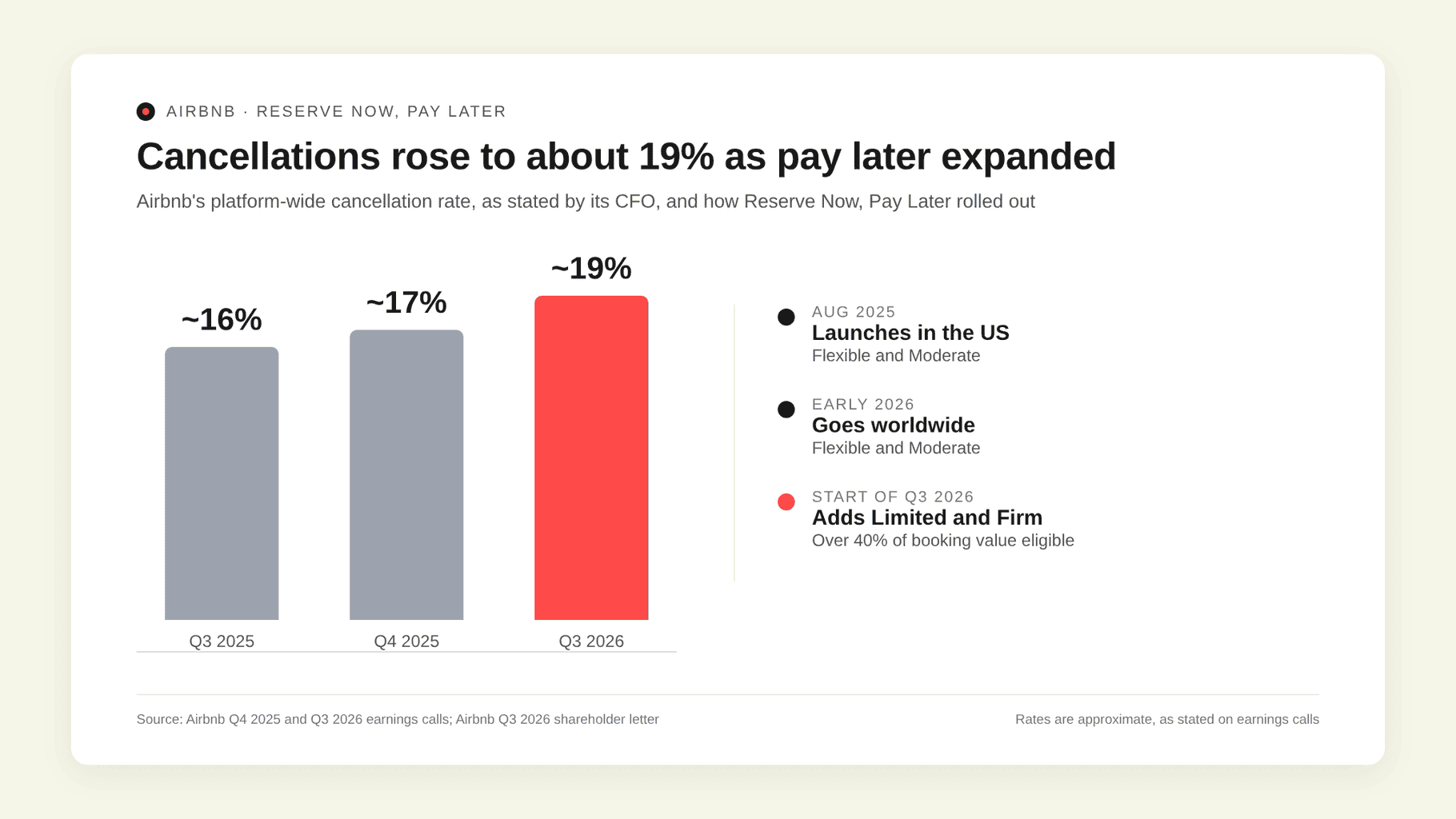
For Airbnb, the trade-off works: across the platform, the extra bookings outweigh the extra cancellations, and Mertz called 19% “very healthy in the travel space.” For a single manager, the math can look different. The gain is spread across millions of listings, but each cancellation lands on one calendar. A cancelled night only counts if you can fill it again, and a calendar that looks full months out may not be full at check-in.
Q4 is when cancellations catch up
Mertz said Q3 was the high point for pay later’s net benefit, as Airbnb had flagged last quarter. Bookings arrive first and cancellations follow, so the net gain shrinks in Q4.
According to Airbnb, guests aren’t charged until 8 days before the free-cancellation deadline. On a Firm policy, that’s about 38 days before check-in. Until then, the booking holds your dates, but the guest hasn’t paid a cent.
Hosts can’t switch pay later off. Airbnb’s help center doesn’t mention an opt-out, and Hostaway reports that Airbnb doesn’t let hosts opt in or out. Only Flexible, Moderate, Limited and Firm policies are eligible, so your cancellation policy is the one lever you control.
Vrbo has announced its own version, for US guests only, while Booking.com lets hosts decide whether guests prepay. We compared all three in our explainer on Vrbo Reserve Now, Pay Later.
Pay later changes when guests pay. Airbnb’s next focus is how much they pay.
Airbnb Calls Pricing Its Next Big Growth Lever. What That Means for Your Rates
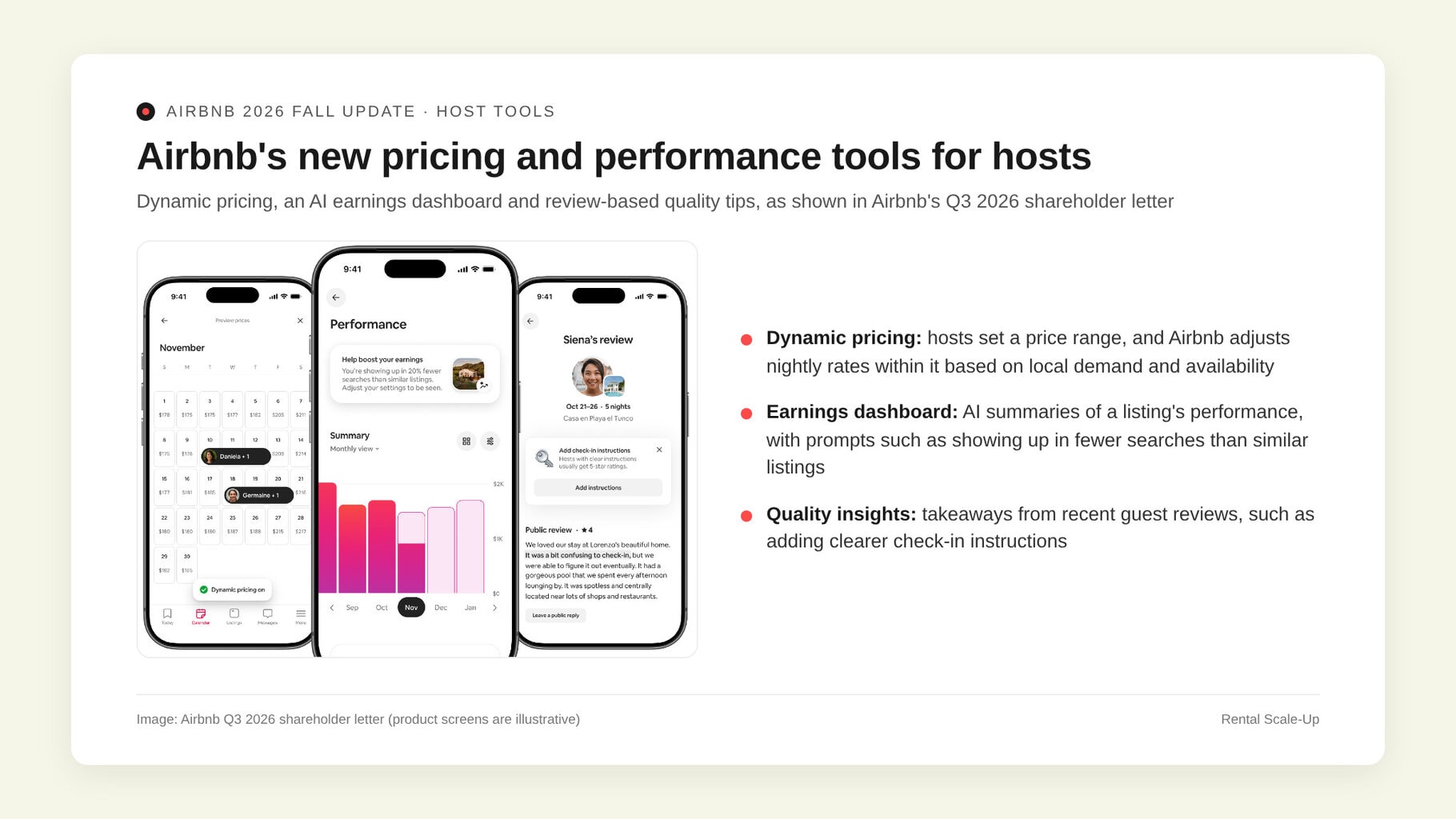
Airbnb’s fall update brought in a dynamic pricing tool. Hosts set a price range, and Airbnb adjusts nightly rates within it based on local demand and availability. CEO Brian Chesky said Airbnb has no results to share yet, “but the adoption is really great.”
What Airbnb said
Chesky called pricing “a massive lever” for Airbnb’s growth. He quoted Pepijn Rijvers, Airbnb’s new Chief Business Officer, who previously ran Booking.com’s accommodations business: “if you think Reserve Now, Pay Later is big, wait till you see what we can do with pricing.”
His pitch to hosts is that a slightly lower price can earn more overall. Charge “like $10 less,” he said, and you may win enough extra bookings that “you’ll actually make a lot more in the long run because your occupancy is much higher.” He called that “not an intuitive thing,” which is why Airbnb wants its tools to help hosts find those price points. Guests come out ahead too, he said, because stays become “a little more affordable.”
Airbnb is nudging prices in other ways as well:
- The new calendar for hosts with several listings suggests changes to minimum stays and last-minute discounts. Nearly 1 in 4 eligible hosts switched it on in the first month.
- The fall update added a 15% discount hosts can offer top-rated guests.
- Nearly all hosts now pay the single 15.5% host-only fee, compared with Vrbo’s new 12% commission. Mertz said the single fee “helps hosts price more competitively.”
Why professional managers may see it differently
RSU is published by PriceLabs, which, among other things, sells pricing tools. We aim to give the most balanced view we can, and you should weigh this section with that in mind.
Airbnb’s case holds up. More bookings are rarely a bad thing, and lower prices help guests. For hosts who list only on Airbnb, a pricing tool built into the platform makes sense, and that’s a big group: Chesky said more than 60% of Airbnb’s inventory is exclusive to Airbnb.
Professional managers often play a different game, in two ways.
They sell on more than one channel. The rest of Airbnb’s supply, still a sizeable share, is listed elsewhere too. Those managers need to set and update prices across Airbnb, Booking.com, Vrbo and their own websites. They also want their pricing to learn from how guests book on every channel, not only Airbnb, because that gives a fuller picture of demand.
They aim for the right price, not just more bookings. Occupancy is one measure, not the whole story. When we looked at 2025 market data, large property managers ran lower occupancy than the overall market in the US, UK, France, Spain and Italy, but earned higher average rates and higher revenue per available night. Many professionals trade some occupancy for rate on purpose. More bookings help when they come at a price that covers your costs and meets your owners’ expectations.
In my view, Airbnb’s tools can be a useful input. Whether a $10 price drop pays off depends on what that night is worth to you across all your channels.
Dropping your price is one way to get noticed on Airbnb. Airbnb also lifted the lid on new ways that are coming.
Sponsored Listings, Loyalty and AI Summaries: Airbnb Is Changing How Guests Find Your Listing
Until now, ranking on Airbnb has come mostly from organic signals: reviews, response times, price, listing quality and a whole host of other metrics. Those still count. What’s coming is visibility hosts can pay for, and new ways for guests to discover listings.
Sponsored listings are in the works
Chesky said Airbnb is “developing sponsored listings,” which would let hosts pay for more visibility. They’ll be built into Airbnb’s upcoming AI agent, and Airbnb will work out how ads fit once that agent launches.
He gave no timeline. But the big platforms keep catching up with each other’s features, and Vrbo opened sponsored listings to partners worldwide this fall. Booking.com sells ads too, as we covered in our look at listing visibility across platforms. In my view, it’s likely we’ll see sponsored listings on Airbnb in 2027.
On loyalty, Chesky has changed his tune
Chesky has long brushed off loyalty programs. In 2023, he said “the best loyalty program is building a product people love so much they want to come back” and “we don’t have to pay them to come back.”
This quarter, he struck a very different note. Airbnb is now “absolutely looking at” a loyalty program, he said, and has been “at a disadvantage” as “the only major travel [company] in the world that doesn’t have one.” He still nodded to his old view that people loving the product is the best loyalty, but said adding hotels, services and experiences gives Airbnb “a lot more to work with” for a program.
It seems to me the new tone matches what Airbnb has been doing. As we’ve reported, it has been assembling a loyalty program piece by piece without calling it one:
- Credit on hotel stays: guests earn Airbnb credit, about 8% to 9% of the booking, on featured hotels.
- Discounts for top-rated guests: first tested in February in exchange for visibility, and now a 15% discount hosts can offer.
- Partner rewards: Amex cardholders earn Membership Rewards points on Airbnb stays, and Airbnb’s airline partnerships with Delta, Qantas and TAP Air connect guests to extra benefits.
For hosts, a loyalty program can cut both ways. Rewards make booking more attractive and give guests a reason to come back, which can mean more bookings for your listings. But the loyalty they build is to Airbnb, not to you. And who pays matters: Airbnb funds the hotel credit, while the top-rated guest discount comes out of your payout. It’s the same split elsewhere: Expedia pays for OneKeyCash on Vrbo, but hosts fund Genius discounts on Booking.com and member discounts on Vrbo. If Airbnb launches a full program, check which rewards it funds and which come from your rates.
AI now describes your listing in search results
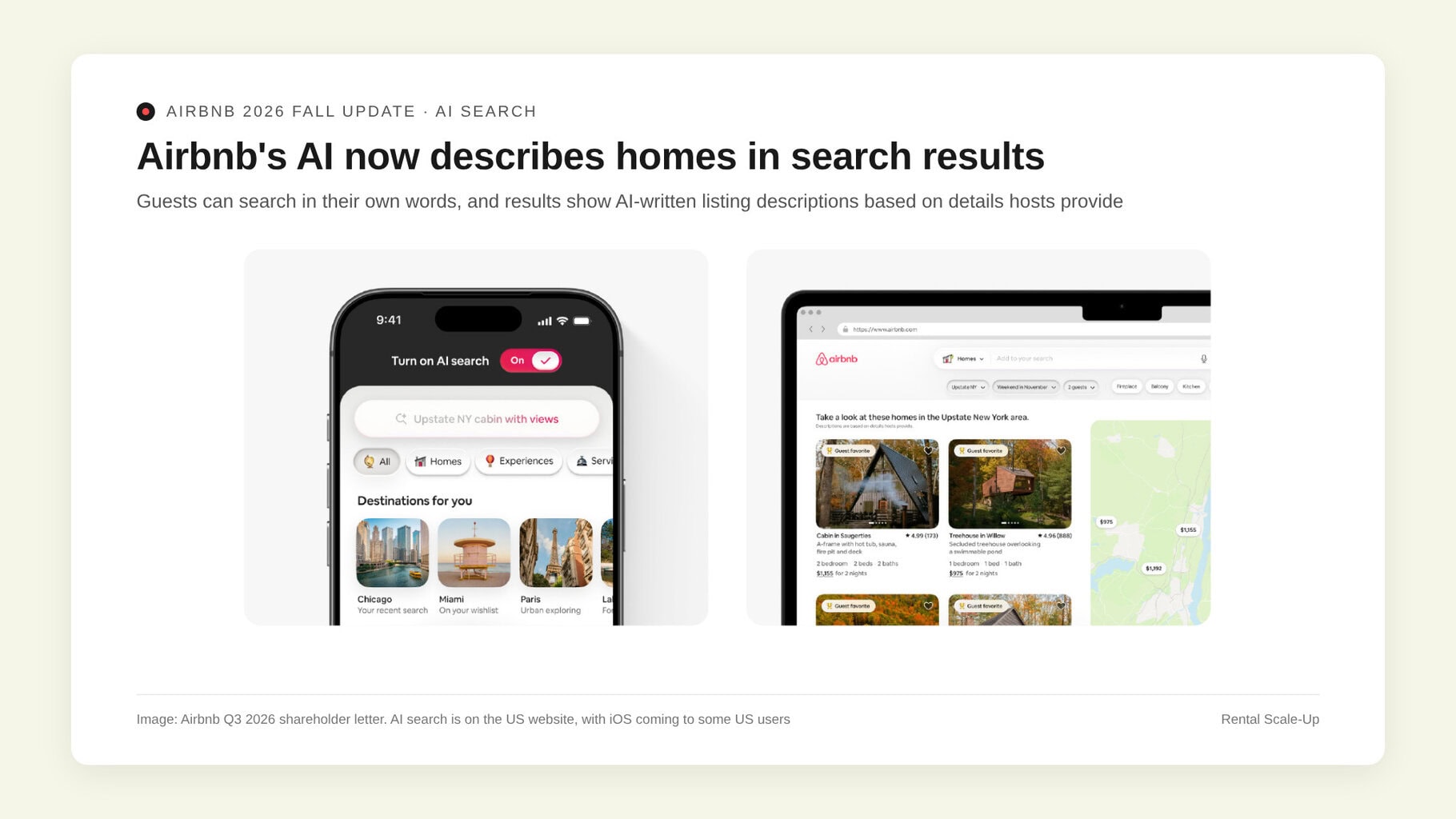
Airbnb’s AI search lets guests describe the trip they want in their own words or by voice. It’s live on Airbnb’s US website and coming to the iOS app for some US users. Vrbo launched its own natural language search on its US English website and app this fall, so guests on both platforms can now search this way in the US.
Both platforms also use AI to explain the results, in different ways. Vrbo shows cards at the top of the page saying why it picked those homes, as we saw when we tested it. Airbnb now shows an AI-written summary of each home in the results, and guests can ask AI questions answered from “guest reviews and details hosts provide.”
So guests may form a view of your home from what Airbnb’s AI says before they ever open your listing, and that summary is built from your listing details and your reviews. I’d look at how Airbnb describes a few of your listings and fill any gaps at the source.
Chesky wants Airbnb’s AI agent built for dreaming, not just tasks
Airbnb plans to start rolling out its own AI agent in the first half of 2027, and this quarter it gave the fullest picture yet of what that means.
Chesky doesn’t want a chatbot. He called a traditional chat window “the wrong interface” for travel, because travel is visual, often planned as a group, and enjoyable in itself: Airbnb says 80% of travelers enjoy researching trips. Instead, the agent will draw on “hundreds of travel-specific interface components,” such as maps, photos, comparisons, calendars and itineraries, and assemble them in real time around what a guest is looking for. Chesky said it will feel “a little bit like generative UI.”
The agent will also help after booking, with changes, payments and support, and plug into outside travel providers over time. For now, Chesky said, bookings from outside AI assistants are still very few. Booking.com tells a similar story: AI chatbots send it well under 1% of its room nights.
In my view, this is a design-led bet, and a sound one. Guests planning a trip want to see the possibilities and picture the stay before they commit, not hand the whole thing to an assistant. For hosts, it means the agent will build its answers from what you give Airbnb: your photos, your location, your amenities and your reviews.
Beyond these three, Airbnb shared updates on several other threads we’ve been following.
Other Airbnb Updates: Hotels, Social Features, Amex Travel and More
Hotels are now in more than 60 destinations
Airbnb’s hotel pilot started in just four cities. It now has thousands of boutique and independent hotels in more than 60 destinations. Hotels are still a single-digit share of nights, but Chesky said they’re growing “markedly faster” than homes.
Airbnb also says about 35% of guests whose first Airbnb booking is a hotel go on to book a home within a year. That’s Airbnb’s case for hotels: they bring in new guests who later book homes. If you manage city apartments, hotels are most likely to compete with you for one-night, business and last-minute stays.
Social features: Airbnb’s take on trust
We’ve followed Airbnb’s real-life social network since May 2025. Chesky now calls it “maybe one of the single most underestimated parts of our business.” Guests can already see where friends and family have stayed, and Airbnb plans to show friends’ stays in search results and on the map.
What has stood out across this whole year is trust, and it’s become a recurring theme for the big booking platforms, with good reason. If a host could see how a guest is connected to them, Chesky said, that would be “a really good proxy for trust.” Airbnb hasn’t said what hosts will see, or when.
In my view, we’ll hear even more about trust next year. As AI assistants compete to plan and book trips, platforms will argue that you already trust them to verify people, take payment securely and step in when something goes wrong. Airbnb’s letter makes that case, and Vrbo’s ads this year each put a trust feature front and center, such as Vrbo Care and verified reviews.
Airbnb’s social features add a different kind of trust: the trust you already place in people you know. By bringing those relationships onto Airbnb, it borrows that trust for guests and, eventually, for hosts.
Airbnb also launched Neighborhood pages in Paris, which it says lifted bookings. It plans to cover 1,500 neighborhoods by the end of the year.
Amex Travel and Luxe: a new source of first-time and luxury guests
Since October 22, more than 1 million Airbnb listings can be booked on Amex Travel through an exclusive partnership. Chesky said nearly a quarter of these bookings come from guests new to Airbnb, and a bigger share than usual are luxury stays. As we covered in our article on Airbnb’s Luxe rebuild, Amex Platinum cardholders can use their lodging credit on Luxe stays, so high-end managers stand to gain the most.
Services compete with some host add-ons
Airbnb added meal delivery, laundry, baby gear, ski gear and boat rentals, and brought grocery delivery to Europe. Car rentals, run with CarTrawler, currently send guests to a partner page, but Chesky wants guests to book every part of a trip inside Airbnb eventually. If you sell extras like these yourself, see how your offer stacks up against Airbnb’s.
Insurance is growing fast
Airbnb’s revenue from guest travel insurance jumped nearly 70%, and Airbnb is testing new insurance products “for both guests and hosts.” As we explained in our piece on what Airbnb earns on top of your rates, this money doesn’t show up in your payout. We’ll cover the host products once Airbnb shares details.
AI handles more support issues
Airbnb says about 40% of all support issues were resolved without a person in Q3, up from a third in Q2. Airbnb now counts all support issues, not only those that start with its AI assistant, so this isn’t directly comparable with earlier figures. Vrbo reported that its AI agent resolved more than 15% of guest contacts in its first two months. Airbnb is also adding AI voice support by phone in the US.
Here’s what all of this means for your Airbnb business.
What Hosts Can Take From Airbnb’s Q3
- Plan for less predictable calendars in Q4. Pay later brings Airbnb more bookings, but it now covers Limited and Firm policies, and Airbnb says its net benefit peaked in Q3. Check cancellations by policy and booking window, and tell owners what to expect.
- Test Airbnb’s pricing advice before you rely on it. Try it on a few listings and compare revenue per available night after fees.
- Keep your listing details and reviews in good shape. Airbnb’s AI summaries are built from them.
- Watch what visibility will cost. When Airbnb shares details on sponsored listings or loyalty, check who pays.
- Check your own market. Airbnb’s growth is strong overall, but it’s watching unrest in Europe, especially France.
FAQs
How did Airbnb perform in Q3 2026?
Airbnb’s nights and seats booked grew 16% to 155 million, the value of bookings grew 21% to $27.7 billion, and revenue grew 19% to $4.9 billion compared with Q3 2025.
What is Airbnb’s cancellation rate in 2026?
Airbnb’s CFO said the cancellation rate is about 19%, up from about 16% a year earlier, mainly because of Reserve Now, Pay Later.
Which Airbnb cancellation policies are eligible for Reserve Now, Pay Later?
Flexible, Moderate, Limited and Firm. Airbnb added Limited and Firm at the start of Q3 2026, and says more than 40% of its booking value is now eligible.
Is Airbnb adding sponsored listings?
Chesky said Airbnb is developing sponsored listings, to be built into its coming AI agent. He gave no timeline.
Does Airbnb have a loyalty program?
Not yet. Chesky said Airbnb is “absolutely looking at” one but has nothing to announce.
Read Next
See how Airbnb’s rivals did this quarter in our Booking Holdings Q3 2026 analysis and our look at Vrbo’s Q3 2026, and catch up on what Airbnb’s 2026 Fall Update means for hosts.

Uvika Wahi is the Editor at RSU by PriceLabs, where she leads news coverage and analysis for professional short-term rental managers. She writes on Airbnb, Booking.com, Vrbo, regulations, and industry trends, helping managers make informed business decisions. Uvika also presents at global industry events such as SCALE, VITUR, and Direct Booking Success Summit.