

Short-term rental policies this week: Dallas and Mexico City wait on court rulings over rules already written, and Croatia’s Parliament takes up a bill that would change who can hold a permit, and where.
Texas Supreme Court Will Decide Whether Dallas Can Enforce Its Single-Family Ban
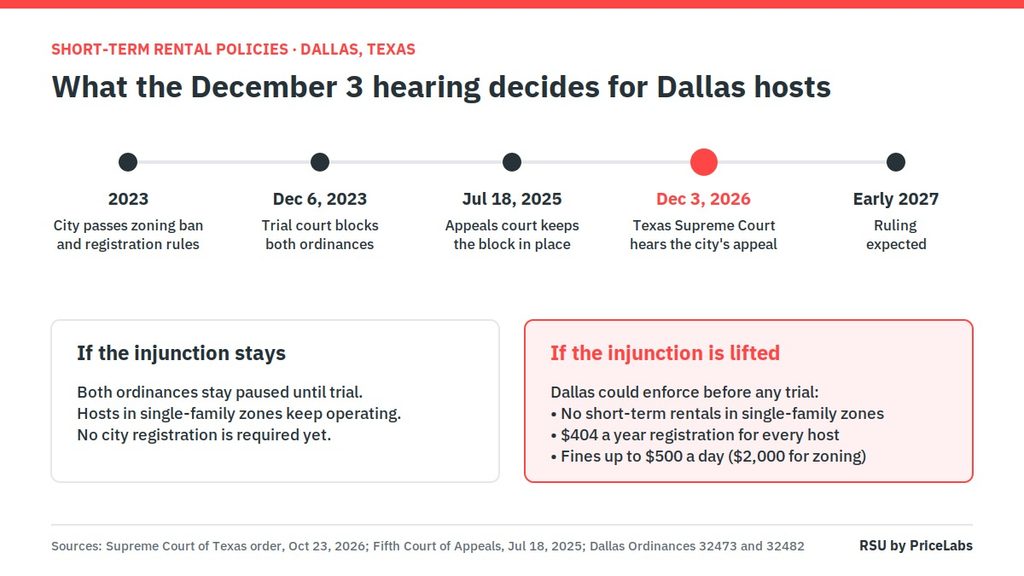
- On October 23, 2026, the Texas Supreme Court agreed to hear the City of Dallas’s appeal against the Dallas Short-Term Rental Alliance and a group of owners. The court’s order list sets oral arguments for 9 a.m. on December 3.
- The case covers two 2023 ordinances. Ordinance 32482 allows short-term rentals only in multifamily, mixed-use, commercial, central area, urban corridor and office zoning, which leaves out single-family districts. The hosts and owners suing the city say that would remove about 95% of the city’s short-term rentals.
- Ordinance 32473 sets the operating rules. Registration would cost $404 a year, with a two-night minimum stay, three guests per bedroom and 12 in total. Platforms could not collect a fee on a booking without a valid registration number, a platform-side check Austin already enforces. Fines run up to $500 a day, and up to $2,000 under the zoning ordinance.
- A trial court blocked both ordinances with a temporary injunction (a court order that pauses a law while a lawsuit runs) on December 6, 2023. On July 18, 2025, the Fifth Court of Appeals kept the injunction in place for the Alliance and three owners. It found they had shown enough, at this early stage, on their claim that the ordinances take away property rights protected by the Texas Constitution.
- The Supreme Court will decide whether the injunction stays until trial. It is not ruling on whether the ordinances are legal.
- What hosts need to do now: Nothing new. The city still cannot enforce either ordinance. If the injunction is lifted, hosts in single-family zones would lose the right to operate, and every host would need to register. A ruling is expected in early 2027.
Guneet’s Views
- Dallas hosts in single-family neighborhoods could lose 2027 bookings before any trial: If the Supreme Court lifts the injunction, the city could enforce the ban while the lawsuit is still running.
- Managers with Dallas listings could check which units are in single-family zones and how many 2027 nights are already booked there. Those bookings would be at risk if enforcement starts early.
- Dallas is one of several US cities fighting over residential zoning in court: A federal appeals court upheld New Orleans’s one-per-block limit in August, and Pittsburgh has debated similar limits for off-site owners in residential zones. In Texas, Corpus Christi’s proposed 200-foot spacing rule is already waiting on the outcome.
- Other Texas cities, including Corpus Christi, will likely read the ruling as a signal of how far they can restrict rentals in residential neighborhoods.
Read more: Santa Barbara’s inland ban
Croatia Bill Would Extend Temporary Permits to 2030 and Keep Company Permits Out of Apartment Buildings
- On October 21, 2026, Croatia’s government sent its final Hospitality Activity Act to Parliament for a second reading.
- Parliament has not voted yet, and a vote is expected in November.
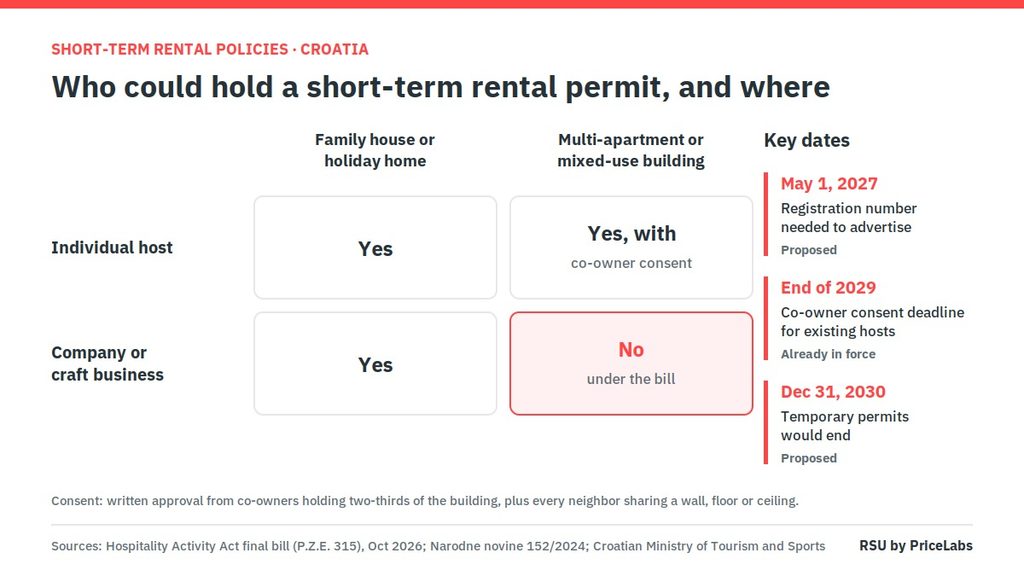
- Companies and sole traders could not get permits for units in apartment buildings or mixed residential and business buildings.
- Hosts in shared buildings already need written co-owner consent from owners holding two-thirds of the building, and existing hosts have until the end of 2029 to get it.
- Temporary permits, held by about 15,000 hosts, would be extended to December 31, 2030.
- Every listing would need a registration number from May 2027, or platforms could be ordered to remove it.
- Fines for registration offenses would run from €2,000 to €6,600 for hosts and from €10,000 to €66,000 for companies.
- What hosts need to do now: Nothing until Parliament votes, apart from the 2029 consent deadline already in law.
Guneet’s Views
- Managers running Croatian units through a company could lose permits in apartment buildings: If the bill passes as drafted, a company permit would not cover those units.
- Managers could check which units sit in apartment buildings and whose name each permit is in.
- Poland’s cabinet approved a similar building-level ban bill in September.
- Listings without a registration number could be removed from platforms from May 2027: Inspectors could order removal whatever the unit’s permit status.
- Managers could check which listings would still lack a number by spring 2027.
Read more: Croatia’s registry rollout
Mexico’s Supreme Court Will Review Mexico City’s 50% Occupancy Cap
- On October 28, 2026, Mexico’s Supreme Court voted unanimously to take over a challenge to Mexico City’s short-term rental rules.
- The case is an amparo, a lawsuit claiming a law breaks constitutional rights, in this case freedom of commerce and the right to housing.
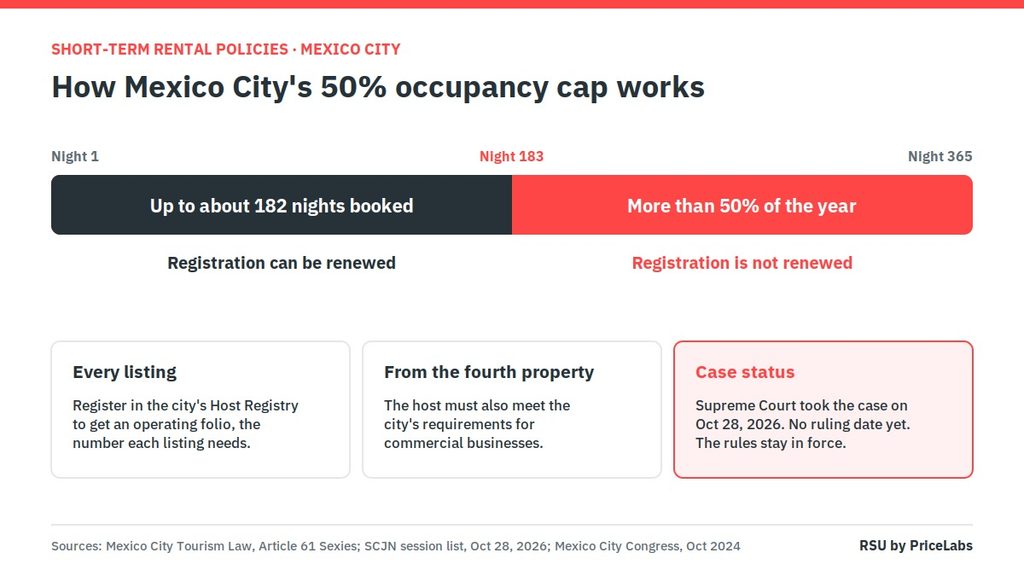
- Under the rules, a property’s registration is not renewed if it was booked on more than 50% of the year’s nights, about 182.
- Every listing needs an operating folio, a registration number from the city’s Host Registry.
- From a fourth property, a host must also meet the city’s rules for commercial businesses.
- Mexico City’s Congress approved the cap in October 2024, and Airbnb filed its own challenge in January 2025.
- What hosts need to do now: Keep following the current rules. They stay in force while the court decides, and no ruling date is set.
Guneet’s Views
- Hosts who pass about 182 booked nights could lose their registration at renewal: The penalty arrives at the end of the registration year, not on the night the cap is passed.
- That makes booked nights the limit on what a unit can earn in a year.
- Byron Bay listings fell 15% after a 60-day cap, though researchers say it is too early to judge.
- Managers could check which units are on pace to pass 182 nights and how much of their remaining availability is already sold.
- The ruling decides whether the cap survives: It will set national precedent on how far Mexican authorities can regulate rental platforms.
- The challengers call the rules a three-property cap.
- The law allows more than three properties, but adds business licensing requirements from the fourth.
- Managers with four or more units could check that each unit’s filings are current, since those rules apply until the court decides.
Read more: Mexico City enforces registration

Stay on top of short-term rental regulation trends and what they mean for your listings.

Guneet has spent five years working at PriceLabs, developing deep expertise in short-term rental operations and hospitality technology. She brings that practitioner’s lens to her writing at RSU, covering platform updates and making sense of market data for property managers.
Related Articles:
 Lisbon Imposes Bans and New Limits, Mabrian Launches Rental Monitoring Tool, and Airbnb Reboots Experiences
 Survive the EU Short-Term Rental registration Deadline: What Managers Must Do Next
 Los Angeles Eyes Olympics Airbnb Deal, Santa Ana Court Voids Ban, Saratoga County Imposes Registry and Tax
 Spain Reissues Housing Decrees, Alameda Advances Primary-Residence Rule, Regulatory Worry Increases