

If your Booking.com bookings felt slower this spring, the platform’s Q3 numbers suggest it was a dip, not a decline. Alternative accommodation room nights grew 7%, nearly double the pace of Q2.
The catch is that more listings are chasing that demand, and Booking Holdings is preparing for a quieter end to the year. Below, I go through what its Q3 2026 results mean for your vacation rental pricing, calendar and listings, and where I think the numbers point next.
Booking.com’s Alternative Accommodation Room Nights Grew 7%, Back in Step With Booking Overall
Alternative accommodations made up about 37% of Booking.com’s room nights in Q3, about one point more than a year earlier. Booking says growth sped up in all its major regions.
A note on terms: I use “alternative accommodations” because it is Booking’s own category. In its annual report, Booking describes this supply as homes, apartments and other unique places to stay, often single units or small collections of independent units. So it covers more than short-term rentals alone.

Alternative accommodations caught up with the rest of Booking
| Q2 2026 | Q3 2026 | |
|---|---|---|
| Booking.com alternative accommodation room nights | +4% | +7% |
| Booking Holdings total room nights | +5% | +7% |
In Q2, according to Booking’s Q2 results, alternative accommodations grew slightly slower than the company overall. In Q3, they matched it.
It looks like alternative accommodation demand on Booking.com tends to move with travel demand in general. So a slow quarter on the platform is a reason to watch your pace closely, not necessarily to drop prices straight away.
More listings are competing for each booking
Alternative accommodation listings grew 9%, faster than room nights. When supply grows faster than demand, each listing gets a slightly smaller share of bookings on average.
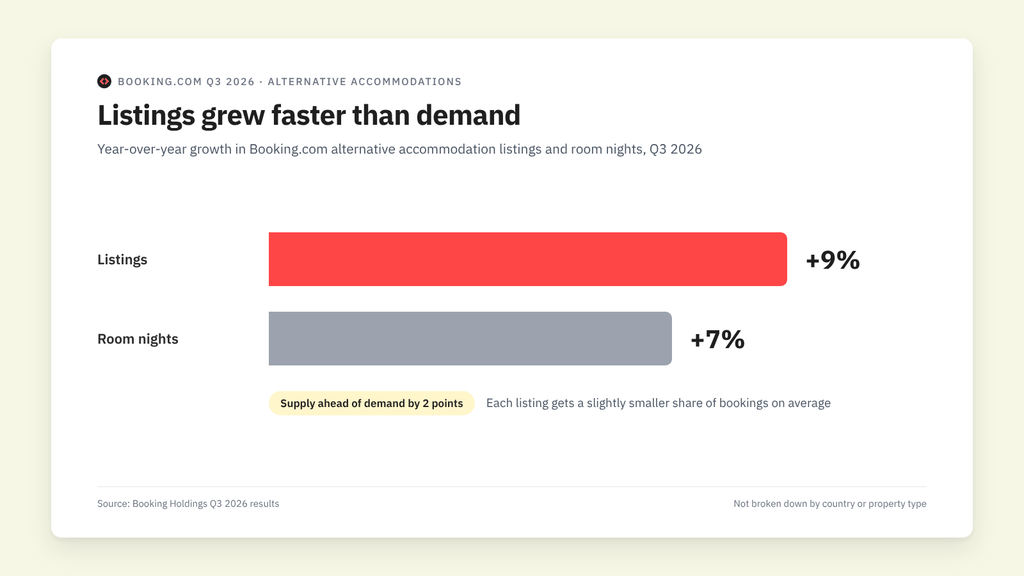
Booking doesn’t break that 9% down by country or by property type. So it isn’t clear which markets the new listings are in, or how much of the growth is short-term rentals versus other kinds of alternative accommodations.
How to tell if it’s affecting you
Comparing your Booking.com occupancy and pickup with the same period last year, market by market, is the quickest check. If your bookings are flat while the number of listings in your area keeps growing, more competition is the likely explanation.
What helps you stand out
When more listings compete for the same guests, the things you control carry more weight in winning the booking:
- Reviews: both your score and how many you have.
- Listing completeness: photos, amenities, policies and descriptions filled in.
- Genius: whether you offer Genius rates to Booking.com’s loyalty members.
Guests Are Taking Shorter Trips Closer to Home: What That Means for Winter Pricing
Across Booking Holdings, domestic room nights grew by a high-single-digit percentage in Q3, while international room nights grew by a mid-single-digit percentage. Higher airfares and fewer flights on some routes, linked to the conflict in the Middle East, are still holding back long-haul trips.
Demand is rerouting, as it did earlier this year
RSU’s Q1 coverage argued that travel demand rarely disappears; it reroutes. Booking now describes the same pattern heading into Q4: domestic travel is holding up as guests take shorter trips to places closer to home.
For hosts, that favors drive-to destinations and domestic guests this winter. Markets that rely on long-haul visitors may see softer demand, which makes it worth watching pace before discounting.
Rerouting has its limits
When flying got more expensive, many guests still traveled, they just drove instead. But driving is getting more expensive too. The US average price of regular gas was about $4.41 a gallon on October 1, up from $3.16 a year earlier and the highest on record for that time of year, according to AAA.
In my view, if fuel and airfares stay this high, the pressure will eventually reach domestic, drive-to travel as well. The softness Booking expects in Q4 could carry into next year, which makes it worth building some caution into 2027 forecasts for drive-to markets, even as the early 2027 bookings look healthy.
What changed in how guests book
- Prices: average daily rates rose about 3%, excluding exchange-rate swings, led by Europe.
- Booking windows: slightly longer in Europe, a little shorter in the US.
- Length of stay: longer than a year ago outside Asia.
Longer stays and higher rates are good news for revenue per booking. The shorter US booking window means more reservations arrive close to check-in, so last-minute pricing and minimum-stay rules carry more weight for US hosts.
Q4 looks slower, 2027 looks healthier
Booking Holdings expects Q4 room nights to grow just 1% to 3%. Q4 2025 was its strongest quarter of growth last year, so this year’s Q4 is measured against a high bar. Booking also cites travel disruption around the Middle East and localized unrest in some European cities.
Looking further out, the CFO said bookings already made for the first half of 2027 look healthy, while calling it an early indicator that could change with cancellations. It seems to me that is a useful signal before cutting next year’s rates too early.
US Hosts: Growth Is Slowing, but Booking Is Still Investing to Win You Over
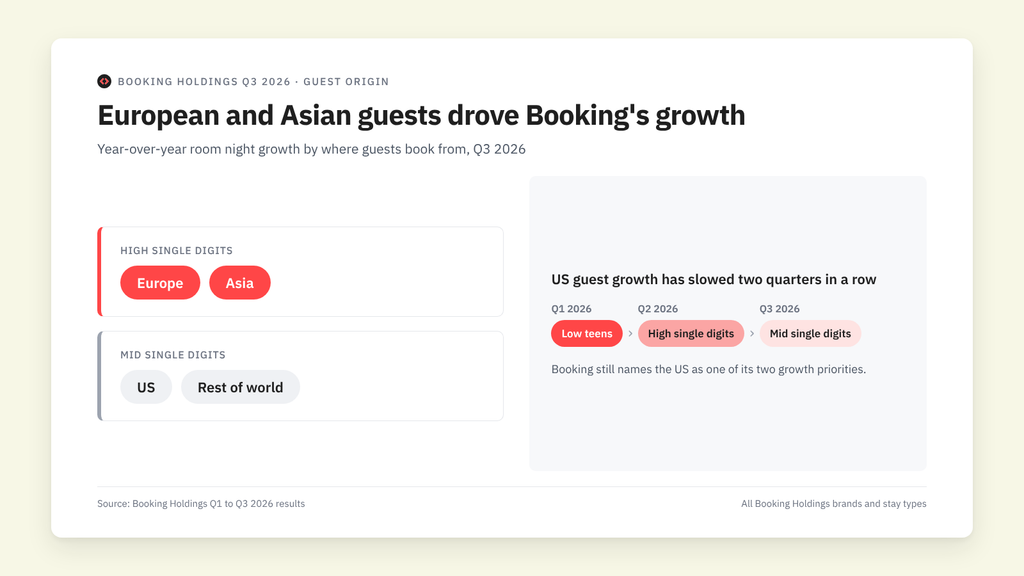
Booking Holdings reports growth by where guests book from. Room nights from US guests grew by a mid-single-digit percentage in Q3, slower than the high single digits in Q2 and the low teens in Q1.
| Where guests book from | Q3 2026 room night growth |
|---|---|
| Europe | High single digits |
| Asia | High single digits |
| US | Mid single digits |
| Rest of world | Mid single digits |
These figures cover all Booking Holdings brands and stay types, not just alternative accommodations.
The US remains one of Booking’s two priorities
In its prepared remarks, Booking named the US and Asia as its two key growth priorities and said it still sees significant room to grow in the US. It has invested in product, supply, brand and marketing there, and reported another quarter of growth in US guests booking directly with it.
It appears to me that winning in the US takes more than adding supply. The more listings Booking.com has, the harder it is for a guest to find the right one, and too many similar options can lead to choice fatigue rather than a booking. That makes Booking’s investment in AI search, which it says helps travelers explore destinations in more detail, as important as the inventory itself.
For hosts, the practical point is that these tools match guests to properties using your listing details. The clearer your listing is about who it suits and what it offers, the better your chances of being shown to the right guest.
What it means for your channel mix
- If you’re a US manager not yet on Booking.com, this is a platform actively trying to win US supply, which may make it a good time to test it on part of your portfolio.
- If you’re already on it, it is worth tracking whether Booking.com’s share of your bookings is changing compared with Airbnb and Vrbo.
- If you host international guests, Booking.com’s reach in Europe and Asia is where its growth is coming from.
Booking Pitches Its Commission as Marketing for Independent Hosts: How to Weigh That Claim
Booking says independent hotels and alternative accommodations make up the vast majority of Booking.com’s room nights, with the ten largest global hotel chains accounting for only a low-double-digit percentage.
Booking’s argument
Booking’s case is that small properties can’t market themselves globally on their own, so its commission pays for reach they couldn’t easily buy. Partners pay “only when they earn revenue for a room that might otherwise have gone empty,” and the fee also covers payments and customer service in over 40 languages.
Testing it against your own costs
In my view, the fairest way to test that argument is to compare the commission with what it would cost you to reach the same guest yourself:
- A first-time guest from another country: reaching them through your own website or ads is often expensive, so the commission may well be the cheaper option.
- A repeat or local guest who already knows you: the commission rarely beats a direct booking.
Genius Guests Are Booking.com’s Fastest-Growing Customers: What That Means for Your Rates
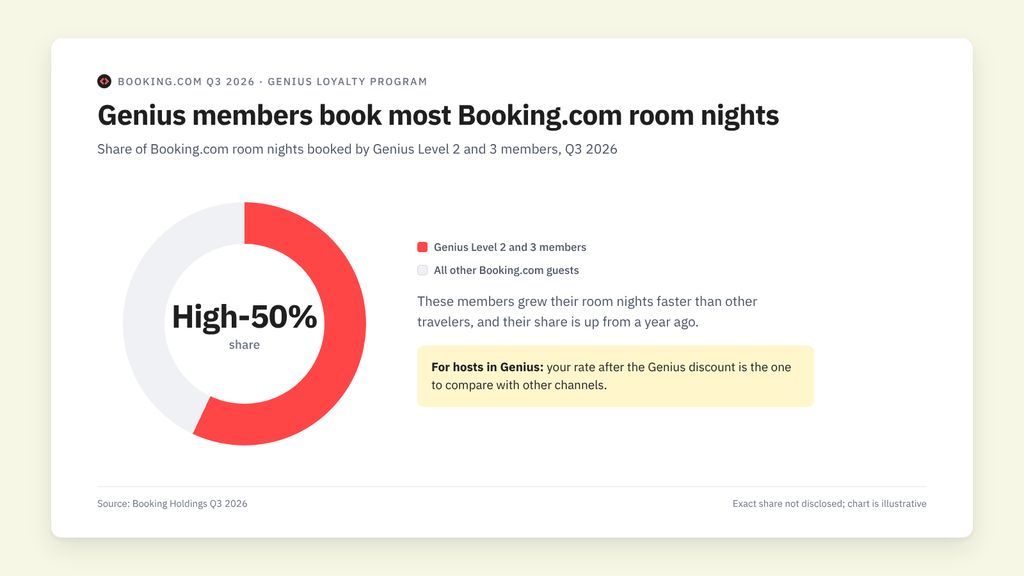
Guests who book directly, use the app and belong to Genius Levels 2 and 3, the loyalty program’s higher tiers, grew their room nights “meaningfully faster” than other travelers, Booking says. Genius Level 2 and 3 members now book a high-50% share of Booking.com’s room nights, up from a year ago.
Your Booking.com rate is increasingly your Genius rate
If you take part in Genius, most of your Booking.com guests are likely paying the discounted rate. That makes your rate after the Genius discount the number to compare against your rates on other channels.
Booking also says it plans to bring flights, attractions and other trip extras together through Genius. It seems to me the program is becoming more central to how Booking.com wins repeat guests, which makes taking part in it harder to skip.
Booking is collecting more guest payments, and that has (some) upsides for hosts
Across Booking Holdings, about 75% of gross bookings were merchant bookings, up about three points from a year earlier. In a merchant booking, the platform collects the guest’s payment and pays the property.
For hosts, that means payouts on Booking’s schedule rather than chasing guests’ cards. It may also play a part in reducing scams. The EU’s investigation into Booking.com covers several issues, including fake listings and how scammers use messaging to request payments. When more guests expect to pay through the platform, a payment request sent outside it is easier to recognize as suspicious.
AI Sends Booking.com Few Guests So Far, but That Number Misses Your Direct Bookings
Referrals from AI chatbots such as ChatGPT are still well under 1% of Booking.com’s room nights, but Booking says they accelerated over the last several weeks. Some of that comes from ChatGPT citing Booking.com more often, and some from Booking’s paid partnership with OpenAI.
The blind spot for direct-booking managers
As we pointed out in August, Booking’s figure only counts guests who come from an AI tool and book on Booking. A guest who researches a stay with ChatGPT and then books on your own website never shows up in it.
So the low number doesn’t mean AI isn’t sending guests to vacation rentals. If you take direct bookings, your own referral data, including bookings with no clear source, is the better place to look.
Booking’s pitch: we’ll get you into AI tools
On the call, Booking’s CFO said AI assistants prefer to work with aggregators like Booking rather than connect to millions of properties directly. Booking Holdings is also combining the units that sell its inventory to other businesses, such as banks and airlines, into one business launching on January 1.
That is Booking’s framing, and part of its pitch to properties: list with us and you’ll show up in AI tools without building that reach yourself. It is plausible, since plugging into one aggregator is easier for an AI company than connecting to millions of properties. But AI companies are still working out how they will make money from travel, and it seems to me that large partners who can pay for prominent placement are likely to benefit first.
What it means if you have a direct booking website
For managers with their own website, being on Booking.com may help you appear in AI answers, but on Booking’s terms and at its commission. Your own site’s visibility in AI tools is still worth building, since AI-referred guests who book with you directly cost you no commission.
Booking Holdings is also testing new AI products, including Vayo, which reads booking confirmations from travelers’ inboxes. RSU looks at what that means for direct bookings in a separate article.
Why Booking Holdings’ $1 Billion Priceline Charge Is a Reminder to Know Where Your Listings Appear
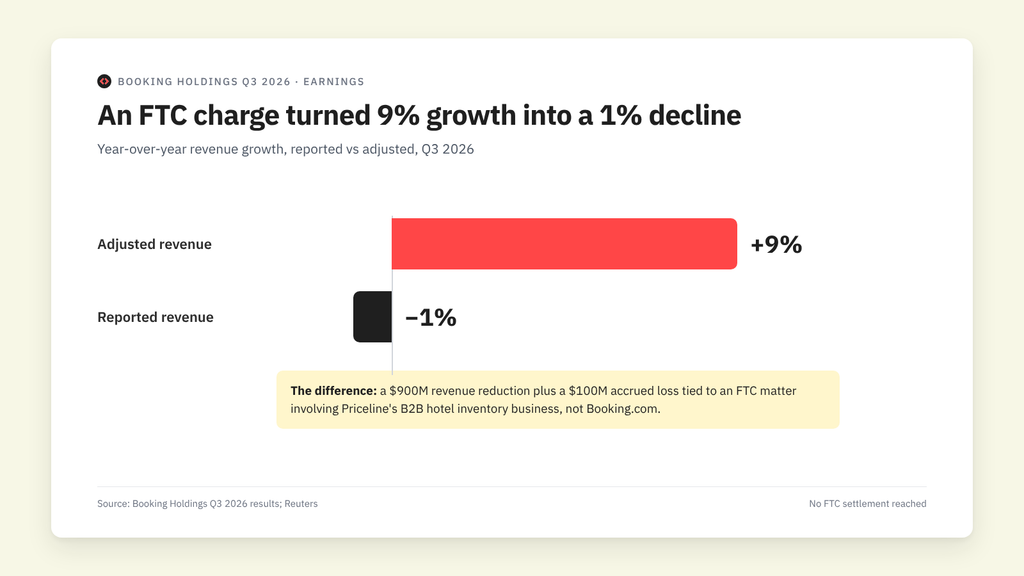
Booking Holdings recorded a $900 million reduction in revenue and a $100 million accrued loss for a Federal Trade Commission (FTC) matter, according to its Q3 results. That is why reported revenue fell 1% while adjusted revenue, which excludes the charge, grew 9%.
The case is not about Booking.com. According to Reuters, it concerns Priceline’s business supplying hotel inventory to a third-party booking site, where many guests said they thought they were booking with the hotel directly. Booking says it is in talks with the FTC and no settlement has been reached.
What it means for hosts
With Booking Holdings merging its B2B units in January, more inventory is likely to be resold through partner sites. It seems to me worth knowing where your listings can appear, because a guest confused about who they booked with may still bring that frustration to your check-in or your reviews.
What Hosts Can Take From Booking.com’s Q3
- One slow quarter is not a trend. Alternative accommodation growth on Booking.com dipped to 4% in Q2 and came back to 7% in Q3, in step with travel overall.
- Demand reroutes more than it disappears. When long-haul travel gets harder, guests take shorter trips closer to home, which favors drive-to and domestic markets this winter.
- Competition is rising faster than demand. With listings up 9% and room nights up 7%, reviews, complete listings and Genius pricing do more of the work of winning bookings.
- Your Booking.com rate is your Genius rate. With Genius members booking most of Booking.com’s room nights, the discounted rate is the one to measure against other channels.
- Judge the commission against your cost to reach the same guest. For international guests, Booking.com is often the cheaper way in; for repeat guests, it rarely is.
- Platform numbers don’t show your direct demand. AI-referred guests who book with you directly are invisible in Booking’s figures, so your own data matters.
FAQs
How much did Booking.com’s alternative accommodations grow in Q3 2026?
Alternative accommodation room nights on Booking.com grew 7% year over year in Q3 2026, up from 4% in Q2. Listings grew 9%.
What share of Booking.com’s bookings are alternative accommodations?
Alternative accommodations, which include vacation rentals, apartments, B&Bs and other non-hotel stays, made up about 37% of Booking.com’s room nights in Q3 2026.
Is Booking.com still growing in the US?
Yes, but more slowly. Booking Holdings’ room nights from US guests grew by a mid-single-digit percentage in Q3 2026, compared with high single digits from European and Asian guests. Booking still names the US as one of its two growth priorities.
What does Booking Holdings expect for Q4 2026?
Booking Holdings expects Q4 2026 room nights to grow 1% to 3%, with domestic travel holding up as guests take shorter trips closer to home.
Why did Booking Holdings’ revenue fall in Q3 2026?
Reported revenue fell 1% because of a $900 million reduction tied to an FTC matter involving Priceline. Excluding it, adjusted revenue grew 9%.

Guneet has spent five years working at PriceLabs, developing deep expertise in short-term rental operations and hospitality technology. She brings that practitioner’s lens to her writing at RSU, covering platform updates and making sense of market data for property managers.
Related Articles:
 Booking.com rolls out Tools and Funding Support for Easier Sustainability Certification
 Goliday Expands to the UK, Edinburgh’s Temporarily Relaxes Regulations, Booking.com’s Top Welcoming Cities for 2025
 Airbnb Launches Co-Host Marketplace in Japan, Vrbo to Delist Poor Listings, Booking.com Bets Big on India and AI
 Booking.com Has Spent Four Years Being the Underdog in US Vacation Rentals, and It’s Tired of It