Five days before Airbnb’s Summer Release, the filter bar is already on its way to being replaced in the US.
Airbnb’s natural-language search appeared in a US browser session this week, ahead of the company’s May 20 Summer Release. The feature has not been formally announced. Property managers may want to look at their listings before the keynote anyway — what sits behind the new search bar changes how the algorithm reads a listing description, and the change is already live for at least some US users.
What is running in the US five days before the announcement
What the interface actually does
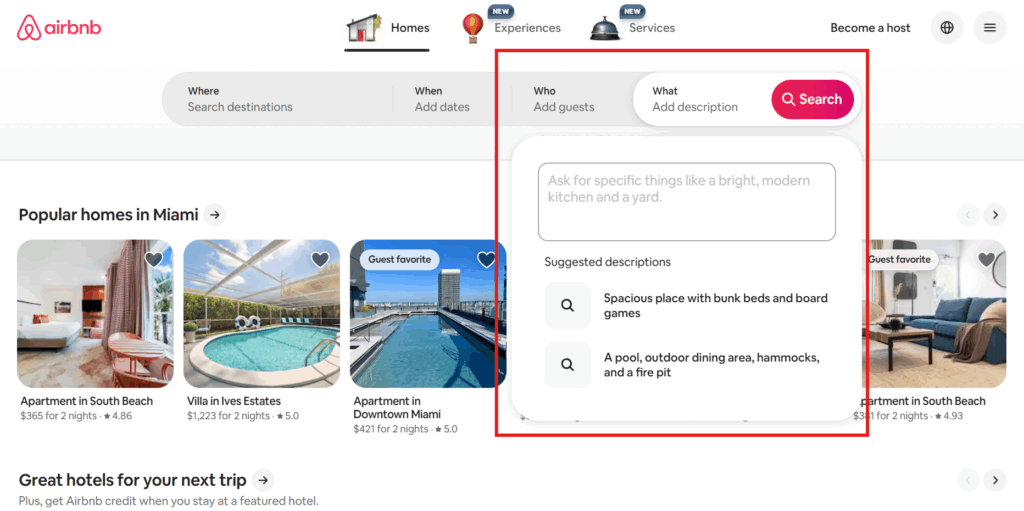
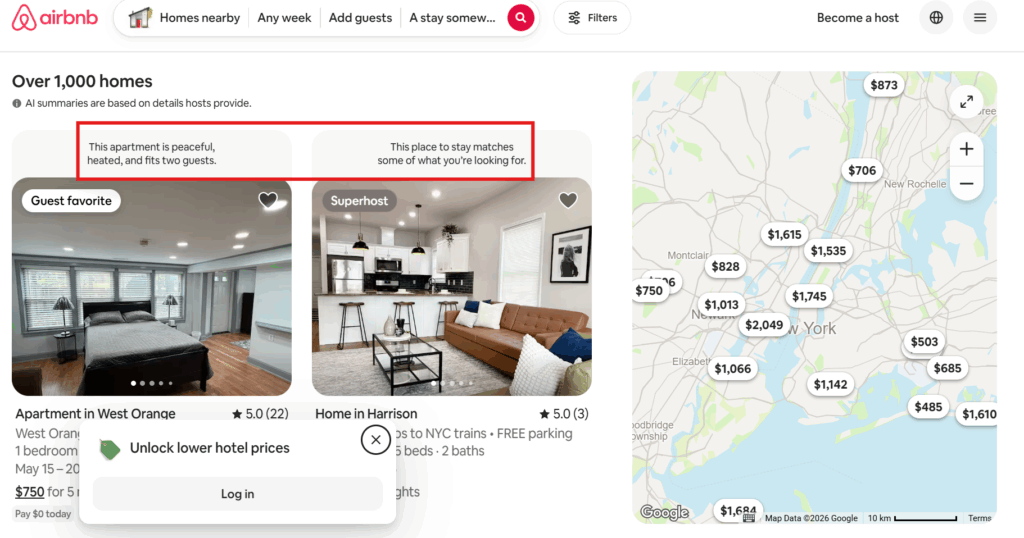
The traditional filter bar has been replaced, in this session, by a single field labelled “What / Add description,” accompanied by suggested prompts such as “Spacious place with bunk beds and board games” and “A pool, outdoor dining area, hammocks, and a fire pit.” On the results page, listing cards now carry short AI-generated summaries — for example, “This apartment is peaceful, heated, and fits two guests” — flagged as derived from host-provided details.
What Chesky actually said on the Q1 2026 call
On Airbnb’s Q1 2026 earnings call, CEO Brian Chesky was skeptical that chatbot-style travel search had been solved by general-purpose AI. He argued that travel and ecommerce need more than text — photos, maps, comparison tools, group decision-making, trust infrastructure — and framed Airbnb’s own AI opportunity as a chance to redesign the travel interface around personalization. Airbnb did not preview the consumer-facing interface on the call. What is new is that the first surface in that direction has now appeared, ahead of the formal May 20 release window the company has confirmed.

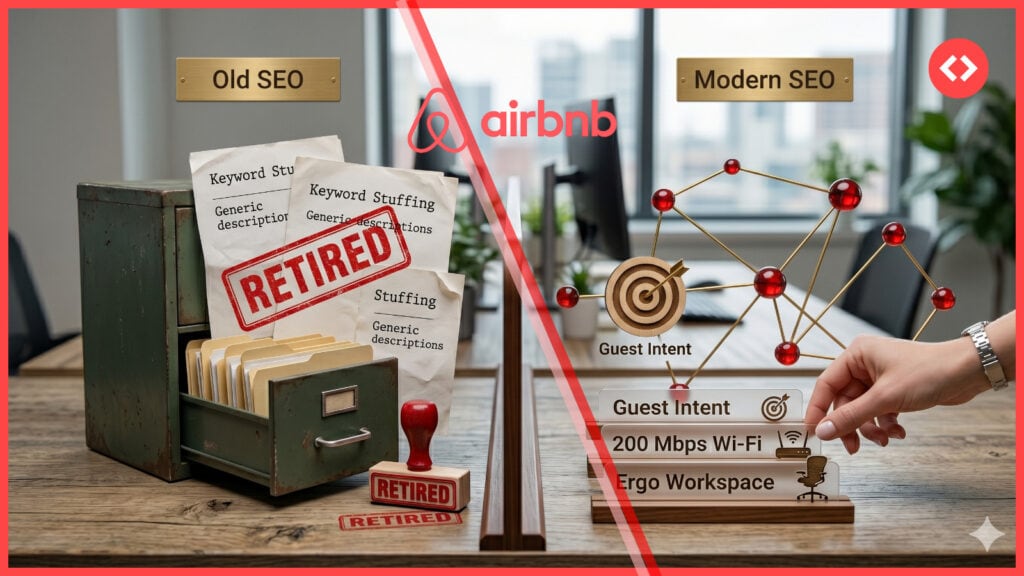
The keyword optimisation playbook is being quietly retired
Filter logic and language-model logic reward different things
For property managers, the news is not the interface. It is what the interface implies about how listings get ranked. Filter-bar logic rewards listings whose titles and descriptions contain the exact strings a guest typed. A natural-language bar — backed by a language model parsing the host’s copy — rewards listings the model can read with confidence.
AI readability rewards specific, factual copy
This is the shift to AI readability. The optimisation question is no longer “which keywords appear in my title.” It is “what does a language model conclude about my property when it parses my listing copy.” Generic marketing language — “stunning views,” “perfectly located,” “your home away from home” — is increasingly noise. Specific, factual, parseable detail — broadband speed in Mbps, the exact bed configuration in each room, walking distance to the nearest station, whether the workspace has a second monitor — gives the model the signals it needs to surface a listing against a specific conversational query.
The model already knows the guest, not just the query
This is the second half of the shift, and it tracks directly with Chesky’s Q1 framing. If Airbnb’s AI opportunity is a redesign around personalization, then the ranking layer is not just matching a query to a listing. It is matching the platform’s model of the guest — built on years of first-party data, verified identities, and historical booking behaviour — to a listing. The natural-language query is the surface input.
Underneath, the model is ranking listings against an inferred guest profile: prior trips, behavioural patterns, stated and unstated preferences. The implication for hosts is that a listing needs to say not only what it is but who it fits. “Long-stay corporate guests,” “families with toddlers,” “dog owners,” “remote workers who care about workspace ergonomics” — these are the signals the model needs to match a listing against a guest it already knows.
The listings that surface first will be the ones that read as data
Three checks before May 20
Three things worth doing before the announcement. First, whether your description contains specific amenity facts a language model can extract — not “fast wifi” but a speed figure, not “great for remote work” but the desk dimensions and monitor setup. Second, whether you have described who the property fits — remote workers, families with toddlers, dog owners, long-stay corporate guests — in language the model can map to a guest profile, not just a query string. Third, whether your title is doing factual work or just running keywords.
The Summer Release is the announcement. The shift is already live.
The natural-language interface is the headline. The personalization layer underneath it is the story. The first cohort of listings that surface well on conversational queries will be the ones whose descriptions already read as data — and as a description of the guest who fits.

Uvika Wahi is the Editor at RSU by PriceLabs, where she leads news coverage and analysis for professional short-term rental managers. She writes on Airbnb, Booking.com, Vrbo, regulations, and industry trends, helping managers make informed business decisions. Uvika also presents at global industry events such as SCALE, VITUR, and Direct Booking Success Summit.