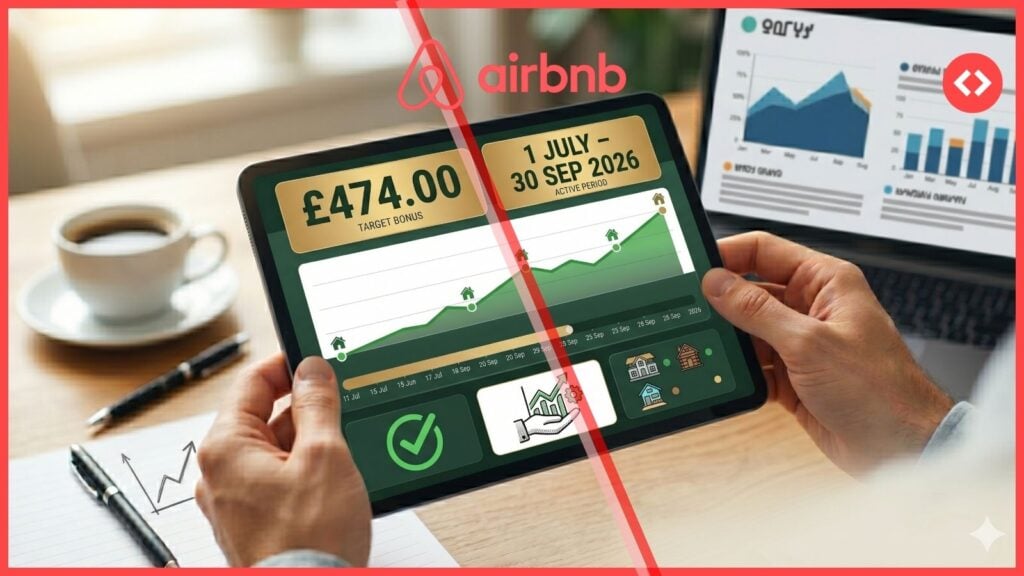
Airbnb has started paying a selected group of UK hosts cash bonuses to hit personalised summer targets. Worth asking, before July: what is the platform seeing in its forward bookings that makes those cheques worth writing?
In early May 2026, UK-based Airbnb hosts began receiving emails inviting them into the Airbnb Host Rewards Challenge. The programme runs from 1 July through 30 September 2026 and pays personalised cash rewards for hitting bespoke hosting targets. One invite reviewed by RSU carried a £474 figure. Registration closed on 7 May. The programme is invite-only and the selection criteria have not been disclosed by Airbnb.
Every previous version of this programme was off-peak
The Challenge belongs to a documented family of supply incentives Airbnb has run across multiple markets — listed in the help centre as Active Available Supply Incentive Reward Promotions. The closest direct analog is the 2025–2026 Active Available Supply Incentive Reward Promotion, which ran across Australia, France, Italy, Mexico, Spain, and the UK from 22 September 2025 through 31 January 2026. It paid a flat $200 USD for keeping a minimum of 130 business hours of availability through 31 December, plus a further $150 if availability held through 31 January. Any qualifying host could opt in. There were no personalised targets and no per-host scoring. The reward was the same for everyone who hit the same threshold.
The same logic governs the other documented versions: the Q1 Active Available Supply Incentive, the Q4 version, the Los Angeles iteration, the services version in Palm Springs and Tulum. Flat rate. Availability-based. Open opt-in. Every documented version has run during off-peak windows — the months Airbnb’s marketplace structurally needs help because demand is thin.

Airbnb Host Rewards Challenge vs. documented precedent
| Previous programmes | Airbnb Host Rewards Challenge | |
| Timing | Off-peak (Sept–Jan, Q1, Q4) | Peak season (July–Sept) |
| Reward | Flat rate — same for all hosts | Personalised — derived from each host’s account |
| Target | Availability hours — show up, earn | Performance targets — outperform Airbnb’s model of you |
| Eligibility | Open opt-in for any qualifying host | Invite-only — selection logic undisclosed |
| Documentation | Help centre articles published | No public help article, no newsroom post |
Peak-season cash is a different signal than off-peak cash
The Airbnb Host Rewards Challenge breaks every part of that pattern.
- Timing. It runs July through September. There is no documented case of Airbnb paying UK hosts to perform better during the summer peak in this programme family. Paying hosts to stay available in January closes a structural supply gap. Paying hosts to perform better in July is a different proposition — it presumes the peak itself is not delivering, and it puts cash behind that presumption.
- Reward shape. Each invited host has been quoted a personalised figure derived from inputs Airbnb has not specified. The £474 in the observed invite is one host’s number, not a programme-wide rate.
- Selection. Open opt-in programmes signal a platform that wants more supply across the board. Invite-only signals a platform that has identified a specific cohort it wants to move and has decided that cohort is worth paying to move.
The combination — peak window, personalised reward, undisclosed selection, no public announcement — fits one coherent reading. Airbnb’s earlier incentive design was structural: keep the marketplace liquid in the months demand thins out. The Airbnb Host Rewards Challenge’s design is corrective: close a gap that should not exist in the months demand peaks. That is not how a platform spends money when its forward booking data is healthy.
The interesting fact is not the cheque. It is that the cheque exists at all.
If your market is next, your forward pacing may be lagging
For property managers in adjacent markets — France, Spain, Italy, Portugal, the Netherlands — the editorial point is not whether the Challenge will reach your portfolio. It almost certainly will, in some form. The point is that Airbnb now operates a per-host underperformance score, is willing to act on it, and is willing to spend money on summer demand it cannot rely on producing organically. If you are not seeing softness in your own pacing yet, you may be looking at a lagging indicator.
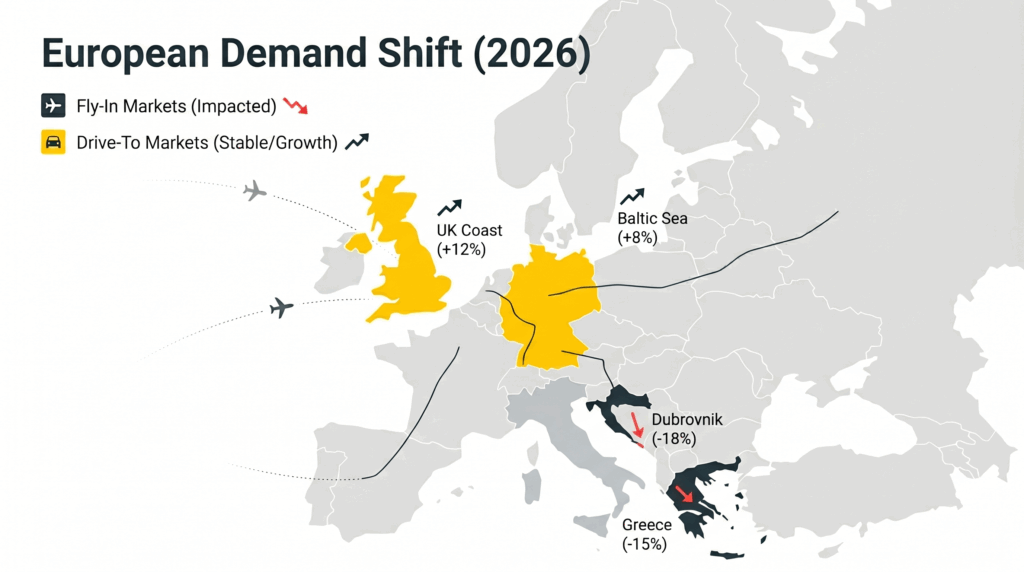
The wider picture supports the read. The 2026 jet fuel crisis, driven by the Strait of Hormuz blockade that began in February, has more than doubled fuel prices and is reshaping where European leisure demand flows. Fly-in destinations such as Greece, where 84% of overnight stays arrive by air, and Croatia’s Dubrovnik, where 80% of visitors fly in, face measurable forward booking pressure. Drive-to markets — UK coastal, German Baltic and Bavarian, French rural — are absorbing some of that redirect, but unevenly. On the consumer side, the University of Michigan Consumer Sentiment Index fell to a record low of 49.8 in April 2026, and the U.S. Travel Association reports only 34% of consumers currently view this as a good time to spend on leisure travel.
Airbnb is not making this bet on a strong summer. STR demand in FIFA 2026 World Cup host cities is already showing strain, with new pickup slowing to 1–2% per week despite flat or shrinking supply — pointing to demand friction, not oversupply. Operators in the markets Airbnb spends in next should treat that as a forward signal — and check their own pacing before July, not after.
If the Challenge reaches your portfolio, the operational logic is straightforward. If hitting the target requires a peak rate cut, the cash reward is funding the loss the rate cut creates. The decision should rest on your own forward data — not on Airbnb’s framing of what a win for you looks like.
And if you want to understand what else the platform is building before July, we analysed 236 open Airbnb job postings to map its summer 2026 roadmap — the hiring patterns point to changes that will matter well beyond this incentive programme.

Guneet has spent five years working at PriceLabs, developing deep expertise in short-term rental operations and hospitality technology. She brings that practitioner’s lens to her writing at RSU, covering platform updates and making sense of market data for property managers.