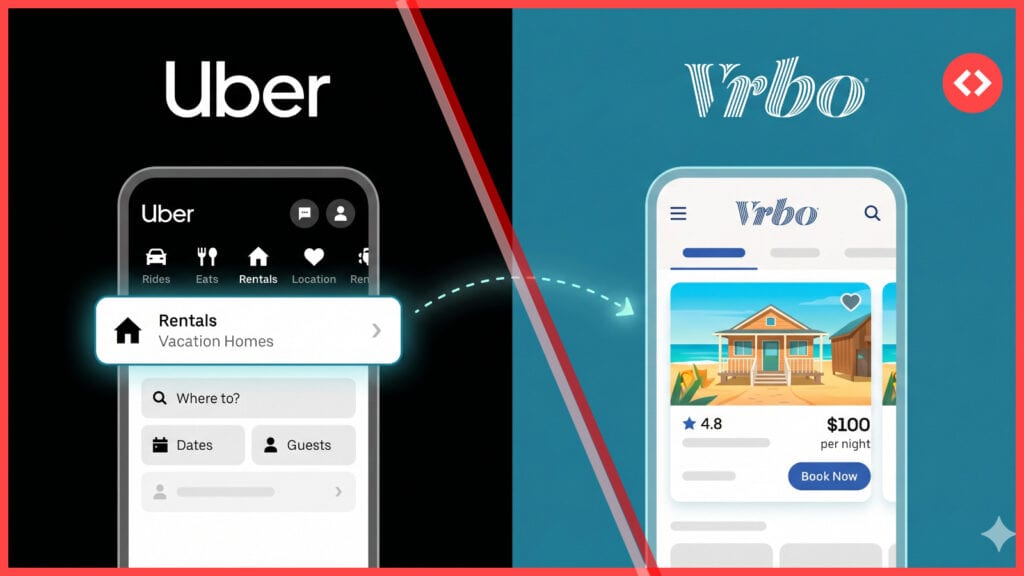
The Vrbo Uber integration is confirmed. Uber’s app will surface Vrbo vacation rentals later in 2026, as the second phase of an exclusive partnership with Expedia Group that launches with hotels first. Bookings happen inside the Uber app — no redirect, no external platform — with Expedia powering the inventory through its B2B distribution network in the background. The deal is two-way: Uber rides also appear inside the Expedia app. One month earlier, Airbnb integrated Welcome Pickups into its own app. The two announcements together draw the clearest picture yet of where the two dominant vacation rental platforms are betting travel distribution is heading.
Uber Will Surface Vrbo Listings Later This Year
The GO–GET 2026 announcement confirmed the Expedia Group partnership, giving Uber users access to more than 700,000 hotel properties at launch, with Vrbo vacation rentals added later this year. The Vrbo Uber integration positions Uber as a new demand channel for short-term rental supply — one that operates at a scale no traditional OTA currently matches.
The deal runs both ways. Uber rides surface inside the Expedia app, and Vrbo rentals will surface inside Uber. Both companies are building superapp functionality simultaneously, each expanding into the other’s territory without replicating the other’s core product. That two-way structure is what separates this from a standard distribution agreement — and what makes the contrast with Airbnb’s strategy so sharp.
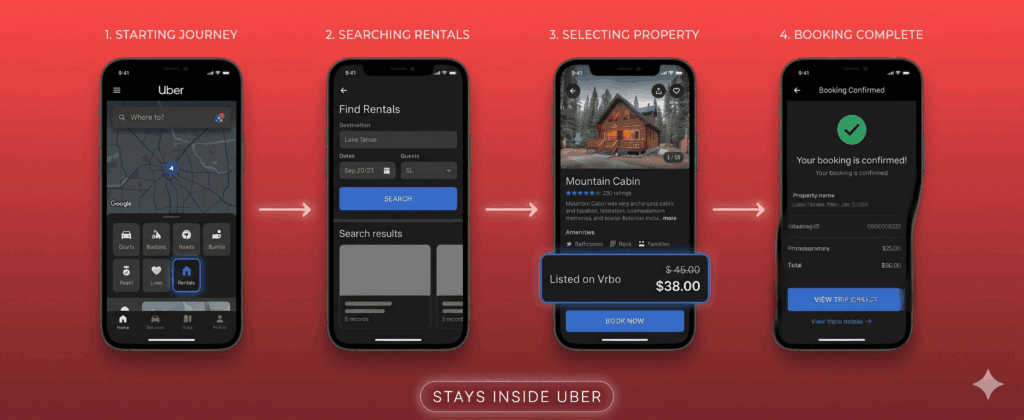
Bookings Stay Inside Uber — Expedia Runs the Back End
How the transaction works
Uber One members get 20% off a rotating selection of 10,000 hotels and 10% back in Uber credits on all bookings. The accommodation tab sits inside the Uber app alongside rides, food delivery, and reservations. When Vrbo listings join later this year, they will appear inside the same tab.

This is not a redirect. Users search, select, and confirm without leaving Uber. Expedia handles inventory and fulfillment; Uber owns the customer relationship at the point of sale. A Vrbo listing is placed in front of someone who opened the app to book a ride — travel intent is incidental, which is precisely what makes Expedia’s B2B distribution strategy different from traditional OTA demand.
What this means for property managers
Eligible Vrbo listings gain this exposure at no additional cost. Vrbo’s Expanded Distribution program automatically enrolls qualifying properties into partner channels, including the B2B network powering the Vrbo Uber integration. No additional action is required from operators whose listings already meet the eligibility thresholds.
Expedia Pushes Supply Out. Airbnb Pulls Services In.
The Vrbo Uber integration landed roughly a month after Airbnb announced its own partnership — and the contrast reveals how differently each platform is thinking about where travel distribution is heading.
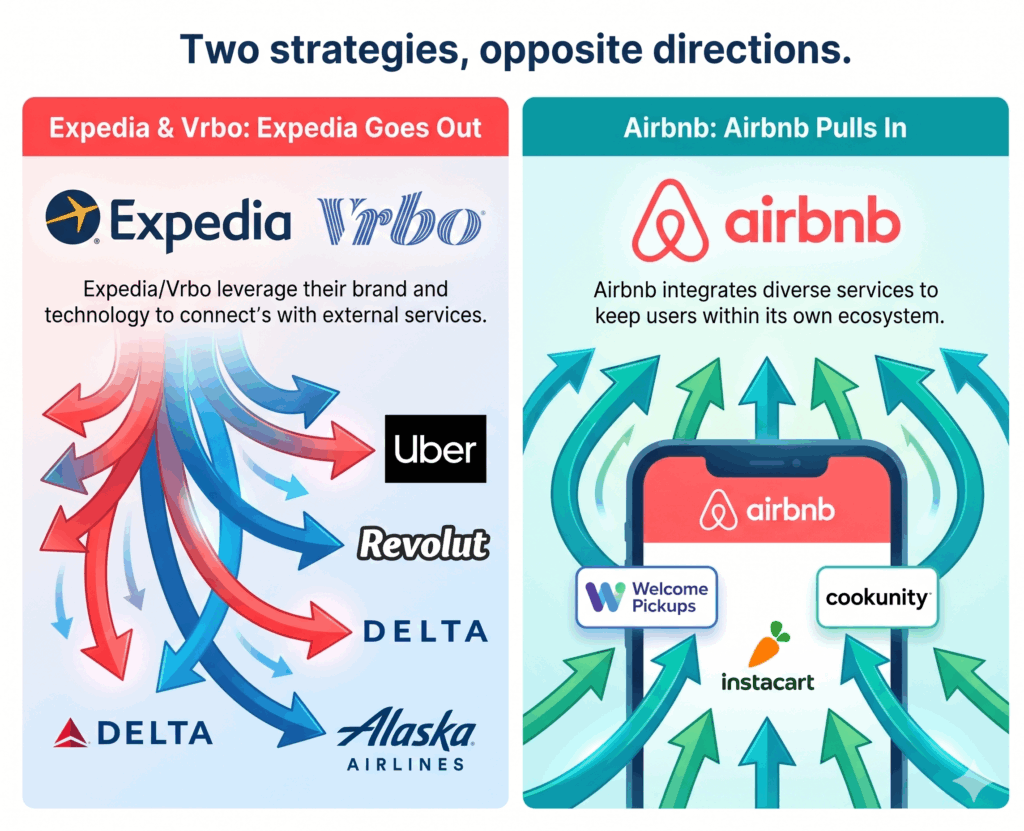
Airbnb’s move: keep everything inside the app
In late March, Airbnb launched private car transfers through Welcome Pickups, letting guests in more than 125 cities pre-book a ride from inside the Airbnb app after confirming a stay. The transaction stays inside Airbnb’s ecosystem — no redirect to Uber or a local taxi app. It builds on Airbnb Services, launched in May 2025, which added private chefs, fitness sessions, and spa treatments to the booking flow. As RSU’s 2026 Airbnb strategy analysis noted, Airbnb is no longer competing just for the bed — it is competing for the guest’s entire trip budget.
The logic is accumulation. More services inside the app means more time spent, more data captured, and a guest who is less likely to think about travel through any other platform.
Expedia’s move: put Vrbo supply where users already are
Expedia’s B2B distribution strategy runs in the opposite direction. Rather than pulling services into Vrbo’s app, it pushes Vrbo listings into platforms where users already spend significant time — a ride, a food order, a banking session. The guest does not go looking for a vacation rental. The listing finds them.
The two-way structure of the Vrbo Uber integration sharpens this further. Expedia surfaces Uber rides; Uber surfaces Vrbo rentals. Both platforms gain utility without building the other’s core product. Airbnb is building everything in-house. Expedia is building a grid.
Neither bet is wrong. One prioritises owning the full guest journey. The other prioritises owning the supply relationship and placing it everywhere demand already lives.
Uber Is the Biggest Channel in a Network That’s Been Running Since 2024
How Expedia’s B2B distribution strategy was built
The Vrbo Uber integration is the latest move in a strategy Expedia has been running since at least late 2024. In September 2025, Expedia began pushing eligible Vrbo listings into its B2B partner network — 70,000 businesses and 160,000 travel agents. Delta, Alaska Airlines, and Revolut were among the first partners to distribute Vrbo supply. By Q4 2025, Expedia’s B2B segment had grown gross bookings by 24%, with vacation rentals feeding directly into that engine.
The implication was already clear then: Vrbo listings could appear in airline booking flows, fintech apps, and through travel agents — without operators changing anything. Tim Rosolio, Vrbo’s VP of Partner Success, described the approach as “meeting partners where demand already lives.”
Why Uber is a different kind of channel
Revolut has heavy traveler usage. Delta and Alaska Airlines catch high-intent bookers mid-trip-planning. Uber is different — it is infrastructure. People open it dozens of times a month without travel on their minds. The Vrbo Uber integration places short-term rental inventory in front of users before they start looking — the difference between being found and being there first.
Listing Quality Now Decides Which Properties Enter These Channels
The eligibility gate
Expedia’s B2B distribution strategy only converts into bookings if properties clear its eligibility thresholds. Vrbo’s Premier Host program is moving to listing-level recognition in 2026, with stricter acceptance rate, cancellation, and review rating requirements. Quality now determines which listings surface in external channels — and the Vrbo Uber integration will be no different. Managers who treat quality metrics as a compliance exercise rather than a distribution lever will find themselves excluded from the channels where Expedia is investing.
The wider question
Expedia already has banks, airlines, and a global mobility platform distributing Vrbo vacation rental supply. The next candidates are platforms where travel intent sits just below the surface — super-apps, loyalty programs, corporate travel tools. Expedia’s stated goal is to tap the “full breadth” of its ecosystem. The Vrbo Uber integration suggests that breadth is larger than the industry has priced in.
Property managers do not need to do anything differently today. But the ones who understand that their Vrbo listing will soon be visible inside a ride-hailing app used by hundreds of millions of people — and who treat their quality metrics as a distribution lever, not a compliance task — are the ones positioned to capture what Expedia’s B2B distribution strategy is building toward.

Guneet has spent five years working at PriceLabs, developing deep expertise in short-term rental operations and hospitality technology. She brings that practitioner’s lens to her writing at RSU, covering platform updates and making sense of market data for property managers.