Airbnb is no longer simply trying to add more supply and wait for demand to arrive.
It is engineering conversion. It is reshaping payment behavior. It is using events to recruit hosts. It is bringing hotels into the same demand funnel. It is using AI to reduce costs and ship faster. And it is increasingly making decisions at marketplace level, not at individual host level.
For professional vacation rental managers, that matters. Airbnb’s strategy is creating more booking opportunities, but also more complexity around pricing, cancellations, competition, guest expectations, and operational quality.
Here are the 10 things managers should take away from Airbnb’s Q1 2026 earnings call.

1) Airbnb’s Growth Is Being Driven by Product Changes, Not Just Travel Demand
Airbnb had a strong Q1 on the surface.
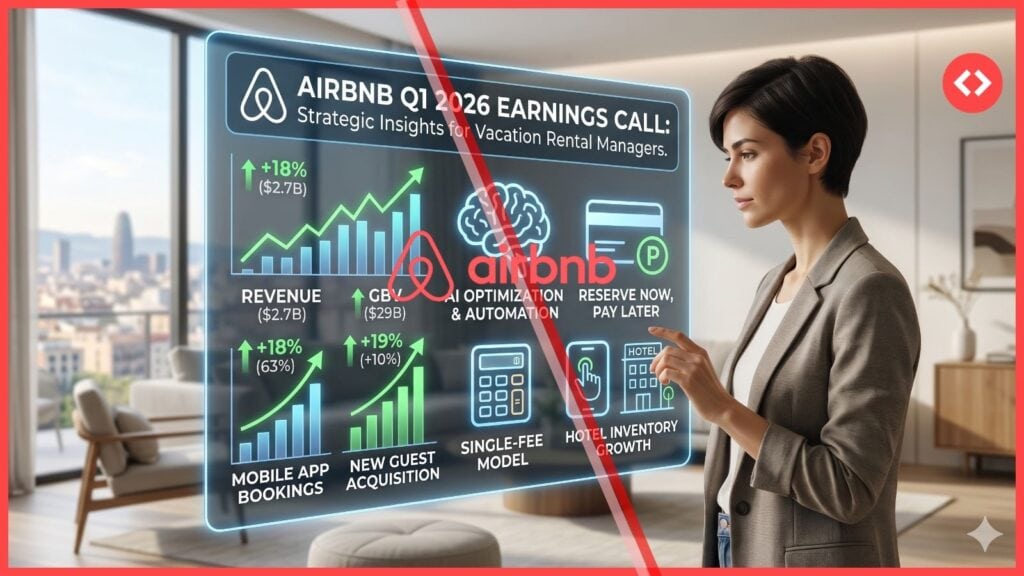
Revenue grew 18% year over year to $2.7 billion. Gross booking value grew 19% to $29 billion. Nights and seats booked grew 9%, or roughly 10% excluding an estimated 100-basis-point headwind from conflict-related cancellations in the Middle East.
But the more important detail is why growth accelerated. Airbnb said three initiatives alone contributed approximately:
- 3 percentage points of nights booked growth.
- 4 percentage points of gross booking value growth.
Those three initiatives were:
- Reserve Now, Pay Later.
- More flexible cancellation policies.
- Migration of some hosts to a simplified single-fee structure.
That means Airbnb’s recent growth is not just a macro travel story. It is a product optimization story.
For managers, the signal is clear: Airbnb is still finding meaningful growth inside the booking funnel.
Small changes to payment timing, cancellation flexibility, fee display, search ranking, and checkout design can materially change guest behavior. Managers should expect Airbnb to keep testing these levers, because they are now directly tied to revenue growth.
This also means your performance on Airbnb may change even when your own operations have not changed. The platform itself is changing underneath you.
2) Reserve Now, Pay Later Is Now a Major Booking Mechanic
Reserve Now, Pay Later is no longer a small experiment.
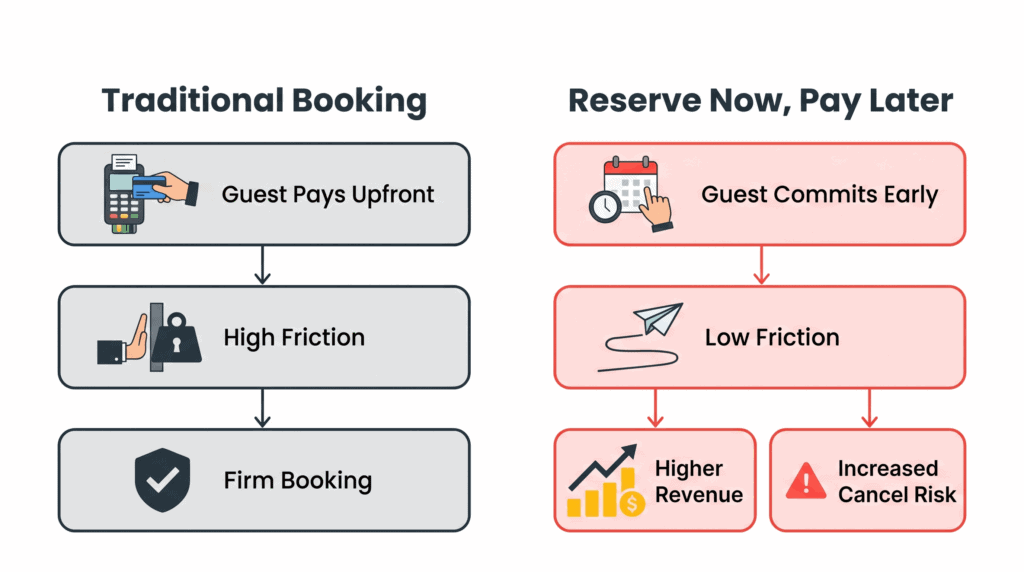
In Q1, Airbnb said roughly 20% of global gross booking value came from Reserve Now, Pay Later bookings. The feature was expanded into more markets, and Airbnb said it is changing how guests book: longer lead times, larger homes, and higher-priced stays. That is a major behavioral shift.
The psychology is simple. A guest who does not have to pay immediately faces less friction. The booking feels easier. The commitment feels lighter. The platform gets the reservation earlier.
For Airbnb, this is a win because it locks in calendar share sooner. For managers, the effect is more complicated.
Longer lead times can help with forecasting. Higher-priced bookings can lift revenue. But pay-later behavior can also increase cancellation risk. Airbnb acknowledged that Reserve Now, Pay Later comes with elevated cancellations, while still saying the net booking impact is positive across regions.
This is classic marketplace logic: More bookings first. Measure cancellations second. Keep the feature if net bookings increase.
For managers, the question is not whether Reserve Now, Pay Later is “good” or “bad.” The question is whether your revenue management systems, cancellation buffers, owner reporting, and pacing models are adapting to it.
A booking made earlier may not be as firm as an old-style prepaid booking. Your pickup reports may look healthier earlier. Your cancellation curve may also change.
Read More: Vrbo Introduces Buy Now, Pay Later for Vacation Rentals
3) The Single-Fee Structure Is Becoming More Important
Airbnb said that more than a quarter of active listings are now subject to a single service fee, and that it is testing expansion of this model to more hosts during the year.
This matters because Airbnb is trying to make pricing easier for guests to understand and easier for listings to compare.
The traditional split-fee model separated host fees from guest service fees. The newer model pushes the Airbnb service fee into the host-side economics, making the guest-facing price clearer.
Airbnb’s logic is straightforward:
- Guests want price transparency.
- Hosts need to appear competitive.
- Cross-listed inventory is easier to compare when fees are simpler.
- Conversion improves when pricing feels less confusing.
For professional managers, this is not just an accounting change. It affects:
- Rate loading.
- Channel parity.
- Owner statements.
- PMS configuration.
- Margin analysis.
- How Airbnb compares against Booking.com, Vrbo, and direct booking.
The risk is that managers absorb the new structure without fully adjusting pricing. The opportunity is that cleaner guest-facing pricing may improve conversion.
Either way, managers should assume Airbnb will keep pushing toward simpler, more standardized pricing. The platform’s Q1 results gave Airbnb more evidence that pricing and fee simplification can drive growth.
4) Airbnb’s App Is Becoming the Center of the Guest Relationship
Airbnb said nights booked on its app grew 22% year over year and now represent 63% of total nights booked, up from 58% a year earlier. That is not just a channel shift. It is a control shift.
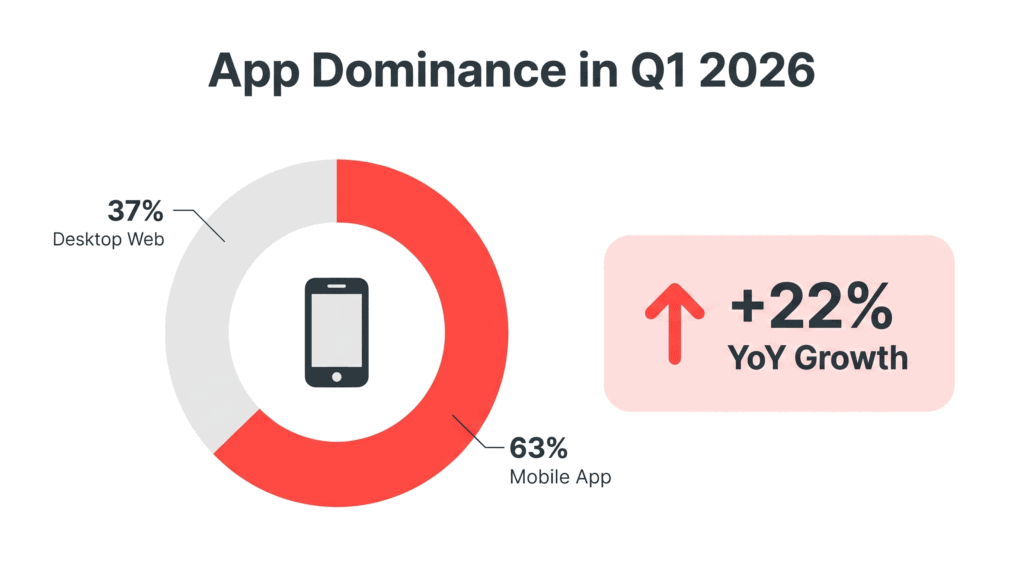
When guests move into the app, Airbnb gains more influence over:
- Notifications.
- Rebooking prompts.
- Trip planning.
- Experiences and services.
- Messaging.
- Support.
- Loyalty-like behavior.
- Personalized search.
Brian Chesky said Airbnb has become more aggressive about pushing mobile web users into the app and using notifications and email hooks to bring users back.
For managers, this means Airbnb is strengthening the direct relationship with the guest.
The more guests book and manage travel inside the Airbnb app, the more Airbnb can shape demand before it reaches your listing. The app becomes the place where Airbnb can introduce hotels, services, experiences, personalized recommendations, AI support, and future loyalty mechanics.
This is good for Airbnb’s repeat behavior. It may also make it harder for managers to differentiate unless listing quality, pricing, reviews, and response operations are excellent. Airbnb is not just sending you traffic. It is building a deeper guest habit.
Read More: Airbnb’s Hotel Strategy in 2026: What the Q1 Earnings Call, Hiring Data, and HotelTonight Tell Us
5) First-Time Bookers Are Accelerating, Especially Outside Core Markets
Airbnb said first-time booker growth accelerated to 10%, the highest growth rate since 2022. The company highlighted Brazil, Japan, and India as particularly strong markets, and said net nights in expansion markets grew at roughly twice the rate of core markets.
This confirms something important: Airbnb’s next growth layer is not evenly distributed.
Mature markets are still important, but expansion markets are where Airbnb sees faster adoption.
Ellie Mertz pointed to Brazil as a proof point. A few years ago, Brazil was barely in Airbnb’s top 10 markets. Now it is consistently among the top five, while still compounding at more than 20% growth.
Airbnb is doing this through localization:
- Local marketing campaigns.
- Country-specific product adjustments.
- Payment methods.
- Installment options.
- Market-specific merchandising.
For managers, this means the headline growth rate may not reflect your market. If you operate in a mature, highly penetrated destination, Airbnb’s global acceleration may not translate into the same local demand lift.
If you operate in Brazil, Japan, India, or other expansion markets, Airbnb may be investing more heavily in demand generation, localization, and guest acquisition.
The practical takeaway: managers should stop reading Airbnb’s global results as a single-market signal. Airbnb is increasingly running a country-by-country playbook.
6) Airbnb Wants Professional Supply, But It Is Warning Professional Hosts About Quality
One of the most important comments in the call was about API-connected hosts, meaning property managers and professional operators.
Brian Chesky said API host partners are growing “really, really fast,” and that Airbnb sees a big opportunity to better serve them. But he also said Airbnb has found that the more properties a host manages, the lower the rating tends to be. In other words, Airbnb’s guests are currently more satisfied with individual hosts than with larger property managers.
That is both an opportunity and a warning.
The opportunity: Airbnb wants professional inventory. It knows property managers can help it scale supply, especially in markets where individual hosts are not enough.
The warning: Airbnb does not want scale at the expense of guest satisfaction.
Chesky said property managers often tell Airbnb they want to be better hosts but need better tools. Airbnb now believes AI can help it build more tools faster for API-connected hosts.
For managers, this is a clear signal. Airbnb will likely invest more in professional host tooling, but it will also keep raising the bar on operational quality.
Expect more pressure around:
- Ratings.
- Response speed.
- Listing accuracy.
- Amenities.
- Cleanliness.
- Issue resolution.
- Pricing competitiveness.
- Guest communication.
Airbnb wants professional managers. It does not want professional mediocrity.
7) Hotels Are Becoming a Real Competitive Layer Inside Airbnb
Hotels are still a small part of Airbnb’s business. Airbnb said hotel nights remain a single-digit percentage of total nights.
But the growth rate is notable: hotel top-line metrics have been growing at more than double the rate of Airbnb’s overall business in recent quarters.
Airbnb is focusing on boutique and independent hotels, especially in mature markets and cities where home supply is constrained by regulation or insufficient to meet demand. It also said roughly 55% of guests who book a hotel on Airbnb later come back and book a home.
That explains the strategy. Hotels are not just a side category. They help Airbnb:
- Capture guests who might otherwise leave the platform.
- Serve demand in regulated urban markets.
- Offer one-night and last-minute options.
- Onboard hotel-first travelers into the Airbnb ecosystem.
- Compete more directly with OTAs.
For vacation rental managers, especially in urban markets, this changes the competitive set. Your listing may not only compete against other short-term rentals. It may increasingly compete against boutique hotels surfaced inside Airbnb’s own search experience.
Airbnb says personalization will matter. A family looking for a week in Tuscany may see homes. A solo traveler booking one night last minute in New York may see hotels. That means managers need to understand trip type, not just destination.
If your inventory overlaps with hotel-like use cases — one-night stays, business travel, last-minute urban bookings — hotel competition inside Airbnb may become more relevant.
8) Experiences and Services Are Demand Flywheels, Not Just Add-Ons
Airbnb continues to position Experiences and Services as part of a broader trip ecosystem. In Q1, Airbnb said almost a quarter of new guests who booked an experience went on to book a stay or service, and about one in three people who booked an experience booked a stay within 90 days.
That is an important data point. Airbnb is not only trying to make money from experiences and services directly. It is using them to create more reasons for people to open Airbnb, interact with the brand, and eventually book accommodation.
This is the bigger strategy: Homes bring guests to Airbnb. Experiences and services bring them back more often. Hotels fill gaps. The app ties it together.
For managers, this may eventually change how demand is generated. A guest may first enter Airbnb through an experience. Then book a service. Then book a hotel. Then book a home.
That is different from the old funnel, where a guest came to Airbnb only when they already needed accommodation.
The more Airbnb becomes a broader travel and lifestyle platform, the more it can generate demand internally rather than relying only on Google, performance marketing, or destination searches.
Managers should watch whether Airbnb starts connecting services and experiences more directly to stays in their markets. That could become a new merchandising surface.
9) Events Are Now a Structured Host Acquisition Strategy
Airbnb was born around event-driven demand, but Q1 showed how mature its event playbook has become.
During the Winter Olympics in Italy, Airbnb said almost 200,000 guests stayed on the platform, supply in host markets grew about 30%, and gross booking value more than tripled. Airbnb also said its marketing campaigns generated around 1 billion impressions.
The next major event is the FIFA World Cup.
Airbnb said it expects to host more guests for the World Cup than for any event in its history. Since starting outreach in October, more than 100,000 homes have listed on Airbnb for the first time. This is not just about event revenue. It is about supply acquisition.
Major events allow Airbnb to convince homeowners to try hosting for the first time. Some will leave after the event. But many stay. Airbnb said that after the Paris Olympics, it retained more than half of the listings that had come on specifically for the games six months later.
For managers, this creates both risk and opportunity.
The risk: event markets may see sudden supply surges, including from amateur hosts.
The opportunity: homeowners who test Airbnb during major events may later need professional management.
Managers in World Cup host cities should be thinking beyond event pricing. They should also be thinking about owner acquisition. The real prize may not be six weeks of demand. It may be the new supply that enters the market and decides hosting is more work than expected.
10) AI Is Already Changing Airbnb’s Cost Structure and Speed
Airbnb’s AI comments were among the most revealing parts of the call.
The company said nearly 60% of the code produced by its engineers is now written by AI, which it estimated is about twice the industry average. It also said more than 40% of guest issues handled through its AI Assistant are now resolved without a human agent, up from about one-third in Q4. Cost per booking decreased about 10% year over year in Q1.
This matters because Airbnb is not treating AI only as a search feature.
It is using AI to:
- Ship product faster.
- Reduce customer support costs.
- Improve self-service.
- Summarize reviews.
- Improve matching and ranking.
- Build tools for hosts.
- Eventually simplify listing creation.
Chesky was also skeptical that chatbot-style travel search has already been solved. He argued that travel and ecommerce need more than text: photos, maps, comparison tools, group decision-making, direct manipulation, and trust infrastructure.
That is important. Airbnb does not see AI search as just a threat from external chatbots. It sees AI as a chance to redesign the whole travel interface around personalization.
For managers, the near-term implication is not that guests will suddenly stop using Airbnb search. The near-term implication is that Airbnb will move faster. More tests. More product changes. More automated support. More personalized search. More AI-generated recommendations for hosts.
The pace of platform change is likely to increase.
Managers who only review their Airbnb strategy once or twice a year will be too slow.
Read More: What Airbnb’s 2025 Updates Really Signal for 2026 (and How Managers Should Prepare)
The Bigger Picture: Airbnb Is Building a Broader Travel Marketplace
The Q1 call made Airbnb’s ambition clearer, once again.
Homes are still the core business.
But Airbnb is adding layers around the home:
- Hotels.
- Services.
- Experiences.
- Event-driven supply.
- AI support.
- Better payments.
- App-based personalization.
- Possible future loyalty.
- Possible future flights.
Brian Chesky once again compared the opportunity to Amazon’s category expansion, where books became the starting point for a much larger marketplace. For Airbnb, homes may be the starting point, but not the endpoint.
For vacation rental managers, the strategic question is changing. It is no longer only: “How do I rank better on Airbnb?” It is becoming: “How do I compete inside Airbnb’s broader travel ecosystem?”
That means managers need to think about:
- Pricing visibility.
- Cancellation exposure.
- App-driven guest behavior.
- Hotel competition.
- Event-based supply spikes.
- AI-mediated support.
- Market-level localization.
- Quality signals.
- Professional host tools.
- Cross-category demand.
Airbnb’s Q1 2026 earnings call showed a company with strong financial momentum.But more importantly, it showed a company becoming more deliberate about how it manufactures that momentum.
For managers, that creates opportunity. It also raises the bar.

Uvika Wahi is the Editor at RSU by PriceLabs, where she leads news coverage and analysis for professional short-term rental managers. She writes on Airbnb, Booking.com, Vrbo, regulations, and industry trends, helping managers make informed business decisions. Uvika also presents at global industry events such as SCALE, VITUR, and Direct Booking Success Summit.
Related Articles:
 Lisbon Imposes Bans and New Limits, Mabrian Launches Rental Monitoring Tool, and Airbnb Reboots Experiences
 Airbnb Launches Co-Host Marketplace in Japan, Vrbo to Delist Poor Listings, Booking.com Bets Big on India and AI
 Before You Drop Prices: How Listing Quality is Costing You Airbnb Revenue
 AI in Vacation Rentals: Build Your Own AI or Wait for Your PMS?