
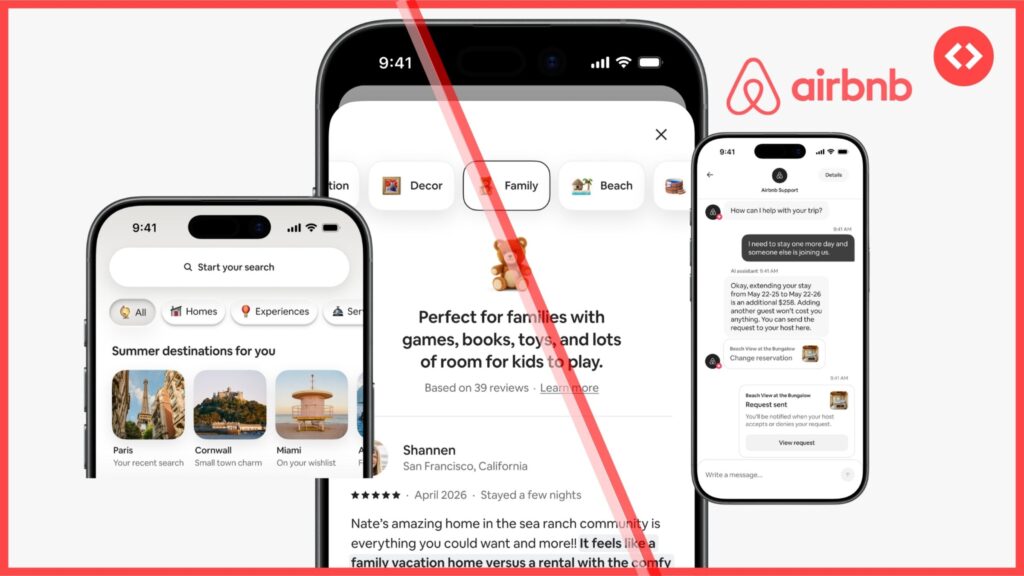
For most of the last decade, a guest landing on your Airbnb listing was reading your words, scanning your photos, and forming a human impression of your property. After Airbnb’s May 20 Summer Release, that interaction is increasingly mediated by an Airbnb AI sitting between your listing and the guest, choosing what to highlight, answering questions in your stead, and comparing your home against the one next door on criteria the algorithm picked.
This isn’t unique to Airbnb. We’ve been tracking the same shift across online travel for over a year now — the slow handoff of property discovery from human reading to Airbnb AI summarization, whether the surface is an answer engine like ChatGPT or Perplexity, Booking.com’s conversational search, or Vrbo, where Expedia has now confirmed natural language search is on the way. AI is no longer one feature among many. It is the interaction layer.
Here is what the Airbnb Summer Release 2026 gives away about Airbnb’s AI direction — and what each piece of it means for professional managers.
1. AI listing creation has narrowed the quality gap pros used to count on
The first big move is Smart Setup, Airbnb’s host-side AI tool for generating a listing from photos and an address. Upload pictures of the property. The platform’s computer vision parses the rooms. An LLM writes the description, structures the amenities, and pulls in location context from public data. A single-listing host without any copywriting background now ships an Airbnb-blessed, semantically dense listing on day one.

For roughly a decade, “well-written listing” was a quiet professional advantage. It wasn’t the only thing pros did better, but it was a consistent one. That gap has now closed at the bottom.
What still separates pros from amateur hosts
What still differentiates a professional operator isn’t gone — but it has moved. Portfolio-level merchandising, deliberate photo curation, amenity stacking that matches local guest intent, hyperlocal voice in the description, and the kind of operational consistency the platform’s review summarization now picks up — those are where the edge lives. Writing prose that an amateur couldn’t isn’t on that list anymore.
2. The AI now answers guest questions before you do
Ask about this home is Airbnb’s new conversational AI feature that lets prospective guests ask questions directly on the listing page and get answers generated from the listing’s structured data — without the host involved.
Airbnb’s “Ask about this home” feature is the one most worth understanding strategically. A prospective guest types a question — “Is this home family friendly?” “Is the Wi-Fi fast enough for a remote workday?” — and an AI assistant answers, pulling from the listing’s structured data. The host doesn’t see the question. The host doesn’t write the answer.
Read what that means carefully. The AI is now your sales agent during the discovery phase, and the only material it has to work with is the metadata you’ve filed. If your amenities aren’t tagged, your house rules aren’t structured, your location context isn’t filled out, the AI will either say it doesn’t know — which kills the inquiry — or say something generic that doesn’t close.
This isn’t just an Airbnb story — it’s happening across every OTA
This is the consumer-facing edge of the broader shift we’ve been writing about: content that is legible to AI is the new SEO, across answer engines and OTAs alike. The same logic now applies whether a guest is asking ChatGPT for a family-friendly rental, using Booking’s conversational search, or — soon — searching Vrbo in natural language. The era of writing for human scanners is being replaced by the era of structuring for AI parsers.
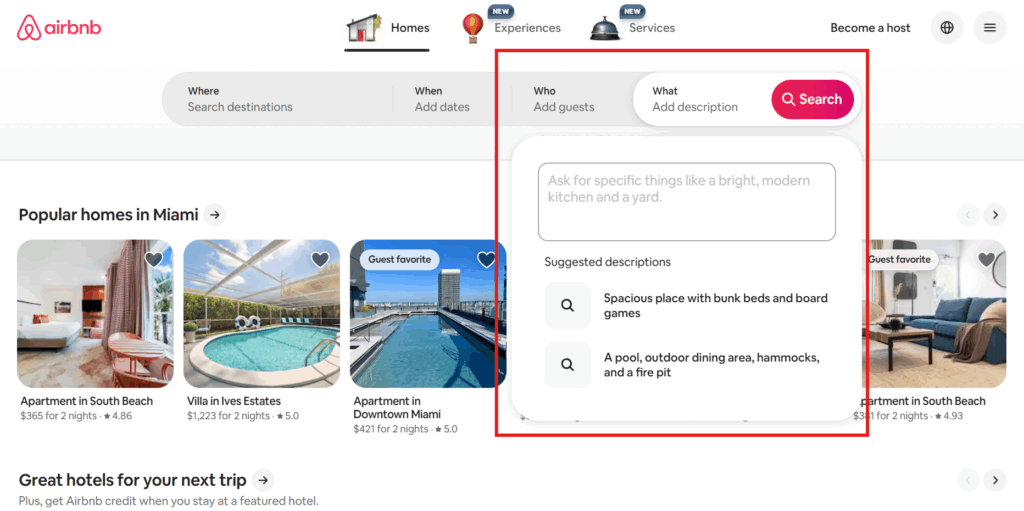
Audit every field. Every amenity. Every detail buried in a paragraph that should be a structured tag. The AI doesn’t read your prose. It reads your data.
3. AI comparison turns “your listing vs. theirs” into a chart the algorithm draws
The Summer Release also rolled out AI-powered side-by-side property comparison — two homes shown to a guest with the platform’s AI surfacing the differentiators it has picked: spatial layout, design quality, location attributes, unique features. Price is in the frame, but it isn’t the headline variable.
Expedia just announced the same for Hotels.com — and Vrbo is likely next
This is another move that isn’t unique to Airbnb. At the same time, Expedia announced AI Property Compare and Property Expert from Hotels.com, designed to let travelers “compare properties based on the factors that matter most to them, such as vibe, location, amenities, and trade-offs,” with a companion tool that answers detailed property and neighborhood questions from listing data and guest reviews. Both are coming later this year. It’s not a stretch to expect both to land on Vrbo too.
For property managers, two implications follow. First, against the boutique hotels Airbnb is now subsidizing with instant discounts and post-stay credits, pure price competition is a losing strategy — the AI is being trained to compare on attributes, not rates. Second, the attributes the AI surfaces are the attributes you need to make visible and structured in your listing data. If “private outdoor space,” “remote-work-ready kitchen,” or “walkable to the trailhead” describes your home, those need to live in tagged fields, not in a paragraph buried halfway down.
4. AI summarization replaces chronological reputation management
Review Highlights, the feature that synthesizes recurring themes across every review a listing has ever received, surfaces semantic patterns rather than the latest five-star. Airbnb is replacing chronological reputation management with algorithmic sentiment extraction.
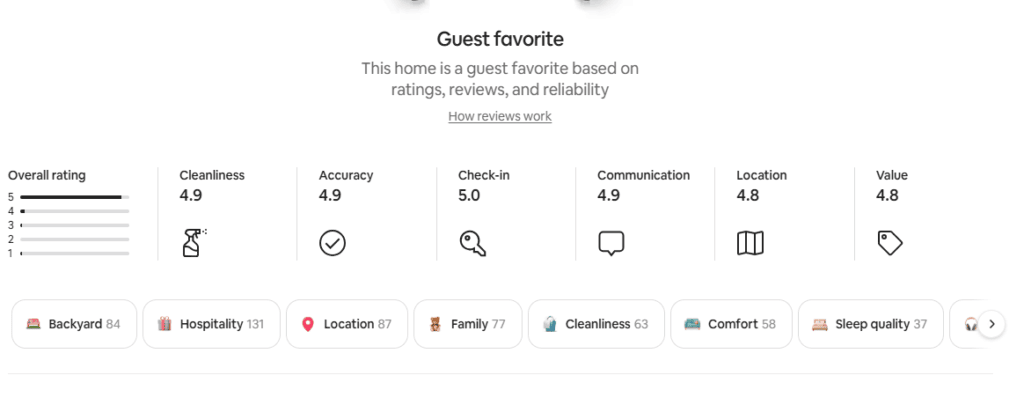
The playbook of “bury one bad review under fresh good ones” stops working when an AI is reading the entire history and pulling out themes. This cuts both ways for property managers. A consistent positive theme — “always immaculate,” “responds within minutes” — gets pinned to the top of the listing without manufacture. But a recurring complaint — slow check-in, thin walls, a missing amenity that keeps getting flagged — surfaces algorithmically too, regardless of how many positive reviews you’ve stacked since.
Operational consistency is now a visible ranking signal. Patterns matter more than recency.
5. The unnamed AI feature: the Airbnb homepage itself
This is the one no one is naming directly, and it may end up being the most consequential of all. Airbnb’s homepage now has to merge stays, hotels, experiences, and services into a single first impression. That isn’t a feed problem you can solve with rules. It’s a personalization problem you solve with AI.

Homepage personalization has been happening on Airbnb for years. What changes now is the surface area and the stakes. With hotels appearing next to short-term rentals, Experiences and Services competing for attention in the same scroll, and the platform aggressively scaling all four product lines at once, the AI that decides what surfaces for which user — and how prominently — becomes the gatekeeper to top-of-funnel visibility in a way it never was before.
What happens to listings the AI can’t read cleanly
For property managers, the implication is uncomfortable but worth naming. If your listing isn’t legible to the AI that builds each user’s homepage — clean data, structured amenities, consistent quality signals, the kind of imagery and tagging the personalization model rewards — you aren’t just losing search rank. You are losing the at-a-glance impression slot too, against an inventory mix that now includes platform-subsidized hotels and curated experiences competing for the same impression.
Between the lines: three things this release gives away about Airbnb’s AI direction
Airbnb is inserting an AI layer at every monetizable decision point.
Listing creation, discovery, comparison, inquiry, reputation, support — and, quietly, homepage composition. None of these are consumer-toy AI features. Every one of them sits at a moment where guests previously formed an impression from a host’s own words or directly contacted the host. The AI is now the intermediary.
The proprietary data advantage is the actual product.
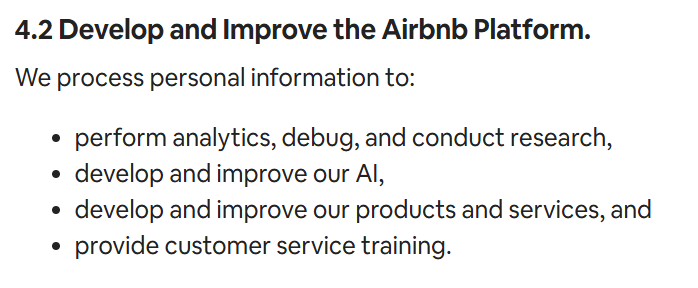
Airbnb’s April 2026 privacy terms quietly secured the rights to train on every host pricing decision, every guest interaction, and the full review archive. The AI features in this release run on a dataset its competitors structurally cannot replicate. This is data neither Booking.com, nor Expedia Group will have. That is the advantage, not the chat bubbles.
The platform is optimizing for itself, not for individual operators.
This is the line worth ending on. The 800-signal ranking algorithm, the AI sales agent on the listing page, the personalized homepage, the comparison view — all of them are tuned to maximize platform-level conversion and total transaction volume. Anywhere those goals diverge from an individual host’s interests — pricing, cancellation policy, hotel subsidies, the visibility of services and experiences competing with your stay — the platform’s interests win.
The practical takeaway is one we’ve been making for a year. The property managers who hold their edge in 2026 are the ones treating Airbnb as one AI-mediated distribution channel among several, optimizing their listing data structure with the same rigor they used to spend on prose, and owning the parts of the guest relationship — direct bookings, off-platform communication, hyperlocal differentiation — that no amount of AI intermediation can touch.
AI legibility is now table stakes, not a competitive advantage. The question is whether your listing has been built for the AI that is now reading it.

Uvika Wahi is the Editor at RSU by PriceLabs, where she leads news coverage and analysis for professional short-term rental managers. She writes on Airbnb, Booking.com, Vrbo, regulations, and industry trends, helping managers make informed business decisions. Uvika also presents at global industry events such as SCALE, VITUR, and Direct Booking Success Summit.
Related Articles:
 Airbnb’s Fourth Pillar: How AI Became a Strategic Defense Against an AI Future
 What Airbnb’s New Privacy Terms Reveal About Its AI Plans for Summer 2026
 Airbnb Launches Co-Host Marketplace in Japan, Vrbo to Delist Poor Listings, Booking.com Bets Big on India and AI
 AI in Vacation Rentals: Build Your Own AI or Wait for Your PMS?