
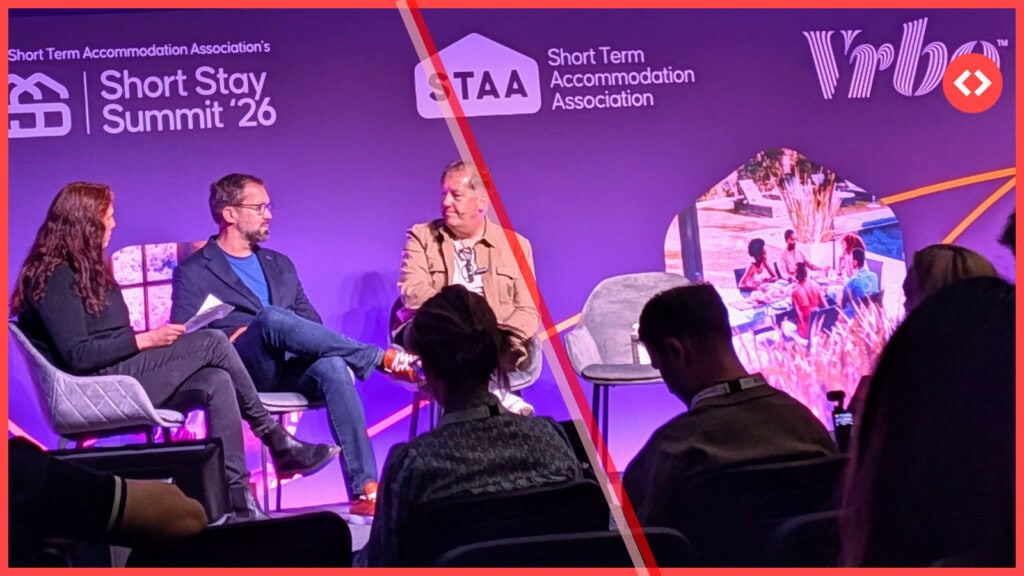
I came to the AI panel at The Short Stay Summit 2026 knowing it would be worth the trip. The two CEOs on stage are in a small club of vacation rental leaders whose teams are actually shipping AI for vacation rentals, not just talking about it. Graham Donoghue, who leads Forge Holiday Group (Sykes Cottages and a portfolio of European brands), is famous in our industry for being unusually eager to show and share what his team is building — and he didn’t hold back on stage. Steve Schwab, CEO of Casago/Vacasa following the merger of the two operators, runs one of the few operations with the scale to stress-test AI in the real world. Hosting with real discipline, Guesty CMO Kate Cox kept the conversation out of the clouds and on the ground where most operators actually live: what works, what flopped, what it costs, and what’s actually defensible.
What surprised me was how much of what they said applies directly to property managers running 50 to 500 units, not 50,000. If anything, the biggest insights came from the flops.
Lesson 1: Point AI inward before you point it outward
The single most underrated piece of advice of the whole session came from Steve Schwab:
“Every time we’ve tried to implement it outward-facing, it’s sub-optimal. Internal-facing AI has been fantastic.”
Industry noise around AI for vacation rentals has been almost entirely about guest-facing chatbots, conversational search, and dynamic trip planning — exactly the category Schwab said has consistently underperformed at Casago/Vacasa. Internal use cases, meanwhile, are where both CEOs reported real margin movement. Schwab described smaller brands inside the Casago/Vacasa group finally being able to afford the kind of business-intelligence depth that used to be the exclusive privilege of enterprise operators. For a property manager below three or four hundred units, he said, being able to dig past top-line KPIs into the nuances of the P&L is now genuinely viable — and it’s showing up in margin.

If you’re a smaller PM sitting on a messy mix of PMS data, channel exports, and owner statements, take this as the permission slip you’ve been waiting for. The fastest ROI isn’t a guest-facing experiment. It’s pointing AI at your own operations — reporting, reconciliation, listing copy, SOPs, training, owner comms, upsell scripts — and leaving the guest-facing work for when your data is mature enough to support it.
Read More: Airbnb’s Fourth Pillar: How AI Became a Strategic Defense Against an AI Future
Lesson 2: No AI strategy survives dirty data
Both CEOs came back to data hygiene so many times that Kate Cox at one point redirected the panel just to keep the conversation moving. Donoghue’s team spent months — not weeks — getting 500 million pricing records into a state where AI could learn from them. Schwab warned the room, in one of the lines of the session:
“Don’t spend a lot of time vibe-coding something that you think could be useful into the future. We’re seeing people get the vibe code up to 80%, and then just can’t finish it up because they don’t have API access, they don’t have access to the proper data.”
For smaller operators, the practical translation is unglamorous: spend the next quarter cleaning up listing attributes, property taxonomies, calendar hygiene, photo metadata, and the weird edge cases inside your PMS before you write a single line of prompt engineering. It isn’t exciting. It’s also the difference between an AI initiative that compounds and one that hallucinates your owner statement into existence — which, as Schwab warned, is exactly what AI does when you feed it information that isn’t “incredibly clear.”
The good news: you don’t need the data maturity of a 90,000-property group. You need your data to be clean enough that a model trained on it stops making things up. That’s a one-quarter project at most for a mid-sized PM. Start now.
Lesson 3: Adoption is a leadership problem, not a tooling problem
Graham Donoghue’s honest admission about adoption was, for me, the most applicable insight of the whole session. Forge gave its teams the tools. Many staff ignored them. The fix wasn’t more training — it was making it non-negotiable. Some employees eventually left the business because they wouldn’t engage.
“I just expected, naively, that people would adopt it if we gave them the tooling. In some cases people did, but in many cases we actually had to say — it’s non-negotiable. You can take a horse to water, but you can’t always make it drink. I was dunking it under the water.”
Smaller PMs tend to assume adoption is a big-company problem. It isn’t. If you hand a reservations manager a Claude or ChatGPT subscription with no mandated use cases, no documentation on which tool for which job, and no feedback loop on quality, nothing changes. AI adoption is a management discipline — specific mandates, specific guardrails, specific review cadences.
The guardrails matter too. Donoghue described an internal system of tiered user rights and approved tools (Forge runs around 175 of them), with clear rules on what data is safe to paste into which model. A 50-unit PM doesn’t need 175 approved tools. But the principle fits on a single page: which model for which job, which data never leaves the company, how outputs get reviewed.
Read More: What Happens When AI Becomes the First Step in Booking a Stay?
Lesson 4: Don’t try to out-build the platforms
Schwab was refreshingly blunt about the build-versus-buy trap. He named Vacasa’s $60-million internal revenue-management build that never delivered, then framed AI decisions the same way:
“Take the Las Vegas effect. Go and play, bet on things that are fun, but don’t bet your company on it.”
For smaller PMs, this is close to a universal rule. You are not going to out-engineer Guesty’s AI roadmap. You are not going to out-compute Airbnb’s LLM investments. Anything you build in-house that requires real data science talent will be outdated in twelve months — and you’ll still be maintaining it.
The smart allocation is best-in-class tools, integrated well, with the budget you save poured into the one thing that’s genuinely yours.
Lesson 5: The smaller-PM moat is context — and AI finally lets you scale it
This was the most optimistic thread of the session, and where Kate Cox was at her best bringing two enterprise CEOs down to something operators could actually copy. Schwab described an experiment where an AI voice bot calls homeowners and has a 20-minute conversation — why they bought the property, who they’d bring, what’s in the neighbourhood, what the owner loves, what the ideal guest looks like — and then structures that context into the listing metadata.
Donoghue had the practical mirror image: Forge’s after-hours AI voice agent, “Kate AI,” handles inbound calls after 7pm using ElevenLabs voices, qualifies leads against property value signals, and drops them into the workflow for humans in the morning. His line was the reassuring one for smaller operators: it was not expensive to build.
Both examples point at the same truth. The depth of property context a smaller operator can capture — about their owners, their properties, their streets, their local partners — is something no OTA will ever replicate. AI isn’t a replacement for that knowledge. It’s the first technology that lets a 100-unit operator scale it into listing content, guest comms, and search visibility without hiring an army.
If AI-search and context-aware discovery are where travel is going — and every signal from Google, OpenAI, and Airbnb suggests they are — then rich, accurate, deeply human property context is the most valuable moat a smaller PM has.
Read More: Are You Listing a Property or Solving a Problem? The Reality of AI Short-Term Rental Marketing
One non-negotiable: declare the AI
The session ended on a point both CEOs agreed on, and which too many smaller PMs still treat as optional. If you deploy AI — voice, chat, email drafting — tell people. Donoghue’s after-hours agent introduces itself as “Kate AI.” Schwab was categorical:
“You will lose trust with your owners and your guests if you don’t declare and are very, very clear about what is AI and what is not.”
Guests will forgive AI. Owners will forgive AI. Neither will forgive being duped.
What I’d do Monday morning if I ran 200 units
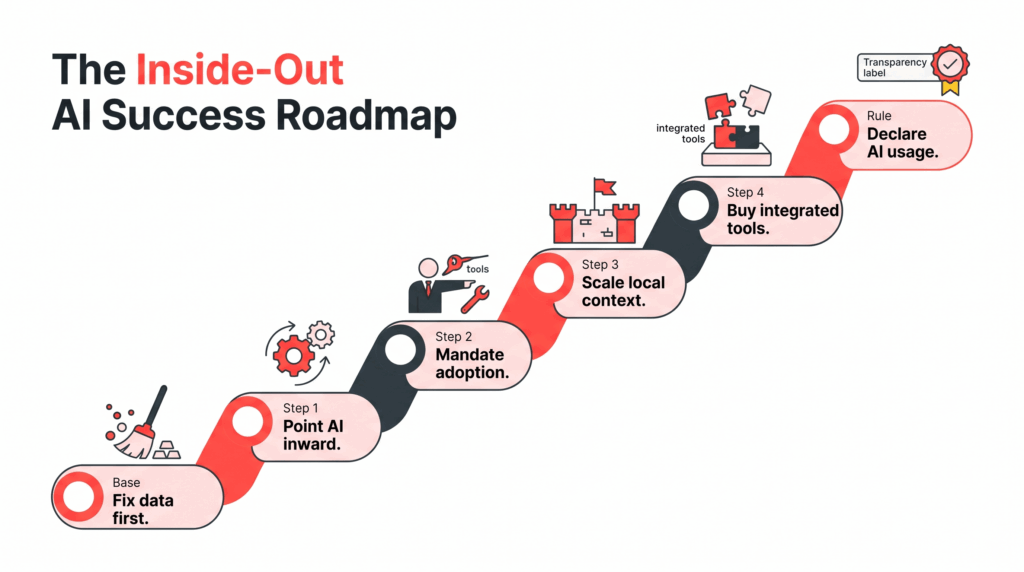
Stripping the session down to the plan I’d execute in a mid-sized property management business:
Clean your data first — listing attributes, PMS taxonomies, photo metadata, owner records. Point AI for vacation rentals at internal operations before anything guest-facing. Mandate a specific set of use cases with tiered user rights and clear rules on what data leaves the company. Buy best-in-class rather than building, and redeploy the saved budget into capturing property and owner context at a depth no OTA can match. Pilot one voice or content use case where that context is your weapon. And declare AI every single time it touches a human.
The AI divide in short-term rentals isn’t going to open between the operators with the biggest models. It’s going to open between the ones who did this boring groundwork — and the ones who kept vibe-coding.

Thibault Masson is a leading expert in vacation rental revenue management and dynamic pricing strategies. As Head of Product Marketing at PriceLabs and founder of Rental Scale-Up, Thibault empowers hosts and property managers with actionable insights and data-driven solutions. With over a decade managing luxury rentals in Bali and St. Barths, he is a sought-after industry speaker and prolific content creator, making complex topics simple for global audiences.
Related Articles:
 Will AI Destroy the Revenue Manager? What I Heard at Scale UK 2026
 AI in Vacation Rentals: Build Your Own AI or Wait for Your PMS?
 Airbnb Launches Co-Host Marketplace in Japan, Vrbo to Delist Poor Listings, Booking.com Bets Big on India and AI
 AI Agents for Property Managers: Build Your Own in Five Levels