

Airbnb’s Summer 2026 product release is weeks away. Quietly, in a legal document most hosts scrolled past, the platform already told you what it’s building, and who’s paying for it. When RSU first mapped Airbnb AI strategy, Thibault Masson argued that the platform’s real moat wasn’t search.
It was the three-layer infrastructure of discovery, financial rails, and trust that AI could threaten at the front door but couldn’t easily replace underneath. When we returned to that thesis after Airbnb’s Q4 2025 earnings call, the picture had sharpened: Airbnb wasn’t defending anymore. It was building. A new CTO from Meta’s Llama team. AI resolving a third of North American support interactions. Five hundred million reviews as training data. Project Y as the blueprint.
What neither piece had was the legal document that completes the picture. That document arrived in February, buried in a routine terms update. It goes into effect April 20.
For the First Time, the Privacy Policy Says It Out Loud
Airbnb’s updated Privacy Policy includes, for the first time, an explicit statement that the platform uses personal information to “develop and improve our AI.” It also adds a new usage data category: interactions with AI-enabled services. Neither appeared in the previous version, last updated in February 2025.

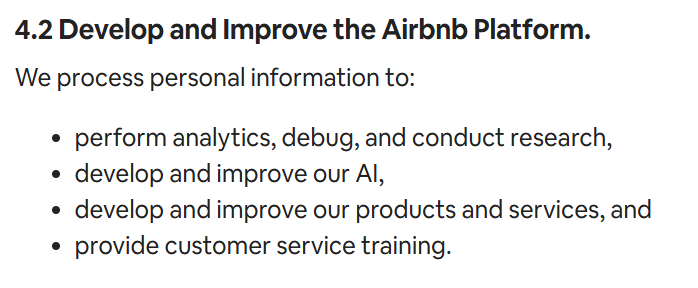
This is not a revelation in the sense that Airbnb was hiding it. Brian Chesky said publicly on the Q4 earnings call that the platform was post-training third-party models on its proprietary dataset. The CTO hire was announced in a press release. The AI ambition has been stated clearly and repeatedly in public forums.
What the privacy policy change does is different. It converts that ambition into a legal right — one that every existing Airbnb user is now being asked to formally consent to. The product roadmap and the legal infrastructure are now pointing at the same date.
Two Forces Converging on the Same Moment
The timing of this formalization is not arbitrary. Two separate pressures arrived at the same point.
The first is regulatory. EU Regulation 2024/1028, which RSU covered in depth, requires platforms to standardize data collection and sharing with local authorities by May 2026. The EU AI Act is simultaneously tightening disclosure requirements around automated decision-making. Platforms operating at Airbnb’s scale are under mounting pressure to have explicit, documented legal bases for how they process and use data. The February privacy update satisfies both requirements simultaneously — it secures Airbnb’s rights over host data for AI development while bringing its disclosure framework into line with what European regulators now expect.
The second pressure is self-imposed. Airbnb’s Summer 2026 release is its most anticipated product cycle in years. A new CTO hired specifically to build AI-native products. A support infrastructure already running on AI at scale. A conversational search interface in pilot. The legal groundwork for training on user data needed to be in place before those products ship. It now is.
What Professional Managers Are Actually Contributing — and What Makes Airbnb’s Position Unique
Here is where the platform comparison matters, because the three major OTAs are not doing the same thing.
Booking.com: Ahead on Compliance, Constrained by It
Booking.com is the most EU-compliant of the three — but that compliance came at a cost. As a designated gatekeeper under the EU Digital Markets Act, Booking.com was required to decommission certain cross-service data processing before November 2024 specifically to avoid triggering consent requirements under DMA Article 5(2). It is ahead on regulatory infrastructure precisely because it had no choice. The designation forced a level of data restraint that Airbnb, not yet subject to equivalent gatekeeper obligations, is not under. Booking.com’s compliance is real. So is its constraint.
Vrbo: AI in the Terms, But Not in the Moat
Vrbo has AI language in its terms — interactions with AI features and product improvement purposes are both referenced. But Vrbo operates inside Expedia Group’s broader infrastructure. The AI being developed on Vrbo data is not a proprietary short-term rental intelligence model. It is part of a generalist travel platform’s machine learning apparatus. The STR-specific signal gets diluted into a much larger pool.
Airbnb: Building Proprietary AI on STR-Specific Data
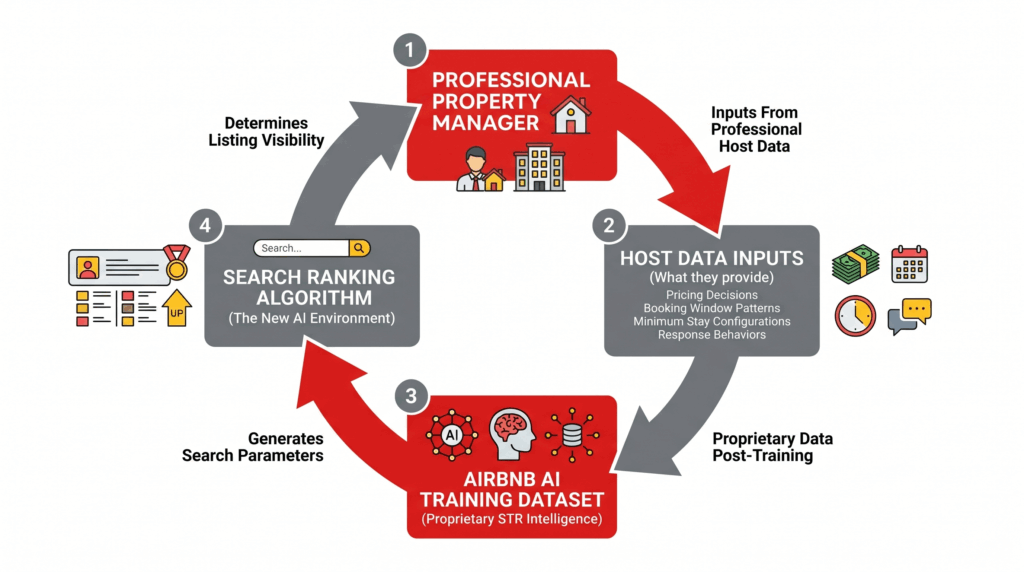
Airbnb is doing something structurally different from both. Airbnb AI strategy is building proprietary AI specifically on STR behavioral data — and it has now formally declared that every host and guest interaction on the platform feeds that build.
For a solo host with two listings, that data contribution is modest. For a professional manager running fifty, a hundred, or two hundred listings across multiple markets, the contribution is substantial. Pricing decisions, booking window patterns, minimum stay configurations, response behaviors, occupancy rates across market cycles — all of it is now formally part of what trains the systems that also determine search ranking, listing visibility, and the algorithmic environment those same managers operate inside every day.
The operators contributing the most data to Airbnb’s AI development are the same operators most dependent on the outcomes that AI produces. The platform’s intelligence and the professional manager’s business are now formally, legally entangled in a way they weren’t twelve months ago.
The Clock Is Running. Here Is What Comes Next.
The privacy policy change frames the possibilities around Airbnb’s Summer 2026 release differently than they would read without it. This is no longer speculation about what Airbnb might build. The legal right to build it using the data already flowing through the platform is secured. The CTO to build it is in place. The training dataset is established. The product cycle is open.
The question that remains — and the one RSU will be tracking — is not whether Airbnb builds significant AI products this summer as part of Airbnb AI strategy. It is what those products reveal about the relationship between the platform and the professional managers who are, whether they knew it or not, among its most important contributors.

Uvika Wahi is the Editor at RSU by PriceLabs, where she leads news coverage and analysis for professional short-term rental managers. She writes on Airbnb, Booking.com, Vrbo, regulations, and industry trends, helping managers make informed business decisions. Uvika also presents at global industry events such as SCALE, VITUR, and Direct Booking Success Summit.
Related Articles:
 Airbnb’s Fourth Pillar: How AI Became a Strategic Defense Against an AI Future
 Airbnb Launches Co-Host Marketplace in Japan, Vrbo to Delist Poor Listings, Booking.com Bets Big on India and AI
 Before You Drop Prices: How Listing Quality is Costing You Airbnb Revenue
 AI in Vacation Rentals: Build Your Own AI or Wait for Your PMS?