“IT’S NOT ABOUT THE DAMN DISHES!”
That was Ginger Harrelson, owner and corporate counsel at Beachball Properties on the Alabama Gulf Coast and a member of the Orange Beach city council, reacting to Airbnb’s new house rules. She agrees guests “shouldn’t be handed a chore list.” Her problem is everything else in the announcement.
From November 20, 2026, Airbnb is limiting what hosts can ask of guests. Checkout chores are mostly out and fines are banned. A companion policy also restricts contracts and guest data: unless a law or a building rule requires it, a host can’t ask an Airbnb guest for an email, a phone number, a copy of their ID or a signed rental agreement “at any point during the booking process or stay,” according to Airbnb. Our explainer covers the rules in detail.
The chores rule got the headlines. But among hosts, property managers and software vendors, the policy raised a different set of questions:

- If guests sign nothing, who carries the risk?
- Can managers still ask for ID?
- Who owns the guest relationship on Airbnb now?
- Which tools are most affected?
- Can you still turn Airbnb guests into direct bookings?
These are fair questions, and Airbnb’s announcement didn’t answer most of them. So we gathered what managers, vendors and specialists have been saying, then checked each point two ways: against the text of Airbnb’s policies, and by typing more than 20 test requests into Airbnb’s Listing editor to see what it flags. For each question, we say what we found and what we think may happen. That last part is our interpretation, not Airbnb’s, and Airbnb may still review or flag things after the editor lets them through.
Key takeaways
- The policy is global and applies to reservations booked on or after November 20, 2026.
- Managers keep the liability for safety and damage, but lose some tools: required rental agreements, waivers and ID copies.
- Airbnb’s answer to the risk is AirCover, including $1M of host liability insurance. We read the terms: professional managers have good reasons to treat it as a backstop rather than a replacement for their own insurance.
- The legal exception for ID is real and clearly written. Expect it to become the industry’s main focus, through local ID laws and building rules.
- Vendors built on capturing guest data are hit hardest. Tools built on compliance or on improving the stay are much less exposed.
- Asking Airbnb guests for their email wasn’t allowed before either. What’s new is that the workarounds are closing, and the editor catches the wording.
- In our tests, the editor flagged chores, fines, contracts, apps and personal data reliably, but also flagged a bear-proof bin request that Airbnb’s own policy gives as a reasonable example. Safety notices, like “no diving,” passed.
1. If guests sign nothing, who carries the risk?
What people are asking
Harrelson put it bluntly: “An Airbnb representative on the phone isn’t showing up at midnight when a party gets out of control. We are.” For her, the rental agreement was never only about checkout rules: “We have insurance requirements tied to rental contracts, and local requirements can make proof of a rental agreement critical when seeking to remove guests for unlawful conduct.”
Pools, hot tubs, docks and fire pits are where the worry is sharpest. Simon Seroussi, co-founder of the guest app and operations platform SuiteOp, asked: “if a guest slips by the pool and never signed the pool waiver, where does that liability land? With the operator? The owner? Airbnb?” Esther Ekpo, who works in guest experience and operations, added: “A waiver never stopped anyone from slipping, but it did make sure guests knew where the risk was.”
And managers want to know whether “No diving” on the pool fence now counts as a rule added after booking.
What we checked
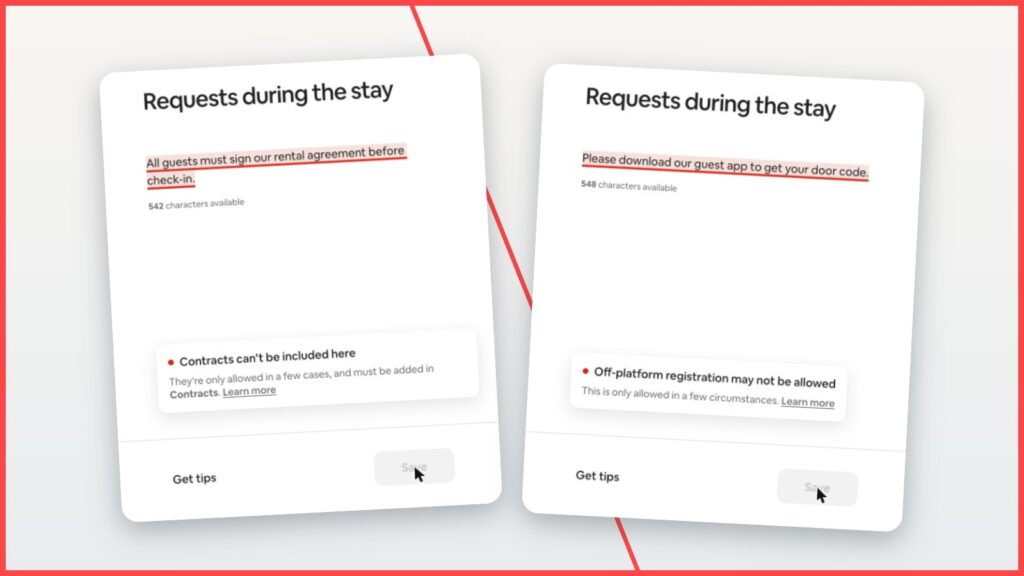
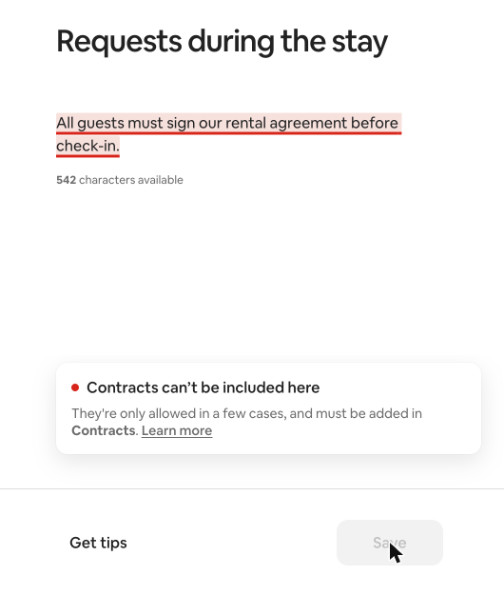
Rental agreements. From November 20, hosts can only require a separate contract in four cases: a law or community association rule requires it (such as an HOA or building security requirement), it’s for an optional amenity like a golf cart, the stay is 28 nights or more, or the listing is part of Airbnb Luxe. Even then, the terms must be “relevant to the stay,” and Airbnb “doesn’t require guests to sign host-imposed contracts, and doesn’t help enforce the terms of these contracts.” Under the old policy, which Airbnb still publishes on the same page, hosts could require a contract as long as they disclosed it before booking. In the editor, “All guests must sign our rental agreement before check-in” was flagged, with a pointer to a separate “Contracts” section.
Waivers. Unless a law or HOA requires one, a waiver can no longer be a condition of the stay. A “use the pool at your own risk” type of notice saved without a flag as a request. But a line in the listing isn’t a signed waiver, and nothing in the policy suggests Airbnb treats it as one.
AirCover. Airbnb describes AirCover for Hosts as including “$3M Host damage protection, $1M Host liability insurance” (Airbnb). Its host liability program summary says:
- It is real insurance, underwritten by third-party insurers (Zurich, in the UK and Europe), at no cost to hosts.
- The limit is $1M per Airbnb stay, for incidents during an actual Airbnb stay.
- It has exclusions, which Airbnb says aren’t exhaustive, including assault and battery, communicable disease, mold, most pollution and contractual liability.
- Since March 1, 2025, for hosts with six or more active listings at the time of a loss, it “may require contribution from any other applicable insurance or apply as excess coverage.” For most professional managers, their own policy may have to pay first.
- Host damage protection “isn’t an insurance policy,” and Airbnb recommends hosts carry their own insurance.
Safety signs. The policy says hosts can’t add rules after booking “by message, signs in the home, or in person.” It doesn’t mention safety signage. In the editor, “no diving” and pool supervision instructions saved without a flag.
Damage. Fines are banned, but Airbnb still points hosts to AirCover for damage. “Guests are responsible for any damage caused during the stay” passed the editor; “A 100 euro cleaning fee will be charged if the house is left dirty” was flagged: “Fines aren’t allowed.”
What vendors and specialists say
- Justin Ford, who leads safety at the property operations software company Breezeway: “Airbnb hasn’t clearly defined where a safety instruction ends and a house rule begins.” A day later, he narrowed it: signs are allowed, in his reading, but the line between a house rule and a safety notice is “a pretty grey area.” His ask: “A safety warning shouldn’t become a policy violation simply because it wasn’t included in the listing.”
- Nick Massey, chief sales officer at the short-term rental insurer Proper Insurance: “Hopefully Airbnb clarifies this before launch.” Proper, which sells competing coverage, calls AirCover “a back-up to a back-up.”
- Hostfully reports that host complaints about AirCover center on “denied claims, slow resolution,” and “the burden of proof sits entirely on the host.”
- Ben Painter, CEO of Nomad Student, who built a 1,500-unit operator in the UK and Ireland, on the contract exception: “Win the exception and you win a document your guest can decline.” On damage, his reading is that “damage recovery is untouched.”
- Savvy, a book-direct marketplace comments: “The first damage claim after Nov 20 is going to be rough when there’s no ID on file and no signed rental agreement to point to.”
Our read
The guest relationship moves to Airbnb, but the liability stays with the manager. AirCover is a meaningful backstop, and hosts who dismiss it entirely are probably wrong. But for a manager with six or more listings, the liability insurance is designed to sit behind their own policy, not replace it, and none of it documents that a guest knew the risk before the stay, the way a waiver did. Whether that matters in court is a question for each manager’s lawyer and insurer.
On damage, some reactions ran ahead of the text: recovery still exists, but it runs through Airbnb’s process. On safety, we think Airbnb is targeting surprise rules, not warnings. Until it says so in writing, the simplest protection is to put key safety instructions in the listing’s requests, where guests see them before booking, and keep the signs up too.
2. Can managers still ask for ID?
What people are asking
The policy lets hosts check an ID in person at check-in, if the listing says so. Harrelson’s response: “what enterprise operator has the capacity to send employees to wait at properties to verify IDs?!” Contact details matter for safety too: “We live and work in a hurricane-prone coastal community. Reaching a guest can be a matter of safety.”
Apartment operators have a different question. “How on earth can Airbnb know what a building requires by law?” asked Dan Barker, a business owner, under Seroussi’s post.
What we checked
Hosts can collect guest data, and even ask guests to register “on a separate website or app,” where it’s necessary to “comply with applicable law or a documented community association rule,” such as an HOA or building security requirement. They must disclose what they collect and why in the listing’s requests before booking, collect no more “than the law or rule calls for,” store it securely and show Airbnb evidence if asked. The policy sets no limit on when the data is collected. Airbnb’s list of restricted data includes a guest’s photo, which matters for selfie-based verification.
The exception follows the law’s scope:
- Spain and Italy require every guest to register, so registration tools can keep doing what the law asks.
- France: the police registration form applies only to foreign guests, according to the data protection regulator, the CNIL.
- UK: the Immigration (Hotel Records) Order 1972 requires name and nationality from guests 16 and over, and a passport number only from “aliens.”
In the editor, a notice explaining that the law requires us to register every guest with the police saved without a flag, as did “We will check your ID in person at check-in.” “Please send us a photo of your passport and your email address before arrival” was flagged (“Asking for personal info may not be allowed”), and so was a request for a guest’s phone number for storm alerts.
During the stay, hosts can still reach guests through Airbnb messages and, in the US and Canada, a temporary phone number that expires two days after checkout.
What vendors and specialists say
- Ben Painter on the UK: EU nationals count as “aliens,” while Irish and Commonwealth citizens don’t, so asking them for a passport number “collects more than the law requires, which Airbnb prohibits.”
- Simon Seroussi on building rules: it “will create an additional friction + proof of burden for operators to show (often confidential) building docs/contracts.”
- Sébastien Long, CEO of the operator Lodgeur and president of the Texas Short-Term Rental Association, noted that Airbnb’s interface only mentions HOAs and local laws. The policy text does include building security requirements, so this looks like a communication gap rather than a policy gap.
- Truvi, which sells guest screening and damage protection, told customers: “We screen the booking using the reservation information the property manager already holds, and the guest is never asked to do anything.”
- Ela Mezhiborsky, co-founder and president of the guest verification company Autohost: “Best-case scenario? Identity verification becomes a legal requirement for every reservation.” Long and Orlie Benjamin, CEO of the direct booking company lasoh.io, have called for local laws requiring ID verification.
Our read
The exception is the part of the policy that matters most for the next year, and it’s written more clearly than much of the commentary suggests. The test is scope, not timing: collect exactly what the law asks, from exactly the guests it covers. The editor seems to understand the difference between a legal notice and a data grab.
What may happen next is our speculation: the industry tries to widen the exception rather than fight the rule, by pushing for local ID laws. Mezhiborsky sells verification, so her best case is also good for business. And if associations take this to city councils, a policy meant to reduce friction for guests could end up producing more regulation. Her own worst case: “Short-term rentals get banned.. and we get to thank Airbnb for it.”
3. Who owns the guest relationship on Airbnb now?
What people are asking
Humphrey Bowles, founder and CEO of Truvi, summed up the mood in a line that did the rounds: “Wrecked the place? I’ll tell the police it was Dave. Profile picture… a sunset.” Harrelson asked the bigger question: “At what point does a ‘booking platform’ exercise so much control over our operations that we need to stop calling it just a booking platform?”
What we checked
Unless a law or building rule applies, this is roughly what a host knows about an Airbnb guest after November 20:
- Name and photo: preferred first name, legal last name and profile photo, once the booking is confirmed (Airbnb).
- Phone: in the US and Canada, a temporary number that expires two days after checkout.
- ID: a look at the door, if the listing says so, but no copy.
- Everything else: no email, no ID copy, no signed agreement.
So Bowles’ line is funny, if not quite accurate: hosts do get a legal last name. Airbnb’s answer is that it does the checking. The policy links to how Airbnb verifies users, and Airbnb describes AirCover for Hosts as including guest identity verification and reservation screening.
This didn’t come out of nowhere. Airbnb has narrowed what hosts control one step at a time:
| When | What changed |
|---|---|
| Nov 20, 2026 | No required email, phone, ID copy or rental agreement without a legal basis; checkout chores limited |
| Mar 9, 2026 | Full address shared as soon as a booking is confirmed |
| May 10, 2025 | Off-platform policy: no required guest apps for entry, no asking for emails after booking, most deposits banned |
| 2021 to 2022 | Host-set security deposits phased out after AirCover for Hosts launched |
| Oct 2018 | Guest profile photos hidden until a booking is confirmed |
What vendors and specialists say
We’ve heard this before. When Airbnb updated its off-platform policy in 2025, the first reactions were “worry, confusion,” especially among vendors. François Gouelo, CEO of the guest experience platform Enso Connect, warned that “even a friendly link to your guest guide or check-in form could be flagged.” Eighteen months later, those vendors are still operating, with optional apps, links sent after booking and data collected during the stay. Truvi is already adapting again: its statement calls the policy “another example of Airbnb overreaching,” then tells customers “day-to-day work stays the same.”
Our read
On Airbnb, the guest relationship now belongs to the platform, while the risk of hosting that guest stays with the manager. The debate isn’t really whether guests are checked. It’s whether managers trust a check they can’t see or audit as much as their own. We expect a version of 2025 again, with two differences that make it harder: the rule covers the whole booking and stay, and enforcement is sharper, with an editor that checks every request and penalties that can reach listing suspension or, for repeat offenses, account removal (Airbnb). It’s a question we’ve been asking since 2024, when we argued Airbnb is becoming “the Amazon of travel.”
4. Which tools are most affected?
What people are asking
Vendors disagree on the size of the change. French revenue management consultant Vasilije Budimlija called it “an earthquake for many short-term rental tech players” (our translation). Seroussi called it “pretty much a rerun,” with rental agreements as the one real change.
What we checked
Airbnb publishes the old and new policies on the same page, so we compared them line by line. Background checks, asking for emails through Airbnb messages, off-platform reviews and required entry apps were already banned. What’s new:
- Contracts go from allowed-if-disclosed to four cases only.
- ID documents are restricted outright, where the old policy only banned asking for ID photos before arrival.
- WiFi portals that ask for an email are named.
- Hosts can’t require or pressure guests into “activity unrelated to the stay,” such as a timeshare presentation. Recommending local businesses is fine if optional, with any referral fee or ownership interest disclosed.
- The old exception letting a guest ask to use another channel of communication is gone.
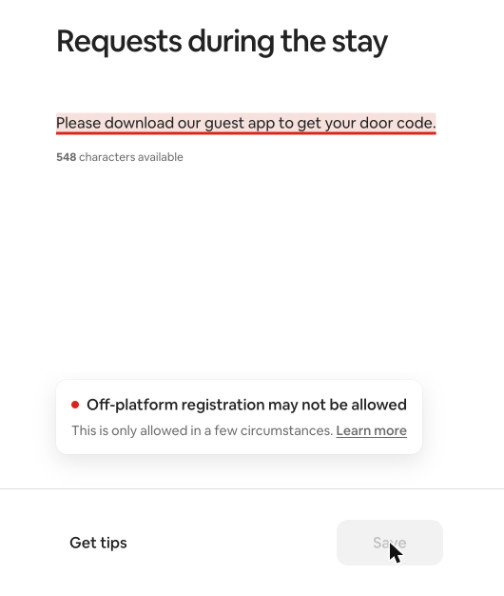
In the editor, “Please download our guest app to get your door code” was flagged as “off-platform registration.” An optional charge for extra plates was flagged as a mandatory fee belonging in “Pricing settings,” while optional breakfast for 15 euros, Airbnb’s own example, passed. Deposits remain allowed for select software-connected hosts, if shown in the price before booking and refunded within 7 days.
What vendors and specialists say
- Seroussi on deposits: “Disclosed deposits and fees through connected software are still allowed.” Airbnb’s Pricing and payment transparency policy confirms it, without saying which hosts qualify.
- Karen Graham, co-founder of the guest experience company Orana Stay, warned of “an administrative nightmare for Property Managers,” with “different policies for each guest based on where the booking came from.”
- Truvi says its screening works from reservation data the manager already holds, without asking the guest for anything.
Our read
On the letter, Seroussi is closer. On the practice, Budimlija is: many old limits were loosely applied, and the new ones come with an editor and listing-level penalties. Here’s how we’d rank exposure:
| Tool category | Exposure | Why |
|---|---|---|
| Legal guest registration | Low | Fits the legal exception, including registration on a separate app |
| Smart locks and keyless entry apps | Low to medium | Allowed if guests can ask for another way in; a required app is flagged |
| Optional guest apps, guidebooks and upsells | Medium | Fine if optional; referral fees must be disclosed |
| Security deposits | Medium | Still allowed for select software-connected hosts, shown before booking |
| ID verification and screening | High | No required ID uploads, photos or background checks without a legal basis |
| WiFi portals and email capture | High | No asking for an email at any point; portals only for hotels, resorts or legal exceptions |
There’s also a cost few have mentioned: check-in flows, rules and messages set by channel rather than by property. That’s work for every property management system, not only the vendors above.
5. Can you still turn Airbnb guests into direct bookings?
What people are asking
Bowles again: “Loved your stay and want to come back next summer? Lovely. I’m not allowed to ask how to reach you.” Orlie Benjamin of lasoh.io started a petition and a LinkedIn poll: “It’s not even about money anymore. It’s about control.” Of 34 votes when we checked, 67% chose “Increase direct booking effort,” 14% “Comply + obey,” 11% “Leave Airbnb” and 5% “I don’t know.” Harrelson’s vote: “Definitely 2. Strongly considering 3.“
What we checked
Asking for emails isn’t new as a ban. Airbnb’s May 2025 off-platform policy already barred asking guests for an email through Airbnb messages or after booking. The spirit hasn’t changed much.
What changed is how hard it is to work around. Many managers got emails through the side doors: a check-in form, a WiFi login page, a guest app required for the door code, a rental agreement to sign. The new policy closes those “at any point during the booking process or stay,” and in our test, a request for an email address was flagged as soon as we saved it.
What vendors and specialists say
- Industry advisor Simon Lehmann voted “comply”: “Airbnb’s marketplace, Airbnb’s rules. A petition won’t move a policy that guests asked for.” Direct share is falling anyway: Key Data reports direct bookings fell to 23% of US reservations from 26% a year earlier. His line: “Direct as a slogan won’t win. Direct as infrastructure will.”
- Eric Goldreyer, founder and CEO of Savvy: “We don’t have a direct booking problem. We have a go-it-alone problem.” His advice: “Comply with Airbnb where you have to, and help build the alternative.”
- Sofia Vienna, who works in market intelligence at the property management software company Jurny: “The operators who will navigate this best are not the ones who fight the rules. They are the ones who spent the last two years quietly building guest email lists, direct booking pages, and independent verification workflows.”
Benjamin and Goldreyer run businesses that benefit when managers rely less on Airbnb. That doesn’t make them wrong, but it’s worth knowing.
Our read
The policy pushes direct booking away from harvesting Airbnb guests and toward what brings guests back anyway: a known brand, a stay worth remembering, and channels where guests find you first, like Google, social media and your own website. In Lehmann’s words: “Comply where you rent the shelf; set your own rules where you own it.”
6. Why small hosts and professional managers are fighting different battles
The backlash isn’t one movement. On LinkedIn, managers and vendors argue about safety, contracts and data. On change.org, small hosts argue about dishes. A UK petition, “Airbnb: Keep Self-Catering Self-Catering,” started by Harry Newington on October 21, passed 5,440 verified signatures by October 22. Its core line: “Guests should not be expected to clean somebody else’s home, but they should be expected to clean up after themselves.”
The camps overlap more than it seems. Even Harrelson agrees: “Is washing your dishes and taking out the trash common courtesy? Of course it is.” She just doesn’t think that’s the part worth fighting over. Sofia Vienna put it in one line: “The glass rule is minor. The ID and agreement restrictions are not.”
The editor draws the line the petition worries about. “Please put used dishes in the sink” passed. “Please load the dishwasher and start it before you leave” and “please wash your dishes weekly,” even for stays over seven nights, were flagged.
Where might Airbnb bend? Our reading, not anything Airbnb has said: on chores, little, since guests asked for this and Airbnb’s CEO promised it back in 2022, though a nuance for long stays or self-catering is possible. On data, clarifications at the edges, like safety signs, building rules and waivers, rather than a reversal, since these rules serve Airbnb’s own interest in keeping the guest relationship.
7. What we found when we tested Airbnb’s Listing editor
On October 23, we typed more than 20 requests, including several cases hosts and managers raised, into the “Requests” section of an unpublished test listing and clicked Save each time.
- It checks when you save, not as you type. Each problem phrase is underlined in red, with a short explanation. Flagged text can still be saved; Airbnb says flagged requests then go to further review (Airbnb).
- It knows the policy’s categories. We saw seven different warnings: chores, fines, mandatory fees, local fines, contracts, personal info and off-platform registration.
- It sends you elsewhere. Contracts go to a “Contracts” section, HOA and local fines to “Local rules,” mandatory fees to “Pricing settings.” The editor is moving information into structured fields Airbnb controls.
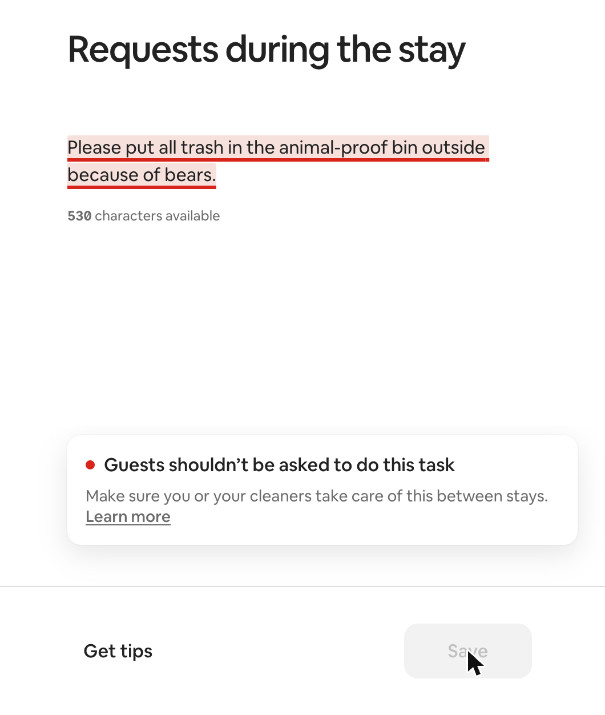
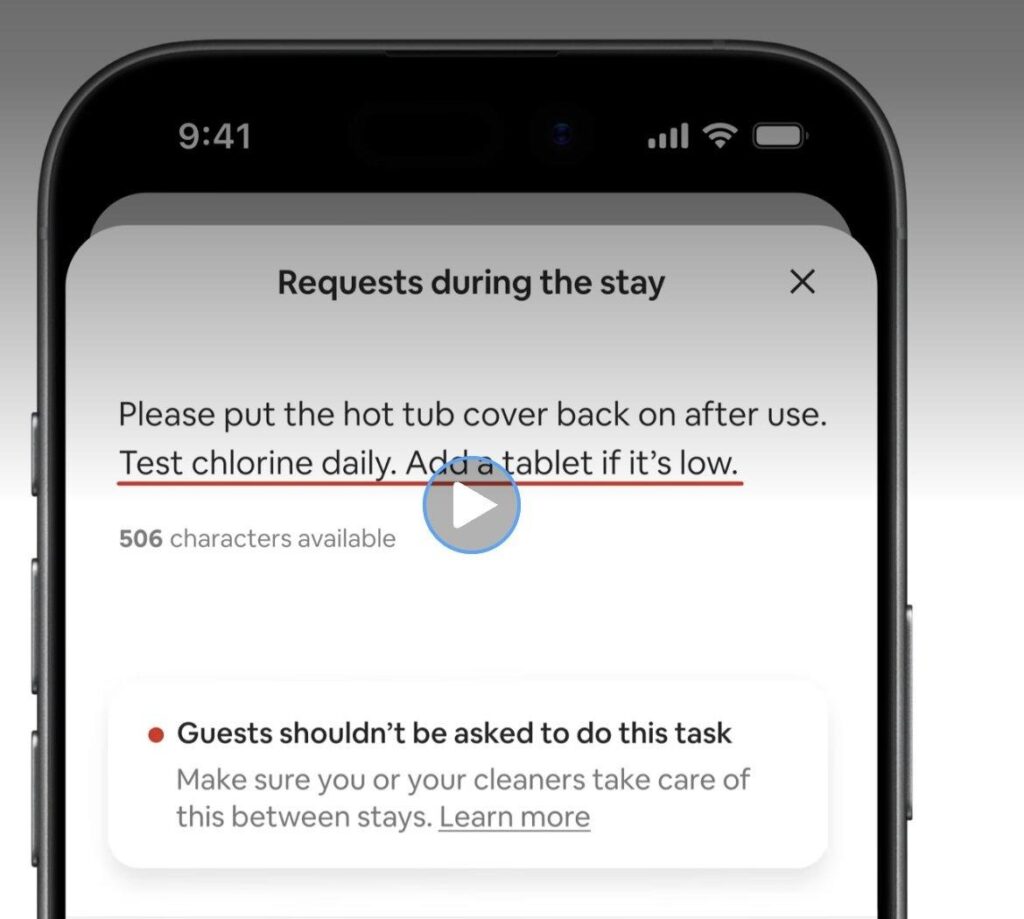
- It reads words, not context. “Please put all trash in the animal-proof bin outside because of bears” was flagged as a chore, though Airbnb’s own policy gives trash in “an animal-proof container in bear country” as a reasonable request (Airbnb). A daily hot tub chlorine check passed for us, though Airbnb’s own demo video shows it flagged.
- Safety and legal notices pass. “No diving,” pool supervision, an own-risk notice, an in-person ID check and a police registration notice citing the law all saved without a flag.
Our test results
| What we typed | Result | Editor’s message |
|---|---|---|
| “Please load the dishwasher and start it before you leave.” | Flagged | “Guests shouldn’t be asked to do this task. Make sure you or your cleaners take care of this between stays.” |
| “For stays over 7 nights, please wash your dishes weekly.” | Flagged | Same chores warning (second half only) |
| “If you check out late, please strip the beds.” | Flagged | Same chores warning |
| “Please take your trash to the outdoor bin before you leave.” | Flagged | Same chores warning |
| “Please put all trash in the animal-proof bin outside because of bears.” | Flagged | Same chores warning |
| “Please put used dishes in the sink and gather used towels before you leave.” | Passed | None |
| “Sort all the garbage” (Before checkout box) | Passed | None |
| “A 100 euro cleaning fee will be charged if the house is left dirty.” | Flagged | “Fines aren’t allowed. Keep in mind Airbnb offers support for damage and house rule violations.” |
| “Unregistered guests are not allowed and will be asked to leave. A 50 euro late checkout fee applies after 11am.” | Fee flagged; first sentence passed | “Fines aren’t allowed” |
| “Our building charges a 200 euro fine for noise after 10pm, which will be passed on to guests.” | Flagged | “Local fines can’t be included here. Add any local government or homeowners association fines in Local rules.” |
| “Extra plates and cookware are available on request for an additional cleaning charge.” | Flagged | “This type of fee can’t be included here. Mandatory fees are only allowed in a few cases, and must be added in Pricing settings.” |
| “Breakfast is available for 15 euros per person, if you would like it.” | Passed | None |
| “All guests must sign our rental agreement before check-in.” | Flagged | “Contracts can’t be included here. They’re only allowed in a few cases, and must be added in Contracts.” |
| “Please send us a photo of your passport and your email address before arrival.” | Flagged (both parts) | “Asking for personal info may not be allowed. This is only allowed in a few circumstances.” |
| A request for the guest’s phone number for storm alerts | Flagged | Personal info warning |
| “Please download our guest app to get your door code.” | Flagged | “Off-platform registration may not be allowed. This is only allowed in a few circumstances.” |
| A notice that the law requires us to register every guest with the police | Passed | None |
| “We will check your ID in person at check-in. Guests are responsible for any damage caused during the stay.” | Passed | None |
| “No diving” and pool supervision instructions; a use-at-your-own-risk notice | Passed | None |
| A daily hot tub chlorine check | Passed (flagged in Airbnb’s demo) | None |
| “Please remove your shoes indoors, no daytime visitors, and return the keys…” | Passed | None |
How much weight to put on this: it was one listing on one day, and Airbnb can change the checker at any time. Passing the editor today doesn’t mean a request complies with the policy. Airbnb reviews listings beyond the editor, and persistent violations can lead to a listing notice or lower search visibility (Airbnb). Likewise, a flag doesn’t mean a host has broken the rules. Airbnb hasn’t said how the checker works; it appears to be automated text analysis, which is fast and consistent but reads words, not the home. A bear bin is a safety rule in Lake Tahoe.
The practical lesson: write requests the way Airbnb’s examples are written, short and tied to the stay. If a genuine safety or wildlife request gets flagged, keep the reason in the text, and be ready to explain it on review.
What Airbnb still hasn’t answered
Our tests show what the editor does today, not what Airbnb will decide in a dispute. These are the questions we’re sending to Airbnb:
- Do safety signs, such as “No diving,” count as house rules added after booking? (The same instruction passes as a request in the listing.)
- How should hosts handle pool, hot tub, dock and fire pit waivers that no law or HOA requires, and does AirCover’s liability insurance respond the same way without one?
- What proof will Airbnb accept for a building security requirement, especially when building documents are confidential?
- Why is a bear-proof bin request, Airbnb’s own example, flagged as a chore, and will flagged safety requests be reviewed by a person?
- Is asking guests not to set the air conditioning below a certain temperature a reasonable request, or restricted access to an amenity?
We’ll update this article with its answers.
What property managers are preparing before November 20
The policy only covers bookings made from November 20, so listings can be fixed without touching existing reservations. Based on the policy, our tests and this week’s discussion:
- Legal basis, market by market: which laws, HOAs or building rules require guest data, and exactly which data. Disclose it in each listing’s requests.
- Listing text: save every listing’s requests in the editor to see what’s flagged. Move contracts, local fines and fees to the sections Airbnb points to, and put key safety instructions in the requests as well as on signs.
- Insurance: how your own policy works alongside AirCover without signed agreements or waivers. Managers with six or more listings should read Airbnb’s host liability program summary with their broker.
- Vendors: how each tool that touches guest data (check-in, screening, deposits, WiFi, locks, recommendations) will work for Airbnb bookings from November 20.
- Turnover records: without ID or an agreement on file, condition photos at each turnover are what an AirCover claim will rest on.
- Repeat guests: shift effort from collecting Airbnb emails to brand, reviews and channels where guests find you first.
Is owning the guest on Airbnb over?
For bookings made on Airbnb, mostly yes, unless the law gives you a reason to collect more.
The chores rule may well improve how guests see vacation rentals, which is good for managers too. But the companion policy is the one that changes how managers operate. It leaves them responsible for the stay while Airbnb holds the identity, the contact details and, increasingly, the rules, now checked line by line in the Listing editor. Airbnb’s answer is that its verification and AirCover carry part of that weight. Having read the terms, we think that’s partly true, and that professional managers are right to keep their own protection in place.
If 2025 is any guide, Airbnb will clarify some of the open questions, and the industry will adapt. The managers who adapt fastest will be the ones who know exactly which laws apply in their markets, and who build their repeat business somewhere Airbnb doesn’t control.

Thibault Masson is a leading expert in vacation rental revenue management and dynamic pricing strategies. As Head of Product Marketing at PriceLabs and founder of Rental Scale-Up, Thibault empowers hosts and property managers with actionable insights and data-driven solutions. With over a decade managing luxury rentals in Bali and St. Barths, he is a sought-after industry speaker and prolific content creator, making complex topics simple for global audiences.
Related Articles:
 Airbnb Launches Host Training Programs in Asia, Canada Pledges $50M Against Rentals, Avantio Partners with Key Data Dashboard
 Airbnb Launches Co-Host Marketplace in Japan, Vrbo to Delist Poor Listings, Booking.com Bets Big on India and AI
 6 Major Airbnb Policy Shifts Every Property Manager Needs to Understand (and Act On)
 Airbnb May 20 2026 Summer Release: What to Expect, and Why This Update Matters More Than Ever