
Airbnb’s new house rules policy takes effect for bookings made from November 20, 2026, and bars hosts from requiring checkout chores like washing dishes or stripping beds.
- What changed: House rules now sit in one place in the Listing editor, every request must be “reasonable,” contracts are limited to a few cases, and collecting guest data is restricted.
- Who it impacts: Hosts and managers with cleaning tasks on their checkout lists, standard rental agreements, or ID collection that no law requires.
- What to watch: How Airbnb weighs “local considerations,” and how quickly listings start showing alerts such as “includes cleaning requests.”
Airbnb is changing its house rules policy on November 20, 2026, and checkout chores are the main target. It answers one of guests’ most persistent complaints about vacation rentals: paying a cleaning fee, then being handed a list of cleaning tasks.
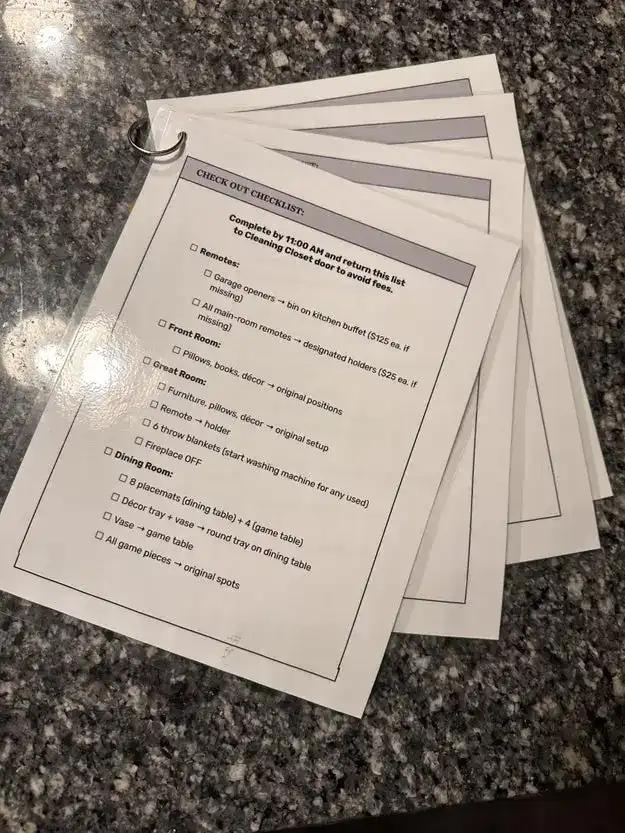
In 2022, a TikTok of one host’s list (rubbish, linens, dishes, laundry), captioned “$700 for two nights ≠ no chores!”, drew nearly 5,000 comments, according to the Otago Daily Times. A four-page checklist shared on Reddit drew thousands more responses in December 2025, BuzzFeed reported.
Hosts, meanwhile, have had little clear guidance on what they can fairly ask, and real reasons to ask: tight turnovers, local recycling rules and owners protecting their homes.
The new Airbnb house rules settle both sides with concrete examples of what’s allowed, consequences for listings that ignore them, and new limits on contracts and guest ID collection.

What Airbnb changed, and what’s already live
Airbnb announced the update on October 20 in an email to hosts and in its Resource Center article, Important changes to house rules. It arrives in two stages.
This isn’t the first time Airbnb has raised the issue. In November 2022, CEO Brian Chesky wrote that he had “heard you loud and clear” that “checkout tasks are a pain,” and said requests should be “reasonable,” Fortune reported. What’s new is a written policy with examples and enforcement.
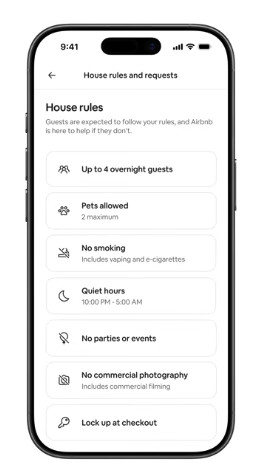
Live since October 20: a new house rules editor. All house rules and requests now sit in one place in the Listing editor, and the separate checkout instructions tab is gone. Hosts choose from seven standard rules:
- Maximum overnight guests (new)
- Quiet hours
- Events
- Pets
- Smoking, vaping and e-cigarettes
- Commercial photography and filming
- Lock up at checkout (new), with optional details on where to return keys
Everything else is now a request. In its explainer video, Airbnb frames requests as being for “the rare instance that you have an additional ask,” and tells hosts to “think like a guest.”
From November 20: the new policy. According to Airbnb’s Reasonable house rules and requests policy, it applies to reservations booked on or after that date. Bookings already made keep the rules that were on the listing when the guest booked, according to Airbnb’s guide to adding house rules.
Guests will also see the rules more often: more prominently on the listing before booking, in the Trips tab and in reservation reminders. Hosts can send them during a stay as a quick reply in messages.
What counts as a “reasonable” request on Airbnb?
Airbnb draws the line at work a cleaner would normally do. Its Resource Center article gives four concrete examples:
| Area | Hosts can ask guests to | Hosts can’t ask guests to |
|---|---|---|
| Dishes | Put used dishes in the sink | Wash dishes and put them away |
| Laundry | Gather used towels | Strip the beds or start a wash |
| Rubbish | Sort rubbish and recycling into indoor bins | Take rubbish off-site |
| Utilities | Switch off the air conditioning when leaving | Avoid using the air conditioning during the stay |
The policy itself rules out four broader categories:
- Effortful tasks: anything that takes significant time or effort, or that a cleaner would normally handle.
- Restricted amenities: limiting access to a feature advertised on the listing.
- Hidden fees: charging for an advertised feature when the fee isn’t in the price shown at booking. Fees for optional add-ons, such as breakfast, can still be listed as requests.
- Fines: imposing fines or other penalties on guests.
Applied to the list from the opening, washing and putting away dishes and driving rubbish to a collection point fall clearly on the wrong side. Putting linens in a basket appears closer to gathering used towels, so it is likely acceptable.
House rules vs. requests: which ones do Airbnb guests have to follow?
Only house rules are binding. Airbnb’s policy says guests “must follow house rules and are encouraged to follow requests.”
The difference matters when something goes wrong. Hosts can cancel without fees or other consequences if a guest breaks a house rule during the stay, or says before check-in that they intend to. Airbnb may also suspend or remove guests who violate its policies.
Requests carry no such backing. Hosts can still contact Airbnb when a guest ignores one, but the cancellation right is tied to house rules.
That leaves checkout chores in a weaker position than many hosts assume. Even a reasonable request, like gathering used towels, appears to be just that: a request. Anything a host truly depends on has to fit one of the seven standard rules, such as lock up at checkout, or be built into the turnover itself.
Does “reasonable” mean the same thing in every country?
Not quite. Airbnb doesn’t define “reasonable” in a single sentence. Instead, it judges each listing in context, “including the type of listing or stay and any relevant local considerations,” and says it may grant exceptions.
It gives two examples of exceptions:
- Asking guests to use animal-proof bins in bear country.
- Asking guests to limit shower time during local drought restrictions.
Waste is where local norms will be tested most. In much of Europe, guests expect to sort their own recycling. In rural areas, the nearest collection point can be a drive away. Thibault Masson, product marketing lead at PriceLabs (the revenue management software company behind RSU), was asked at a countryside rental in Europe to load the sorted rubbish into his car and drive it to one.
Sorting into indoor bins is allowed everywhere. Taking rubbish off-site is on Airbnb’s “not allowed” list, and Airbnb hasn’t said whether a lack of local collection would earn an exception. Hosts in that position would likely need to make their case through the appeal process when a request is flagged.
Local fines are handled separately. Possible fines from a homeowners association (HOA) or local government go in their own section of the listing, not in requests.
What happens if your listing breaks Airbnb’s house rules policy?
The consequences escalate from a warning in the editor to lower search visibility. Based on Airbnb’s Resource Center article and help pages, the steps run like this:
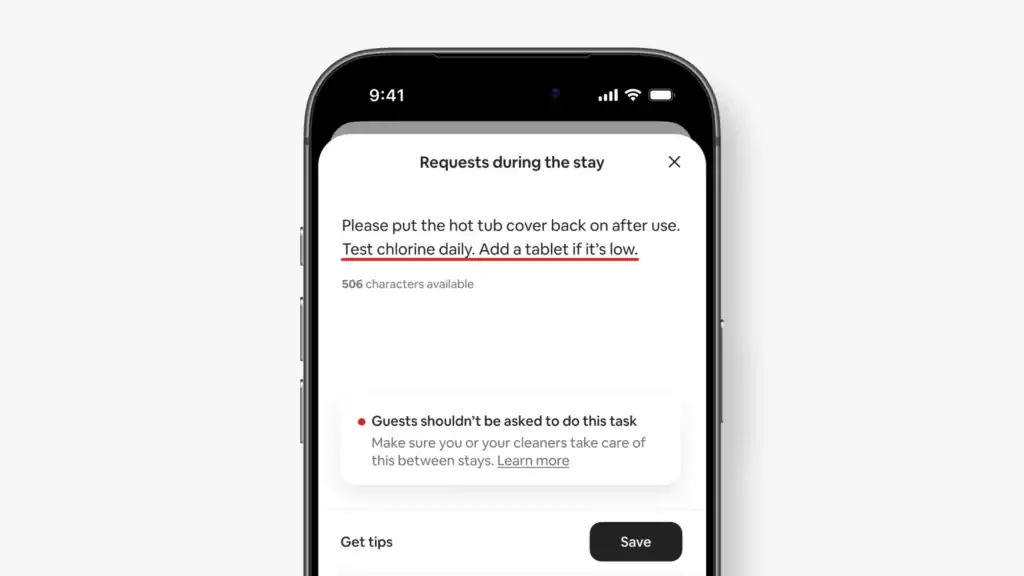
- Flagged in the editor. The Listing editor highlights text that may break the policy, with a short explanation and tips to fix it.
- Sent for review. If a host saves a flagged request anyway, it goes to further review and Airbnb contacts the host with next steps.
- Email and appeal. Hosts receive an email, can appeal and get guidance on resolving the issue.
- Guest-facing alert. If the issue isn’t resolved, guests may see an alert on the listing, such as “includes cleaning requests.”
- Visibility penalties. For persistent violations, Airbnb may add a notice to the listing, reduce its visibility in search or take other action under its Terms of Service.
The last two steps are what make this a revenue issue, not just a compliance one. An alert appears right when a guest is deciding whether to book. Lower search placement means fewer guests see the listing at all.
Rules sent by message or posted on signs no longer count
If a rule isn’t in the listing’s House rules and requests section when the guest books, it isn’t a rule. Airbnb’s policy says hosts can’t add new rules later by message, through signs in the home or in person.
Rules also have to be consistent with the rest of the listing page. A pre-arrival WhatsApp message, a door sign or a guidebook can still remind guests of a rule, but it can’t create one.
Airbnb is offering a replacement for some of those reminders: hosts can now send their house rules as a quick reply in Airbnb messages.
When can Airbnb hosts still require a rental agreement?
Only in four cases. Under Airbnb’s policy on limiting host-imposed contracts, which also applies to bookings from November 20, hosts generally can’t require a separate contract. The exceptions are contracts that are:
- Required by law or by community association rules, such as an HOA or building security.
- Needed to use an optional amenity, such as a golf cart.
- For monthly stays of 28 nights or more.
- For Airbnb Luxe listings, Airbnb’s high-end tier.
How contracts now work on Airbnb
According to Airbnb’s guide to adding a contract, each listing can have one contract, uploaded as a PDF under Contract in the listing’s settings. It is publicly visible, so personal information has to be removed first.
Airbnb may ask hosts to prove that a contract meets one of the four criteria. Airbnb doesn’t require guests to sign and doesn’t enforce the terms, so collecting signatures is the host’s job. A host also can’t require a guest to sign a contract that wasn’t on the listing when they booked.
The practical shift is for managers who send every guest a standard rental agreement. Unless the stay fits one of the four exceptions, that agreement can no longer be a condition of the stay.
Can Airbnb hosts still ask for guest ID? Yes, when the law requires it
The same contracts policy limits what personal data hosts can collect. By default, hosts can’t collect guests’ contact details, ID documents, financial details, background or credit checks, or biometric or health data.
There are two exceptions. Hosts can collect data when it’s necessary to comply with the law or a documented community association rule, or to get an allowed contract signed. In those cases, hosts have to:
- Say in the listing’s requests what data is required and why.
- Collect no more than necessary.
- Store and dispose of sensitive data securely.
- Provide evidence that the exception applies if Airbnb asks.
Without a legal basis, hosts can still check a guest’s ID in person at check-in, as long as the listing’s requests say so. They can’t keep a digital or physical copy.
What this means for check-in apps
Hosts in markets with legal guest registration rules can keep collecting what the law requires, as long as they disclose it. The bigger change is for hosts and managers who ask for ID uploads for security reasons alone, which is common where no such law exists.
The policy also covers apps more broadly:
- Hosts can’t require a third-party app or website registration to enter the home or use a critical amenity.
- Keyless entry apps are allowed if guests can ask for another way in.
- Optional apps, such as smart speakers or thermostats, are fine.
- Hosts can’t ask guests to leave a review or fill in a survey on another site, unless the listing is a hotel.
Is Airbnb’s limit on checkout chores good for hosts?
For guests, it’s a clear win. For hosts, it depends on how much of their turnover was quietly running on guest labor.
The case for the change
Dennis Goedheid, founder and CEO of Casiola, a vacation rental management and franchising company, called the change “overdue” in a LinkedIn post. “Guests pay a cleaning fee and then get a list of chores. That never felt like hospitality,” he wrote.
His view is that the problem sits with the host’s operations, not the guest. “If your turnover only works when guests strip the beds, that’s not a guest problem. It’s a housekeeping process problem.”
The cost side
Basit Ali, founder of Hostomat, pointed to the money. “If your cleaning fee is priced on the assumption that guests do half the turnover, you have 30 days to fix either the checkout list or the fee,” he wrote on LinkedIn.
Stripping beds, starting laundry and washing dishes all take housekeeping time. When guests stop doing them, someone has to be paid to do them instead, and that cost goes into the cleaning fee or the nightly rate.
My take
I think a single, published standard helps hosts as much as guests. Guests who have been burned by a long chore list will book with more confidence when Airbnb sets the limits. Hosts who already run a full turnover lose nothing, and they no longer compete with listings that look cheaper only because guests do part of the cleaning.
How property managers are preparing before November 20
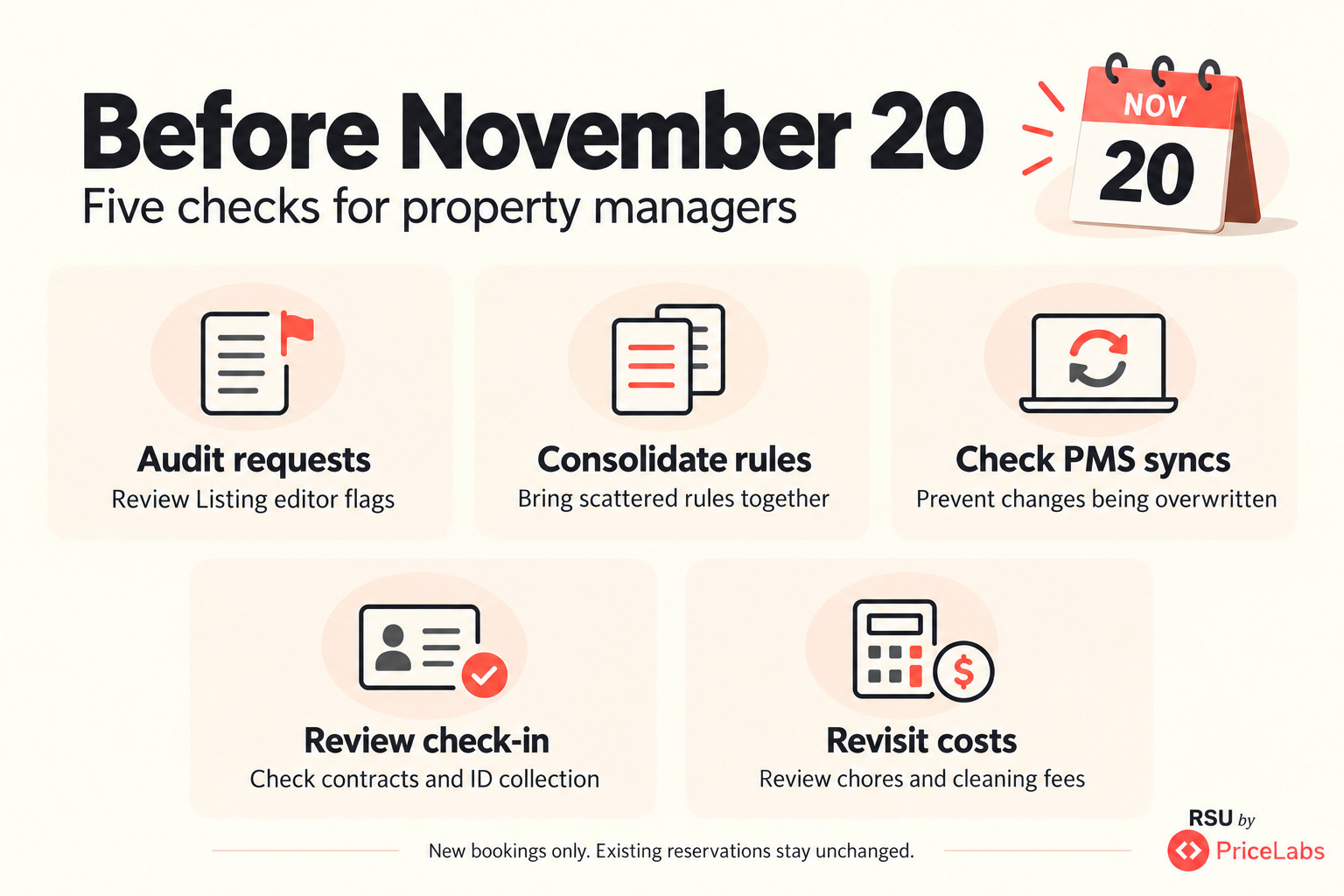
Managers have about a month, and because the policy covers new bookings only, listings can be updated without touching existing reservations.
The preparation falls into five areas:
- Auditing requests: the Listing editor is already flagging requests that break the policy.
- Consolidating rules: moving anything that lives in messages, guidebooks or door signs into House rules and requests.
- Checking software syncs: where rules are pushed from a property management system, confirming that fixes made on Airbnb aren’t overwritten, a point Goedheid also raised.
- Reviewing contracts and check-in flows: testing rental agreements and ID collection against the exceptions above.
- Revisiting the numbers: deciding whether removed chores mean a shorter checkout list, a higher cleaning fee or both.
How to talk to owners about the new house rules
Many of the strictest checkout lists come from owners, not managers. For those conversations, the policy gives managers a clear third-party standard to point to, and a short set of options:
- Absorb the work: move the tasks into housekeeping and accept the extra cost.
- Reprice: cover the added labor through the cleaning fee or nightly rate.
- Use the right tool: turn what qualifies into a standard rule (lock up at checkout) or an allowed contract (HOA requirements).
- Keep the list as is: and accept the risk of a guest-facing alert and lower search visibility.
For owners who see chores as a way to protect their home, the binding house rules are still there: events, pets, smoking, quiet hours and maximum overnight guests.
FAQ: what can an Airbnb host ask guests to do?
Can an Airbnb host ask me to wash the dishes?
Not for bookings made from November 20, 2026. A host can ask you to put used dishes in the sink, but not to wash them and put them away.
Can an Airbnb host ask me to strip the beds?
No. A host can ask you to gather used towels, but not to strip the beds or start a load of laundry.
Can an Airbnb host ask me to take out the trash?
A host can ask you to sort trash and recycling into indoor bins, but not to take it off-site. Airbnb may allow local exceptions, such as animal-proof bins in bear country.
Do I have to follow house rules a host sends by message?
No. Only rules listed in the House rules and requests section when you booked apply. Rules added later by message, on signs or in person don’t count.
Can an Airbnb host fine me?
No. Hosts can’t impose fines or penalties on guests. They can tell you about possible fines from a community association or local government.
Can an Airbnb host ask for a copy of my ID?
Only when the law or a documented community association rule requires it, and the listing says so. Otherwise, a host can check your ID in person at check-in but can’t keep a copy.
What happens if I ignore a checkout request?
Requests are encouraged rather than required. A host can cancel without penalty only if you break a house rule, such as the limit on overnight guests.

Uvika Wahi is the Editor at RSU by PriceLabs, where she leads news coverage and analysis for professional short-term rental managers. She writes on Airbnb, Booking.com, Vrbo, regulations, and industry trends, helping managers make informed business decisions. Uvika also presents at global industry events such as SCALE, VITUR, and Direct Booking Success Summit.