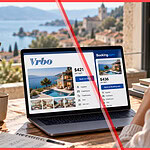
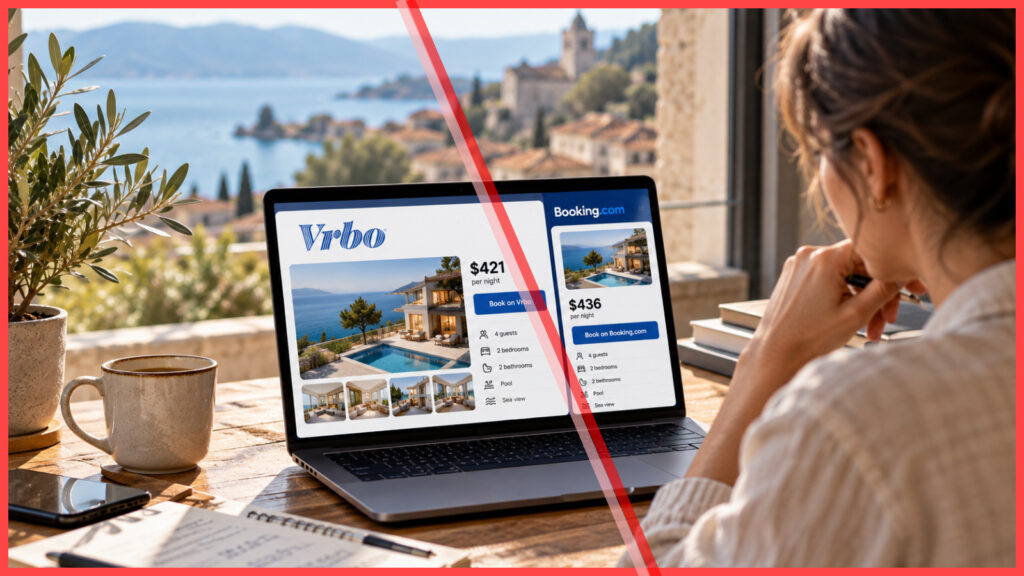
Vrbo plans to drop its requirement that your Vrbo price match your own website. Its new 12% commission still starts October 29.
- What changed: After host pushback, Vrbo plans to stop requiring your Vrbo price to match your own website, reports say. Other booking sites still can’t beat your Vrbo price, and the commission change goes ahead.
- Who it impacts: Vrbo hosts, including those on Vrbo’s local sites Abritel in France and FeWo-direkt in Germany, whose new contracts carry the same price rule.
- What to watch: Whether the change reaches Abritel and FeWo-direkt, and when Stayz (Australia) and Bookabach (New Zealand) publish new terms.
Vrbo may walk back a requirement it only just added to its terms: that your Vrbo price match your own website. Its new commission, a flat 12% for most hosts from October 29, is not changing.
Guests will still pay a service fee on Vrbo. Vrbo says that fee will become dynamic and will “typically be lower” than today, according to Expedia’s FAQ, but it has not said by how much.
For Vrbo hosts, that means paying more per booking while guests may see lower fees, and, if the walk-back is confirmed, more freedom to price their own websites. Outside the US, the details depend on the market. In France and Germany, where Vrbo operates as Abritel and FeWo-direkt, the same price rule is already in hosts’ new contracts.
This article covers what Vrbo is changing, what its terms say in each market, and how Vrbo would even know what you charge elsewhere.

Is Vrbo dropping rate parity? Only for direct sites, and not yet in writing
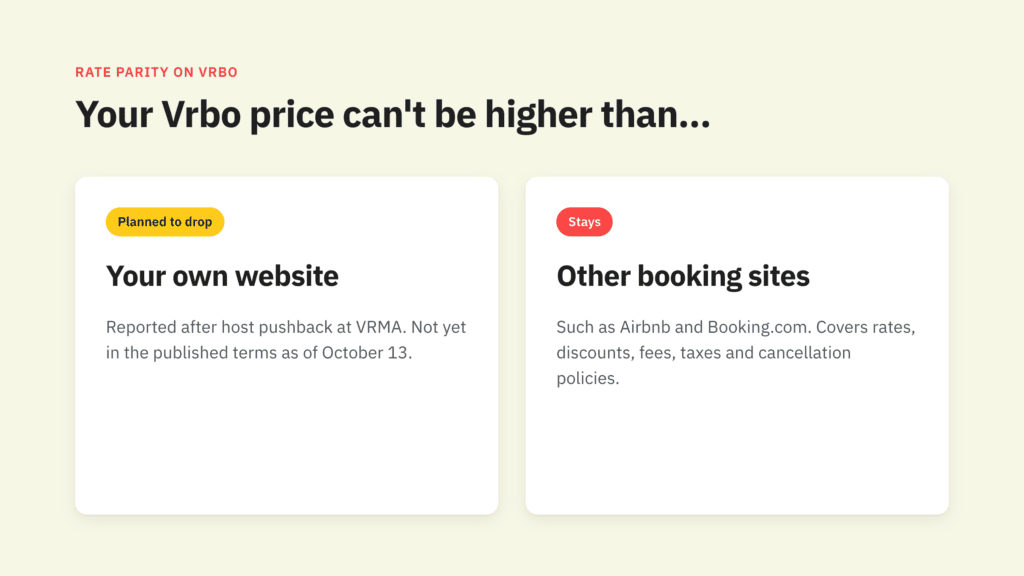
Rate parity means your price on Vrbo can’t be higher than your price anywhere else. Vrbo added it to its new Host Terms, effective October 29, as RSU reported on September 30. It now plans to drop that requirement for hosts’ own websites. Your Vrbo price would still have to match or beat other booking sites, such as Airbnb and Booking.com.
Why Vrbo is revisiting the rule
The plan follows pushback at the Vacation Rental Management Association (VRMA) conference in Nashville last week, according to Skift. Property managers and vacation rental software executives raised concerns about the move to a single 12% commission.
- Vrbo staff at the event said the new model is meant to make Vrbo more competitive and lower the fees guests pay, the report says.
- Tim Rosolio, Expedia Group’s vice president of vacation rental partnerships, said partners received the standard 30-day notice.
What has not changed yet
As of October 13, the published terms still carry the original wording.
- The Vrbo Host Terms effective October 29 show no revision.
- Expedia’s FAQ on the change does not mention parity.
Do Vrbo’s new terms require rate parity? Yes, and prices are explicitly included
The word “parity” never appears in Vrbo’s October 29 Host Terms. The obligation comes from two clauses read together.
- Section 4.5.7 requires everything you list on Vrbo to be “at least as complete, accurate, current, detailed, and favorable” as what you offer anywhere else, including your own website.
- Section 5.5.1 spells out that this covers “availability, rates, discounts, fees, taxes, cancellation policies, booking conditions.”
In short, your Vrbo prices and fees can’t be worse than anywhere else, as RSU reported on September 30.
Consistent prices also help your Vrbo search ranking
Two more clauses affect this day to day.
- Section 7.1 lists “rate consistency” as one factor in how Vrbo scores listings for search, alongside an accurate calendar and few host cancellations. The terms don’t explain what it means.
- Section 12.7.2 says your listing can’t be noticeably better elsewhere, for example more detailed or easier to book, unless the law requires it or Vrbo agrees in writing.
If you don’t meet these rules, Vrbo can edit, pause or remove your listings (section 9.2.14).
It is not yet clear whether dropping the requirement would change this score. A lower price on your own site could be allowed by the contract and still hurt your Vrbo search ranking.
Do the new terms apply to Abritel, FeWo-direkt, Stayz and Bookabach?
They apply in France and Germany. In Australia and New Zealand, no new terms have been published yet.
Vrbo grew partly by acquiring local rental sites and kept several of their brands. Hosts in those markets sign that brand’s terms, not the vrbo.com version. The US Host Terms, for example, cover only the US, Canada and Brazil.
| Brand | Market | October 29 terms published? | Price rule covers your own website? | Company you sign with |
|---|---|---|---|---|
| Vrbo | US, Canada, Brazil | Yes | Yes (sections 4.5.7 and 5.5.1) | HomeAway.com, Inc. (US, Canada); a Brazilian Expedia subsidiary |
| Abritel | France | Yes | Yes (sections 4.3.7 and 5.5.1) | EG Vacation Rentals Ireland Limited |
| FeWo-direkt | Germany | Yes | Yes (sections 4.3.7 and 5.5.1) | EG Vacation Rentals Ireland Limited |
| Stayz | Australia | No, the notice page is empty | No, current terms date from August 1, 2025 | HomeAway.com, Inc. |
| Bookabach | New Zealand | No, the notice page is empty | No, current terms date from August 1, 2025 | HomeAway.com, Inc. |
The 12% commission itself appears in the help centers for Vrbo, Abritel and FeWo-direkt, with the same wording in each language. The same pages list separate tax rules for properties in Australia, Japan and New Zealand.
Abritel hosts in France: rate parity (price matching) applies from October 29
Abritel’s new terms include the same price-matching rule as Vrbo’s US terms. They take effect on October 29, 2026 (“29 octobre 2026”).
Hosts sign with EG Vacation Rentals Ireland Limited, an Expedia Group company in Dublin, according to the Abritel host terms.
What Abritel’s price rule says
- Section 4.3.7: everything you list on Abritel must be at least as complete, accurate, up to date, detailed and favorable (“favorables”) as anywhere else.
- Anywhere else includes: your own websites, apps, booking engines, social networks and AI or automated agents.
- Section 5.5.1: what you list (“Contenu”) includes prices (“les tarifs”), discounts, fees, taxes and cancellation policies.
In practice, your Abritel rates should not be higher than your rates on your own website or other platforms.
One difference from the US: price is not listed as a search ranking factor
Abritel’s ranking clause (section 7) names location, search relevance and guest reviews. It does not name price or “rate consistency,” unlike section 7.1 of the US terms. Price appears only as a sort or filter option for travelers.
The list in section 7 is not exhaustive, so this does not rule out price as a factor. It does mean the French contract does not state it.
What happens if a host does not comply
Breaking the price rule means breaking the contract. Abritel can respond in these ways:
- Suspension or cancellation (section 9.2): of the affected listing, or of all the owner’s listings, with no refund of listing fees.
- Other measures (section 9.3): restricting use of the site, removing the listing from search results or lowering its ranking, or showing “Indisponible” (unavailable) on the owner’s profile.
- Notice first (section 9.4): Abritel must generally notify the owner and allow a correction, except in cases such as fraud or illegal activity.
Commission and VAT on Abritel
- Commission: 12%, with VAT (TVA) charged on top where it applies, according to Aide Abritel.
- VAT-registered owners: EU owners with a VAT number aren’t charged VAT by Abritel and declare it themselves instead (section 13).
It is not yet known whether the change Skift reported will also apply to Abritel.
How would Vrbo know what you charge elsewhere?
Vrbo’s terms don’t say how it checks your prices on other sites. Online travel agencies typically do it by scanning other websites for the same listing.
What a price scan compares
A scan finds the same property on another site and compares like for like:
- The same stay: identical dates, number of nights and number of guests.
- The total price: the nightly rate plus fees such as cleaning, since Vrbo’s rule covers fees as well as rates.
- Availability: whether dates are open on one site and closed on another, which the rule also covers.
If the same stay costs less elsewhere, that gap is what a parity check would pick up.
Booking.com shows that this scanning happens. Its partner dashboard still displays external price scans, now “for information only” in Europe, as RSU reported on October 8.
Why vacation rentals are harder to check than hotels
- Hotels are easy to match. The same hotel has the same name and address on every site, so comparing prices is relatively simple.
- Vacation rentals are not. The same home can carry a different name on each site, often hides its exact address, and may not be listed everywhere.
- The gap is closing. Data tools that match photos and listing details make it easier to find the same property across sites.
How Vrbo could enforce the rule
The terms give Vrbo two levers. The softer one is search ranking, since “rate consistency” feeds a listing’s quality score (section 7.1). The harder one is editing, pausing or removing listings (section 9.2.14).
Where the rule comes from
In my view, parity is a hotel-industry habit moving into vacation rentals. Booking.com built its business on hotels, and Vrbo now sits inside Expedia Group, which did the same. That context helps explain why the Booking.com comparison below matters for Vrbo hosts.
How does Vrbo compare with Booking.com on parity in Europe?
In Europe, the two platforms now take opposite approaches. Booking.com no longer looks at your prices elsewhere at all, while Vrbo’s new European contracts still require your Vrbo price to be your best price. The timing stands out: Booking.com cut its last link to outside prices in September, weeks before Vrbo’s new contracts take effect.
Booking.com: no price-matching rules in Europe
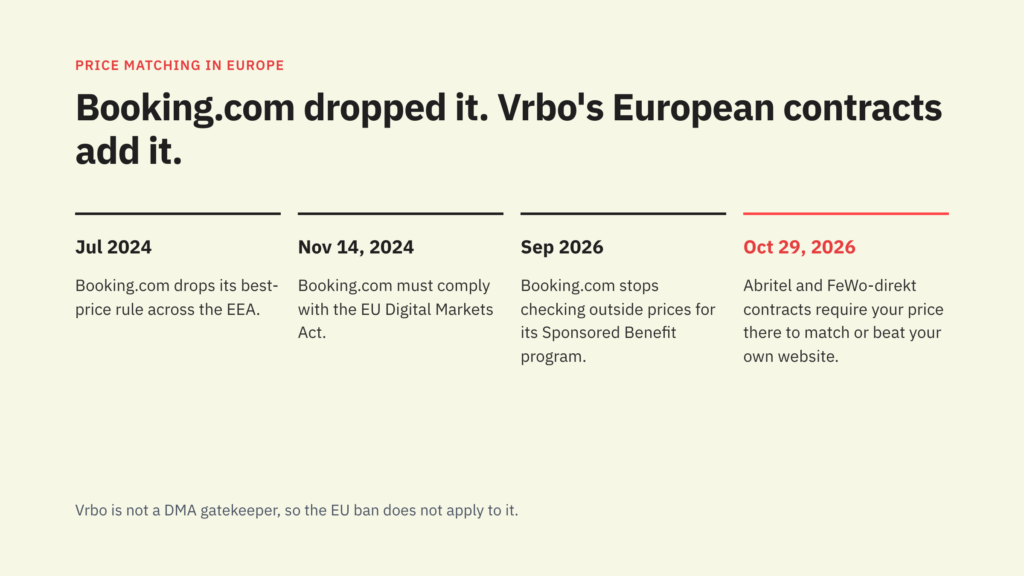
Booking.com has had to comply with the Digital Markets Act (DMA), the EU law that sets rules for the largest “gatekeeper” platforms, since November 14, 2024.
- July 2024: Booking.com dropped its rule requiring your Booking.com price to be your best price across the European Economic Area (EEA), the EU plus Iceland, Liechtenstein and Norway.
- September 2026: it stopped checking outside prices when deciding eligibility for Booking Sponsored Benefit, its sponsored discount program. According to the European Commission, this removed the last way your prices elsewhere could affect your Booking.com terms in Europe.
RSU covered the details in Booking.com Rate Parity in Europe.
Vrbo: not covered by the EU ban
The DMA covers only the largest platforms, and Vrbo is not one of them, so the ban does not yet apply. Its new Abritel and FeWo-direkt contracts, starting October 29, require your price there to match or beat your own website.
For a manager listing the same property on both platforms in France or Germany, the price-matching rule applies on Abritel or FeWo-direkt but not on Booking.com.
What Vrbo’s October 29 changes mean for hosts
Vrbo’s plan to drop the requirement was reported during the VRMA conference itself, which suggests it is listening to professional managers. Until revised wording is published, though, the October 29 terms are the ones hosts accept.
- The commission change goes ahead. It is a flat 12% for most hosts and up to 15% in some regions. The PriceLabs knowledge base shows how much Vrbo prices would need to rise to keep payouts the same, by setup and by country, including VAT and GST. PriceLabs is the revenue management software company behind RSU.
- European hosts sign separate contracts. Abritel and FeWo-direkt have their own terms, so a change announced for vrbo.com may not reach them automatically.
- Direct bookings from Vrbo guests still carry commission. Expedia’s FAQ also points to a long-standing rule, now in the terms “for consistency”: if a guest first contacts you through Vrbo and books with you directly within 30 days, Vrbo is owed its commission.
RSU will update this story when Vrbo publishes the revised clause.

Uvika Wahi is the Editor at RSU by PriceLabs, where she leads news coverage and analysis for professional short-term rental managers. She writes on Airbnb, Booking.com, Vrbo, regulations, and industry trends, helping managers make informed business decisions. Uvika also presents at global industry events such as SCALE, VITUR, and Direct Booking Success Summit.
Related Articles:
 Vrbo Q2 2025 Results Show Clear Shift Toward Promotions, Shorter Stays, and Bundled Value
 Vrbo Tightens Its Premier Host Standards: What Property Managers Need to Know (UPDATED)
 Vrbo’s New Tagline Signals the End of the Ad Wars — and a Bigger Strategic Shift
 Vrbo Moves All Hosts to a Single 12% Commission: What Changes on October 29