

Updates in short-term rental policies this week: Santa Barbara’s City Council voted unanimously on October 6 to advance rules that bar short-term rentals from Inland residential zones and high-fire areas, while Ireland published its Short Term Letting and Tourism Bill and Orange Township, New Jersey, passed a permit ordinance on first reading.
- What changed: Santa Barbara’s two ordinances keep a two-night minimum, limit licenses to one per owner and close inland residential zones to rentals. Ireland’s bill puts registration checks on booking platforms, and Orange Township’s Ordinance 44-2026 adds an annual permit and a two-night minimum.
- Who it impacts: Vacation rental managers and hosts with homes in Santa Barbara’s inland and high-fire areas, anyone listing in Ireland, and owners in Orange Township.
- What to watch: Santa Barbara’s final adoption vote on October 27, Orange Township’s second reading on November 4, and the opening of Ireland’s register on December 1.
Santa Barbara’s City Council voted unanimously on October 6 to advance two short-term rental ordinances, one for the inland area and one for the coastal zone. The inland ordinance bars rentals from residential zones and high-fire areas, and the city plans formal adoption on October 27.
Ireland and Orange Township moved the same day. Ireland published a bill that makes booking platforms display registration numbers and remove non-compliant listings, and Orange Township’s council passed a permit ordinance on first reading. Each one is still short of final law, so the details below can change.
Santa Barbara bars short-term rentals from inland residential zones and high-fire areas
- The City Council voted unanimously on October 6 to advance two ordinances, one covering the inland area and one covering the coastal zone, according to the city.
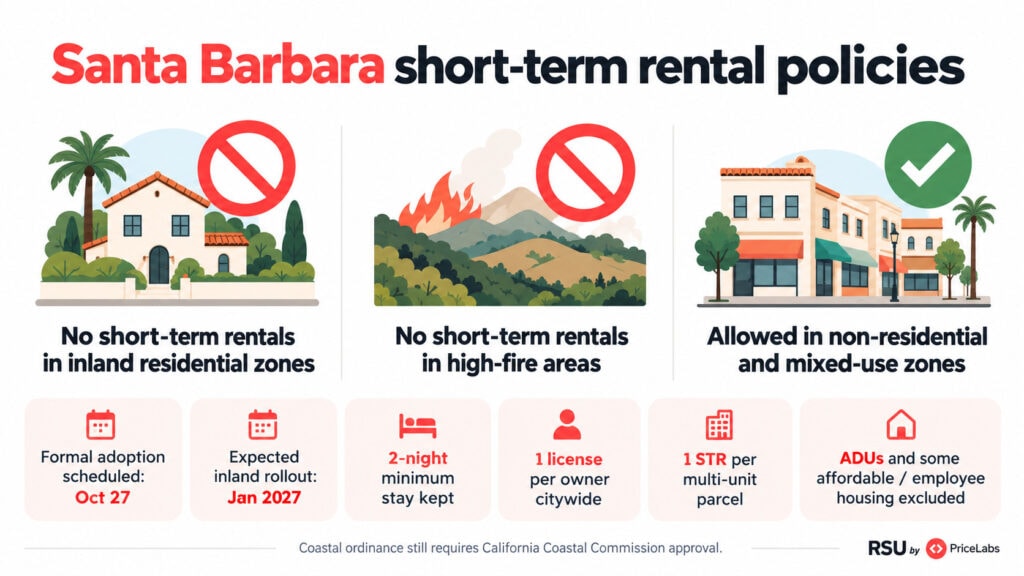
- Formal adoption is scheduled for October 27. The city plans to post the final text the Thursday before the hearing, so details can still change.
- The inland ordinance bars short-term rentals from all residential zones and high-fire areas. Noozhawk reports that rentals will be allowed only in non-residential or mixed-use zones, including the downtown, Milpas Street and Upper State Street corridors.
- The council kept a two-night minimum stay, limited licenses to one per owner citywide, and limited multi-unit parcels to a single short-term rental.
- Accessory dwelling units and some affordable and employee housing are excluded, according to KEYT.
- The city expects the inland rules to begin rolling out in January 2027. The coastal ordinance goes to the California Coastal Commission before it takes effect.
Aishwarya’s Views
- Fire-risk maps add a second layer of zoning: A home can sit in a zone that would otherwise qualify and still fall inside a high-fire area, so the check has to happen parcel by parcel.
- Vacation rental managers and hosts can run each inland address against the city’s license area map before January.
- Legal supply concentrates in commercial corridors: The one-license-per-owner limit caps how much of that supply any single owner can hold.
- Managers with inland homes in prohibited zones can move them to stays longer than 30 days, since the new chapters cover rentals of fewer than 30 days.
Ireland publishes its Short Term Letting and Tourism Bill
- Minister Peter Burke published the bill on October 6. It gives effect to EU Regulation 2024/1028, according to the government’s press release.
- Fáilte Ireland becomes the competent authority and runs a national register covering stays of up to 21 nights.
- Hosts must obtain a registration number and display it on every advertisement and listing.
- Platforms must display the numbers, run random checks on listings, submit data on rental activity, and remove or disable non-compliant listings where required.
- Serious platform breaches can bring fines of up to 2% of annual worldwide turnover.
- The bill is moving through the Oireachtas. The register is set to open on December 1, and the Department of Enterprise, Tourism and Employment says hosts must be registered by December 31.
- Hosts must confirm they are planning compliant to register. Hosts in locations with under 20,000 population have two years to regularise their planning.

Aishwarya’s Views
- Enforcement moves to the point of booking: A listing without a valid number can be disabled at the platform, so enforcement does not depend on inspectors reaching every host first.
- Vacation rental managers and hosts can confirm that every Irish listing has a place for the registration number ready before December 1.
- Planning status decides who can register: Hosts must show planning compliance at registration, and only smaller locations get the two-year window.
- Managers can audit planning status for every Irish property now and collect the documents before the register opens.
Orange Township introduces a short-term rental permit system
- Orange Township’s council passed Ordinance 44-2026 on first reading on October 6. Second reading and final passage are scheduled for November 4, according to the township’s public notice.
- The ordinance adds a short-term rental article to the rent control and rental registration chapter and defines a short-term rental as a stay of fewer than 30 consecutive days.
- Each property needs an annual permit, and every listing must carry the permit number.
- Rentals need a minimum stay of two consecutive nights, and reservations cannot be split to get around it.
- Occupancy is capped at the lesser of the lawful occupancy or two guests per bedroom plus two, with children under two not counted.
- Each property needs a responsible party reachable around the clock, who answers by phone within 30 minutes and can reach the property within 60.
- Rent-controlled units can be used as short-term rentals only if the owner shows the city attorney or another city official that the use is lawful under the rent control rules.
- Existing short-term rentals get 90 days after the effective date to apply for a permit.

Aishwarya’s Views
- Rent control units go through a city review: The ordinance sends them through an approval step instead of a flat ban.
- Owners can confirm the rent control status of each unit before applying for a permit.
- The responsible-party rule is the heaviest operational change: Around-the-clock coverage with a 60-minute on-site response requires a local contact for every permitted property.
- Managers running remote portfolios can line up local contacts before the ordinance takes effect.
- The two-night minimum ends single-night gap filling: The ban on split reservations closes the workaround.
- Managers can set a two-night minimum in their PMS and pricing tools for Orange Township listings and price the shoulder nights of longer stays accordingly. The ordinance has passed first reading only, so the text can still change before November 4.
Vacation rental managers and hosts tracking short-term rental regulation have three dates to watch. Santa Barbara’s council holds its final adoption vote on October 27, Orange Township’s council takes up the second reading on November 4, and Ireland’s register opens on December 1.