TL;DR: Since October 8, guests who live in 10 European countries can add “weather protection” at Airbnb checkout. This so-called “rain insurance” lets guests receive €50–€1,000 per qualifying rainy day. It’s underwritten by Chubb and pays automatically based on measured rainfall, with no claim required.
Why it matters:
- For Airbnb: A new revenue stream that could increase its take rate, while making guests more comfortable booking off-season stays in rainy destinations.
- For property managers: An opportunity to improve low-season conversion, but also a potential disadvantage for direct bookings that lack similar protection.
- For guests: An easy-to-understand add-on, but it covers only significant rain during daytime hours, not wind, snow or hail.
Competitive context: HomeToGo and Vrbo already offer similar products. Airbnb’s advantage is its massive distribution and a simpler, per-rainy-day payout model.
Bottom line: This isn’t a new insurance concept; it’s Airbnb bringing weather protection to scale. Property managers should prepare to answer guest questions, test it in off-season marketing and monitor how paid add-ons affect the total price guests see at checkout.

Airbnb pays a fixed amount per rainy day, in 10 European countries
Here’s what Airbnb announced: a “parametric” policy, which means it pays out when a weather station or satellite measures a set threshold, not when the guest proves a loss (see the Airbnb announcement and the help center terms).
The numbers:
- A rainy hour means at least 1.5 mm of rain per hour at the listing, counted between 08:00 and 20:00 local time.
- A day counts once it reaches the minimum number of rainy hours shown on the certificate (3 in Airbnb’s example: €95 per day, €380 in total).
- The payout ranges from €50 to €1,000 per day, and stays of 30 nights or more are capped at 29 days.
- Guests must buy at checkout or at least 7 days before check-in. They get a full refund if they cancel at least 10 days before arrival, and nothing back after that.
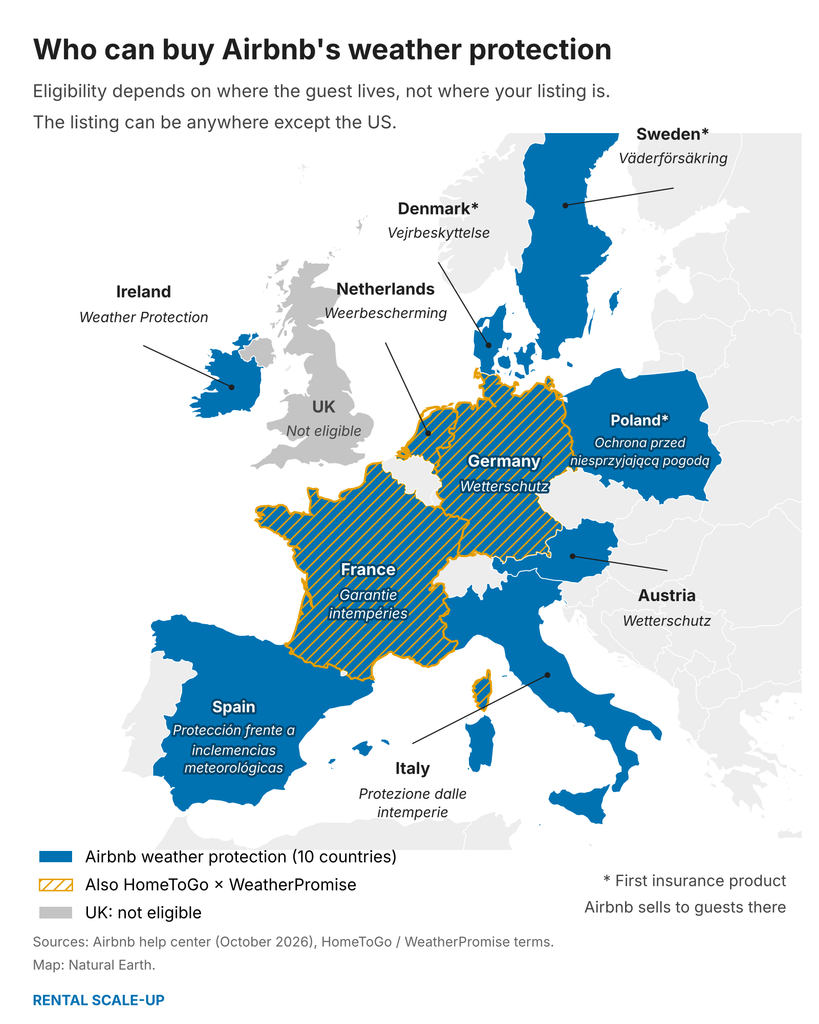
Who can buy it: residents of 10 countries, where the product goes by a different name in each language.
| Country | Name on Airbnb |
|---|---|
| France | Garantie intempéries |
| Germany | Wetterschutz |
| Austria | Wetterschutz |
| Italy | Protezione dalle intemperie |
| Spain | Protección frente a inclemencias meteorológicas |
| Netherlands | Weerbescherming |
| Poland | Ochrona przed niesprzyjającą pogodą |
| Sweden | Väderförsäkring |
| Denmark | Vejrbeskyttelse |
| Ireland | Weather Protection |
It isn’t available in the UK or the US, so far, and trips to the US are excluded even for eligible residents. In Denmark, Poland and Sweden, it’s the first insurance product Airbnb has sold to guests.
However, the fine print matters: it covers rain only (no snow, hail or wind), and only the booker is covered. It excludes forecast natural disasters and trips under travel advisories, and a guest who cancels the policy can’t buy it again.
How it compares:
| Airbnb | HomeToGo × WeatherPromise | Vrbo × WeatherPromise | |
|---|---|---|---|
| Rainy hour | At least 1.5 mm/h | More than 1 mm/h | Set per property |
| Payout | Per day, from the first rainy day | All or nothing, once the trip threshold is met | Per day once the threshold is met |
| Where it’s measured | At the listing | 8 km radius | At the property |
| Snow and hail | Not covered | Covered (melted equivalent) | — |
| Markets | 10 EU countries | France, Germany, Netherlands | US only |
So, if it rains all the time in Brittany or the Netherlands, won’t guests get paid every day? No, and the reason is the threshold. A light drizzle doesn’t count: an hour only counts as rainy at 1.5 mm or more, which is a proper downpour, and Airbnb needs several of those hours in the same day before it pays.
The price also follows the local odds. Airbnb’s insurer prices each policy on about 20 years of weather data for that place and those dates, so a November week in Brittany would cost more than a June week in Seville. In other words, guests in rainy regions don’t get a bargain: they pay for the risk they actually face.
To give an order of magnitude, a HomeToGo quote we pulled for 9 days in Normandy in November priced a €555 payout at €36.26, about 6.5% of the payout.
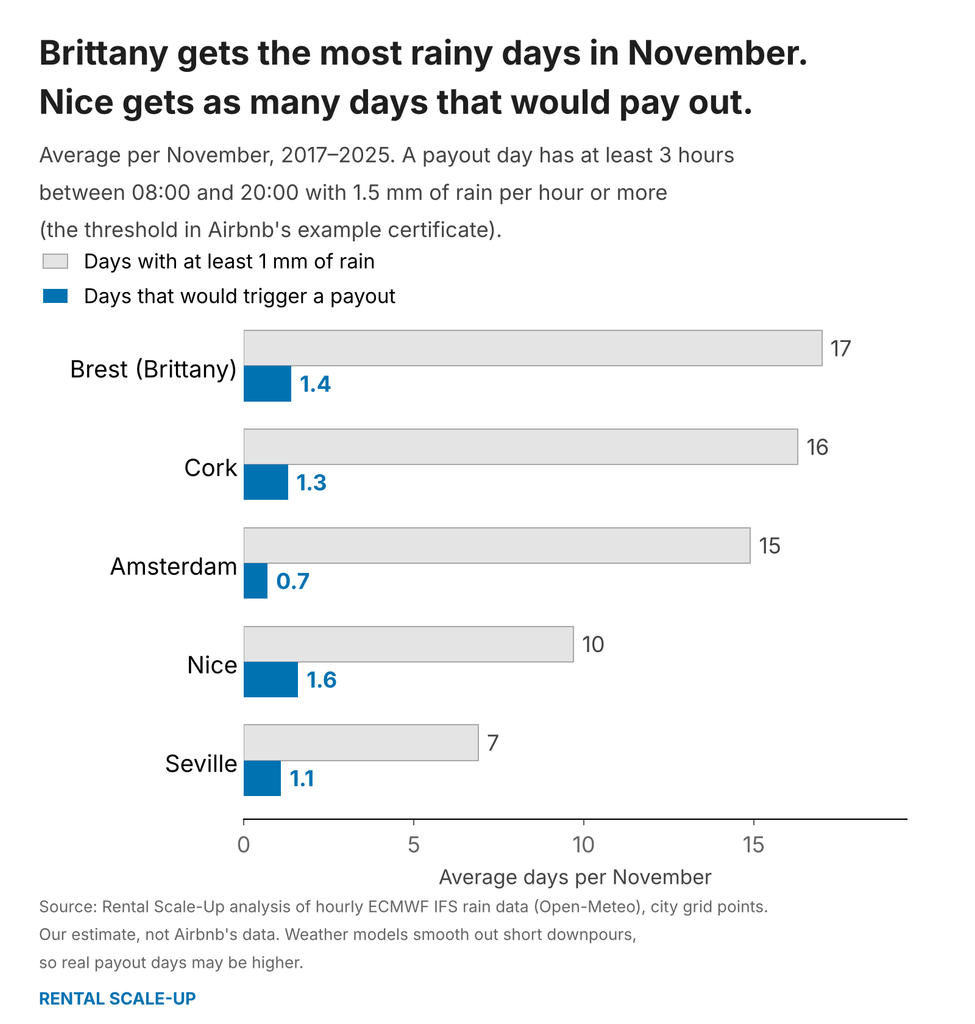
We checked how often Airbnb’s threshold is actually met, using nine years of hourly weather data. Brest gets about 17 days with at least 1 mm of rain in an average November, but only about 1.4 days that would meet the threshold in Airbnb’s example, while sunny Nice, with 10 rainy days, gets 1.6. So, Brittany’s rain is mostly drizzle, and the Riviera’s comes in downpours.
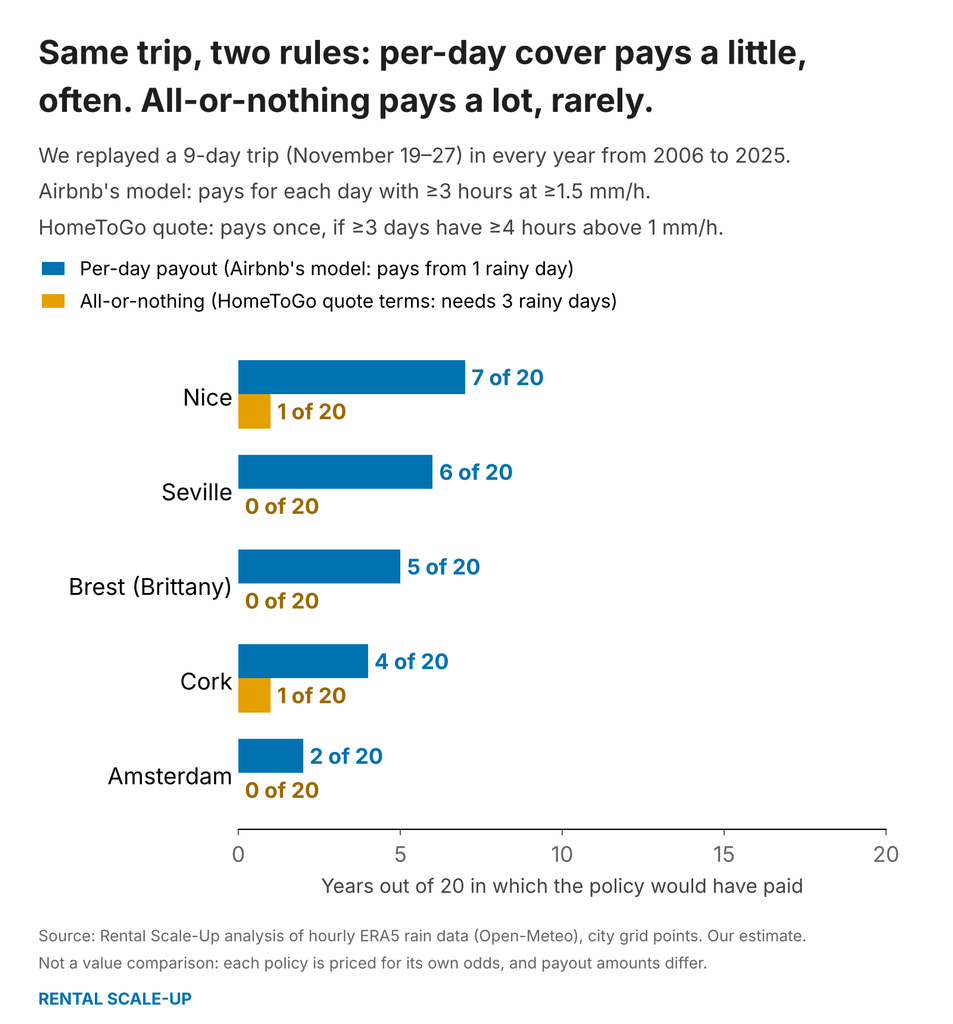
We then took the dates of our HomeToGo quote (a 9-day trip, November 19–27) and replayed them in five cities in each of the last 20 years. Under Airbnb’s per-day rule, a guest in Brest would have been paid something in 5 of those 20 years, while under the all-or-nothing terms of the HomeToGo quote, they would have been paid in none. That’s not a judgement on value, since each policy is priced for its own odds, which fits with the HomeToGo cover costing only about 6.5% of its payout.
To be fair: it’s not a promise of sunshine. It’s a fixed payout for a properly wet day, priced for where and when you travel.
HomeToGo and Vrbo got there first; Airbnb brings the scale
Zoom out, and the timeline is long:
- 2024: Sensible Weather with Hipcamp and KOA (US camping), and HomeToGo tests WeatherPromise in Germany (May).
- 2025: JetBlue Vacations (February), Marriott Homes & Villas (June), and HomeToGo in France and the Netherlands (October).
- 2026: Vrbo in the US (February), JetBlue’s Jamaica guarantee (March), and Airbnb in 10 EU countries (October).
- Abritel, Booking and Hopper: nothing comparable so far.
We covered the US side of this story in our analysis of Vrbo’s WeatherPromise guarantee.
The bottom line on innovation: Airbnb didn’t invent rain insurance, but it may be the one that makes it ordinary. The new part is the scale (one checkout, 10 countries, 9 languages) and the per-day payout from the first rainy day, which is easier for guests to understand than an all-or-nothing trip threshold.
Why Airbnb is doing it: bookings, take rate, and an insurance stack
Airbnb’s case: the product takes away a reason not to book. It’s the same logic as Reserve Now, Pay Later (pay nothing upfront), which CFO Ellie Mertz said “drove more bookings, longer booking lead times” in Q2 2026.
Here’s the thing: management has said where this fits.
- From the Q1 2026 shareholder letter: “our insurance programs, which are expected to lift our full-year take rate”.
- Same letter: Airbnb has “begun piloting additional forms of insurance products to support both guests and hosts”.
- Brian Chesky (Q1): the payments and pricing roadmap could deliver “hundreds of millions of dollars in revenue each year”.
- Ellie Mertz (Q2): the take rate is “relatively flat compared to 2025”, and would have been “slightly higher” without incentives.
The 2026 stack:
- February: Reserve Now, Pay Later worldwide.
- June: Earnings Protection for US hosts, with MIC Global.
- June: an extended cancellation option in 12 markets.
- October: weather protection, with Chubb.
Guest travel insurance, through Generali, has run since 2022, and its revenue grew about 45% in Q1 2026. We tallied what Airbnb now earns on top of your stay rates earlier this year.
Why one product sits in Europe and another in the US: insurance is licensed country by country. An EU licence can be “passported” (reused in other EU countries), while the US needs state-by-state approval and the UK left the EU system with Brexit. So Chubb’s French entity can sell in 10 EU countries at once, while host-side products started in the US with a different insurer. HomeToGo follows the same pattern. In June, a Virginia regulator said Airbnb lacked an insurance licence for a host damage plan, a reminder that the rules bite.
What Airbnb didn’t mention: the premium, Airbnb’s commission on each policy, or a rollout date for the US or UK. Insurance wasn’t discussed on the Q2 earnings call either.
Our thought bubble: we at Rental Scale-Up read this as a test of a bigger idea, where Airbnb sells a different protection product in each market, depending on which partner and regulator says yes.
What it means for property managers
- Expect the question. Guests who see “weather protection” at checkout may assume you owe them something when it rains, but you don’t. A rainy stay falls under your listing’s cancellation policy like any other stay, and Airbnb’s Major Disruptive Events policy excludes “weather or natural conditions that are common enough to be foreseeable in a given location.” The new cover is a contract between the guest and the insurer, Chubb, which pays the guest directly and costs you nothing.
- Mention the cover in your low-season listings. You can’t buy weather protection yourself, but your guests can, so use it to calm the main worry of an off-season booking in a rainy area. A line in your listing description or pre-booking replies, such as “Worried about the weather? Airbnb now lets you insure your stay against rain at checkout,” may help convert a hesitant November guest. Keep in mind that it only works for guests who live in one of the 10 eligible countries
- Watch your direct bookings. Guests booking on your own website don’t get Airbnb’s cover. Rain insurance providers such as WeatherPromise already work with booking sites (HomeToGo, Vrbo), so it may be worth asking them, or your booking software provider, whether a version exists for property managers.
- Track the add-ons. Every add-on raises what the guest pays in total, so compare what guests see at checkout with your own price over the same dates.
So, is Airbnb’s rain insurance a gimmick? Well, not for guests heading to Brittany in November, and it’s a revenue line for Airbnb either way.
Go deeper
- Airbnb: Introducing weather protection
- Airbnb help center: weather protection terms
- Rental Scale-Up: Vrbo’s WeatherPromise weather guarantee
- Rental Scale-Up: Airbnb Earnings Protection
- Rental Scale-Up: What Airbnb now earns on top of your stay rates

Thibault Masson is a leading expert in vacation rental revenue management and dynamic pricing strategies. As Head of Product Marketing at PriceLabs and founder of Rental Scale-Up, Thibault empowers hosts and property managers with actionable insights and data-driven solutions. With over a decade managing luxury rentals in Bali and St. Barths, he is a sought-after industry speaker and prolific content creator, making complex topics simple for global audiences.
Related Articles:
 Airbnb Enters Japanese Real Estate, HomeToGo Unveils AI Search Tool, Sonder Layoffs Begin
 Avoiding a Santastrophe: How to Win Winter Bookings Like Airbnb
 Stricter Rental Laws in Greece, Airbnb Shares Valentine’s Day Trends, and Gen Z’s Winter Travel Shifts
 The Five Stories That Defined Short-Term Rentals in 2025, And What They Reveal About 2026