For years, an Airbnb booking that was made usually stuck. That predictability is being dismantled piece by piece, and the Airbnb Extended Cancellation Option is the newest piece. If you have been following our coverage of Airbnb’s 2026 cancellation overhaul, this will feel familiar — but it introduces something none of the earlier changes did: a guest-paid flexibility product.
Here is exactly what the Extended Cancellation Option is, how hosts get paid, how it compares to Booking.com, why Airbnb is doing it, and what you should do before your first one shows up.
What Is the Airbnb Extended Cancellation Option?
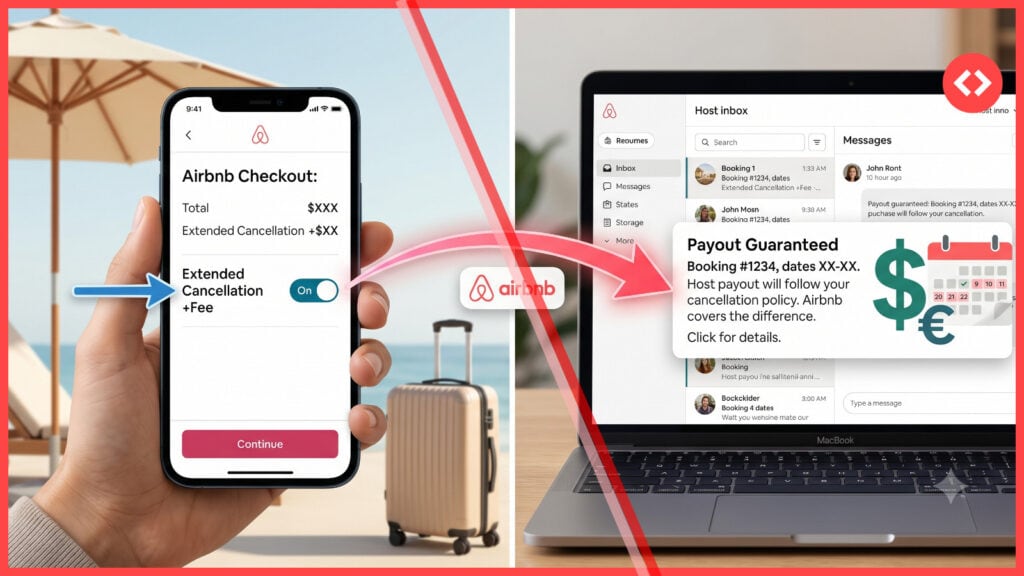
The Airbnb Extended Cancellation Option is an add-on that guests can purchase at checkout. In exchange for an extra fee paid to Airbnb, the guest can cancel their reservation for a full refund up to 24 hours before check-in — regardless of how strict the host’s underlying cancellation policy is.
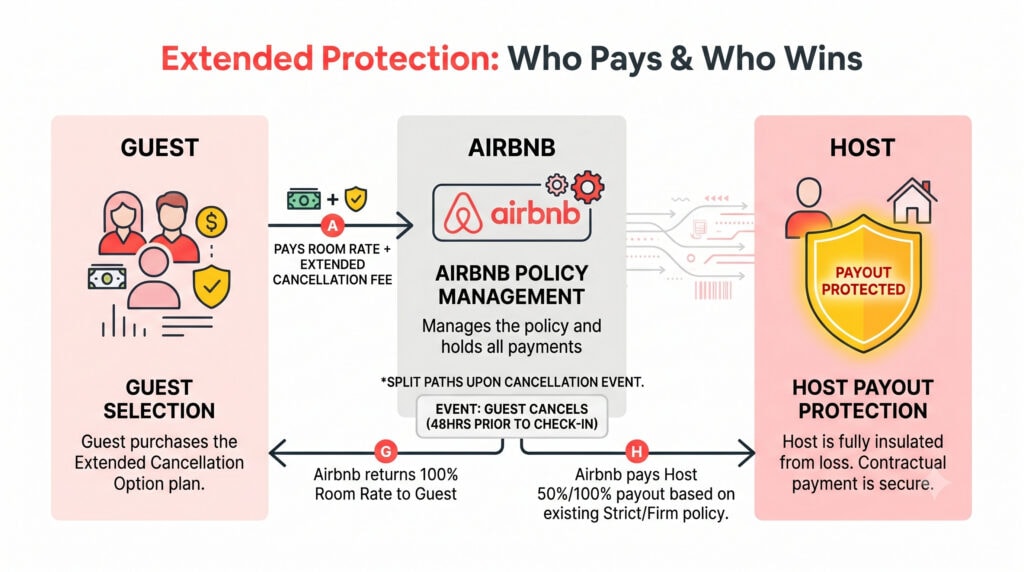
The key point for hosts: your cancellation policy does not change, and you are still paid according to it. If a guest with the Extended Cancellation Option cancels, Airbnb refunds the guest in full and pays you whatever your policy entitles you to. Airbnb absorbs the difference.

In other words, the guest erases their own cancellation penalty, your protected payout stays intact, and the platform covers the gap. (Source: Airbnb Help Center, Understanding the extended cancellation option and Get more flexibility with an extended cancellation option.)
How the Airbnb Extended Cancellation Option Works
Here is the mechanism step by step:
- A guest books an eligible listing and, at checkout, chooses to add the Extended Cancellation Option for an additional fee paid to Airbnb.
- The guest can now cancel for any reason up to 24 hours before check-in and receive a full refund of the reservation.
- If they cancel, the host is paid per their existing cancellation policy — there is no impact on the host’s cancellation rate or Superhost status.
- The canceled dates reopen immediately for new bookings.
- If the guest cancels within the final 24 hours before check-in, the host’s normal policy applies and the Extended Cancellation fee is not refunded.
Hosts can identify these bookings two ways: the reservation details will show that the guest selected the Extended Cancellation Option, and it will be noted in the booking confirmation email.
Where the Airbnb Extended Cancellation Option Is Available
At launch, the Extended Cancellation Option is being tested for eligible hosts and listings in: Argentina, Canada, Chile, Colombia, Ireland, Netherlands, Philippines, Poland, Sweden, Türkiye, the US, and Vietnam.
Most listings with Moderate, Limited, Firm, or Strict (grandfathered) policies are automatically eligible. It is never offered on Flexible policies — which makes sense, because Flexible already allows near-free cancellation, so there is nothing for a guest to “buy.” If your listing uses a policy with a penalty window, Airbnb has built a way for the guest to remove that penalty while yours stays in place.
For the full picture of how these policies now stack up, see our breakdown in Airbnb Drops Strict Policy — Limited Takes Over.
How Hosts Get Paid Under the Extended Cancellation Option
This is where hosts get nervous, so let’s be precise. Your payout follows your existing policy. The Extended Cancellation Option does not reduce it — Airbnb funds the difference between what the guest gets back and what you are owed.
| Scenario | What the guest gets | What the host gets |
|---|---|---|
| Guest cancels more than 24h before check-in (Extended Cancellation active) | Full refund of the reservation | Paid per existing policy (Airbnb covers the gap) |
| Guest cancels within 24h of check-in | Refund per host’s standard policy; Extended Cancellation fee not refunded | Paid per existing policy |
| Host cancels | Full refund including the Extended Cancellation fee | No payout; standard host cancellation penalties may apply |
| Major Disruptive Event applies | Refund / travel credit regardless of policy | No payout, even if Extended Cancellation was purchased |
The one genuine carve-out to watch: under Airbnb’s Major Disruptive Events Policy, the guest is refunded and the host receives no payout, even when the Extended Cancellation Option was purchased.
Is the Extended Cancellation Fee Refundable?
It depends on the country:
- United States: the Extended Cancellation fee is non-refundable, even when the guest cancels.
- Argentina, Canada, Chile, Colombia, Ireland, Netherlands, Philippines, Poland, Sweden, Türkiye, and Vietnam: the fee is refunded to the guest when they cancel.
That regional split is a strong clue about Airbnb’s intent, which we’ll come back to below.
How to Opt Out of the Extended Cancellation Option
Most eligible listings are automatically opted in. Hosts who don’t want to offer it can opt out at any time through their listing settings. If you run high-value or peak-season stays where a late cancellation is hard to backfill, this is worth reviewing before the test reaches your market.
Airbnb Extended Cancellation vs. Booking.com Smart Flex
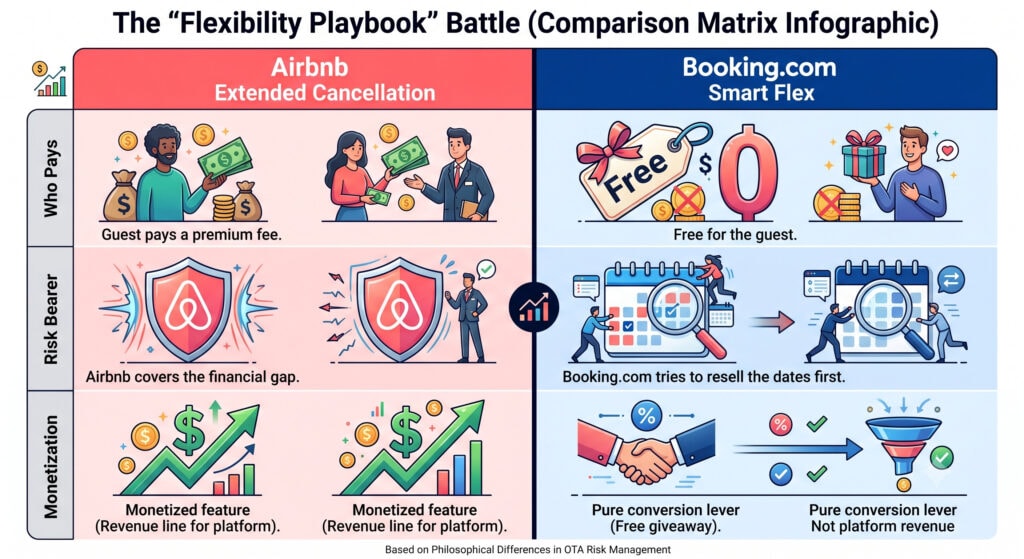
Airbnb is not inventing this idea — it is catching up to Booking.com, which normalized flexibility-as-default years ago. But the two models are built differently, and the difference matters.
| Airbnb Extended Cancellation Option | Booking.com Smart Flex (ex-Risk-Free Reservations) | |
|---|---|---|
| Who pays for the flexibility | The guest pays Airbnb a fee | Nobody — it’s free; Booking.com self-funds it |
| Who carries the cancellation risk | Airbnb covers the gap to the host | Booking.com resells the dates, or pays the host if it can’t |
| Host payout | Per existing policy | Per original terms (after resell attempt) |
| Enrollment | Auto-on for eligible listings, opt-out available | Auto-on; re-opts you back in ~3 months after opt-out |
| Offered on | Moderate, Limited, Firm, Strict | Guests judged unlikely to cancel |
The headline difference: Booking.com gives flexibility away to win bookings; Airbnb sells it. Airbnb turned the same competitive pressure into a paid product. The fact that the fee is non-refundable in the US — but refunded elsewhere — suggests Airbnb is testing whether this can be a revenue line in its biggest market, while running it purely as a conversion lever in the others.
This is the same pattern we flagged when Airbnb hired a Booking.com veteran to lead its hotels push: the OTA playbook is being adopted deliberately, not by accident.
Why Airbnb Is Doing This
Pulling this together with the rest of Airbnb’s 2026 changes, the Extended Cancellation Option solves three problems at once:
- Conversion. Lower perceived booking risk means more bookings, especially against hotels and Booking.com. This is the same logic behind Reserve Now, Pay Later and the universal 24-hour grace period.
- Competitive parity. Airbnb was the rigid one. Closing the flexibility gap with Booking.com without abolishing host policies lets it compete globally.
- A possible new revenue line. Unlike Booking.com’s free program, Airbnb charges for the option — and keeps the fee in the US.
It fits the broader thesis we laid out in Will Airbnb Hosts See a Rise in Cancellations in 2026?: Airbnb is trading host predictability for guest confidence because guest flexibility drives volume. The Extended Cancellation Option simply takes that one step further — it puts a price tag on the flexibility.
A fair caveat: because Airbnb funds the gap (and refunds the fee outside the US), this is genuinely an insurance product with real cost to Airbnb, not free money. The host’s headline payout really is protected. The catch for hosts is in the second-order effects.
The Downsides Hosts Should Watch
Your payout is protected — but your operation may not be:
- More frequent, later cancellations. When a guest’s penalty disappears, the deterrent you chose a stricter policy for disappears with it. Expect more cancellations, closer to check-in.
- Calendar volatility. A cancellation 24 hours out is hard to rebook at the same rate, especially for peak dates.
- Vendor cost mismatch. If you use cleaners or services with their own cancellation windows (say, 5 days), more late cancellations mean more times you owe a vendor for a stay that didn’t happen — a cost the Extended Cancellation Option does not cover.
- Default-on, low visibility. Because it’s automatic and only flagged in the reservation details and confirmation email, many hosts won’t notice it until a cancellation lands.
- Property managers: watch your owner statements. A payout with no completed stay behind it is exactly the kind of line that can be misclassified. Build a category for “policy payout, no stay” so cancellation revenue is tracked and split correctly.
What Hosts Should Do Now
- Check whether you’re opted in once the test reaches your market, and decide deliberately — especially for high-value or holiday stays.
- Renegotiate vendor terms (cleaning, linens) toward shorter-notice cancellation so your vendor window matches your shortened guest window.
- Lean on dynamic pricing to rebook late cancellations fast — the hosts who win in a higher-churn environment are the ones who can re-fill a calendar quickly. (See Airbnb’s October 2025 host tools update for the new policy controls.)
- Protect your peak dates with the strictest eligible policy and, where available, seasonal/dynamic cancellation settings.
- Track cancellation revenue separately if you manage owners’ properties.
The Big Picture
Airbnb’s priority in 2026 is not reducing cancellations — it’s increasing bookings. The Airbnb Extended Cancellation Option is the clearest expression of that yet: it makes booking easier for guests, protects the host’s headline payout, and — in the US at least — lets Airbnb earn a fee for the privilege.
The company once built its brand on commitment between strangers. It is now building on flexibility between transactions. That isn’t necessarily bad for hosts, but it does reward a different skill set: availability, fast rebooking, and tight operations over rigid rules. The hosts who treat this as an operations challenge rather than an Airbnb betrayal will come out ahead.
FAQ: Airbnb Extended Cancellation Option
What is the Airbnb Extended Cancellation Option?
It is a paid add-on currently tested in 12 markets, that lets a guest pay Airbnb a fee in the US from June 3, 2026, that lets a guest pay Airbnb a fee to cancel for a full refund up to 24 hours before check-in, even on stricter policies. The host is still paid per their existing cancellation policy.
Does the Extended Cancellation Option reduce the host’s payout?
No. The host is paid according to their existing policy. Airbnb covers the difference between the guest’s full refund and the host’s payout.
Can hosts opt out of the Extended Cancellation Option?
Yes. Most eligible listings are automatically opted in, but hosts can opt out at any time in their listing settings.
Is the Extended Cancellation fee refundable?
In the US, the fee is non-refundable. In Argentina, Canada, Chile, Colombia, Ireland, Netherlands, Philippines, Poland, Sweden, Türkiye, and Vietnam, it is refunded when the guest cancels.
Which cancellation policies offer the Extended Cancellation Option?
Moderate, Limited, Firm, and grandfathered Strict. It is never offered on Flexible policies.
How is it different from Booking.com’s Smart Flex / Risk-Free Reservations?
Booking.com offers flexibility for free and self-funds the risk by reselling the dates or paying the host. Airbnb charges the guest a fee and covers the gap to the host. Both auto-enroll hosts by default.

Thibault Masson is a leading expert in vacation rental revenue management and dynamic pricing strategies. As Head of Product Marketing at PriceLabs and founder of Rental Scale-Up, Thibault empowers hosts and property managers with actionable insights and data-driven solutions. With over a decade managing luxury rentals in Bali and St. Barths, he is a sought-after industry speaker and prolific content creator, making complex topics simple for global audiences.