
While a sprawling global mega-event like the FIFA football World Cup is struggling with the structural friction of long-haul flights, massive travel distances, and unpredictable tournament brackets, Glasgow’s highly accessible Commonwealth Games 2026 are proving the immense power of concentrated regional demand.
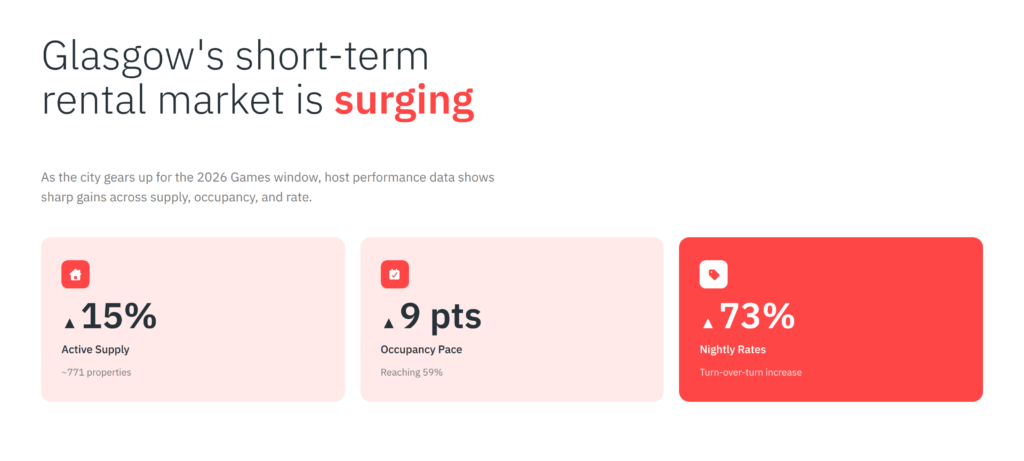
According to PriceLabs data, Glasgow’s short-term rental market is effortlessly absorbing a 15% surge in supply while simultaneously pushing occupancy rates 9 points ahead of last year’s pace. Even more impressive: this dramatic spike in demand is layered directly on top of what is already Scotland’s peak summer tourism season, proving that localized, frictionless travel can outperform fragmented global events.
Glasgow Short-Term Rentals: More Listings, Higher Prices, Yet Booking is King
Standard economic theory dictates that a sudden influx of inventory forces a harder fight for guests. Glasgow is completely upending that script just ten days before the Commonwealth Games 2026 open on July 23.
Despite a 15% jump in active listings (representing roughly 771 new properties coming onto the market), occupancy did not thin out, but intensified. Glasgow’s occupancy for the Games window has climbed to 59% (up 9 points from the same period last year), while nightly rates have skyrocketed by 73%.

A host can raise their prices whenever they like, but whether a guest actually books is the real test of an event’s draw. Contrast this with the US FIFA World Cup host cities this summer: operators there aggressively bumped nightly rates by 55%, but occupancy actually fell by 5 points. While the US market raised prices into calendars with more empty nights, Glasgow filled its rooms first, letting genuine demand drive the rate premium.
The Three Drivers Behind Glasgow’s Perfect Booking Storm
Why is the Commonwealth Games 2026 footprint outperforming a global footprint? It comes down to three distinct dynamics:
The Absent Athletes’ Village
Every hotel bed occupied by an athlete or official is a bed stripped from an everyday tourist. Because Glasgow chose a lean, sustainable model for 2026, the city bypasses a dedicated, purpose-built athletes’ village. Instead, thousands of competitors and staff are being housed in central hotels and university residences, the same approach Birmingham used in 2022. This structural decision has effectively squeezed the local hotel supply, funneling a wave of displaced leisure travelers straight into the short-term rental market.
A Frictionless, High-Certainty Audience
The demographic makeup of the Commonwealth Games creates a highly predictable travel pattern. When Glasgow last hosted the Games in 2014, government survey data found 96% of visitors lived in the UK, and just 4% came from overseas, with over half of that small international group arriving from other Commonwealth countries or territories. For most of this audience, travel to Scotland is largely frictionless, often involving straightforward domestic transit rather than a long-haul flight.
High-Certainty Decision Making
Unlike a football World Cup, where fans are hesitant to book multi-thousand-dollar international trips until they know if their team survives the group stages, the Commonwealth Games 2026 offer total certainty. The event is compact, the schedules are fixed, and the entire tournament takes place within a single city corridor. Because the financial and logistical barriers to entry are significantly lower, travelers can make firm booking commitments months in advance without the risk of an early tournament exit ruining their itinerary.
Strict Rules Couldn’t Dampen Supply
What makes this supply growth particularly remarkable is the regulatory environment. Scotland operates one of the strictest short-term rental licensing frameworks in Europe, requiring hosts to secure a council license before taking a single booking under penalty of steep fines.
Glasgow’s council considered temporarily waiving these licensing rules just for the Games. Public consultation responses narrowly opposed the idea, and as of publication, no exemption route is in place. Operators still found a way to adapt regardless. The 15% increase in active listings shows that structured, professional supply, complemented by occasional hosts, can expand dynamically to meet major event demand without relying on regulatory shortcuts.
The Bottom Line
Glasgow 2026 is providing a masterclass in modern event hosting. By ditching the multi-billion-dollar price tags of sprawling global tournaments and focusing on a compact, sustainable footprint, the city has unlocked extraordinary value for the local hospitality economy.

Uvika Wahi is the Editor at RSU by PriceLabs, where she leads news coverage and analysis for professional short-term rental managers. She writes on Airbnb, Booking.com, Vrbo, regulations, and industry trends, helping managers make informed business decisions. Uvika also presents at global industry events such as SCALE, VITUR, and Direct Booking Success Summit.