
As soccer fans brace for this Sunday’s blockbuster Spain vs. Argentina final at MetLife Stadium, short-term rental operators are surveying a tournament that proved sudden-death suspense doesn’t always translate to packed rental calendars. While the bracket delivered peak drama on the pitch, the 2026 FIFA World Cup exposed a stark hospitality reality across its 16 host cities: certainty fills rooms, but bracket suspense leaves them empty.
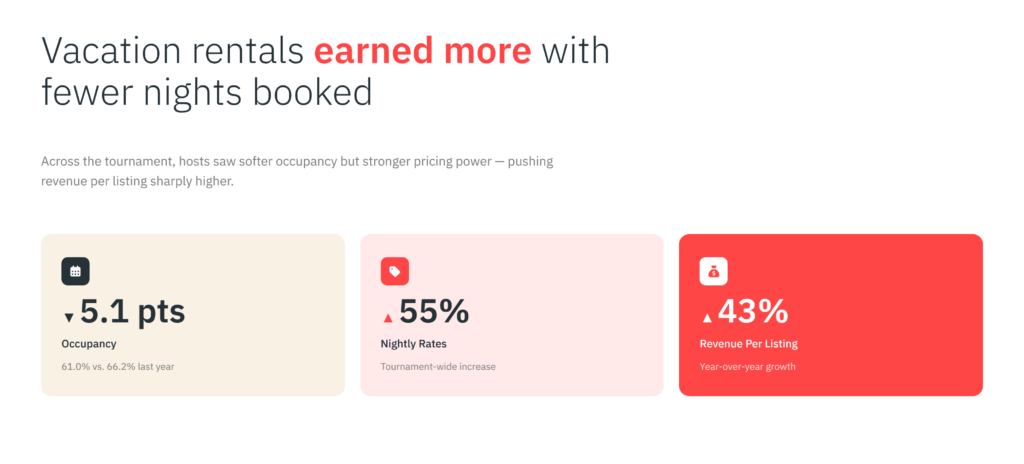
According to PriceLabs data, tournament-wide occupancy across the 16 host cities landed at 61.0%, falling 5.1 points below last year’s baseline. While short-term rental hosts still walked away with a win due to an aggressive 55% surge in nightly rates, the tournament exposed a massive operational divide between the predictable group stages and the chaotic logistics of the knockout rounds.
A Six-Month Head Start vs. A Four-Day Scramble
The data reveals that travelers with a six-month runway happily booked accommodation, while fans facing a four-day scramble simply stayed home. Group-stage matches, locked in half a year in advance by the December draw, held relatively close to normal summer pacing. Conversely, knockout matches, decided only days before kickoff, saw occupancy crater across the board.
- Group-Stage Occupancy: Finished at 62.6% (a minor drop of 3.4 points behind last year).
- Knockout-Round Occupancy: Plummeted to 57.9% (widening the gap to 7.9 points behind last year).
- Revenue Growth Impact: While revenue per listing (RevPAR) climbed 47% during the certain demand of the group stage, growth cooled significantly to 35% during the unpredictable knockouts.
The Operational Friction: Picture an international fan. If their team’s location is known months in advance, they can easily secure transatlantic flights, log vacation days, and sort visa requirements. Forcing that same fan to arrange an expensive international flight and turn a multi-thousand-dollar trip around in a 96-hour window after a penalty shootout is where demand completely breaks down.

Read More: FIFA World Cup 2026 Is Driving Breakout Demand, Just Not in the Same Way Everywhere
Case Study: One Stadium, Opposite Booking Realities
Nowhere was this dynamic clearer than at AT&T Stadium in Dallas, where the exact same market and hosts experienced completely opposite booking outcomes based entirely on schedule notice:
| Match Phase & Lineup | Booking Notice | Occupancy vs. Previous Year |
| Japan vs. Sweden (Group Stage) | 6 Months (Known since December draw) | ▲ +14 points (74% overall occupancy) |
| Norway vs. Ivory Coast (Round of 32) | Days out (Bracket dependent) | ▼ -16 points (43% vs. 59% last year) |
| France vs. Spain (Semifinal) | Days out (Bracket dependent) | ▼ -8 points (41% vs. 49% last year) |
Read More: Tour de France 2026: Airbnb Revenue Up 430% on Alpe d’Huez, Barely Moving in Paris
Star Power Couldn’t Defeat Travel Fatigue During 2026 FIFA World Cup
Even the tournament’s biggest box-office draws couldn’t salvage the short-notice knockout slots. Argentina’s fanbase initially brought a 14-point occupancy bump to Miami for their Round of 32 match against Cape Verde. But by the time they reached their semifinal against England in Atlanta, three short-notice trips later, the sheer financial and logistical strain wore travelers down, dragging occupancy 17 points behind last year’s baseline.
Worse still, Brazil’s global fanbase experienced knockout fatigue almost instantly: their Round of 32 match against Japan in Houston registered a staggering 26.5-point occupancy deficit, making it the only knockout match where hosts actually made less total revenue than the year before.
Read More: Commonwealth Games 2026: Glasgow’s Regional Demand Outpaces Sprawling Mega-Events
The Cross-Border Divide: Mexico Wins on Frictionless Travel
When breaking down performance by host nations, domestic travelers within the US and Canada largely skipped host cities to avoid localized price spikes, traffic, and congestion. However, Mexico proved to be the lone exception to the rule.
OCCUPANCY GAINS/LOSSES BY HOST NATION
├── 🇲🇽 Mexico:  ▲ +4.5 points vs. last year
├── 🇺🇸 United States: ▼ -5.6 points vs. last year
└── 🇨🇦 Canada:        ▼ -11.6 points vs. last year
- The Visa Advantage: Mexico carries significantly less visa friction than the United States, allowing it to capture late-stage international demand much more fluidly as the bracket shifted.
- The Canadian Squeeze: Canada’s steep 11.6-point drop highlighted pre-tournament structural vulnerabilities. Aggressive short-term rental caps in cities like Vancouver severely restricted how much flexible supply could enter the market, while high local costs likely prompted many Canadian fans to support their teams from home rather than cross into the US.
Conclusion: Rates Saved the Bottom Line, But Left a Warning
From a pure revenue perspective, short-term rental operators still won the summer. Because nightly rates rose 55% across the board, total revenue per listing finished 43% higher tournament-wide, successfully covering the empty beds.
Even ahead of Sunday’s 2026 FIFA World Cup final between Argentina and Spain at MetLife Stadium, booking velocity in the New York area is still pacing behind an ordinary, non-event July Sunday. Pricing power completely masked the occupancy drop-off, but the long-term lesson for operators is clear: aggressively baking premium pricing into short-notice event calendars without guaranteed demand is a high-risk gamble.

Guneet has spent five years working at PriceLabs, developing deep expertise in short-term rental operations and hospitality technology. She brings that practitioner’s lens to her writing at RSU, covering platform updates and making sense of market data for property managers.