

Short-term rental rules updates this week: Salt Lake City, Malaga, and Byron Bay each moved on policies affecting operators — spanning a nuanced cap in the US, bureaucratic gridlock in Spain, and contested impact data from Australia’s regulatory wave.
Salt Lake City Activates 200-Night Cap and Licensing Framework
Salt Lake City’s new ordinance balances winter ski demand with neighborhood preservation by capping rentals at 200 nights per year.
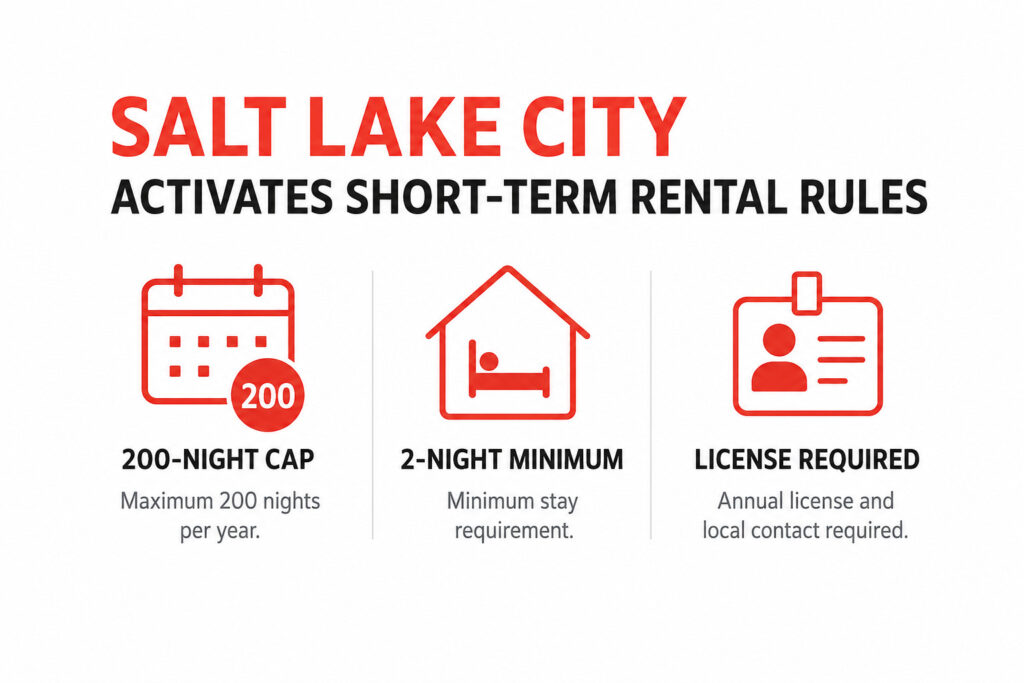
- As of July 1, 2026, Salt Lake City officially activated its first formal short-term rental licensing framework, adopted as part of the city’s 2026–2027 budget.
- Operators are now legally required to carry an annual business license to host guests.
- The new ordinance enforces a 200-night annual cap per property, preventing full-time, year-round commercial use.
- To curb nuisance issues, the city has mandated a two-night minimum stay and requires a local emergency contact who must respond to issues within two hours, according to Axios Salt Lake City.
- Additional conditions apply: properties need at least one off-street parking space, and licenses are capped at one per building for buildings with 10 or fewer units, or up to 10% of units in larger buildings, per KSL’s reporting on the ordinance.
- Violations can draw a $1,000 fine every seven days for operating without a license.
Uvika’s Views
- A Nuanced Alternative to Bans: In recent weeks, we have covered drastic measures across the US — from Cleveland’s strict 10% density cap to Idaho and Indiana entirely prohibiting local cities from regulating rentals. Salt Lake City is charting a middle path. The 200-night cap threads the needle: it allows hosts to fully capture the lucrative winter ski season and peak summer months, but legally prevents 365-day commercial arbitrage.
- Revenue Management Shift: The combination of a 200-night ceiling and a two-night minimum stay forces a fundamental shift in revenue strategy. Property managers can no longer rely on volume. Operators may need to heavily prioritize high-ADR weekends and peak booking windows, intentionally blocking out low-margin shoulder season nights so they don’t waste their 200-night allowance.
Malaga Imposes Planning Hurdles on New Short-Term Rentals
Malaga has escalated its tourist apartment freeze into a permanent bureaucratic hurdle, requiring new operators to prove wider public benefit.
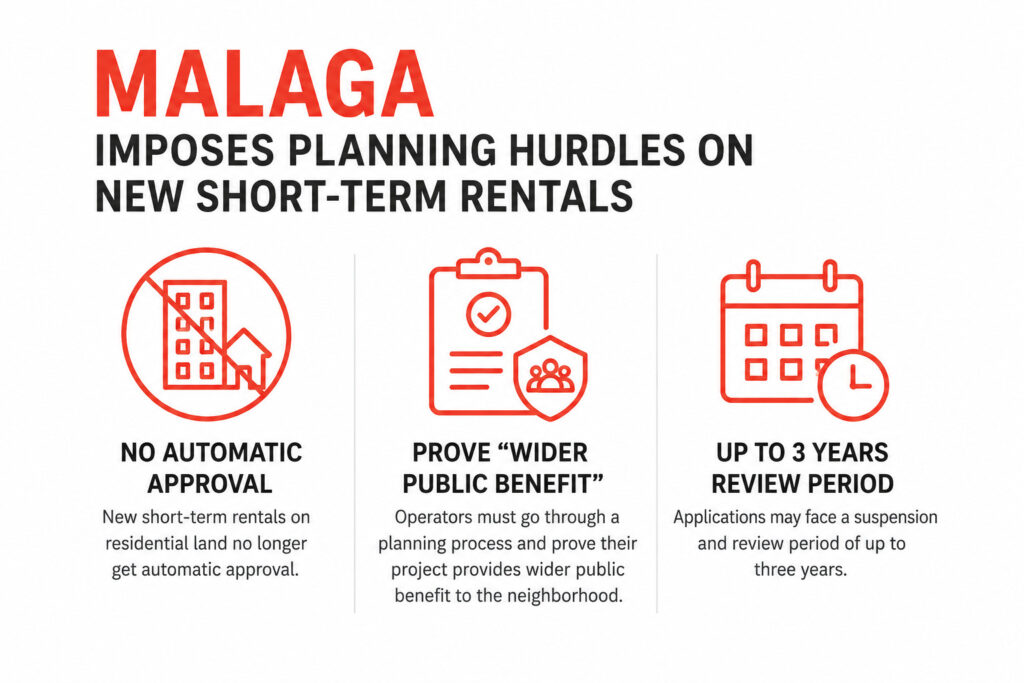
- On July 6, 2026, the Malaga City Council approved expanded restrictions on new tourist accommodation, as first reported by Euro Weekly News.
- Any new hotels, hostels, tourist apartments, or short-term rentals proposed on residential land will no longer receive automatic approval.
- Operators must now undergo a full planning modification process and legally demonstrate that their proposed accommodation provides a “wider public benefit” appropriate to the neighborhood, according to ShortTermRentalz.
- Applications submitted after the rule takes effect could face a suspension and review period lasting up to three years; projects already in the planning system continue under the previous short-term rental rules.
- This builds on Malaga’s August 2025 moratorium, which froze new short-term rental registrations for three years in 43 neighborhoods where such rentals exceeded 8% of local housing stock. Regional data shows Malaga has more than 12,000 registered short-term rental properties offering roughly 64,000 beds, concentrated in the city center, Plaza de la Merced, Pedregalejo, El Palo, La Malagueta, and Huelin.
Uvika’s Views
- Weaponizing Bureaucracy: Back in August 2025, we covered Malaga hitting the “pause button” on new tourist apartment licenses in specific zones — around the same time we were tracking Chicago’s ban extension debate, Croatia’s new registry, and Florence’s expanded rental ban. This July 6 update escalates that temporary freeze into a permanent, wider bureaucratic barrier covering all residential land in the city — not just the 43 saturated neighborhoods. Rather than issuing a blanket ban like Florence, the city is using red tape as a deterrent.
- Locking Out Small Operators: Proving a “wider public benefit” through a multi-year planning modification process is an incredibly high legal and financial bar. This effectively narrows the field to well-capitalized, institutional firms capable of weathering years of legal fees — individual hosts and small property managers are largely locked out of new market entry in Malaga going forward.
Byron Bay Short-Term Listings Drop 15% — But Effectiveness Remains Disputed
A new UNSW roundup cites a 15% drop in Byron Bay short-term listings following its 60-day cap, though the research itself urges caution and sits alongside a contradictory industry-funded study.

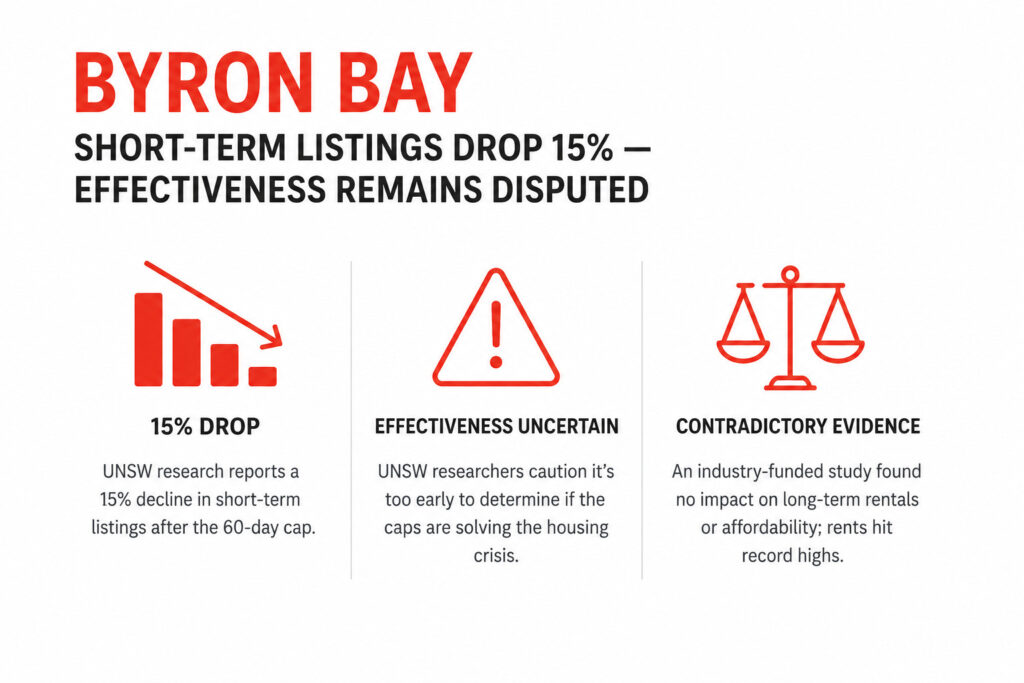
- A UNSW Newsroom feature published in early July 2026, surveying short-term rental regulation across several Australian and international jurisdictions, states that Byron Shire’s strict day caps have contributed to a 15% decline in short-term listings, with some properties returning to the long-term rental market.
- Critically, UNSW’s own researchers caution that after roughly one year, it’s too early to say how effective the caps have been at solving the underlying housing crisis.
- This finding sits in tension with a November 2025 independent analysis by Frontier Economics, commissioned by the Australia and New Zealand Short-Term Rental Association, which found the 60-day cap had no measurable impact on long-term rental availability or affordability — with total rental numbers falling slightly and rents in Byron Shire hitting record highs (around A$1,193/week) over the same period.
- Despite the disagreement on effectiveness, other councils are watching the listings data closely: Hobart City Council has begun modifying its own planning scheme to block new short-term rental permits in residential areas, and other jurisdictions — including those we’ve tracked in our coverage of Mountainside, Sydney, and France — are weighing similar caps or outright bans.
Uvika’s Views
- A More Complicated Data Narrative Than It Looks: In our May 2026 coverage of the Sydney suburb-level ban investigation, we cited early University of Sydney research suggesting the 60-day cap had not reduced market share. This new UNSW figure confirms that listings have, in fact, come down by 15% — but it stops well short of proving the policy is “working.” A separate, more rigorous economic analysis found no corresponding gain in long-term rental supply or affordability. Fewer short-term listings and a healthier long-term rental market are not the same outcome, and property managers should treat this as an open question, not a settled one.
- The Escalation Risk: Regardless of whether the cap is actually solving Byron’s housing crunch, the optics of a 15% listings drop are being used politically. Councils like Hobart aren’t waiting for the effectiveness debate to resolve — they’re using Byron Bay’s headline number as a blueprint to push for stricter caps or outright bans in residential zones. Property managers operating across Australia should expect the regulatory timeline to keep accelerating even while the underlying evidence remains contested.
Stay on top of short-term rental regulation trends and what they mean for your operating environment.

Uvika Wahi is the Editor at RSU by PriceLabs, where she leads news coverage and analysis for professional short-term rental managers. She writes on Airbnb, Booking.com, Vrbo, regulations, and industry trends, helping managers make informed business decisions. Uvika also presents at global industry events such as SCALE, VITUR, and Direct Booking Success Summit.
Related Articles:
 Airbnb’s Vision for Fair Regulations in Spain and Elsewhere
 EU Signals Short-Term Rental Regulation as Part of Housing Crisis Response
 The May 20 EU Data Deadline: Should Property Managers Expect Mass Delistings?
 Los Angeles Eyes Olympics Airbnb Deal, Santa Ana Court Voids Ban, Saratoga County Imposes Registry and Tax