
Following the outbreak of the US–Iran conflict in late February 2026, the Dubai short-term rental market has temporarily shifted from operating as a tourist destination to operating as a displacement housing market. The tourists have disappeared. The guests who remain — regional residents and expats seeking flexible housing — are a fundamentally different customer booking a fundamentally different product.
Based on PriceLabs Market Dashboard data (updated through April 9, 2026) and on-the-ground intelligence from operators and industry consultants, here is how that shift is playing out — and where operator pricing has not yet caught up with it.
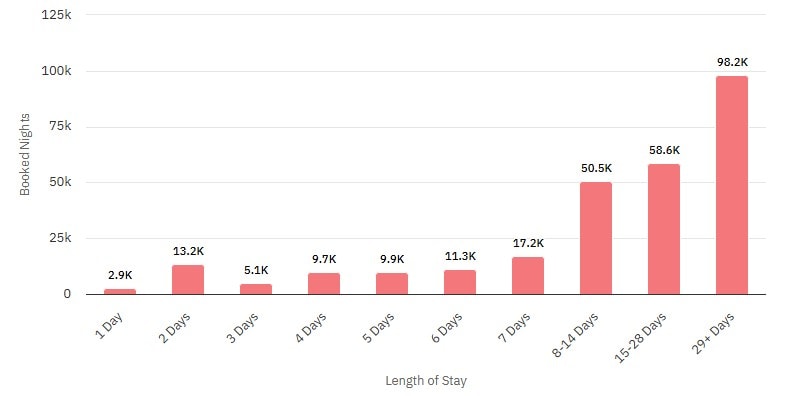
29+ Day Stays Have Tripled — Dubai Is No Longer A Leisure Market
The clearest evidence of the shift is the length-of-stay data. Demand for 29+ day stays more than tripled in March and April 2026 compared to the same period in 2025. According to operators and industry consultants, this new demographic consists largely of regional residents and expats opting out of traditional long-term leases while they assess job and housing uncertainty.
The implication for operators is structural, not cosmetic. Properties configured for three-night leisure guests are now being asked to function as month-long contingency housing — different amenities, different cleaning economics, different channel mix. The listings that reposition quickly will capture the demand that remains. The ones that continue marketing to a tourist base that is not coming back will not.

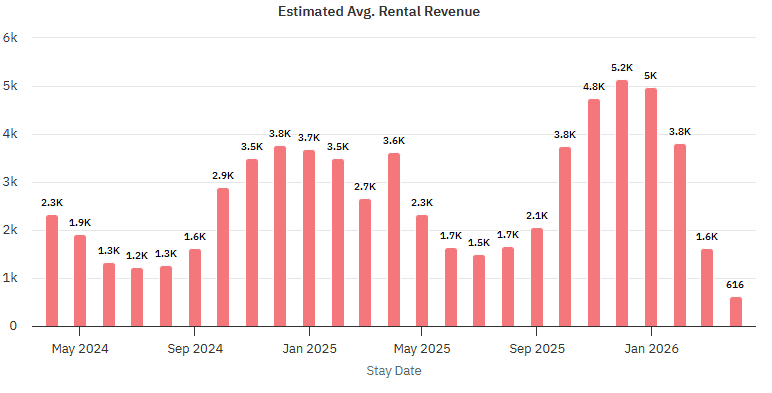
Revenue Per Listing Has Dropped To $616 — From $3,633 A Year Ago
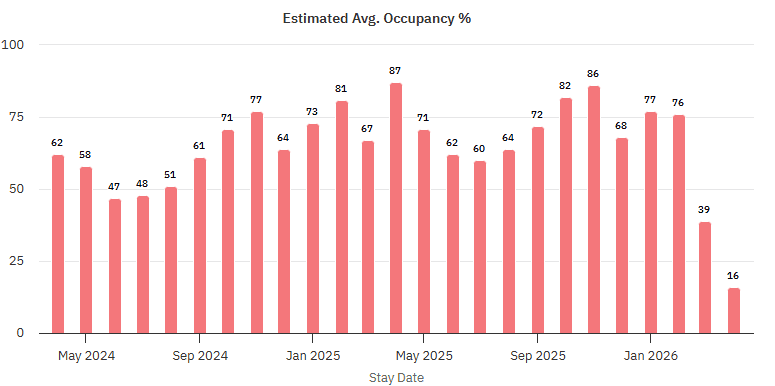
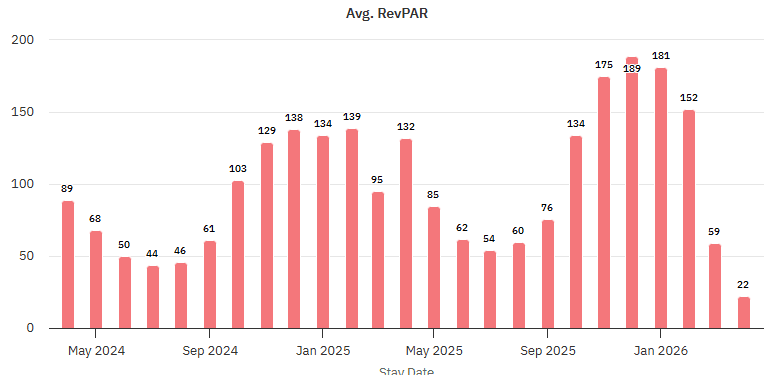
A year ago, the Dubai market was operating at peak capacity. Dubai operators averaged $3,633 per listing in April 2025. This April, they are on track for roughly $616 — with three weeks still to go in the month. March told a similar story: average revenue of $1,615, down from $2,668 the previous March. Occupancy for the first nine days of April sits at 17%, against 85% the same period last year. RevPAR has collapsed from $132 to $22.
Operators Held Rates Through March — Then April Broke Them
One pattern inside those numbers is worth isolating. Operators initially held their rates through March: Average Daily Rate for March 2026 came in at $153, actually higher than the $142 recorded in March 2025. By April, that discipline broke. With demand not returning and the early-April booking pace stalled at 28.6% versus 85.0% on the same day last year, ADR dropped to $132 — a 13.2% year-on-year decline. Managers initially treated this as a short disruption to price through. By April, enough of them had recalibrated to pull market-wide rates down.
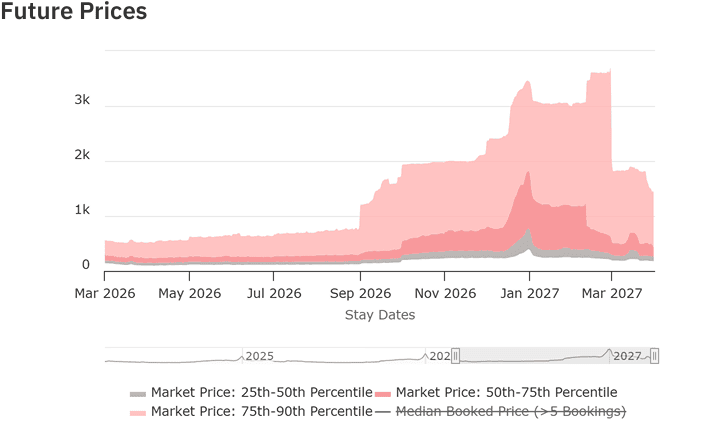
Operators Have Repriced Through August. Q4 Is Still At Peak-Season Rates.
The most consequential decision operators face right now is how to price the back half of the year. The forward-looking data shows a clean split between what has been repriced and what hasn’t.
The Two Halves Of The Year
- March–August 2026: Median booked price fell from $210 in January to $143 in March and $125 in April, holding in the $120–$130 range through August as managers price defensively to capture regional demand.
- September–December 2026: Rates jump back to peak-season territory — $161 in September, $212 in October, $221 in November, $225 in December — effectively unchanged from pre-crisis levels.
Industry insiders are calling this the “Hopium Strategy”: the assumption that winter will bring recovery and traditional peak-season pricing will hold. The gap between the two halves of the year is the most informative single data point in this piece. It reveals what operators believe — and where they have not yet let the forward data revise that belief.
The Risk: Static Peak-Season Rates Into Uncertain Demand
Properties running dynamic pricing will adjust as Q4 demand signals develop through the summer. Properties holding static peak-season rates are making a bet the forward data does not yet validate. If the geopolitical disruption extends into winter, those unadjusted rates will sit on empty calendars while dynamically priced listings capture whatever bookings remain.
When OTAs Invoke Force Majeure, The Refund Comes Out Of The Operator’s Pocket
Beyond the drop in top-line revenue, professional managers are absorbing a direct, OTA-driven financial squeeze. This is not a wave of bad-faith cancellations — travellers are caught in genuinely difficult situations, stranded by suspended flight routes, rerouted away from the region, or facing real security uncertainty. But the operational consequence for operators is real.
How The Policy Works
Platforms including Booking.com and Expedia have been invoking force-majeure-style clauses and emergency-waiver policies to process guest cancellations on non-refundable bookings. Under Expedia’s Extenuating Circumstances Policy for Vrbo, partners are required to refund guests in full when broad-scale travel disruptions occur — regardless of the host’s original cancellation terms. Expedia also published a dedicated Middle East travel advisory on March 27, signalling how seriously the disruption has registered at the OTA level.
Calendars Look Full. Most Of It May Not Materialise.
Traditional pacing models are currently ineffective. Forward-looking data for April 2026 shows a sharp increase in cancellations for reservations made 14 to 30 days in advance. In a fluid geopolitical environment, travellers and displaced residents are using vacation rentals as contingency plans. Flexible cancellation policies and OTA emergency waivers remove the financial risk, so guests lock in availability “just in case.”
As check-in approaches — and if flight routes are suspended or plans shift — these guests cancel just before the penalty window opens. The result is a frustrating illusion for operators: calendars look artificially full weeks out due to this “ghost demand,” then hollow out close to the stay.
The Market Is Now Running On A 3-Day Booking Window
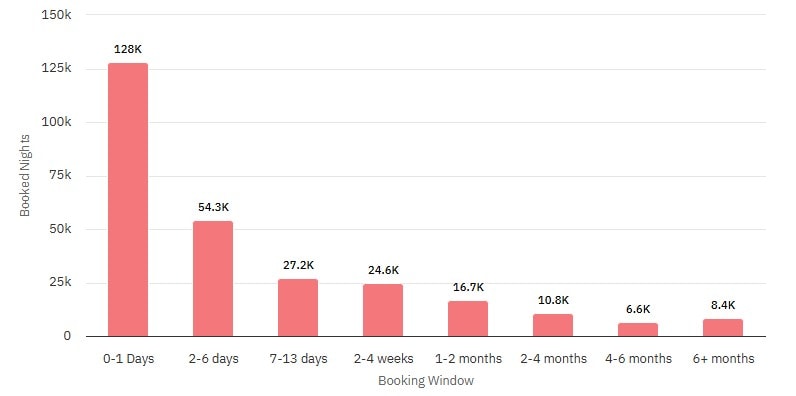
Because advance bookings increasingly dissolve into cancellations, the only guests committing to non-refundable stays are those moving immediately. The market’s median booking window has contracted to 3 days in March 2026, down from 6 days in 2025, and has stayed there through early April. Historical pacing curves have stopped functioning as a forecasting tool. Revenue is being driven almost entirely by hyper-reactive, last-minute arrivals responding to the daily news cycle.
Active Listings Went Up. The Demand Data Tells A Different Story.
On paper, supply increased during the crisis. April 2026 shows 35,316 active listings, up from 31,265 in April 2025, while total booked nights fell from 426,992 to 183,410.
Industry consultants note this is partially a data illusion. A property booked for even one or two nights in a month still registers as “active.” Many hosts have also blocked their calendars to pull properties off the market temporarily, which can register in raw scrapes as occupancy or booked days — masking the true severity of the demand drought.
Operators Are Pricing March Through August For Reality. They’re Pricing Q4 For Hope.
Dubai’s market has not returned to normal. The forward data suggests operators are pricing part of the year as if it has. The March–August window reflects the reality on the ground; the September–December window reflects a hope that may or may not clear. The operators adjusting rates as forward demand develops will capture what bookings materialise. The ones holding static peak-season Q4 rates are making a bet the data has not yet supported.
For more on adjusting pricing strategy during sudden market shifts, see our recent analysis on the new reality of vacation rental revenue management and the PriceLabs Revenue Accelerator.

Guneet has spent five years working at PriceLabs, developing deep expertise in short-term rental operations and hospitality technology. She brings that practitioner’s lens to her writing at RSU, covering platform updates and making sense of market data for property managers.
Related Articles:
![Trump-Era Policies Fuel Travel Uncertainty: Fewer Canadians, Europeans to U.S.—Fewer Americans to Europe [Early Data]](https://www.rentalscaleup.com/wp-content/uploads/2025/04/Trump-Era-Policies-Fuel-Travel-Uncertainty-Fewer-Canadians-Europeans-to-U.S.—Fewer-Americans-to-Europe-Early-Data-150x150.jpg "Trump-Era Policies Fuel Travel Uncertainty: Fewer Canadians, Europeans to U.S.—Fewer Americans to Europe [Early Data] 2") Trump-Era Policies Fuel Travel Uncertainty: Fewer Canadians, Europeans to U.S.—Fewer Americans to Europe [Early Data]
Trump-Era Policies Fuel Travel Uncertainty: Fewer Canadians, Europeans to U.S.—Fewer Americans to Europe [Early Data]
 PriceLabs Hits 161 Integrations, HomeToGo Snaps Interhome, Booking.com Debuts Rewards Card
 Planning for 2026? What 2025 Market Data Is Telling Large Property Managers
 Super Bowl LX Flips the Bay Area Script: Santa Clara Beats San Francisco on Price