
Your revenue manager may not be the only problem. Your pricing tool may not be the only problem. The bigger issue is the gap between your vacation rental revenue management team and everyone else (ops, marketing, BD, owner relations) all pulling in slightly different directions, with no shared view of the numbers.
That was the central thread running through this week’s webinar, Stopping the Leaks: How Non-Pricing Teams Influence Your Revenue, with Bryant Loy, Director of Revenue Management and Distribution at Brett Robinson (1,800+ units on the Gulf Coast), and Becca Madigan, who leads the US Solutions team at PriceLabs and spent years as a property manager before that and hosted by Thibault Masson, Founder at Rentals Scale Up and Product Marketing Head at PriceLabs.
The vacation rental revenue management leaks they described aren’t dramatic. They’re quiet, structural, and completely fixable. Here are the three that matter most.
The Visibility Trap: Your Listing Is Quietly Killing Your Rankings
Bad listing content forces your revenue team to do something it should never have to do: lower prices to compensate for poor visibility.

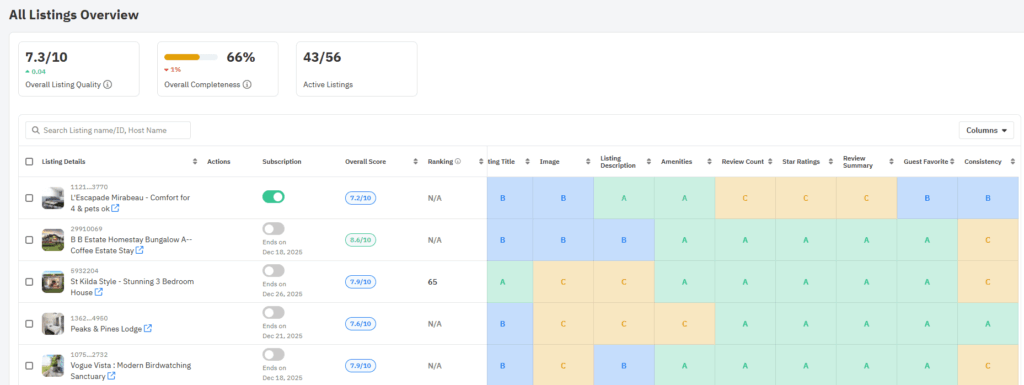
If a listing has blurry photos, a thin description, or unchecked amenities, the algorithm penalises it. The revenue manager sees low conversion and responds by dropping the nightly rate. The root problem — a listing that shouldn’t be live in that state — goes unaddressed.
A PriceLabs analysis of 10,000+ listings found 88% had quality issues quietly hurting their visibility or conversion. And this isn’t just about photos. Airbnb now ranks listings on over 800 signals — including whether a listing is likely to convert, and whether it will end in a 5-star stay. Unclear descriptions and inconsistent content now carry a measurable ranking cost.
How to fix it
Bryant’s fix at Brett Robinson: distribution sits inside revenue management. The same team watching rate data is also watching listing quality, talking to OTA reps about algorithm priorities, and running an eye test on every property before it goes live.
If you can’t restructure your org chart right now, start smaller:
- Assign a named owner to listing quality for each property, with a fixed audit cadence
- Pull listings up on the guest-facing OTA view, not just your backend, to see what guests actually see
- Have three or four people read a description before it goes live. Optimising for keywords alone isn’t enough if it doesn’t read like a human wrote it
Bryant flagged one other thing: don’t neglect your direct booking website. Brett Robinson does over 60% of bookings there. An OTA-optimised listing sitting on a clunky property page is a conversion problem your pricing tool can’t solve.
The Cleaning Fee Dilemma: How a Flat Fee Bleeds Off-Season Revenue
Here’s a number that landed hard during the live session: in a poll of attendees, 95% of property managers charge the same flat cleaning fee year-round.
For most operators, this is a slow off-season tax. A $200 cleaning fee attached to a $100 nightly rate in January scares away guests. Worse, it signals to Airbnb’s algorithm that your total checkout price is uncompetitive. Airbnb’s shift to total price display has made high cleaning fees visible upfront, meaning short stays with inflated fees now suffer in search visibility before a guest even clicks through. You end up cutting your nightly rate to compensate, which eats owner income, which eventually eats owner trust.
Bryant’s approach at Brett Robinson: seasonal cleaning fees, where high-season rates cover the real cost of cleaning, and off-season fees drop to keep total checkout prices competitive. For gap nights and orphan one- or two-night stays, they drop all fees by 40 to 50%. They absorb the margin hit as a company, because filling ten or twelve of those for an owner over a year builds loyalty that no acquisition budget can buy.
Becca’s view: dynamic fees are the next frontier in revenue management, and most operators aren’t there yet, partly because the OTA and PMS infrastructure doesn’t make it easy. But the direction is clear. Operators who’ve modelled it are already seeing the margin impact when fees flex by length of stay and season.
How to fix it
What you can do now:
- Price a one-night stay on your own listing as a guest would see it. If the total checkout cost is higher than your nightly rate alone suggests, your fee structure is working against you
- Model the breakeven: what does your cleaning fee need to be, at each length of stay, to cover actual costs without pricing you out of the off-season market?
- If your PMS doesn’t support variable fees, use minimum-stay rules and length-of-stay pricing adjustments as a second lever. If a two-night stay at current fees isn’t viable, adjust the minimum stay rather than leaving an uncompetitive listing up
For a deeper look at how listing visibility and fee strategy interact with your overall revenue setup, check out PriceLabs Revenue Accelerator and what it means for how property managers approach revenue today.
The Owner Retention Gap: Your Frontline Team Needs Better Data
Bryant made this point plainly: retaining an owner is far cheaper than acquiring one. The cost of marketing to new owners, running acquisition meetings, and onboarding new properties is enormous compared to simply keeping the ones you have happy.
The operators who lose owners aren’t always underperforming on revenue. Often, they’re just underreporting. The owner relations person has a difficult call, no data in front of them, and no clear answer to “why are my dates empty in October?”
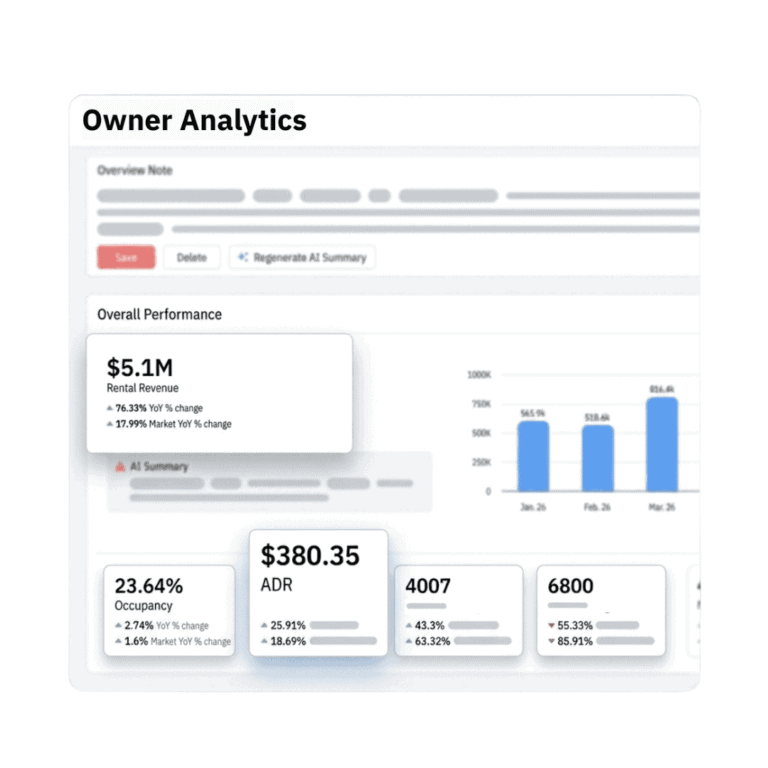
At Brett Robinson, the revenue team builds Power BI dashboards that give owner-facing staff a drop-down view of any property’s performance, occupancy trends, and market positioning. What used to take 20 minutes of report-pulling now takes five. The owner relations person shows up to the call prepared. Automated owner reporting is one of the clearest operational wins available to mid-size and large operators right now — and one of the least implemented.
How to fix it
The same logic applies to the acquisitions team. Bryant’s team built a dashboard where an acquisitions rep can enter a few parameters: property type, building, spec level, and produce a professional revenue projection in minutes. The revenue team reviews it. They don’t build it from scratch every time.
The underlying principle: your revenue team holds the most accurate data in the company. The question is whether they’re sharing it in a format that the people who need it can actually use. Operators who’ve cracked this treat owner retention as a revenue strategy, not an admin function.
Revenue management becomes a ceiling when it stays inside one team. The operators who are growing in a tighter market are the ones who’ve figured out how to make the rest of the company part of the picture.

Guneet has spent five years working at PriceLabs, developing deep expertise in short-term rental operations and hospitality technology. She brings that practitioner’s lens to her writing at RSU, covering platform updates and making sense of market data for property managers.
Related Articles:
 Casago Acquires Vacasa: What It Means for US Vacation Rental ManageRs IN 2025
 Vacasa-Casago Merger Closes with Shareholder Backing—Davidson Kempner Exits the Race
 Hospitable Automates Security Deposits, Whimstay Opens to Individual Hosts, Casago Deepens Streamline Partnership
 How Steve Schwab’s Relationship Philosophy Helped Casago Outperform Vacasa