

Short-term rental laws 2026 updates this week: Porto, South Africa, and Hawaii each moved on frameworks affecting short-term rental operators—one executing hard enforcement on paperwork, one exploring a national baseline, and one handing a regulatory kill switch to local counties.
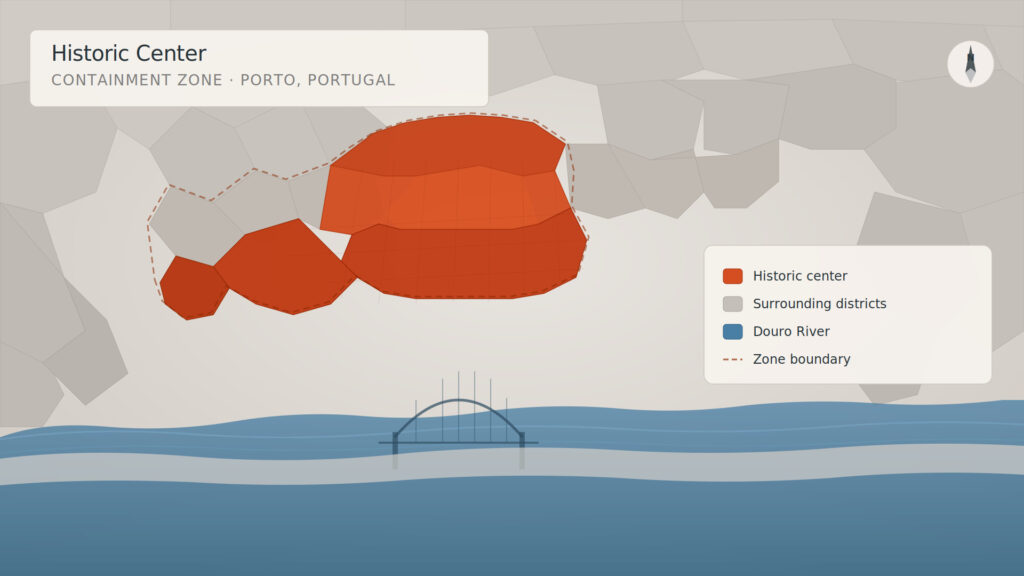
Porto Alojamento Local Cancellations Remove Over 1,400 Listings
- The Porto City Council is officially canceling 1,413 Alojamento Local (AL) establishments. This represents roughly 13% of the city’s current total of 10,821 active local accommodation registrations.
- The legal trigger for these cancellations is non-compliance: operators failed to submit mandatory proof of civil liability insurance to the National Local Accommodation Register (RNAL), a requirement demanded by law.
- The Association of Local Accommodation in Portugal (ALEP) noted that between 50% and 60% of these canceled registrations are concentrated in Porto’s historic center.
- Crucially, under the current containment rules, registrations canceled in the historic center will not be allowed to reactivate their tourist activity.
- The municipality stated it undertook various initiatives to support and warn non-compliant economic agents before initiating the cancellation procedures.
Read More: Exit Door 2026: The Paris Room Where France’s Short-Term Rental Consolidation Is Being Negotiated
Uvika’s Views
- This is hard enforcement over administrative compliance. The city isn’t passing a new zoning law; they are using an existing paperwork requirement (proof of insurance) to execute a massive supply reduction.
- The permanent loss of these licenses in the historic center is the most commercially significant detail. For property managers operating in Porto’s containment zones, maintaining immaculate compliance documentation is now an existential requirement, as the city has proven it will not grant second chances for administrative oversights.
- Operators in other European markets with strict containment zones (like Barcelona or Florence) may want to watch this playbook closely. Cities looking to passively reduce tourist housing footprints may increasingly rely on strict audits of existing operational requirements rather than passing controversial new bans.
Entities
Alojamento Local (AL) — The official Portuguese legal category for short-term tourist accommodation.
ALEP (Associação do Alojamento Local em Portugal) — The national association representing the local accommodation sector in Portugal.

South Africa Short-Term Rental Code Closes Public Consultation
- South Africa’s Department of Tourism closed its 60-day public consultation on May 12, 2026, for a new Draft Code of Good Practice for short-term rentals.
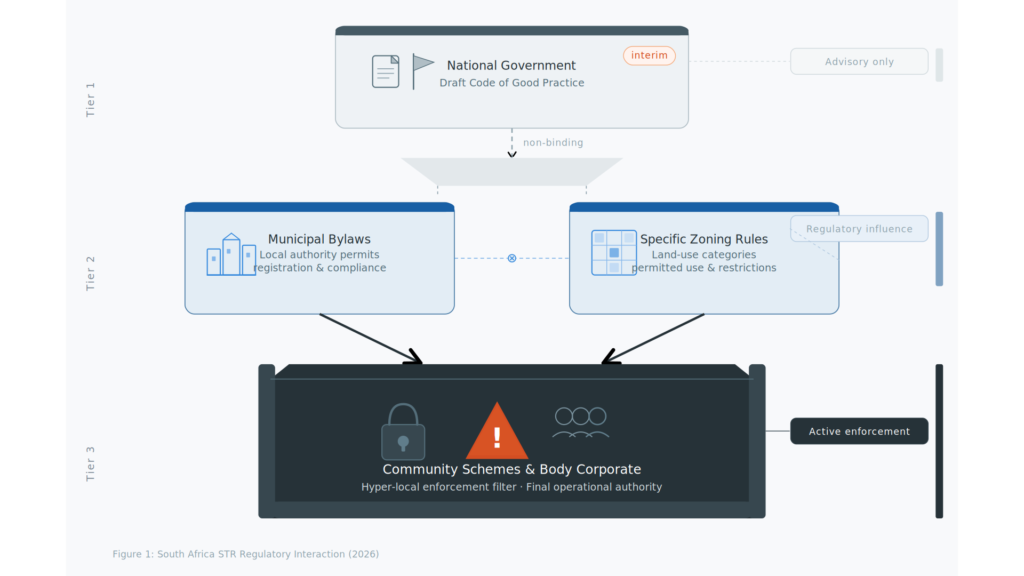
- The code was published under the Promotion of Administrative Justice Act (PAJA) as an interim regulatory measure. It was introduced in the context of the ongoing review of the Tourism Act of 2014, which followed the adoption of the 2024 White Paper on the Development and Promotion of Tourism — a review the Minister has noted the current Tourism Act does not itself empower her to use for direct STR regulation.
- It is currently designated as non-binding and is intended to guide hosts, guests, and platforms while a formal Tourism Amendment Bill is developed.
- The South African Short-Term Rental Association (SASTRA) briefed the Portfolio Committee on Tourism, emphasizing the need to protect consumers, support SMMEs, and ensure regulatory alignment between national and local governments.
- Industry experts note the draft code lacks clear guidance on how it interacts with existing community schemes or body corporate rules that may already restrict or prohibit short-term rental activity.
Read More: The May 20 EU Data Deadline: Should Property Managers Expect Mass Delistings?
Uvika’s Views
- This represents South Africa’s first major attempt to establish a national baseline for the short-term rental ecosystem. While the code is currently non-binding, it effectively serves as the blueprint for the upcoming, binding Tourism Amendment Bill.
- The enforcement vacuum is the critical detail for property managers right now. Because the code is aspirational, trustees and managing agents in community schemes are left to enforce their own body corporate rules. The interaction between national guidelines and hyper-local strata rules remains completely unresolved.
- Operators may want to track how the Department of Tourism incorporates industry feedback into the final Tourism Amendment Bill. If the final legislation formalizes arbitrary night caps—as SASTRA has warned against—the profitability math for smaller operators will fundamentally change.
Entities
SASTRA (South African Short-Term Rental Association) — The industry body representing short-term rental hosts and operators in South Africa, currently lobbying for proportional regulations during the national framework review.
Hawaii Short-Term Rental Phase-Out Authority Formalized
- Governor Josh Green signed Act 017 (SB 2919) into law on May 3, 2024, explicitly granting Hawaii’s counties complete control over short-term rentals. County-level bills empowered by the legislation are now actively advancing — most significantly in West Maui and Waikiki — making the law’s on-the-ground implications a live issue for operators this year.
- The legislation empowers counties to regulate the “time, place, manner, and duration” of short-term rentals.
- Most significantly, the law grants local authorities the power to amortize and phase out existing, legal short-term rentals in residential and agricultural zones.
- The law ensures that Hawaii counties can tax and regulate short-term rentals by the same standards as hotels, or designate them as non-residential use for zoning purposes.
- This state-level enablement has profound implications for markets like Waikiki condotels and West Maui, where county-level bills aimed at phasing out thousands of apartment-zoned rentals are already advancing.
Read More: Maui Bill 9 Becomes Law: What the Final Ordinance Actually Does and What Comes Next
Uvika’s Views
- This is a massive paradigm shift. Over the last two years, the dominant US trend has been state legislatures passing preemption laws to protect short-term rentals from local city bans (as seen in Idaho, Indiana, and Florida). Hawaii has inverted that model: the state passed a law explicitly handing counties a regulatory kill switch.
- The power to “amortize” existing legal rentals is the detail with the most friction. Historically, operators holding legal, non-conforming use permits were generally protected by “grandfathering” clauses when zoning rules changed. SB 2919 strips away that default state-level protection.
- For property managers operating in Hawaii, the regulatory threat level has officially moved from the statehouse to the county councils. Operators holding legal permits shouldn’t read their current status as permanent, and may want to factor potential local phase-outs into their long-term portfolio planning.

Uvika Wahi is the Editor at RSU by PriceLabs, where she leads news coverage and analysis for professional short-term rental managers. She writes on Airbnb, Booking.com, Vrbo, regulations, and industry trends, helping managers make informed business decisions. Uvika also presents at global industry events such as SCALE, VITUR, and Direct Booking Success Summit.
Related Articles:
 Airbnb’s Vision for Fair Regulations in Spain and Elsewhere
 The May 20 EU Data Deadline: Should Property Managers Expect Mass Delistings?
 French Short-term rentals and the Hoguet Law: What the FNAIM Report from April 2026 Says
 Mexico City Enforces Registration, England Delays Planning Class, Cleveland Caps Density