
Most coverage of Airbnb is written through a travel lens. That misses half the story. Experiences and Services are bookable by locals. Airbnb-friendly apartments target tenants, not travelers. Nearly half of Experience bookings in Q4 2025 came from people not simultaneously staying at an Airbnb. The Airbnb Summer Release 2026 could be the clearest signal yet that Airbnb is running a lifestyle platform play underneath the travel one — and the two axes are starting to merge.
Our prediction in one sentence
The 2026 Summer Release lands as AI-leaning, lifestyle-positioned Airbnb — natural language search and AI trip planning as the consumer headline, a services expansion that absorbs what property managers already offer, a loyalty framework preview, AI-powered host tools plus a third-party marketplace that reshape (but don’t necessarily consume) the host-tool ecosystem, and at least one lifestyle-axis moment — most likely Airbnb-friendly apartments for renters — that reminds the industry Airbnb isn’t only a travel company.
Here’s what we expect, pillar by pillar.
1. Strengthening the core: more supply, more offerings
Before the headline-grabbing predictions, here’s what we’d call baseline expansion — continuation of strategy, not news.

- More hotels, especially boutique and independent in supply-constrained cities.
- Luxe visibility expansion. Luxe already lives on the site as a filter — Airbnb is demand-testing luxury without committing to a separate brand. Summer Release promotion from filter to named surface is the same pattern they used with Rooms. Low-risk stage moment.
2. More Services and Experiences: the PM replication thesis
Airbnb is systematically platforming the services professional property managers already provide to vacation rental guests. The margin is Airbnb’s; the service gets commoditized. Guests stop routing through you for arrival and stay services.
Arrival and logistics
- Welcome Pickups expansion to US and Canada. Launched in roughly 125 cities in March 2026 but explicitly excluded North America. The Summer Release is the natural window to close that gap.
- Luggage storage partnerships. Bounce and Nannybag already run city-wide networks. Fits the “one-stop trip” pitch.
In-home services — expect more trials here
- Grocery and food delivery partnership. Instacart or DoorDash. Not just delivery — a tiered model: “welcome basket” → “stocked for the week.” The stage demo is obvious: “you arrive and the fridge is stocked.”
- Baby and child equipment. Cribs, high chairs, strollers. BabyQuip-style model.
- Gear rental with delivery. Ski and snowboard gear, surfboards, bikes, kayaks. Matches seasonally to existing categories and the Milano-Cortina supply play. Ski Butlers, BeachBumRentals, and BabyQuip all exist today and fit as acquisition targets or partnership templates.
Our pick for what ships at Summer 2026
Grocery and food delivery, baby and child equipment, and gear rental with delivery. They map cleanly to existing vendors Airbnb can partner with, and they’re demo-able on stage with a clear “you arrive and it’s already there” narrative.
Why it matters for property managers
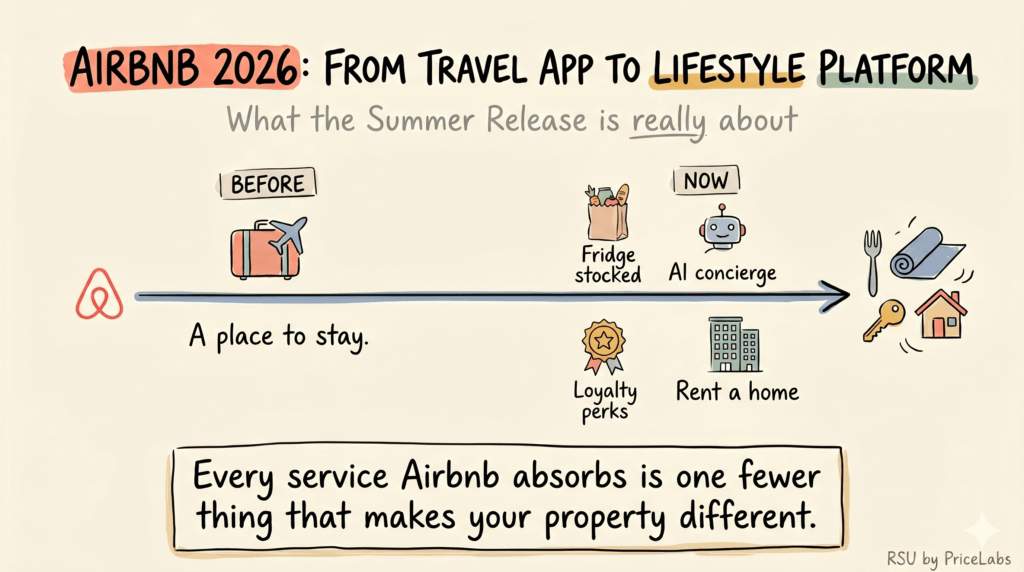
Every service Airbnb platforms is one fewer differentiator you can offer. Decide now which services you retain as your edge — hyperlocal knowledge, complex multi-property logistics, event-specific concierge — and which you let Airbnb absorb as a commodity.
3. The Connection Economy: meet-ups against loneliness
Quick context. Connections is the social layer Airbnb added to profiles at the 2025 Summer Release — a way to see and remember people you’ve met through the platform. In early 2026, Airbnb partnered with Timeleft, which seats six strangers at a restaurant for a guided dinner. In April 2026, Airbnb’s engineers publicly described context-aware profile IDs — identity infrastructure for surfacing the same user across different social contexts.
Three data points, one direction: Airbnb is building social infrastructure, not just booking infrastructure.
The prediction: a distinct meet-up category, separate from paid Experiences (booked activities) and Services (chefs, massages, photographers), differentiated on three axes:
- Price: free or near-free, not $300
- Format: peer-to-peer, not commercial host-led
- Framing: loneliness and belonging, not tourism or expertise
Without this separation, it collapses into Experiences. With it, it’s closer to Meetup.com with verified Airbnb identities.
The cannibalization question
Why launch free meet-ups when Airbnb earns 15–20% on paid Services? Three reasons:
- Different audience — locals, solo and budget travelers Airbnb doesn’t currently monetize.
- Engagement, not transaction — monetization comes downstream via ads, featured Services, and loyalty.
- Clean separation — $300 Experience = “book an expert”; free meet-up = “show up to meet neighbors.”
If we’re wrong: Airbnb pushes more paid Services instead, and Connections stays passive. That’s the signal to watch on stage.
Likely formats
Communal dinners (Timeleft model), run clubs, language exchanges, hobby meet-ups, cooking together in a host’s home, volunteer afternoons, skill-share evenings. Pattern: low commitment, low cost, local, recurring.
Why it matters for property managers
If Airbnb builds a social graph around real-world interaction, your guests return to Airbnb for reasons unrelated to their stay with you. Review dynamics, referrals, and repeat-guest metrics shift in ways the booking funnel doesn’t capture.
4. Guest-side AI: the stage demo
This will be the headline feature most coverage leads with.
- Natural language search. “Show me a cabin I can walk to a lake from, under $200, with good reviews from solo travelers.” This is the on-stage moment that sells the AI-native framing in one sentence — the kind of demo that clips into every piece of coverage.
- AI trip planning that stitches stays, experiences, and services into a single itinerary. The connective tissue that makes the 2025 “more than an Airbnb” thesis actually feel unified.
Why it matters for property managers
Distribution visibility stops being about keywords and starts being about how your listing is understood by an AI that weights quality signals, guest-fit signals, and review sentiment differently. Rewrite listings for AI readability now — specifics, not SEO.
5. Host-side AI and the marketplace question
Here’s the honest section. We need to name the implications.
The privacy policy now explicitly permits Airbnb to train AI on host behavioral data — pricing decisions, booking windows, response patterns, occupancy rates. The CTO is ex-Meta, from the Llama team. The pieces are assembled.
Our predictions
- Photo-to-listing description. Upload photos, AI drafts title, description, house rules, amenity list. Multimodal AI can do this well now; Airbnb can ship it.
- Photo quality scoring and re-shoot suggestions. AI flags which photos underperform and recommends retakes. Massive time-saver for new hosts and a quality lever for Airbnb.
- Booking success analytics with AI-suggested improvements. Title and description optimization, gallery ordering, pricing prompts, minimum-stay suggestions.
- Host Services Marketplace — a connector, not a competitor. The more interesting version of this prediction: Airbnb builds a marketplace that lets hosts connect to third-party tools directly — dynamic pricing software, cleaning marketplaces, turnover management, repair dispatching — without needing a full PMS in the middle. Hosts pick the tools they need; Airbnb provides the integration layer.
Who wins and who loses if the marketplace prediction lands
Third-party specialized tools potentially benefit — PriceLabs, cleaner marketplaces, pricing tools. They get discoverable native distribution.
Full PMS platforms face real structural pressure. The vendors whose pitch is “one system to rule them all” see the integration layer they own become commodity infrastructure owned by Airbnb.
This is a meaningfully different prediction than “Airbnb builds everything natively and eats the tools ecosystem.”
The honest caveat
Even in this more benign framing, Airbnb’s native AI features still raise the baseline of what an unsupported host can do. Photo-to-listing, listing diagnostics, AI-drafted messaging — the floor rises. Specialized tools have to articulate their edge above that floor, which pushes them into things Airbnb’s generic AI won’t do well: multi-channel pricing, multi-market strategy, revenue management at portfolio scale.
The yellow flag
A host-side marketplace has been talked about for multiple cycles without shipping. The base rate of prior non-delivery should push confidence below 75%.
Our bet is that the 2026 version ships because the underlying Services infrastructure (over 250 cities of chef, massage, and photographer bookings) is now real, and the same rails extend to hosts hiring services. But it’s worth watching rather than betting on.
Why it matters for property managers
If this ships, the professional edge shifts. Airbnb’s native tools plus a marketplace of third-party integrations will be adequate for most single-listing hosts. Professional operators need to re-articulate their edge around things single-listing hosts still can’t replicate — complex property portfolios, hyperlocal expertise, multi-channel distribution strategy, operational orchestration at scale.
6. Loyalty: framework preview, building on what’s already in test
Loyalty is an “always coming” prediction. I’ve been wrong on the timing before.
What’s already happening. In February 2026 I covered an Airbnb test at RSU: some hosts were invited to offer 20% off in exchange for higher search ranking, targeting guests with 4.8+ ratings. Not formal enrollment. Not branded. But structurally, a soft Genius launch.
A correction I owe readers. I earlier wrote “Chesky will resist Genius-style discount mechanics.” The February test undermines that. Hosts are already funding a 20% discount for visibility — Genius mechanics under a different name.
The prediction
Framework preview at the Summer Release, building on the field test. Three acts: Chesky’s February “massive accelerant” line → the live 20%-for-visibility invite → a framework announcement that names and brands what’s already running.
Likely features: tiered recognition, non-discount perks (early access, priority support, experiential rewards) layered over the pay-to-play lever, and possibly tied to Services and Experiences — lifestyle loyalty, not just travel loyalty.
Confidence: sub-75%. Base rate of prior non-delivery still applies.
What to watch on stage
- Does the test expand beyond invite-only?
- Does enrollment formalize into tiers?
- Does guest tier branding appear?
- Is the 20% discount pitched as optional — or as default?
Why it matters for property managers
The lever is economic, not behavioral — you pay margin for visibility. Decide whether you’re willing to trade margin for ranking, because the mechanism is already live, and the Summer Release may be where it gets formalized and scaled.
7. Dark horses: what trade press will miss
The predictions not in anyone’s consensus. If any of them ship on stage, you heard it here first.
Airbnb-friendly apartments gets a consumer-facing moment
1,300 buildings, 75+ markets, partnerships with 16 of the 50 largest US multifamily managers. A renter-facing pitch — “live in an Airbnb-friendly building” — is overdue. This is the clearest lifestyle-axis move Airbnb could make on stage, and the one most likely to surprise the travel-focused trade press.
Financial services teaser
Three-signal convergence: Reserve Now Pay Later drove material Q4 2025 GBV growth; the CTO’s background includes Meta payments (WhatsApp Pay, Facebook Pay); expanded payments discretion is baked into the new Terms of Service.
Airbnb won’t launch a bank. But an Airbnb-branded payments or installments product is a dark-horse teaser. Almost no one in the STR industry is discussing this.
What property managers should do right now
Four moves to make before the Summer Release lands.
1. Rewrite listings for AI readability
Specifics, quality signals, guest-fit signals. Not SEO keywords. Assume your listing will be parsed by a model, not skimmed by a human.
2. Audit which services you bundle into stays
Decide which you retain as your edge — hyperlocal knowledge, complex property logistics, event-specific concierge — and which you cede to Airbnb’s platform (grocery stocking, gear rental, baby equipment).
3. Review your third-party tool stack
Identify which tools solve problems Airbnb’s native AI and marketplace won’t solve: multi-channel pricing, multi-listing-site strategy, market-level revenue management, cross-property operations.
4. Prepare for credentialing
The new ToS already collects business credentials, professional licenses, and online presence data from hosts. The infrastructure for a verified-professional layer is visibly being built. Have your business registration, professional licenses, insurance certificates, and online presence documentation ready. If a verified-operator tier launches, be in the first cohort.
The practical takeaway for property managers
The floor rises. Airbnb’s native AI plus a connected tools marketplace will make single-listing hosts look more professional than they are. Your edge has to shift to things that don’t commoditize — local expertise, portfolio orchestration, multi-channel strategy — or into services Airbnb hasn’t yet platformed.
The next six months are the window to decide where you’re defensible.

Thibault Masson is a leading expert in vacation rental revenue management and dynamic pricing strategies. As Head of Product Marketing at PriceLabs and founder of Rental Scale-Up, Thibault empowers hosts and property managers with actionable insights and data-driven solutions. With over a decade managing luxury rentals in Bali and St. Barths, he is a sought-after industry speaker and prolific content creator, making complex topics simple for global audiences.