

Short-term rental policies updates this week: Folly Beach, Greece, and Abu Dhabi each moved on strategies affecting operators. The landscape shows a distinct shift in regulatory tactics globally — from severing an unlawful revenue mechanism so a supply cap can survive a court loss, to reconciling platform-reported income against filed tax returns, to widening who may legally hold a licence while making the licence itself a precondition for distribution.
Folly Beach Reinstates Its 800-Licence Cap and Drops the Registration Fee
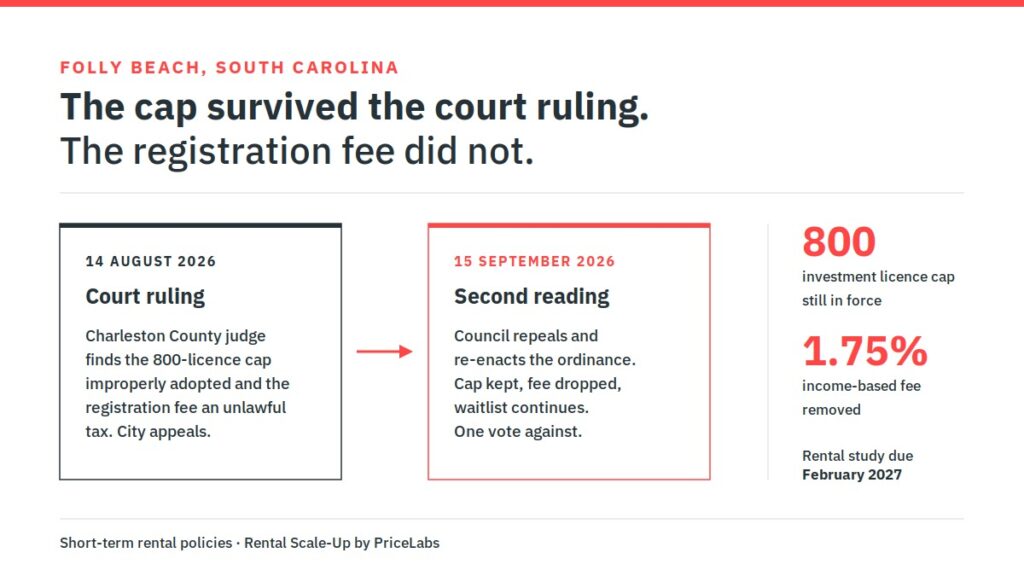
- On September 15, 2026, the Folly Beach City Council passed the second reading of an ordinance that repeals and simultaneously re-enacts the island’s short-term rental framework. The cap of 800 business licences for investment, non-owner-occupied rentals stays in place; the income-based registration fee is removed.
- The rewrite follows an August 14, 2026 Charleston County ruling by Judge Thomas J. Rode, which found the cap had been improperly adopted through referendum and that the registration fee amounted to an unlawful tax. The city has appealed that ruling separately.
- First reading passed 6-0 on September 8. At second reading, Councilman Blair Holladay cast the sole opposing vote and questioned how the city intends to refund fees it now concedes were improperly collected.
- The fee generated more than $1.5 million in 2025 according to the city budget. Owners who paid 1.75% of rental income since 2022 filed a proposed class action on September 3, 2026 seeking refunds.
- A moratorium on new licences remains in effect. New applicants join a waitlist rather than receiving a licence. Mayor Chris Bizzell described the ordinance as a way to hold a stable policy framework while the city waits for the results of a commissioned rental study.
- The “Why” / The Timeline: The rental study is due back in February 2027, and council has signalled that the longer-term shape of the ordinance will be decided then. The current text is designed to hold the line in the interim without carrying the defect the court identified.
Uvika’s Views
- A court loss did not return inventory to the market: The ruling invalidated two things — the cap and the fee — and the city responded by keeping the first and discarding the second. Supply constraints and revenue mechanisms were treated as separable, and only one of them was legally fragile.
- For managers, the practical position is unchanged from before the ruling: the licence count is still capped, the waitlist still governs new entries, and a property sold today does not carry a guaranteed licence to its buyer.
- What professional managers can do is treat a favourable ruling as a prompt to check what specifically was struck down rather than assuming the constraint has lifted. Owners reading headlines about a cap being overturned will ask whether they can now list, and the answer here is no.
- The fee removal creates a refund question, not a clean saving: Operators stop paying 1.75% of rental income going forward, but amounts already collected since 2022 are the subject of a pending class action rather than an automatic return.
- The forward saving is real and should be reflected in net revenue modelling for 2027 onward. The backward claim is contingent and should not be booked as receivable.
- Managers holding owner funds or preparing statements can flag the distinction explicitly: fee relief begins when the ordinance takes effect, and any recovery of past payments depends on litigation the city is contesting.
- Waitlist position is now a material asset attribute: With the cap intact and the licence pool full, a property’s standing in the queue affects what it can earn and what it is worth.
- Acquisition conversations should establish whether a target property holds an active licence, sits on the waitlist, or has neither, before revenue projections are built.
- Managers onboarding new Folly Beach inventory can make licence status a gating question in the intake process rather than something discovered after a contract is signed.
Greece Matches Booking Platform Data Against This Year’s Tax Returns
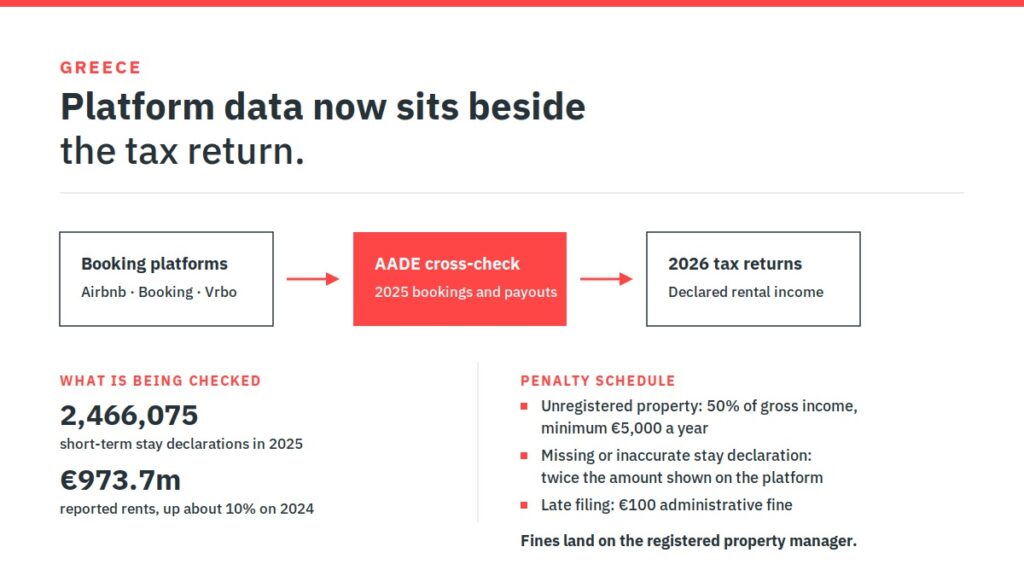
- Greece’s Independent Authority for Public Revenue (AADE) is comparing 2025 earnings recorded by Airbnb, Booking.com and Vrbo against the income declared on tax returns filed in 2026. The authority is working from data supplied directly by the platforms rather than from self-reported figures alone.
- The dataset covers 2,466,075 short-term stay declarations recorded in 2025, with reported rents totalling €973.712 million, up from €888.851 million in 2024 — an increase of roughly 10%.
- Failure to register a property in the Short-Term Accommodation Registry carries an annual fine equal to 50% of the gross income earned in the year of the violation, with a minimum penalty of €5,000. A repeat of the same offence within one year of a fine being imposed doubles the penalty, and any further repeat results in four times the original amount.
- Failure to file, or filing an inaccurate Short-Term Stay Declaration, carries a fine equal to twice the rental amount shown on the relevant digital platform. Late filing carries a separate €100 administrative fine.
- Fines are imposed on the person registered as the property manager. Where that manager is not a sublessor or other third party, liability falls to the owner or the holder of the property’s usufruct rights. The statutory basis is set out in Article 111 of Law 4446/2016 as updated.
- The “Why” / The Timeline: The cross-check applies to income earned in 2025 and declared in returns filed this year, which means the exposure period is already closed. There is no forward-looking compliance step that changes what was reported.
Uvika’s Views
- Naming a management company as registered manager transfers the penalty, not just the paperwork: The fine attaches to the registered manager first, and only falls back to the owner where no manager is registered.
- A management company carrying dozens or hundreds of registry entries is aggregating penalty exposure for declarations it may not have filed itself, on income figures it may not fully control.
- What professional managers can do is audit which properties list them as registered manager and confirm that the declaration filing responsibility for each one is documented in the management agreement, including who files and who is liable if the filing is wrong.
- The penalty for an inaccurate declaration is calculated from platform data, not from the gap: The fine is twice the rental amount recorded by the platform, rather than twice the shortfall between declared and actual.
- A small reporting discrepancy on a high-revenue property therefore produces a penalty sized to the whole booking, which makes minor clerical errors disproportionately expensive relative to their fiscal effect.
- Managers can reconcile platform payout reports against the declarations filed for each property before any authority contact, so that discrepancies are identified and corrected as voluntary disclosures rather than found in an audit.
- Registration status is a separate and larger exposure than declaration accuracy: An unregistered property draws 50% of gross income annually with a €5,000 floor, escalating to double and then quadruple on repeats.
- Properties that entered a portfolio mid-year, changed ownership, or were added informally to an existing manager’s roster are the most likely to be missing a valid registry entry.
- A portfolio-wide check that every Greek property has an active registration number, correctly matched to the current manager, addresses the largest single line in the penalty schedule.
Abu Dhabi Upgrades Holiday Home Licensing and Widens Who Can Hold a Licence
- The Department of Culture and Tourism – Abu Dhabi (DCT Abu Dhabi) announced an upgraded holiday home regulatory platform on September 15-16, 2026, reducing approval times and simplifying licensing procedures while adding tools for monitoring, inspections, compliance tracking and revenue management.
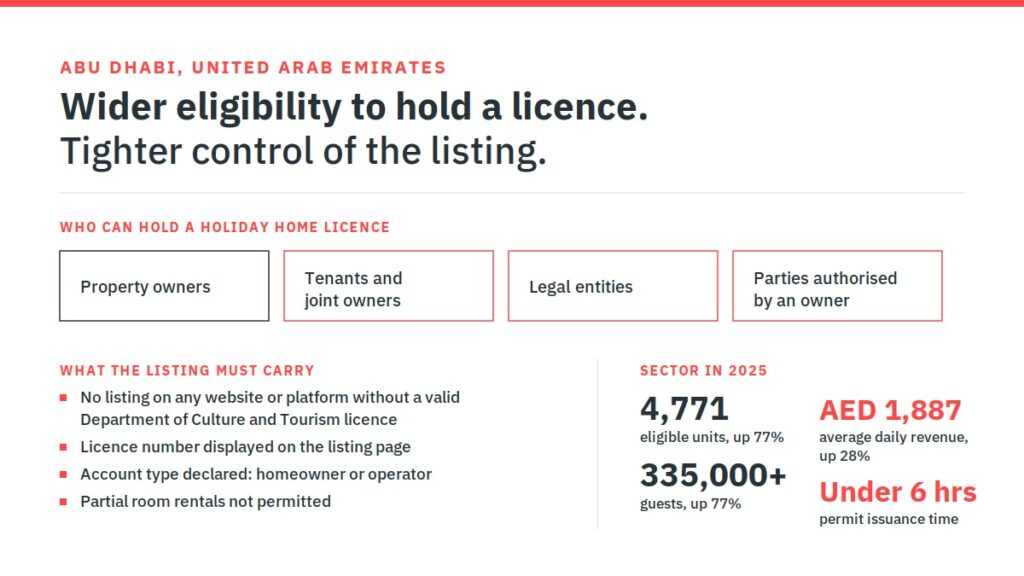
- Under the amended framework, tenants, joint owners, legal entities and parties authorised by an owner can hold a holiday home licence, extending eligibility beyond property owners alone.
- Properties cannot be listed on any website or digital platform without a valid DCT Abu Dhabi licence, and the licence number must be displayed on the listing page. Partial room rentals are not permitted, and users of the platform must specify whether they are registering as a homeowner or an operator, supplying a Department of Economic Development licence where applicable.
- The department reports that holiday home supply grew 77% in 2025 to 4,771 eligible units, guests rose 77% to more than 335,000, domestic guests climbed 114% to 82,900, and average daily revenue rose 28% to AED 1,887.
- A 2024 integration between the licensing platform, the Department of Municipalities and Transport, and the self-inspection system reduced permit issuance time to under six hours.
- The “Why” / The Timeline: The framework sits under Tourism Strategy 2030, which sets an objective of diversifying accommodation supply beyond hotels. The listing-level rules were set out when DCT Abu Dhabi announced amendments to its 2020 regulations earlier in 2026; the September announcement concerns the system that administers them.
Uvika’s Views
- Eligibility widening is a supply signal, not a relaxation of control: Allowing tenants and authorised third parties to hold licences enlarges the pool of legal operators while leaving the licence requirement itself untouched.
- For management companies, the significant change is that a lease-and-operate model becomes viable without needing the freehold owner to sit on the licence, which shortens the path from signed agreement to live listing.
- What professional managers can do is revisit master-lease and authorised-operator structures that were previously ruled out, and confirm with DCT which licence category and supporting Department of Economic Development documentation their intended structure requires.
- Licence display on the listing page makes compliance externally visible: Requiring the number on the listing means a missing or invalid licence is detectable by anyone looking at the page, including the platform and the regulator.
- This removes the lag between a licence lapsing and enforcement noticing, because the evidence of compliance is published continuously rather than checked periodically.
- Managers can build licence expiry into the listing-maintenance calendar rather than an internal compliance file, and verify after every listing edit that the number is still rendered on the live page.
- Faster approvals shift the constraint from permitting to portfolio quality: With issuance measured in hours rather than weeks, the regulatory timeline stops being the bottleneck on adding a unit.
- When permitting is no longer the limiting factor, expansion speed is governed by whether the inspection, safety and quality standards attached to the licence can be met across a growing portfolio.
- Managers scaling in the emirate can front-load the self-inspection and standards work at onboarding, since the licence can be issued faster than a property can realistically be brought up to the standard it commits to.
Stay on top of short-term rental regulation trends and what they mean for your operating environment.

Guneet has spent five years working at PriceLabs, developing deep expertise in short-term rental operations and hospitality technology. She brings that practitioner’s lens to her writing at RSU, covering platform updates and making sense of market data for property managers.