
On September 9, the European Commission formally adopted the Affordable Housing Act proposal. We covered the leaked draft here previously.
Most of what we said then still stands. But I have now read the leaked draft and the official text side by side, article by article, alongside the Annex, the impact assessment and the accompanying Recommendation that the leak did not include.
Several things moved between the two versions. A few of them change what you should tell your owners.
Before the comparison, here is the Act itself in plain terms, because the reporting around it has been loose.

What the EU Affordable Housing Act is, and what it means for short-term rentals
The Affordable Housing Act is a proposed EU Regulation. It is the European Commission’s response to a housing affordability crisis that is sharpest in cities, metropolitan areas, islands and tourist destinations.
It is not a Europe-wide cap on short-term rental nights. It sets no maximum number of rental days, designates no cities, and requires no authority to do anything.
What it does is set the conditions a public authority must satisfy before it restricts short-term rentals, second homes or vacant properties on housing affordability grounds.
Why short-term rentals sit in the middle of it
Because the Act covers two categories of local measure, and one of them is short-term rentals.
Article 2 brings in measures restricting short-term rental services in residential property, and measures restricting the acquisition or use of land and residential property that is not a primary residence.
The Commission’s position is that supply shortages are the structural cause of the crisis, and that some non-primary uses of housing can make it worse in specific constrained markets. Its own impact assessment records that consultations found broad agreement that short-term rental activity is not the principal driver of housing stress.
So this is not framed as an anti-Airbnb law. It is framed as a rulebook for cities that want to act.
Why an EU law reaches a rule made by your city
Housing policy belongs to national, regional and local government. But when a local rule restricts someone’s ability to provide a service, establish a business or buy property, it touches freedoms protected by EU law.
The EU Court of Justice has already accepted, in the 2020 Cali Apartments case, that a shortage of long-term housing can justify requiring authorisation for short-term rentals. The restriction still has to be justified and go no further than necessary.
The problem the Commission identifies is that those principles are general. There is no common method for showing that an area has a housing problem, or for proving a restriction is proportionate. So cities use different evidence, and end up in court.
The Act’s purpose is to replace that uncertainty with a common test.
The three tests a city would have to pass
If an authority wants to restrict short-term rentals to protect housing, it would have to show all three.
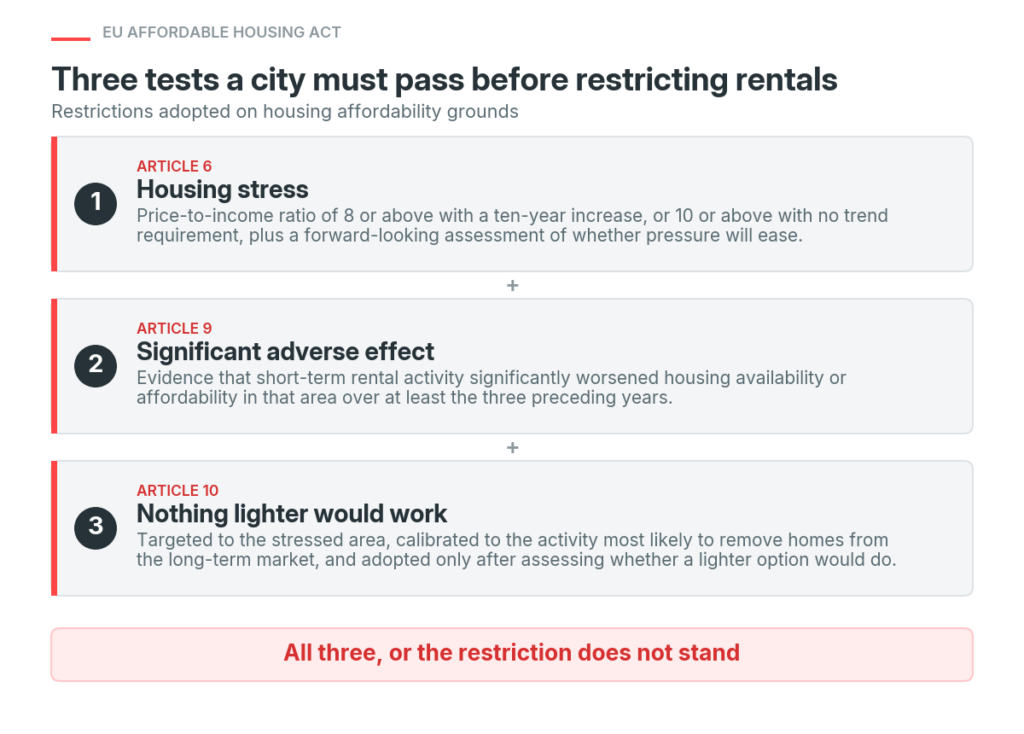
One, that the area is under housing stress. Article 6 sets a price-to-income threshold, with a required trend and a forward-looking assessment of whether pressure will ease.
Two, that short-term rentals made it worse. Article 9 requires evidence of a significant adverse effect on housing availability or affordability in that area over at least the three preceding years. Housing being expensive is not enough on its own.
Three, that nothing less restrictive would work. Article 10 requires the measure to be targeted to the stressed area, calibrated to the activity most likely to remove homes from the long-term market, and adopted only after assessing whether a lighter option would do the job.
On top of that, the authority would have to publish its assessments, the exact territory covered and the duration before the measure takes effect, and affected businesses would have access to judicial review.
There is also a precondition that gets overlooked: to restrict short-term rentals, an authority must already be applying and enforcing the EU short-term rental data regulation, Regulation (EU) 2024/1028, in that area. That is the registration and data-sharing regime that has applied since May 2026.
The distinction that decides your exposure
Not how many properties you manage. Whether each one is the host’s main home.
The Act separates a host’s primary residence, broadly the home where someone normally lives, from every other residential property. Restrictions adopted on housing affordability grounds would reach the second category, not the first.
That means an individual with one dedicated rental apartment is not automatically protected, and hiring a property manager does not by itself change how a property is treated.
The protection for primary residences is also narrower than it sounds, which is where the official text moved, and where this article starts.
Where it stands
Adopted by the Commission on September 9, 2026. Not law. Parliament and Council negotiate next and can change the text.
No compliance deadline applies to you today, and existing local rules in your markets are unaffected by it.
What changed between the leaked draft and the official text
The leak Euractiv published was the Regulation alone. The official release added an Annex, an impact assessment, a subsidiarity grid and a separate Commission Recommendation on housing supply.
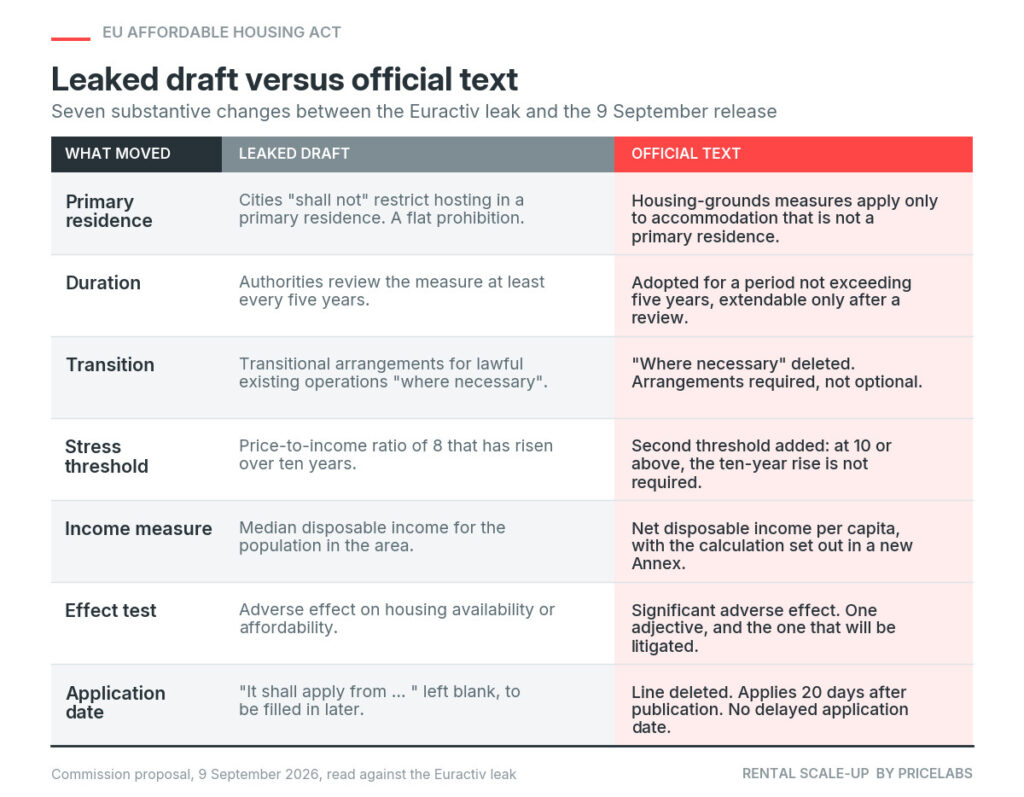
Comparing the two side by side, here is what changed.
1. Primary residence: the exemption is narrower than the headlines say
What the leak said
The leaked Article 5(2) was a prohibition. Competent authorities shall not impose restrictions on short-term rental services provided by a host in their primary residence. Full stop.
What the official text says
The official Article 5(2) is not a prohibition. It says that measures taken solely on housing affordability and availability grounds under this Regulation apply only to accommodation that is not the host’s primary residence.
The difference is the qualifier. The leak said cities cannot restrict primary-residence hosting. The official text says cities cannot restrict primary-residence hosting using this particular justification.
And the official text added a sentence confirming it
The leaked draft explained that the EU Services Directive would continue to apply to short-term rental restrictions based on other public-interest grounds.
The official recital 15 says the same thing, and adds five words that were not in the leak: both on primary and non-primary residences.
It then lists the grounds that remain available: public policy, public security, public health, consumer protection, the environment and the urban environment, and the protection of cultural heritage.
What this means in practice
A city that wants to cap nights on primary-residence hosting is not blocked by this Regulation. It simply cannot use housing affordability as its stated reason. It can use the urban environment, or public policy, and stay under the existing Services Directive rules.
Paris-style 120-night caps on primary residences are a good example. Nothing in this proposal touches them.
For your business: if an owner asks whether “Brussels is protecting main-home rentals,” the accurate answer is that Brussels is limiting one specific justification. It is not creating a right to rent your main home.
2. Restrictions would expire after five years unless a city renews them
This one moved in operators’ favour, and it is a genuine change rather than a clarification.
The leaked Article 12 only required authorities to review a measure at least every five years. In our first article I wrote that a five-yearly review does not mean a restriction automatically ends after five years. That was accurate for the leak.
The official Article 12(1) is different. Measures would be adopted for a period “not exceeding five years.” They can be extended, but only after a review confirming the conditions in Articles 6 to 10 still hold.
Be realistic about it. The same authority that imposed the restriction runs the review and decides the extension, so treat it as a scheduled checkpoint rather than a guaranteed sunset. But it is a checkpoint you can prepare for, and a moment where the evidence has to be produced again.
3. Transitional arrangements for existing operators became mandatory
A small edit with real consequences.
Leaked Article 10(2) said that where measures affect existing lawful situations, they shall include appropriate transitional arrangements where necessary.
The official text deletes “where necessary.”
Where a new restriction hits a lawful existing operation, transitional arrangements would be required, not optional.
The text still does not define a minimum notice period or guarantee that any specific rental continues. But “appropriate transitional arrangements” without a get-out clause is a stronger footing than it was.
4. The housing stress test: price-to-income, two thresholds, and a new income measure
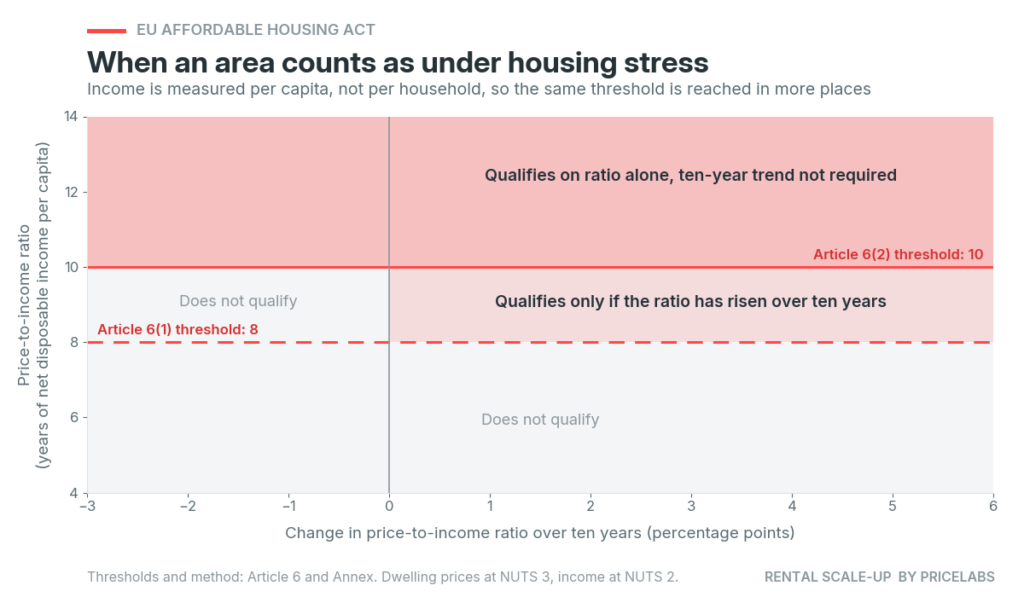
Our first article described the test as a price-to-income ratio of eight that has risen over ten years, plus a forward look at whether pressure will ease. That structure survived. Three things around it changed.
A second threshold was added
The official Article 6(2) is new. Where the price-to-income ratio is 10 or above, the ten-year-increase requirement does not apply.
This matters for markets that spiked and then flattened. An area with a very high but stable, or even slightly falling, ratio can still qualify. Several well-known European city markets sit in exactly that position after the interest rate rises of recent years.
The income measure changed
The leaked text compared dwelling prices against median disposable income for the population in the area.
The official text, in Article 4(5) and in a new Annex, compares against net disposable income per capita.
That is a lower number than a household figure, which means the same threshold of eight is reached in more places. If you assumed “eight times income” sounded like a high bar, recalibrate.
The calculation is now published
The leaked draft had no Annex. The official one does, and it specifies:
- Dwelling prices: average transaction price at NUTS 3 level
- Income: Eurostat net disposable income of private households per capita at NUTS 2 level
- Thresholds: 8 and 10 years of per capita income to buy an average-size existing dwelling
The Commission also names the tool behind it: Mapadomo, a housing database built by its economics department and Joint Research Centre, holding price and stock data down to municipality level.
Article 6(4) additionally lets authorities use their own more granular data if they can show it is consistent with the thresholds. Combined with Article 7, which now includes rural areas alongside districts, municipalities and metropolitan areas, neighbourhood-level and rural designations are both clearly on the table.
For your business: this is the part you can actually check. The methodology and the data source are public, so you can form a view on whether your markets are near the line before any authority acts.
5. Cities must now prove a “significant” adverse effect from short-term rentals
Article 9 still requires an authority to show that short-term rental activity affected housing availability or affordability over at least the three years before the measure.
The official text adds one word. The effect must now be a significant adverse effect.
One adjective, and it is the word that will be argued over in court. It also sits alongside a Commission statement worth keeping on file: the impact assessment summary records that consultations found broad agreement that short-term rental activity is not the principal driver of housing stress, and that structural supply constraints deserve more attention.
That is the Commission’s own document, not an industry claim.
6. Local rules adopted before the law takes effect escape it entirely
The leaked Article 17 had a separate line: “It shall apply from … .” A blank, to be filled in later. I noted at the time that there was no compliance deadline in that empty space.
The official text deletes that line entirely. The Regulation would enter into force 20 days after publication in the Official Journal, and apply from that moment. There is no delayed application date.
Article 14 was changed to match. Measures adopted before entry into force fall outside this Regulation, and authorities only “may review” them. The leak had said authorities may amend or renew them under the new rules.
Follow that through. Any restriction a city adopts before this text enters into force never has to satisfy the housing-stress test, the significant-adverse-effect test, or the proportionality conditions.
That creates an incentive for authorities to move during the negotiation rather than after it. Watch for local measures brought forward while Parliament and Council are still debating.
7. No EU enforcement layer, and the loss of the notification safeguard
Article 3(1) confirms what the leak showed: covered short-term rental measures would leave the Services Directive, including its Article 15(7) notification obligation.
The Commission presents this as simplification. Industry bodies see it differently, and on this point they have a reasonable argument.
Notification meant restrictions were flagged to the Commission and other Member States before taking effect. Under the new framework, the replacement is Article 13 publication: the authority publishes its assessments, the exact territory and the duration, before the measure enters into force. There is no standstill period and no approval step.
This is the single thing the platforms asked for and did not get. Airbnb’s response on the day of publication asks for exactly one process change: that authorities notify new and existing restrictions to the Commission, with the supporting evidence attached. It is a narrow ask, and it is about the safeguard this text removes.
The Commission is candid about its own capacity
The budget documents attached to the proposal allocate three full-time staff at the responsible directorate-general and around 11 million euros across 2028 to 2034.
The Commission identifies inconsistent application by local authorities as the principal implementation risk, and flags that the data behind the housing-stress calculation may not stay current.
There is no EU body approving designations. There is no central register of stressed areas. Every assessment is published locally, by the authority that wrote it, in whatever form it chooses.
So the Act creates a stream of public evidence and no public mechanism for reading it.
Someone else is building the scorecard
That vacuum is already being filled, and not by a public body.
On September 14, five days after the Act was published, Airbnb announced the Airbnb City Index, an annual worldwide ranking of cities on housing policy and outcomes, due later this year. It comes in two parts: an open dataset covering housing additions per capita, rent-to-income ratios and how far local regulation blocks construction, and an editorial ranking that is Airbnb’s own judgement of which cities are making progress.
We cover the Index and the $250 million Housing Accelerator it was announced alongside in a separate article.
Be precise about what this is and is not.
It is not a compliance monitor. It does not check whether a city met the Article 6 threshold, produced three years of evidence under Article 9, or assessed less restrictive options under Article 10. Nothing in it tells you whether a restriction in your market would survive a court challenge.
It is, though, the first recurring cross-city housing scoreboard anyone has built, arriving in the same month the EU decided not to build one. Comparable data of this kind genuinely does not exist today.
And it is produced by a company with a direct commercial interest in how cities score. Airbnb has not published the methodology, has not named an auditor and has not said which cities are in scope.
For your business: two practical consequences. The loss of notification means your advance warning is now local publication under Article 13, so build the habit of monitoring it in the markets you operate in.
8. The supply half of the Affordable Housing Act is not binding
The leak Euractiv published was the Regulation alone. The official release included a Commission Recommendation on housing affordability and supply in areas under housing stress.
It is substantial: housing acceleration plans, 60-day permitting targets, tacit approval for some permit steps, land banks, modern construction methods, and an acknowledged funding gap of around 150 billion euros a year.
It is also a Recommendation. The half that enables restrictions is a Regulation, directly applicable. The half that addresses supply is guidance.
The Regulation’s recitals say authorities should pair restrictions with supply measures. The Commission’s own performance indicators track how often that happens.
For your business: this is a usable advocacy line. When a city proposes a cap, ask where its housing acceleration plan is, and whether the Commission’s recommended supply measures are on the table alongside the restriction.
Still unanswered: how a management company’s portfolio is counted
The question we raised first time has not been answered.
The text still calibrates restrictions around a “single host,” and now defines host by reference to the EU short-term rental data regulation. It still does not say how a management company’s portfolio is counted when fifty homes belong to fifty different owners.
If you want one thing fixed during the parliamentary stage, this is it. Say so to your national association.
Recommendations for professional short-term rental managers
Nothing to your operations. This is still a proposal and the co-legislators can change it.
Check your markets against the real number. Price-to-income using per capita income, not household income. The threshold is lower than it sounds.
Check what your cities have just adopted. Anything landing before entry into force escapes these tests entirely.
Correct the conversation with owners. Not “Brussels protects main homes.” Brussels is narrowing one justification, putting an expiry date on restrictions, requiring transition arrangements, and leaving enforcement almost entirely to local authorities.
Our conclusion from the first article holds, with one adjustment. The Act would make justified restrictions easier to defend and unjustified ones easier to question. What the official text makes clearer is how much of that depends on cities choosing to play by rules that nobody at EU level is resourced to enforce.

Uvika Wahi is the Editor at RSU by PriceLabs, where she leads news coverage and analysis for professional short-term rental managers. She writes on Airbnb, Booking.com, Vrbo, regulations, and industry trends, helping managers make informed business decisions. Uvika also presents at global industry events such as SCALE, VITUR, and Direct Booking Success Summit.
Related Articles:
 Short-Term Rental Regulations Update Roundup: Athens, Alicante, and Egypt
 Cape Town To Impose Rental Tax, Booking.com Partners with Maldives, HomeToGo Launches 5 Localized Platforms
 Montreal Limits Rentals to 3 Months, Landfolk Expands in France, Vrbo’s Top Vacation Rentals of 2025
 Mountainside NJ Pre-empts FIFA STR Surge, Sydney Eyes Suburb-Level Airbnb Ban, France Counts Down to Declaloc Deadline