

Short-term rental rules updates this week: Montgomery County, England, and Shinjuku Ward each moved on measures affecting operators. The landscape shows a distinct shift in regulatory tactics globally—from placing licence verification inside the booking transaction, to building national registration infrastructure with a fixed delivery date, to redrawing where operation is permitted at all.
Montgomery County Introduces Platform Verification and Payment Restrictions
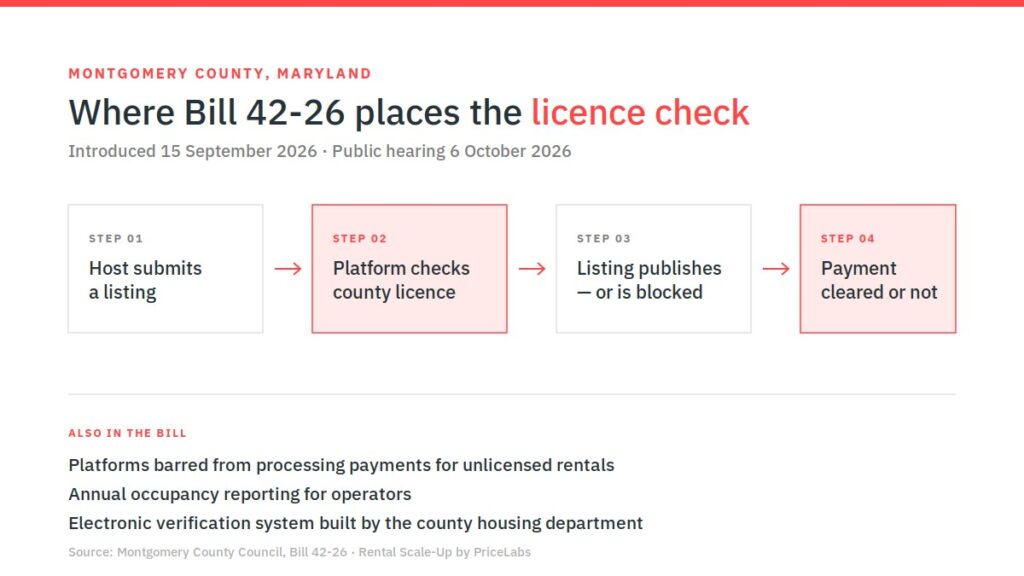
- On September 15, 2026, the Montgomery County Council introduced Bill 42-26, sponsored by Councilmember Shebra Evans, as part of a broader housing and tax credit package.
- The bill would require booking platforms to confirm a valid county licence before a listing is published.
- It would separately bar platforms from processing payments for rentals without a valid licence.
- Operators would face annual occupancy reporting obligations, while the Department of Housing and Community Affairs develops an electronic verification system for platforms to query.
- The “Why” / The Timeline: A public hearing is scheduled for October 6, 2026. The bill has been introduced, not enacted, and the committee stage follows the hearing.
Verification requirements of this kind have already been tested elsewhere; Austin’s platform verification framework took effect earlier this year on a comparable model.
Uvika’s Views
- Verification Moves Upstream: Placing the licence check before publication changes what a lapsed licence costs an operator.
- Under a takedown-request model, a listing stays live until the county identifies it. Under a pre-publication check, the listing does not appear at all, and the gap is immediate rather than eventual.
- What professional managers can do is move licence renewal dates into the same calendar they use for insurance and permit expiries, and build a buffer of several weeks rather than renewing at the deadline.
- The Payment Clause Carries the Weight: Blocking payment processing separates the compliance consequence from the listing itself.
- A property can remain visible and still be unable to convert a booking, which turns an administrative lapse into a revenue interruption within a single booking cycle.
- What professional managers can do is audit every Montgomery County unit against the county licence register now, before the October hearing, and identify which entity of record holds each licence so that ownership transfers do not orphan a permit.
- Reporting Is a New Operational Line Item: Annual occupancy reporting requires data most operators hold but few compile in a submittable form.
- Nightly occupancy, guest counts and booking source typically sit across a property management system and multiple channel dashboards.
- Managers weighing this may want to confirm their property management system can export occupancy by unit for a full calendar year, rather than reconstructing it manually at deadline.
England Confirms March 2027 for the National Short-Term Lets Register
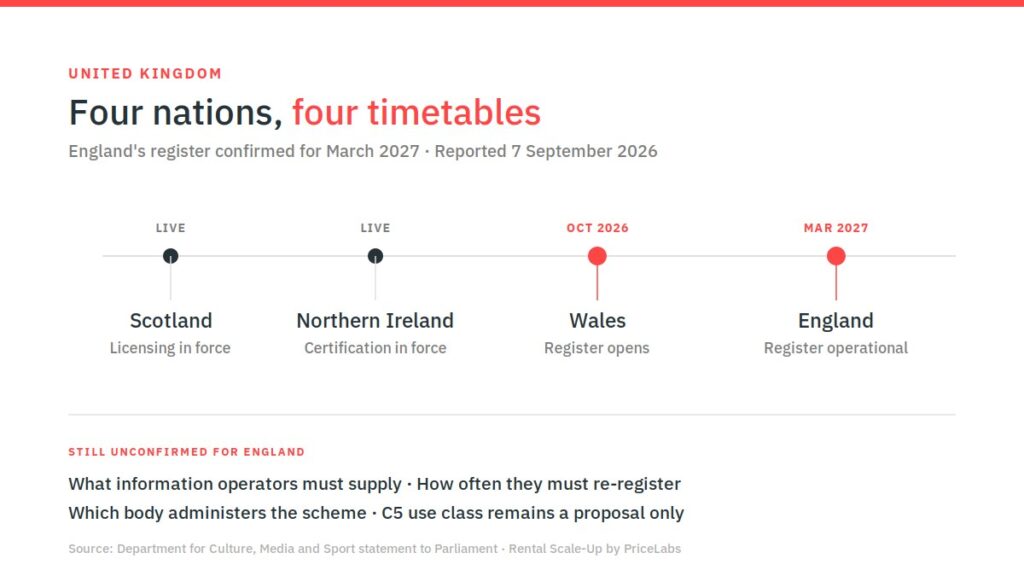
- Culture Secretary Lisa Nandy confirmed in Parliament that England’s national register of short-term and holiday lets will be fully operational by March 2027. The statement was reported across the UK property trade press on September 7, 2026.
- The scheme is expected to be mandatory and delivered primarily online.
- Several design details remain unconfirmed: what information operators must supply, how often they must re-register, and which body will administer the scheme.
- The stated purpose is to give local authorities data on the number and location of short-term lets in their areas, and to support enforcement of existing health and safety requirements.
- The “Why” / The Timeline: Wales opens its visitor accommodation register with the Welsh Revenue Authority in October 2026. Scotland and Northern Ireland already operate licensing and certification schemes. The proposed C5 planning use class remains a proposal, with no statutory instrument laid and no commencement date.
The register has been pending since a 2022 consultation, and the C5 use class has been in planning limbo alongside it since the implementation delay announced earlier this year.
Uvika’s Views
- A Date Changes the Planning Horizon: The register has been under discussion since a 2022 consultation without a fixed operational date attached to it.
- A named month converts an open-ended compliance liability into a schedule that can be costed, staffed and sequenced against other work.
- What professional managers can do is assign an owner for register readiness now and treat March 2027 as a hard date, on the basis that partial readiness at launch is more expensive to fix than early preparation.
- The Unconfirmed Fields Are the Real Workload: The administrative burden depends entirely on details the government has not yet published.
- If the register requires per-property safety documentation or nightly activity data, the collection effort is substantial. If it requires only address and contact details, it is minor. Operators cannot size the task until the secondary legislation appears.
- What professional managers can do is assemble the documentation that any plausible version would request — gas safety certificates, electrical installation condition reports, fire risk assessments and Energy Performance Certificates — into a single per-property file, so that whichever fields are specified, the underlying records already exist.
- Four Regimes, One Portfolio: Operators with inventory across the UK now face four separate registration and licensing frameworks running to four separate timetables.
- England’s register arrives in March 2027, Wales opens in October 2026, and Scotland and Northern Ireland already require compliance.
- Managers in this position may want to maintain a single compliance matrix mapping each property to its applicable regime and deadline, rather than managing each nation through a separate process.
Shinjuku Ward Proposes Zonal Restrictions on Private Lodging
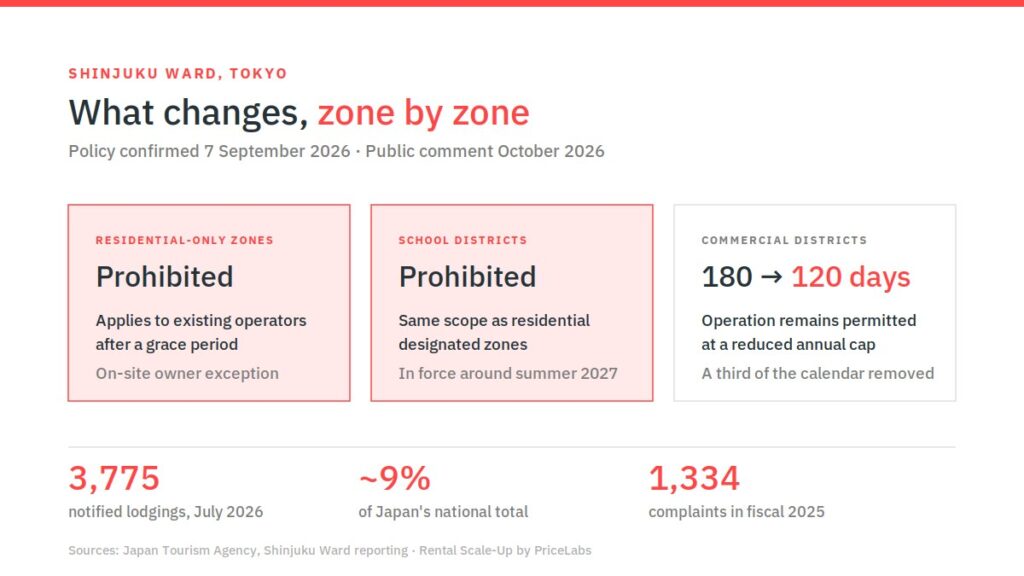
- On September 7, 2026, Shinjuku Ward confirmed a policy to prohibit minpaku operations in residential areas and around schools, applying in principle to city-planning zones designated exclusively for residential use and to school districts.
- The ward holds 3,775 notified private lodgings as of July 2026 — the highest of any municipality in Japan, and roughly 9% of the national total of about 42,000. Reporting indicates the restriction would affect around 2,000 properties, more than half the ward’s inventory.
- The restriction would apply to existing operators as well as new entrants, following a grace period. Operators who live on site and meet specified operating conditions may be permitted to continue as an exception.
- In commercial districts, where operation would remain permitted, the annual operating cap is set to fall from 180 days to 120.
- Complaint volume is the stated driver: 1,334 private lodging complaints in fiscal 2025, covering waste disposal, noise and smoking, with 510 already recorded by the end of July in fiscal 2026.
- The “Why” / The Timeline: The ward plans to open public comment in October 2026, submit the amended ordinance to the ward assembly in February 2027, and bring it into force around summer 2027, with a grace period for existing operators on top of that.
The ward is acting under authority granted nationally, after the Japan Tourism Agency permitted municipalities to set their own operating limits in designated residential zones.

Uvika’s Views
- Existing Permits Are Inside Scope: The proposal does not exempt lodgings that are already notified and operating lawfully.
- Acquisition models have generally assumed that a notified property retains its operating right through subsequent rule changes. A restriction drafted to reach existing stock removes that assumption for properties in the affected zones.
- What professional managers can do is map every Shinjuku unit against the city-planning zone designation it sits in, rather than against its current notification status, since the zone is what determines exposure here.
- The Owner-Occupancy Exception Is the Only Continuity Route: Where an exception is available, it is tied to the operator residing on the property.
- That condition is compatible with owner-hosted models and largely incompatible with remotely managed portfolios, which narrows the set of units that could qualify.
- What professional managers can do is identify which properties could plausibly meet an on-site residence condition and treat the remainder as requiring an alternative use case.
- The Commercial Zone Is Not a Safe Harbour: Properties in commercial districts remain permitted but face a reduced operating ceiling.
- A cap falling from 180 to 120 days removes a third of the available operating calendar, which changes annual revenue assumptions for units underwritten at the higher figure.
- Managers holding commercial-zone inventory may want to re-run their revenue models at 120 days and identify which nights are most valuable, so that the reduced allowance is allocated to peak demand rather than consumed early in the year.
- A Long Runway, but a Defined One: Public comment in October, assembly submission in February 2027 and commencement around summer 2027 give operators a multi-quarter window.
- The public comment stage is the point at which operator input carries procedural weight.
- What professional managers can do is prepare a submission for the October comment period, and in parallel begin assessing whether affected units convert to monthly or long-term letting.
Stay on top of short-term rental regulation trends and what they mean for your operating environment.

Guneet has spent five years working at PriceLabs, developing deep expertise in short-term rental operations and hospitality technology. She brings that practitioner’s lens to her writing at RSU, covering platform updates and making sense of market data for property managers.
Related Articles:
 Short-Term Rental Regulations Update Roundup: Athens, Alicante, and Egypt
 Cape Town To Impose Rental Tax, Booking.com Partners with Maldives, HomeToGo Launches 5 Localized Platforms
 Montreal Limits Rentals to 3 Months, Landfolk Expands in France, Vrbo’s Top Vacation Rentals of 2025
 Mountainside NJ Pre-empts FIFA STR Surge, Sydney Eyes Suburb-Level Airbnb Ban, France Counts Down to Declaloc Deadline