For a decade, cities have blamed short-term rentals for removing homes from the long-term market, and Airbnb has played defence. On 14 September the company set out to change that dynamic. By launching the Airbnb Housing Accelerator, it is repositioning itself as a funder of supply rather than a contributor to the shortage.
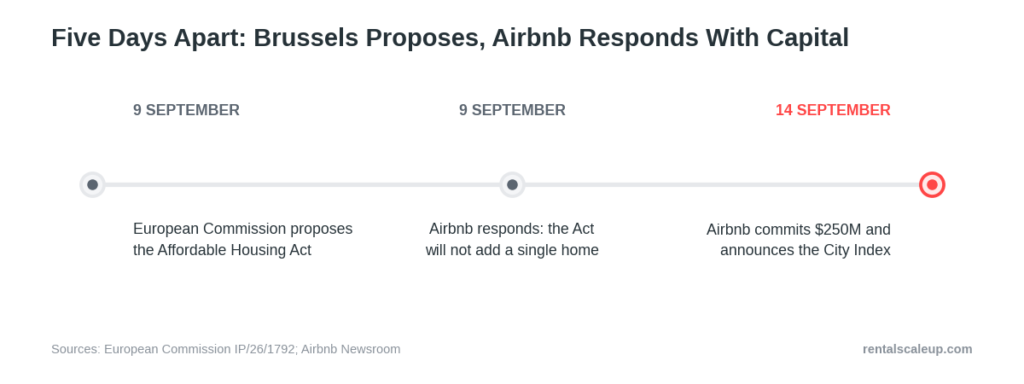
Whether you operate in Lisbon, Barcelona, Budapest, London or New Orleans, this pivot reaches your market. Days before the Accelerator launched, the European Commission proposed the Affordable Housing Act, which would let cities under housing stress restrict commercial short-term rentals while exempting occasional home-sharers. Airbnb’s response was sharp, arguing the Act would not add a single home. By launching its own housing fund and a data-driven City Index, Airbnb is building a counter-narrative to challenge local regulators on their own ground.
Inside the Airbnb Housing Accelerator
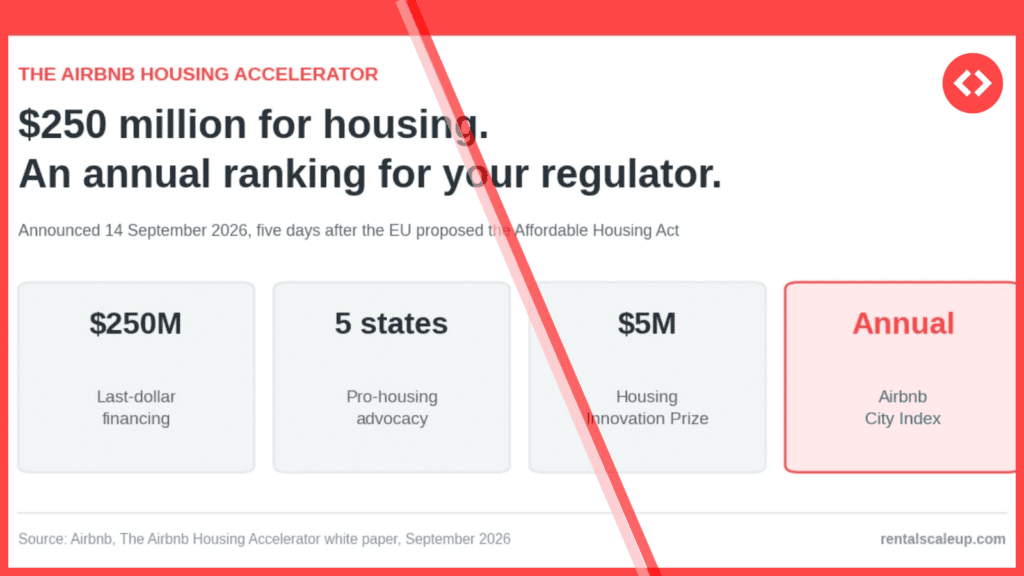
The Housing Accelerator has four parts, set out in a white paper published the same day, Tackling the Housing Crisis.
- $250 million in last-dollar financing, which Airbnb expects will set off more than $5 billion of construction over ten years. First investment: $6.4 million toward 201 affordable units in Austin, Texas.
- Funding for pro-housing advocacy groups working on zoning, permitting, building codes and impact fees, across five United States states in 2026 and more after that. Partners include YIMBY Action, the Citizens’ Housing and Planning Association, the Florida Housing Coalition, the Housing Action Coalition and AURA.
- A $5 million Housing Innovation Prize, five annual awards of $1 million for construction technology.
- The Airbnb City Index, an annual worldwide ranking of cities on housing policy and outcomes, due later this year.
The scope is already international. Alongside the $250 million, Airbnb has committed $50 million over three years to restoring and modernising homes in small villages across Spain, and the white paper says the Accelerator will expand into more countries.

The Financial Model: How Last-Dollar Financing Works
Last-dollar financing means backing projects that have cleared the difficult approvals and raised most of their funding, but sit short of the final slice. Airbnb’s white paper gives terms the press releases left out: it expects returns of at least 50% below standard investor rates, and it will recycle the proceeds into further housing.
This is capital Airbnb expects to recover and redeploy, not a donation.
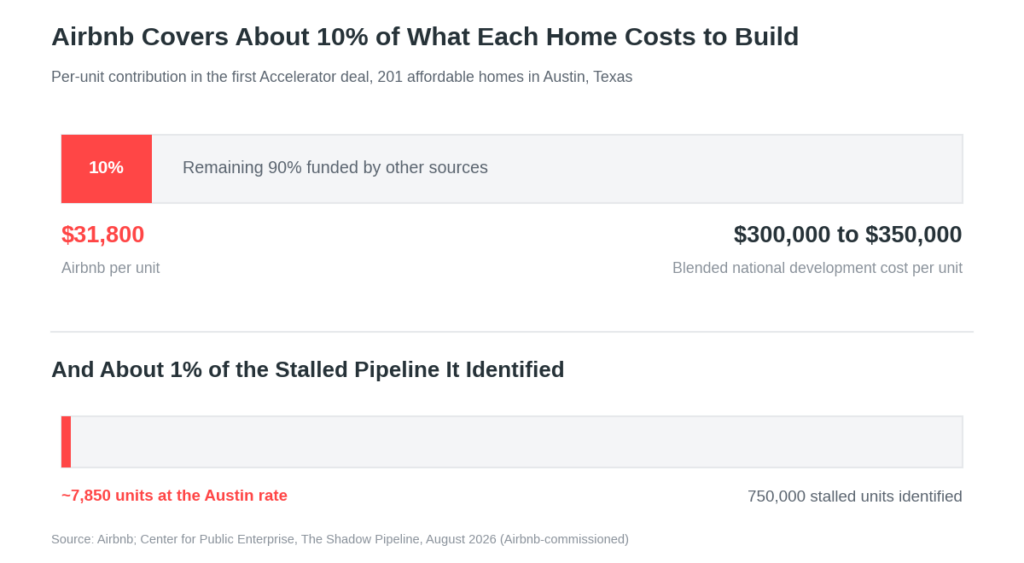
The Austin deal shows the mechanism. Under the city’s agreement with its developer, Greystar, a fully affordable 201-unit building had to be completed before a companion 325-unit mixed-income project could proceed. That gate stayed shut for five years after interest rates rose and rents fell in 2022. Airbnb’s $6.4 million closes the gap and releases more than 500 homes in total. Chesky confirmed Airbnb is taking no incentives from the city, and that Austin’s tougher short-term rental rules stay exactly as they are.
What last-dollar financing buys
| Measure | Figure |
|---|---|
| Airbnb’s contribution per Austin unit | $31,800 ($6.4 million across 201 homes) |
| Blended national development cost per unit | $300,000 to $350,000 (Center for Public Enterprise) |
| Share of the cost Airbnb is covering | around 10% |
| Units if the full $250 million is spent at the Austin rate | around 7,850 |
| Stalled units the Airbnb-commissioned research identified | 750,000 |
| Share of that pipeline reached | around 1% |
Airbnb does not overclaim on scale. Chesky told CBS Austin that the company is a very, very small part of the solution.
Strategic Impact: Shifting the Housing Narrative
The old question was whether short-term rentals take homes away from residents. On that question, Airbnb is the defendant.
The new question is whether your city builds enough homes. On that one, Airbnb appears to be positioning itself as the funder, the convener and, once the Index publishes, the scorekeeper. Its case, made in the white paper, is that the United States built 7.9 homes per 1,000 people in the 1970s and builds 4.3 today, against a shortfall of more than 5 million homes. The 750,000 stalled units it quotes come from research it commissioned from the Center for Public Enterprise, and it should be read as such.
On listings, read the wording carefully. The white paper states there is no requirement or expectation that these investments create Airbnb listings, and that short-term rentals are not permitted in the Austin units, which are income-restricted. That is a statement about the current deal rather than a standing rule. Airbnb has not said that future Accelerator projects will exclude short-term rentals, and it already operates a separate Airbnb-friendly Apartments programme built on the opposite principle.
The Global Tool: The Airbnb City Index
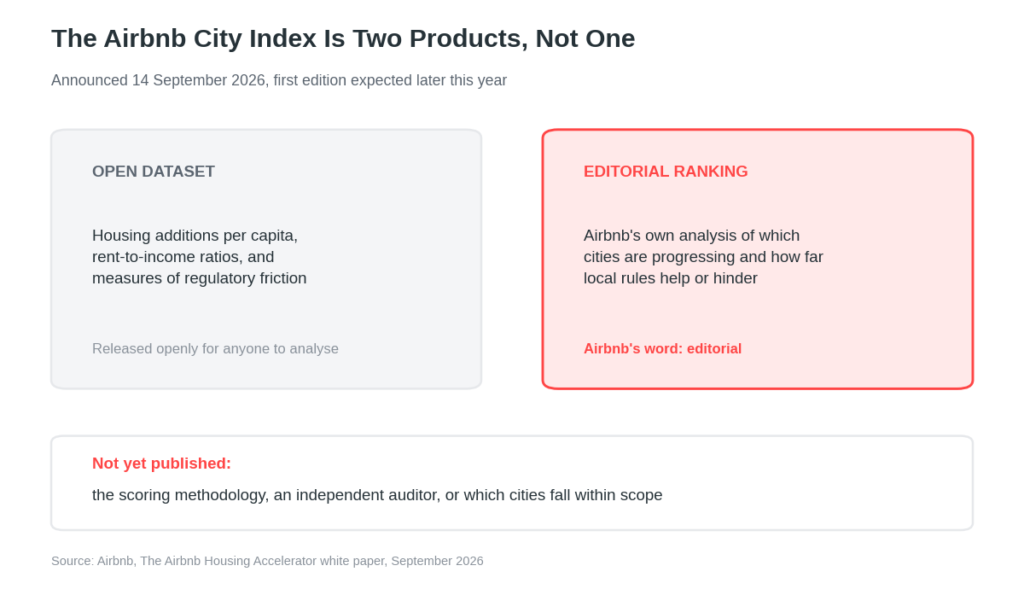
Airbnb describes the Index as two products:
| Component | What it is | Who controls it |
|---|---|---|
| Harmonised dataset | Housing additions per capita, rent-to-income ratios, and measures of how far regulation blocks construction | Released openly for anyone to analyse |
| Editorial ranking | Airbnb’s own analysis of which cities are progressing and how far local rules help or hinder | Airbnb, in its own choice of word, editorial |
The dataset would be unprecedented. Comparable cross-city housing data that tracks regulatory friction does not currently exist, and Airbnb is correct that research funding rarely pays for building it.
The editorial ranking is a different object. Every year, in every city where your permit is decided, there will be a number attached to your council’s housing record, published by the platform your listings sit on, generating a local news cycle on a schedule. The strategic value of that number is highest in the markets where restrictions are most contested, which is where we would expect the Index to concentrate first, though Airbnb has not said so.
Airbnb has not published the methodology, has not named an auditor, and has not said which cities are in scope.
The Regulatory Reality for Professional Short-Term Rental Managers
Four things follow from this for anyone running properties as a business.
Airbnb is building a live proof of concept for an argument it has made for years. The claim that short-term rentals are a minor factor against chronic underbuilding is not new. What is new is that Airbnb is funding construction to demonstrate it. If Austin performs, expect those results amplified into every regulatory fight the company is in.
The everyday host sits at the centre of that story, and you do not. Airbnb’s EU Host Action Plan from December 2021, which we covered at the time, explicitly supports letting cities act against what it calls property speculators while protecting people who occasionally share a home. Its advocacy money goes to zoning and permitting, not to short-term rental rules.
The split Airbnb proposes is three-way, not two-way, and that detail matters. The same 2021 document argues that a property manager handling several properties does not by itself make the underlying activity commercial, and that within the professional category, smaller operators should be distinguished from speculators. Airbnb’s firmest position, that outright or de facto bans can never be proportionate, protects the whole industry including you.
But the law is moving toward exactly this distinction. Airbnb asked Brussels in 2021 for objective thresholds agreed in advance, restrictions confined to districts where harm is proven, fixed review dates and a requirement to try registration before permits. The Affordable Housing Act proposed on 9 September contains all of it: a housing-stress test on price-to-income ratios, evidence of harm over three years, a lighter-measure assessment, full implementation of Regulation (EU) 2024/1028 first, geographic targeting and five-yearly review. What Airbnb did not get, and is now fighting for, is a clear legal line between the everyday host and the commercial operator. Where you fall on that line is being decided now.
Which leaves the one thing nobody outside Airbnb can check. An annual ranking of the world’s cities is being built by a company with a direct commercial interest in how those cities score, and the scoring rules have not been shown to anyone.

Guneet has spent five years working at PriceLabs, developing deep expertise in short-term rental operations and hospitality technology. She brings that practitioner’s lens to her writing at RSU, covering platform updates and making sense of market data for property managers.
Related Articles:
 How Airbnb is Building an Amazon-Like Platform Beyond Accommodation
 Airbnb Ending “Strict” Cancellation Policy: Hosts Must Act Now to Retain It, Plus Important 24-Hour Cancellation Change Explained
 How to Rank Higher on Airbnb: Booking Probability and Guest Satisfaction Now Drive VisibilitY
 Airbnb Is Still Bashing Hotels in Its Ads, While Adding Them to Its Platform