As you may remember, throughout 2026, we have been talking here on Rental Scale-Up (RSU) about two approaches to AI:
- More of your software in your AI tool: your property management (PMS) or revenue management software (RMS) becomes available inside your favorite AI tool, like ChatGPT or Claude.
- More AI in your software: your existing software tools (PMS, RMS, etc.) get more AI power and savvy built in.
The first approach is typically what PriceLabs did this summer with its MCP connector, a tool that lets an AI tool like Claude read and act on your PriceLabs data. Other vendors offer similar connectors for their own software. The second is what we are seeing now, at the end of 2026. Inside existing software, vendors are launching agents that do more than chat, and that don’t require you to start from a blank page.
What I find very interesting is that these agents show what AI can do when it relies on deep domain expertise and on watching how property managers and individual hosts actually work. The launch of Athena by PriceLabs, on October 3, just ahead of the VRMA International Conference in Nashville, is one illustration of that.
Athena in one paragraph
PriceLabs calls Athena an AI revenue analyst, built into its dynamic pricing and revenue management platform. Instead of waiting for a question, it runs revenue management checks on a schedule, flags what needs attention with the reason why, and changes nothing until you click Accept.

Why I am sharing this
As the creator of Rental Scale-Up, head of product marketing at PriceLabs and, simply, a fan of this industry, I am very happy about this. I am even happier that I got to spend several days in Nashville talking about all these topics with vacation rental managers, and testing this view against theirs. I found those conversations more telling than the launch itself, which is why I want to share them here.
Why it matters: every vendor will soon say it has “agents”, so the question for your business is no longer whether a tool has AI. The question I think matters most is how good its agents are, and what expertise sits behind them.
What Athena does, in plain words
Five parts that make it an “AI revenue analyst”
Athena is a small system with five parts, which is why PriceLabs calls it an AI revenue analyst:
- Agents: about a dozen built-in checks, each built by the PriceLabs team to do one job, on the revenue management expertise the company has developed since 2014.
- Your context: each finding is read against your own business, meaning your revenue goals, your portfolio’s performance and shape, your market, and the notes you keep on a listing or its owner (an owner who prefers longer stays, say, or has a view on pricing).
- Skills: your own checks, written in plain English, the way you would brief a colleague.
- Routines: the schedule, so agents and skills run on their own, daily or weekly, and send what they find to PriceLabs and to your inbox.
- Safeguards: nothing changes until you click Accept, Review shows the evidence behind each finding, and every run and change is logged, along with who accepted it. All your company and owner data stays within PriceLabs.
Put together, that is what you would expect from a good junior analyst: it knows what to check, checks it on time, explains what it found, and asks before touching your prices.
Four built-in agents, as examples
These four run as routines:
- Underperforming Listings Scanner: flags listings with few bookings over the next 60 days, the ones you tend to notice too late.
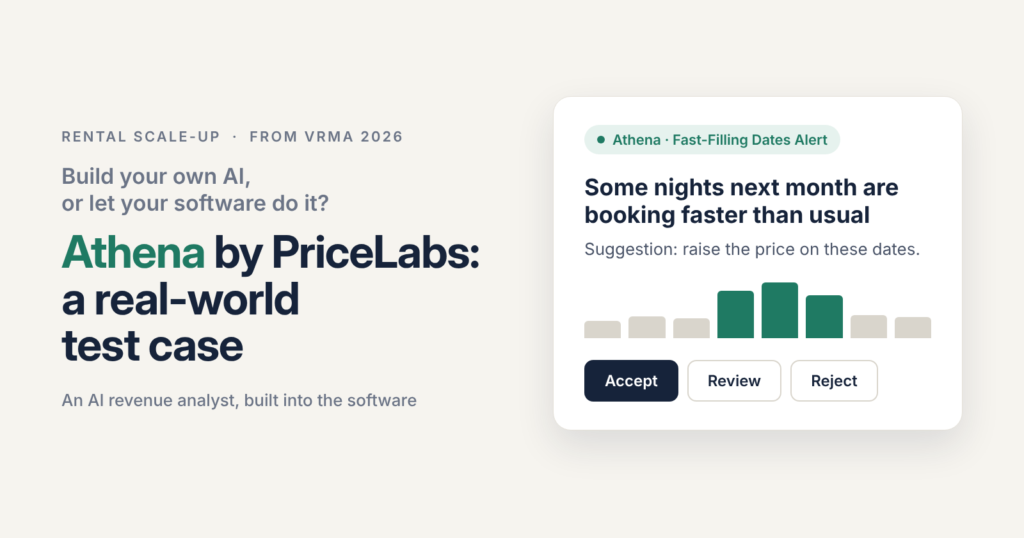
- Fast-Filling Dates Alert: catches nights that are booking faster than usual, and suggests raising them (unless you have already set a price by hand).
- Fast-Booking Listings Alert: flags a listing that is suddenly booking much faster than usual, which can be a sign its price is too low.
- Segment Occupancy Pacing Monitor: warns when a group of similar listings is filling more slowly than the market, or than last year, over the next three months.
Others run on request, such as the Portfolio Health Check, which compares your portfolio with its market and with last year.
What a skill looks like
“Each week, compare booking pickup against the same point last year. Call out the dates slowing down and what would move them.”
(Pickup is the number of new bookings coming in over a given period.)
What it looks like on a Monday morning
- Athena spots something: say the Fast-Filling Dates Alert sees some nights next month booking faster than usual.
- You get the finding: in PriceLabs and by email, with the bookings behind it and a suggestion to raise the price.
- You decide: Review opens the chart behind the finding, Accept makes the change in PriceLabs, and Reject leaves everything as it was.
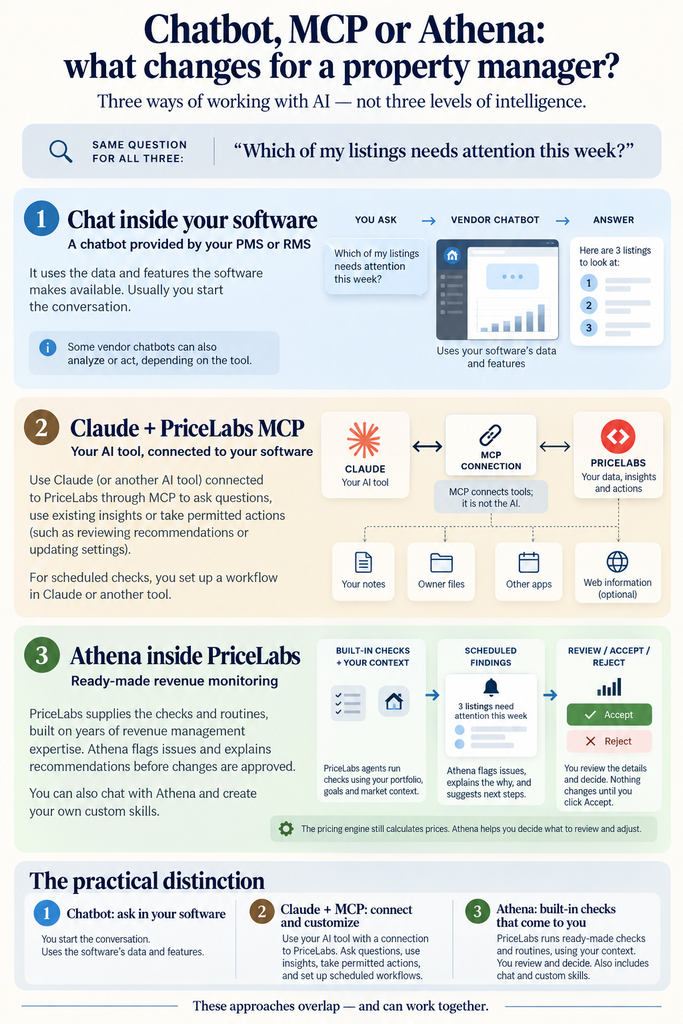
How different is it? Chatbot, connector and Athena side by side
| Chatbot inside your software | Claude + PriceLabs MCP | Athena inside PriceLabs | |
|---|---|---|---|
| What you start from | A chat inside your PMS or RMS, using the data and features the vendor makes available | Claude connected to PriceLabs data and tools, plus other sources you connect | Built-in revenue checks and findings, ready to review, plus chat |
| Who starts the work | Usually you, by asking a question | You, or an automated workflow you set up | Athena, through scheduled routines, or you on demand |
| Who builds the checks | Depends on the vendor; some provide their own analysis | You can create custom checks and use existing PriceLabs diagnostics and recommendations | PriceLabs supplies built-in checks; you can add your own skills |
| Who makes the change | You, or the chatbot if the software allows it | You, or Claude if authorized to take the action | Athena, after you click Accept |
These are not three levels of AI intelligence. A chatbot is a way to interact, MCP is a way to connect AI to software, and Athena is a ready-made revenue management assistant combining chat, specialized checks, scheduled routines and approval controls.
These are not three levels of AI intelligence. A chatbot is a way to interact, MCP is a way to connect AI to software, and Athena is a ready-made revenue management assistant that combines chat, specialized checks, scheduled routines and approval controls.
MCP connects the tools. Athena comes with the workflow.
Here’s the distinction, as I see it: MCP lets an AI tool like Claude access PriceLabs data and tools, including existing alerts and recommendations. So it is not just a connection to raw data. Claude can analyze what it finds, and you can use it to build your own workflows.
Athena takes a different approach. PriceLabs has already built the revenue management checks, made them available as scheduled routines, and created a way to review the findings and approve changes. You can add your own checks, too. The difference isn’t that MCP has no intelligence. It’s how much of the work has already been done for you.
Could you rebuild it yourself?
Yes, you could build something similar with Claude, MCP and your own automations. Some managers already do. You can even reuse existing PriceLabs recommendations rather than starting entirely from scratch.
But you would still need to decide what to check, build and maintain the routines, and put safeguards around any changes. And reproducing all of Athena’s built-in checks is another matter: those draw on years of PriceLabs revenue management expertise, not just a few good prompts.
And the poll we ran during our June debate (Build Your Own AI or Wait for Your PMS?) suggests most managers would rather not start from a blank page. Asked what held them back, attendees answered:
- Know-how: 54%
- Time: 37%
- Cost: 5%, last on the list
So the question becomes whether you want more PriceLabs in your AI tool, or more AI in PriceLabs, and nothing stops you from using both.
What I heard in Nashville: the builders and the “glad you did it” camp
Most managers are a 2 out of 4 on AI
On the Monday of VRMA, I co-hosted a workshop with Michael Vialpando of Renjoy, “Map Your Team Against AI”. A packed room of managers scored their own companies on a four-stage AI scorecard (Most Vacation Rental Managers Are a 2 Out of 4 on AI):
- At stage 2, a person still starts and finishes each task and AI helps in the middle.
- At stage 3, a tool does the work every day and a person reviews and decides.
Most put themselves at a 2, a few reached a 3 in one or two areas of their business, and nobody I heard claimed a 4.
The same two camps showed up in that room and in the conversations I had about Athena afterwards.
Camp 1: the builders
The first is the builders, who told me, more or less, that they want to build everything themselves, and many of them already do, with Claude, our connector and their own routines. (If that is you, our guide to building your own AI agents in five levels is a good place to start.)
As we wrote in the scorecard article, the risk on that side is that nobody checks the work, and the day the person who built it leaves, the team can fall back a stage.
Camp 2: the “glad you did it” managers
The second camp was made of a lot of managers who said something like “You know what, I’m kind of glad you’re doing this,” and asked to join the beta. They see the point of not starting from a blank page. Several of them sounded like future heavy users, the kind of people who will write their own skills once the built-in agents have shown them what a good check looks like.
What struck me most
These are impressions from a few days of conversations, not a survey, and they match the June poll rather than prove anything new. But as a product marketer, I found it interesting to see the approach validated by the people it is meant for, and not only by our own team. What struck me most is that agents become something you can use, rather than something you first have to build.
Where the industry is going: every vendor will sell you agents
The “SaaSpocalypse” scare
If you follow the stock market, you may have heard of the “SaaSpocalypse”. In early 2026, software stocks fell hard because investors feared AI agents would soon do the work people do inside subscription software, like your PMS or your pricing tool. A fund tracking software stocks fell more than 14%, its worst stretch since 2008, according to the Motley Fool.
Not everyone bought the story, though. J.P. Morgan called the sell-off “broken logic”, and sources quoted by the Australian Financial Review argued that AI agents still need the systems that hold the data.
My reading: vendors will compete on intelligence
Once again, I work for a software company, so take what follows as my reading. If access to your data is becoming easy and cheap, software companies will compete on the intelligence they package on top of it. So I expect most tools you pay for to start pitching you agents, and Athena is one early example.
The build-your-own theory is not wrong, either, as anyone who has built a guidebook site with an AI builder over a weekend can tell you. But rebuilding a core system, like your PMS or your pricing engine, is another story.
How good is the agent? That is the question to ask any vendor
The question I heard most in Nashville
In Nashville, once people had seen how Athena works, the question I heard most was a fair one. How are your agents better than what I could build myself with a connector, or than what any other software company could come up with?
The exhibition hall did not help, since it was full of vendors showing agents, chatbots and “AI-powered” features, some of them only weeks old. One line from the workshop sums up the mood: managers are not tired of AI, they are tired of being told about AI.
The dynamic pricing lesson
The best way I know to answer is through dynamic pricing. For years, plenty of tools have been able to say “we do dynamic pricing” because they offer a last-minute discount you switch on and off. That is a feature, and a button is easy to build, so managers have learned, sometimes the hard way, to ask about the algorithm behind it.
Three questions to ask any vendor about its agents
I think agents are heading the same way. When a vendor says it has an agent checking your portfolio, ask:
- What expertise sits behind it? Years of revenue management data, or a prompt written last month?
- Does it run on a couple of simple rules, or on logic that has been tried and tested?
- Does it read your context (your listings, your notes, your revenue goals), or does it give everyone the same generic advice?
PriceLabs’ bet, and once again I am biased, is that this is exactly where domain expertise counts. You don’t have to take my word for it, and you shouldn’t. Ask any vendor, including us, how its agents work, and judge the answers by how often you would accept a recommendation as it stands.
You keep the final say, and Athena shows its reasoning
Nothing to connect, which also matters for safety
Because Athena is built in, there is nothing to connect, which also matters for safety. In our connector article, we warned that a teammate with Claude access and permission to change prices could reprice a whole portfolio from a chat window. With Athena, the Accept button and the change log come built in.
AI explains, tested models decide
At Scale UK in June, the revenue managers on stage drew a line we keep coming back to. Let AI explain what is happening in a portfolio, and let tested pricing models decide what changes (Will AI Destroy the Revenue Manager?). Athena is built along that line, since the numbers come from PriceLabs’ checks and the AI’s job is to explain them. That leaves less room for the AI to invent a number, though not none, and the product itself warns that “Athena is AI and can make mistakes”.
An explanation is not a strategy
Dynamic pricing has long had a reputation as a black box, and what I find interesting in this generation of tools, whatever the vendor, is that the recommendation now comes with its reasoning. But an explanation is not a strategy: knowing why a weekend rate looks low does not tell you whether this owner cares more about occupancy or about ADR (average daily rate).
To be fair, the trade-off runs both ways. A connector lets you combine PriceLabs data with your own files, such as owner contracts, while Athena does what PriceLabs built it to do, plus the skills you add.
What it means for property managers, depending on where you are
If you are a host with a few listings
Athena is mostly a way to make PriceLabs easier to use. You can ask in your own words why a date is priced the way it is, and get an email when something needs a look. So it is more about peace of mind than a new way of working.
If you run a growing company without a revenue manager
This is where the “revenue analyst” label fits best. Athena runs the checks you know you should be running in the background, and comes back with the few things that need you, each with a reason.
If you have an in-house revenue manager or a consultancy
Athena works like a junior on the team. It does the routine checks and the first pass of analysis, while your revenue manager keeps the owner conversations and the final say. The way I see it, the likely effect is a faster team rather than a smaller one.
In every case, the strategy is still yours
Athena reads its recommendations against the goals you set in PriceLabs and the notes you keep on each listing, and someone has to write those. That is why, on our scorecard, I put Athena at a solid stage 3 for revenue management: a tool flags listings every morning, and a person reviews and decides. Getting to a 4 depends on someone in your company owning the rules, and your goals and listing notes are a big part of those rules.
So, built-in or build-your-own?
Well, after a year of covering both on Rental Scale-Up and a few days of talking about it in Nashville, my answer is that it is not either-or.
- If time and know-how are your bottleneck, start with what is built in, and after a few weeks, judge it by how often you accept its recommendations as they stand.
- If someone on your team likes to build, keep a connector for the custom work no vendor will do for you, such as owner reports that combine pricing data with your contracts. Our four AI workflows, built live and free to copy, are a good start.
- Either way, write down your strategy, and give it an owner. Goals, owner preferences and listing notes are what every AI tool works from. Start with the audit question from our VRMA scorecard: who reviews prices before they go live?
If you want to try it, PriceLabs customers can request free early access to Athena here; new users can start a free trial at pricelabs.co.

Thibault Masson is a leading expert in vacation rental revenue management and dynamic pricing strategies. As Head of Product Marketing at PriceLabs and founder of Rental Scale-Up, Thibault empowers hosts and property managers with actionable insights and data-driven solutions. With over a decade managing luxury rentals in Bali and St. Barths, he is a sought-after industry speaker and prolific content creator, making complex topics simple for global audiences.
Related Articles:
 We’ve Been Explaining MCP in Theory. PriceLabs’ New AI Connector Lets Us Show You in Practice.
 PriceLabs’ 2026 Revenue Accelerator, in Context: Why Revenue Is No Longer One Person’s Job — and How AI Is Reshaping That Job in Two Directions at Once
 Sykes Cottages AND Casago/Vacasa on AI: Lessons for Smaller Property Managers from The Short Stay SUMMIT 2026
 AI in Vacation Rentals: Build Your Own AI or Wait for Your PMS?