Exclusive Rental Scale-Up analysis of Eurostat’s short-term rental datasets for Airbnb, Booking.com and Expedia Group, country by country and region by region
TL;DR
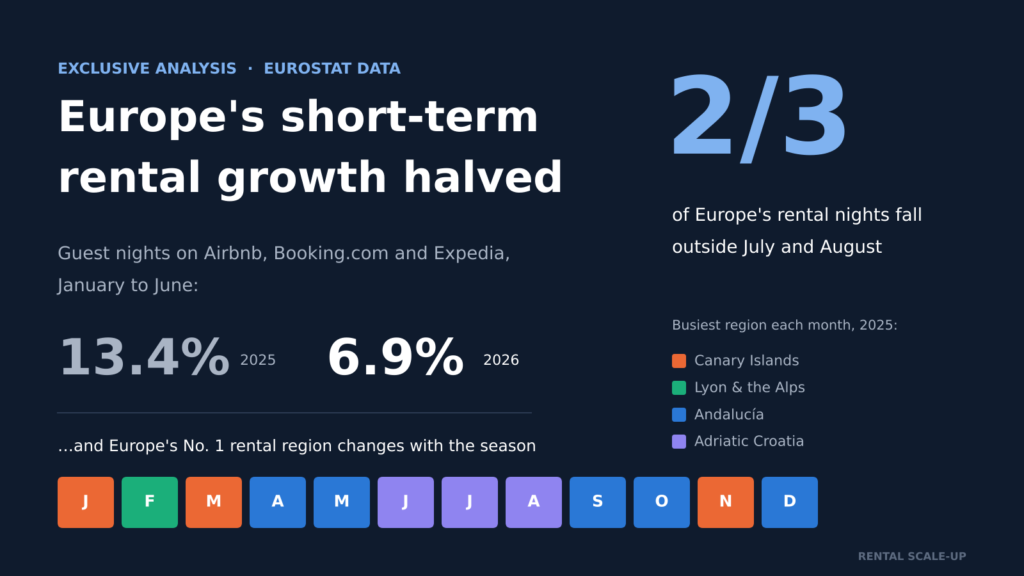
- Growth halved. Guest nights booked through Airbnb, Booking.com and Expedia Group in the EU grew 6.9% from January to June 2026, against 13.4% a year earlier. The data does not say why.
- Spain drove the slowdown. It alone explains 31% of the drop, while Austria, Croatia and Hungary barely grew and Italy, Poland and Czechia still grew 10% or more.
- Europe’s short-term rental market is not mainly a summer market. Two-thirds of nights fall outside July and August, and Europe’s busiest region changes with the season: the Canary Islands, Lyon and the Alps, Andalucía, then Adriatic Croatia.
- France, not Spain, is Europe’s biggest market, with 213 million nights in 2025, thanks to six large regions that peak at different times and a big home market.
- For managers: read this year’s figures against your own calendar. For beach markets, the real test is the summer data Eurostat publishes in January 2027.
On October 2, Eurostat published figures that most property managers never look at: the actual stays booked through Airbnb, Booking.com and Expedia Group (which owns Vrbo) in every EU country and region, month by month. They show that Europe’s short-term rental market (vacation and holiday rentals, booked by the night) cooled sharply in the first half of 2026, and that several things the industry takes for granted about where and when Europeans rent are simply wrong.
These are not estimates built from scraped listings. The platforms have reported their stays to Eurostat, the EU’s statistics office, since a 2020 agreement with the European Commission. Since May 20, 2026, an EU regulation also requires platforms to share activity data with public authorities. The result is one of the most complete sets of short-term rental data available for Europe.

For this article, the Rental Scale-Up team went beyond Eurostat’s press release. We downloaded the underlying datasets, with monthly figures for every EU country going back several years and for about 240 regions in 2025, and compared them to build our own reading of the data, including rankings Eurostat does not publish, such as which region leads Europe each month and where demand swings the most.
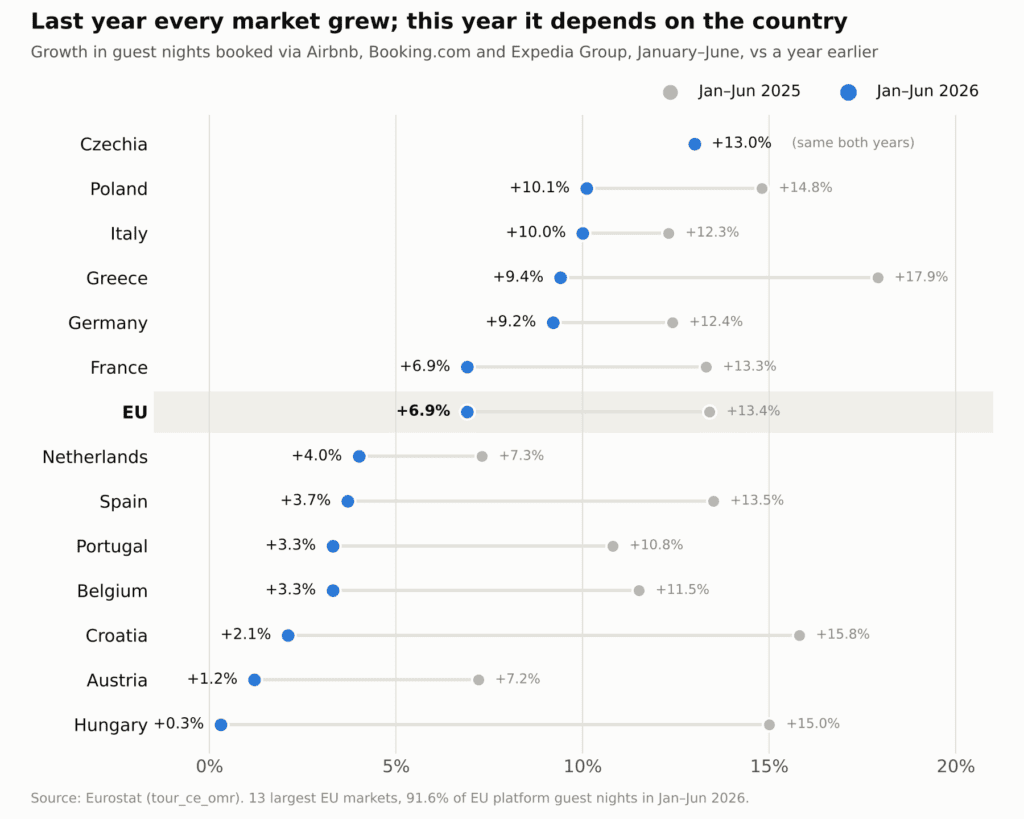
First, the cooling. Guest nights booked through the three platforms grew 6.9% from January to June 2026, against 13.4% over the same months of 2025, according to Eurostat. Bookings are still rising, but at half last year’s pace, and only 3 of the 13 largest markets grew 10% or more, against 11 a year earlier.
The data does not say why. Tighter household budgets, higher travel costs such as fuel, and fewer listings in places where new rules have cut supply could all play a part. Easter and Pentecost also fell in different months than in 2025, which moves trips around. We do not try to rank those causes. What the data shows clearly is the cooling itself, and where it hit hardest.
Second, the clichés. Before reading on, try this quick test of what you think you know about Europe’s short-term rental market:
- Is most of the demand in summer? No. July and August held only a third of EU platform nights in 2025. Even with June added, the three summer months make up 43% of the year.
- Are the busiest regions all around the Mediterranean? No. The Canary Islands, in the Atlantic off the coast of Africa, are Europe’s No. 1 short-term rental region in January, March and November. In February, the top spot goes to the region of Lyon and the French Alps, and the Paris region is the fifth largest over the whole year.
- Is Spain Europe’s biggest market? No. France is, with 213 million nights in 2025 against 189 million for Spain, and 60% of France’s nights are booked by people who live in France.
- Is Croatia one of Europe’s short-term rental giants? Only in summer. Its coast is Europe’s No. 1 rental region in July, but it ranks 82nd in January.
Why it matters: Your market’s calendar decides what this year’s cooling means for you. A weak January to June is a warning for a ski or city market, but it says little yet about a beach market whose year is decided in July and August.
Key findings from our exclusive analysis of Eurostat data:
- 57% of EU platform nights in 2025 were in just three countries: France, Spain and Italy
- 31% of the fall in the EU’s growth rate comes from Spain alone
- 8,000 to 2.3 million: guest nights on Greece’s Ionian Islands in January 2025, then in August
- 1.4 times: the gap between Madrid’s busiest and quietest month, the flattest of any large region
How to read these figures: Eurostat counts guest nights, not bookings or properties. Each person counts for each night, so a family of four staying three nights counts as 12 guest nights. Every growth figure in this article compares a period with the same period a year earlier.
Europe’s No. 1 short-term rental region changes four times a year
We ranked every EU region by guest nights for each month of 2025. Eurostat’s regions are the large administrative regions countries already use, such as Spain’s autonomous communities or Italy’s regioni, and there are about 240 of them in the EU. The top spot moves with the calendar:
- Winter sun: the Canary Islands, Spain’s Atlantic archipelago off Africa, lead in January, March and November.
- Snow: Rhône-Alpes, the region of Lyon and the French Alps (Annecy, Chamonix), leads in February.
- Spring and autumn: Andalucía leads in April, May, September, October and December.
- Summer: Adriatic Croatia, the country’s coast and islands from Istria to Dubrovnik, leads in June, July and August, with 12.2 million nights in August alone.
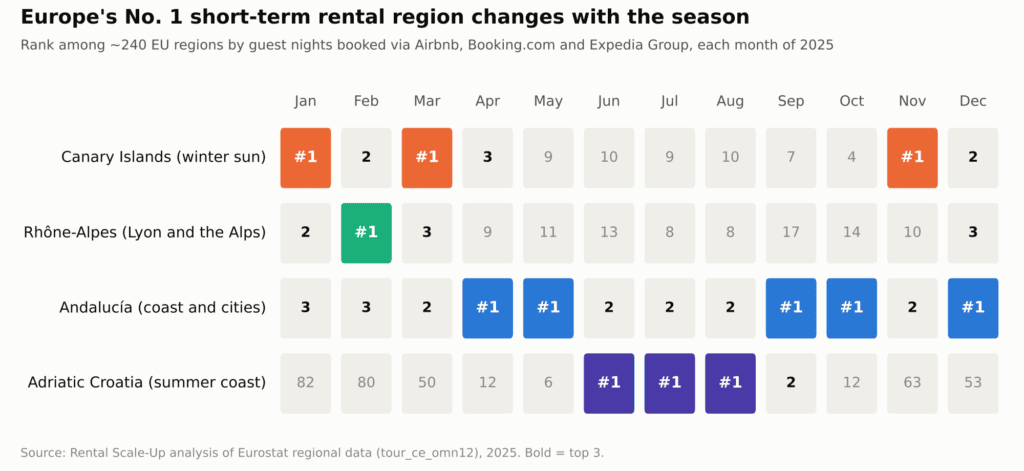
Andalucía is the only region in Europe’s top three every month of the year, which makes it the continent’s most consistent short-term rental market as well as its largest. Adriatic Croatia shows the other extreme: it ranks 82nd in January, sixth in May and first from June to August.
Rhône-Alpes is not only a ski region. It also includes Lyon, one of France’s largest cities, which draws business and leisure travellers all year. That keeps the region from falling too low between seasons. Even in its quietest month, November, it recorded 0.8 million nights, seven times more than Adriatic Croatia in January, and its busiest month is only about four times its quietest.
In winter, the market moves south and up the mountains. Across January, February and December 2025, the Canary Islands recorded 8.8 million nights, Rhône-Alpes 8.4 million and Andalucía 8.1 million, all ahead of the Paris region (5.9 million). Each sells a different winter: sun, snow, and a mild coast with cities.
A few regions make the market
Below country level, demand is concentrated in a small number of places. The ten biggest regions hold 32% of all EU platform nights, and the top 20 hold 46%.
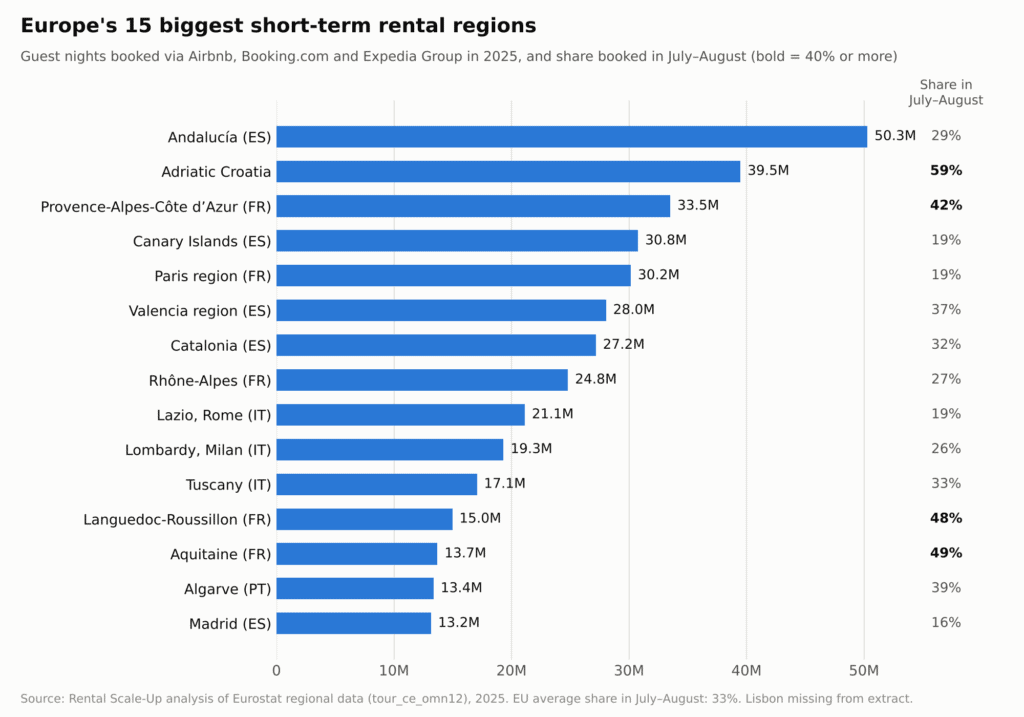
Andalucía alone had 50.3 million nights, more than all of Portugal (49.5 million) or Poland (44.4 million). In several countries, one region is most of the market: the Adriatic coast makes up 94% of Croatia’s nights, Budapest 72% of Hungary’s and Prague 50% of Czechia’s.
Germany is the exception. Its biggest platform regions are its Baltic and North Sea coasts, led by Mecklenburg-Vorpommern with 9% of German nights, while Berlin holds 5%.
Why France is Europe’s No. 1 short-term rental market
France recorded 213 million platform nights in 2025, ahead of Spain (189 million) and Italy (139 million). The reason is not that France is busy all year; its demand is actually a little more concentrated in summer than Spain’s, with 35% of its nights in July and August against 30%. It is that France has several large markets that each peak at a different time, and an enormous home crowd in summer.
Six big regions, each with its own peak
Six of Europe’s 20 biggest short-term rental regions are French, as many as in Spain. They are Provence-Alpes-Côte d’Azur (33.5 million nights), the Paris region (30.2 million), Rhône-Alpes (24.8 million), Languedoc-Roussillon (15.0 million), Aquitaine (13.7 million) and Brittany (12.5 million). No single region dominates, and the largest, Provence-Alpes-Côte d’Azur, holds only 16% of France’s nights, against 27% for Andalucía in Spain.
Those regions sell different things. The Paris region peaks in June and stays busy all year, Rhône-Alpes has its peak in February thanks to ski, and the Atlantic and Mediterranean coasts fill up in July and August.
A large home market
The second reason is French travellers themselves. In 2025, 60% of France’s platform nights were booked by people living in France, against 38% across the EU. In August, France recorded 40.6 million nights against 30.1 million for Spain, and over the year France was ahead of Spain in eight months out of twelve. Spain wins March and the autumn, from September to November.
The biggest swings: from Corfu’s August to Madrid’s flat year
The most striking figure in the data is the gap between a region’s busiest and quietest month. On Greece’s Ionian Islands (Corfu, Zakynthos, Kefalonia), guests spent about 8,000 nights in January 2025 and 2.3 million in August, 281 times more.
Busiest month against quietest month
| Region | Busiest month | Quietest month | Busiest vs quietest |
|---|---|---|---|
| Ionian Islands (Greece) | August: 2.35M | January: 8,000 | 281 times |
| South Aegean (Greece) | August: 2.29M | January: 18,000 | 130 times |
| Adriatic Croatia | August: 12.16M | January: 107,000 | 114 times |
| Corsica (France) | August: 1.45M | January: 17,000 | 85 times |
| Sardinia (Italy) | August: 2.05M | January: 40,000 | 51 times |
| Crete (Greece) | August: 2.00M | January: 44,000 | 45 times |
| Vienna (Austria) | December: 729,000 | February: 352,000 | 2.1 times |
| Paris region (France) | June: 3.21M | February: 1.72M | 1.9 times |
| Canary Islands (Spain) | August: 3.07M | May: 1.68M | 1.8 times |
| Madrid (Spain) | October: 1.25M | February: 0.89M | 1.4 times |
Guest nights in 2025, regions with more than 5 million nights a year. Source: Rental Scale-Up analysis of Eurostat data.
Islands and capitals run different businesses
In 2021, we described Europe’s short-term rental demand as hyperseasonal, with a long summer peak and weak months on either side. The 2025 data suggests a more nuanced picture: that description fits the islands and the coast, but not the capitals or the Canary Islands.
For a manager on the Greek or Croatian islands, the year is earned in about eight weeks, and a weak July or August cannot be made up later. A manager in Madrid, Paris or Vienna runs a business that barely changes from month to month, and in Vienna the busiest month is December.
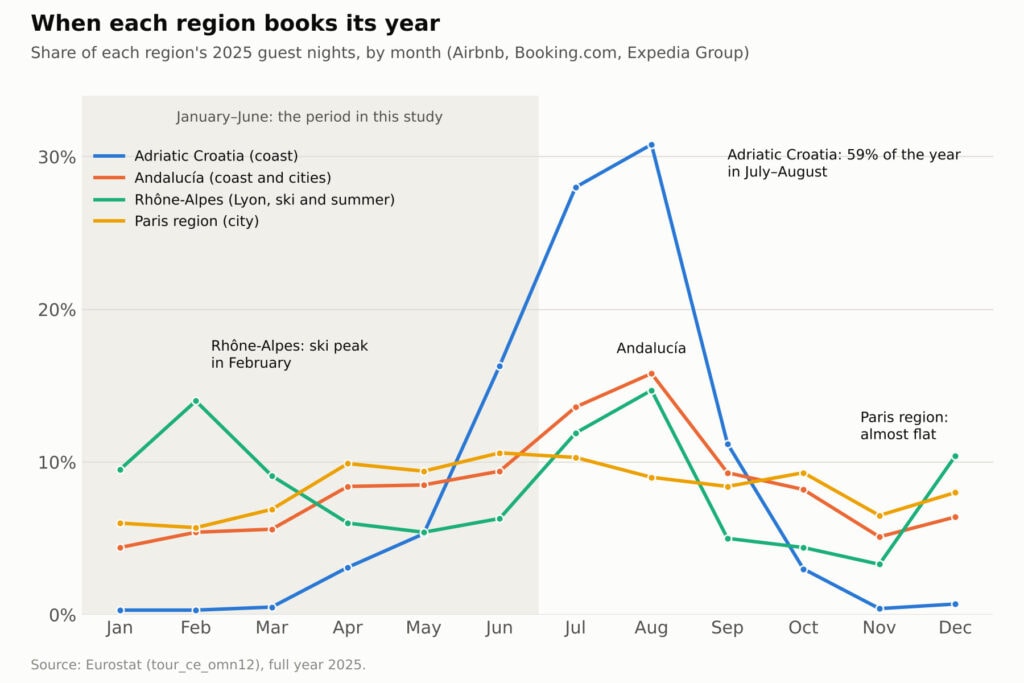
The most summer-dependent large regions are all coastal: Adriatic Croatia books 59% of its year in July and August, Corsica 54%, the Ionian Islands 52%, and Aquitaine, Galicia and the South Aegean 49%. Capitals sit at the other end, with Madrid at 16% and Paris, Rome, Vienna and the Canary Islands at about 19%.
Where the 2026 cooling hit hardest
January to June is the main season for cities, ski areas and the Canary Islands, but the off-season for the beach. Across the EU, these six months held 40% of 2025’s nights, against only 27% in Croatia and 31% in Greece, and 49% in Austria. So the slower growth Eurostat reported mostly describes year-round markets and says little yet about summer ones.
Austria and Croatia: the same cooling, a different meaning
Austria grew 1.2% in months that hold half its year, which makes it a weak main season and a real warning. Croatia grew 2.1% in months that hold barely a quarter of its year, so its verdict will come with the summer figures.
Spain drove the slowdown, Italy picked up the slack
Spain went from driving Europe’s growth to holding it back. Its growth fell from 13.5% to 3.7%, and because Spain is so large, that fall alone explains 31% of the drop in the EU’s growth rate (from 13.4% to 6.9%). Of the 25.9 million extra nights Europe gained, Spain added 2.9 million against 5.5 million for Italy. France grew 6.9%, exactly the EU average, and still accounts for 22% of the drop because it grew 13.3% a year earlier.
Because Budapest and Prague dominate their countries, Hungary’s 0.3% and Czechia’s 13.0% largely describe two capital cities heading in opposite directions. That is our reading, since Eurostat’s regional figures do not yet cover all of 2026.
Foreign guests stalled in four markets
In Croatia, Austria, Portugal and Hungary, guests from abroad make up 83% to 91% of nights. From January to June 2026, nights booked by foreign guests grew between −3.6% and +2.3% there, while nights booked by local residents grew 4.8% to 25.1%. Czechia shows this is not a rule: 71% of its nights are foreign, and foreign nights still grew 11.2%.
Why single months mislead this year
Holidays moved this year. Easter fell on April 20 in 2025 but April 5 in 2026, and Whit Monday, the public holiday after Pentecost in Germany, Austria, France and other countries, moved from June 9 to May 25. EU growth swung from +11.4% in March to +1.4% in April and from +14.2% in May to +1.2% in June, so the six-month 6.9% is the figure to use.
What it means for property managers
- Know your calendar. Work out what share of your nights fall between January and June. If it is close to half, as in Austria or a capital city, this year’s figures already describe your main season.
- Compare yourself with your type of region, not the EU line. A Paris apartment and a Corfu villa are different businesses, and Europe’s average mostly reflects France, Spain and Italy.
- Look at which region leads your months. If you sell winter, your competition for guests is the Canary Islands, the Alps and Andalucía, not the average European market.
- If most of your guests come from abroad, track them separately from local guests. In the four markets most dependent on foreign travel, local guests carried this year’s growth, so marketing to nearby and domestic travellers may pay off.
- If you run a summer market, wait for January. Eurostat publishes July to September data in early January 2027, the first real test for beach regions. In the meantime, our low-season checklist covers ways to fill the quieter months.
How we measured
Rental Scale-Up ranked about 240 EU regions (what Eurostat calls NUTS 2 regions) by monthly guest nights in 2025, using Eurostat’s dataset tour_ce_omn12 (extracted October 8, 2026). National figures, including foreign and domestic guests, come from Eurostat’s dataset tour_ce_omr (extracted October 9, 2026). Lisbon, central Portugal, Utrecht and South Holland are missing from the regional extract because of a 2024 boundary change.
Go deeper
- Eurostat’s April–June 2026 release and January–March 2026 release
- EU Regulation 2024/1028: things to consider before May 20, 2026
- Has tourism become hyperseasonal in Europe? (2021)
- European holiday rental pricing strategy 2026: the fuel crisis
- European short-term rentals: 2024 highs and the 2025 outlook
- The great European short-term rental comeback

Thibault Masson is a leading expert in vacation rental revenue management and dynamic pricing strategies. As Head of Product Marketing at PriceLabs and founder of Rental Scale-Up, Thibault empowers hosts and property managers with actionable insights and data-driven solutions. With over a decade managing luxury rentals in Bali and St. Barths, he is a sought-after industry speaker and prolific content creator, making complex topics simple for global audiences.
Related Articles:
 How AI-driven dynamic pricing can improve your revenue strategy without sacrificing control
 Paris Short-Term Rentals After the Olympic Glut: What French Open 2025 Tells Us
 What the Data Says (and What the Experts Do) to Keep Occupancy Strong in Shoulder Season
 Céline Dion at Plenitude Arena and Pope Leo XIV in Paris: What the Airbnb Data Actually Shows