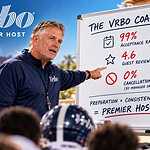
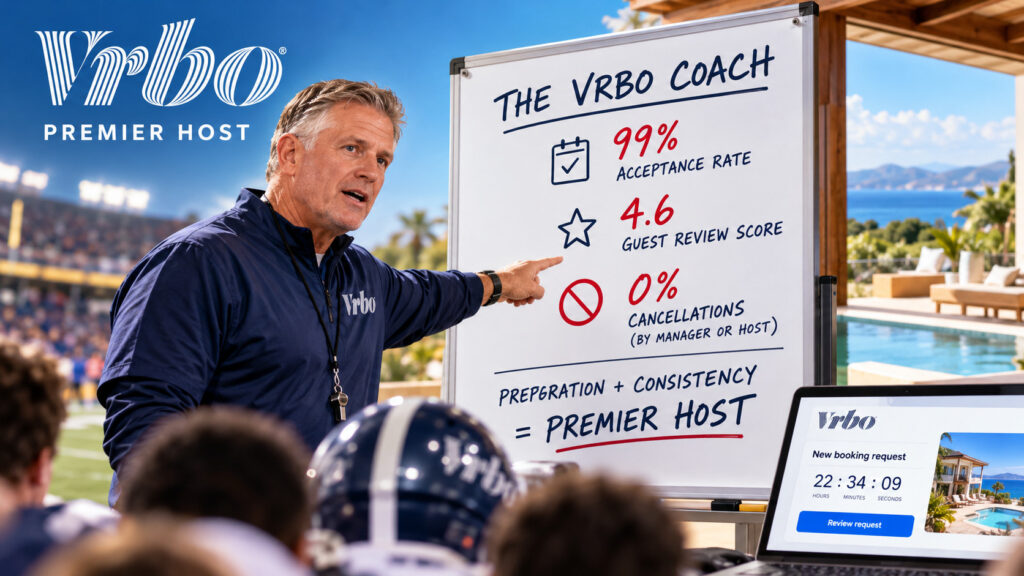
Vrbo has put its name on college football for years, and this season, for the first time, it is using the sport to talk to vacation rental managers and hosts, not only to travelers. In a one-minute video, Michigan coach Kyle Whittingham, billed as “The Vrbo Coach”, lays out Vrbo’s stricter 2026 Premier Host bar: 99% acceptance, zero cancellations by the manager or host and a 4.6 guest review score.
What “The Vrbo Coach” tells hosts
“For the first time, Vrbo is using its college football platform to speak to both sides of its marketplace,” Expedia Group said in a release dated September 24, 2026. The host side has three parts: the video above, a September 14 post on Expedia Group’s site for managers and hosts, and a podcast episode. Vrbo says webinar and case study content will follow later this year.
Whittingham became Michigan’s head coach in December 2025 after 21 seasons at Utah. In the video, he coaches a host introduced on screen as “Travis, future Vrbo Premier Host”, and his first line sets the theme: “This is good. Now let’s make it great.” The film then follows a stay from booking to review. Travis gets one line: “Coach, I just want people to love staying here.” Whittingham closes with “From booking to review, consistency is what sets great hosts apart,” before the campaign’s tagline appears: “Make every stay a win.”
Notably, no one in the video says “Premier Host” or any number out loud. The badge, the targets and the statistics appear only on screen, in Travis’s caption, on the whiteboard and on the cards, while the script talks about craft and pride. Here is how Whittingham frames hosting in the campaign post:

“In football, we talk about how everything matters. Every minor detail, down to the last detail, is important. And I think that’s what makes a great host — someone that goes the extra mile and pays attention to the little things that really make the stay a success.”
In the video, he turns that into a whiteboard titled “Protect the Record”. Under “Keys to the Game”, it lists an acceptance rate of 99% or higher, an “honored booking rate” of 100% and guest reviews of 4.6 or higher. The board ends with a sum: preparation plus consistency equals Premier Host. Vrbo does not define honored booking rate, but a 100% rate would mean the manager or host cancels no confirmed booking, so we read it as the 0% cancellation criterion.
On the podcast, he pushes the same good-to-great idea: “It’s hard to be great. People are comfortable being good. But very few take that next step to be great.”
The playbook, play by play
The campaign post turns the three targets into concrete advice. Here’s what Vrbo recommends:
- To accept more bookings: turn on Instant Booking, which Vrbo says “prevents requests from expiring before you respond”, and set up text alerts in the Vrbo Owner App so you can answer requests quickly.
- To avoid cancelling: keep calendars synced to prevent double bookings, set clear house rules up front, and if something comes up, contact the guest early “before canceling”. Vrbo warns that host cancellations “can affect how your listing shows up in search or lead to fees”.
- To earn better reviews: stay responsive during the stay, add details such as a local guide or good linens, and send a short thank-you note after checkout.
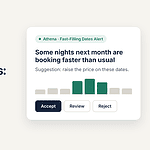
The video adds a clock. In one scene, a booking request on a laptop shows 22 hours, 34 minutes and 9 seconds left to respond, and in another Whittingham stands next to a red scoreboard showing 24. That matches Vrbo’s 24-hour review setting, under which a request left unanswered for a full day is automatically declined. On screen, the card reads “Fast replies drive 2.1x more bookings”. The post is more precise: properties that answer traveler inquiries within 3 hours convert 2.1 times more inquiries into bookings than those that wait 24 hours or more. Whittingham’s line in that scene makes the point: “Good clock management, but great hosts don’t stop there.” In other words, the 24-hour limit is a ceiling, not a target.
The video also leans on new research. “4 in 5 guests pay more for rentals with strong trust signals”, one card says, and another adds that “reviews drive revenue”. Both cite Vrbo’s Built to Stay report, published on July 29. In that survey, run by The Harris Poll, 81% of respondents said they would pay more for a vacation rental with stronger trust signals, rising to 88% among Gen Z. Reviews carry most of that trust: 68% called verified reviews very or extremely important, and 66% said the same of the overall review score.
The survey covered 1,758 adults in the US, Canada, Mexico, the UK, France, Germany and Australia who had stayed in a vacation rental in the past year, polled online from April 22 to 24, 2026. It measures what travelers say they would pay, not what they paid. Still, it is Vrbo’s clearest case for why the 4.6 review bar matters to a manager’s revenue, and not only to Vrbo’s brand.
Vrbo has sponsored college football for years; speaking to hosts is new
The sponsorship itself is not new. Vrbo is in its fourth year as an official sponsor of the College Football Playoff and is the title sponsor of the Vrbo Fiesta Bowl.
What has changed is who the coach is talking to. In 2024, Vrbo cast former Alabama coach Nick Saban as an overbearing host whose house rules were “no fun, no streaming, no games”. The spot argued that rentals are better without a host around, according to MediaPost. Two seasons later, Vrbo’s coach is coaching the hosts.
What Premier Host gets you
Premier Host is Vrbo’s recognition program, which Vrbo says it “created to recognize extraordinary vacation rental owners and property managers.” Vrbo calls these managers and hosts its “partners”. According to its partner page, qualifying listings get:
- a Premier Host badge on the listing
- a place in the Premier Host search filter travelers can switch on
- an “improved search position”
- priority 24/7 support
- a chance to appear in Expedia Group-funded marketing, such as traveler emails and social posts
Meeting the criteria moves a listing into the second of Vrbo’s three Performance Milestones, according to Vrbo’s Help Center, which also lists an “automatic search position increase” among the benefits. As RSU explained in Vrbo’s Performance Milestones: Visibility Is the New Currency, the third milestone adds a Top 1% badge and the most visibility.
The criteria, word for word
The entry bar rose on January 1, 2026. Here are the current criteria exactly as Vrbo’s partner page lists them, next to the bar that applied in 2024 and 2025, as RSU reported at the time. Until 2026, Vrbo measured these across a host’s whole account rather than listing by listing.
| Vrbo’s criterion, as written on its page | Through 2025 | From January 1, 2026 |
|---|---|---|
| “5+ bookings or 60 booked nights” | Same (5 bookings or 60 booked nights) | Required |
| “5+ guest reviews across your account” | 3 or more reviews | Required |
| “4.6 or higher guest review score” | 4.4 or higher | Required |
| “99% or higher accepted booking rate” | 95% or higher | Required |
| “0% partner-initiated cancellation rate” | 1% or lower | Required |
“Partner-initiated” means the cancellation comes from the vacation rental manager or host, not the guest; Vrbo’s Help Center calls the same thing owner-initiated. Vrbo reviews eligibility quarterly, “with assessments on February 1, May 1, August 1, and November 1”, looking at “performance over the past twelve months”. Its ranking metrics page defines the acceptance rate as “the percentage of booking requests you have accepted over the past 365 days”. It counts the cancellation rate over the same period using only host-initiated cancellations, so guest cancellations do not count against you.
The status now applies listing by listing. Vrbo’s Help Center says it “is awarded at listing level”, so a portfolio can hold the badge on some properties and not others. Vrbo’s pages differ on reviews, though. The partner page still says “5+ guest reviews across your account”, while the Help Center lists “5 or more Vrbo reviews.” Its Performance Milestones page says “every property worldwide is eligible”, which points to reviews counted per property. RSU covered the change in Vrbo tightens its Premier Host standards.
What the badge is worth, according to Vrbo, and what the data can’t show
Vrbo backs the targets with three figures from its own and Expedia Group’s internal data. The headline one comes on a card in the video: “The Game Plan: Earn Premier Host status for 2x more listing views.” Its fine print gives a different measure, bookings rather than views, so here are the figures as Vrbo footnotes them:
- Hosts with a 95% or higher acceptance rate appear more than 40% higher in search results than those who accept fewer requests (partners with at least 5 booking requests, October 2024 to September 2025).
- “Premier Host listings generate 2x more bookings per month versus non-Premier Host counterparts”, “combining stronger visibility and conversion” (Vrbo internal data, January 2025 to March 2026).
- Replies within 3 hours convert 2.1 times more inquiries than replies after 24 hours or more (January 2025 to March 2026).
To Vrbo’s credit, it publishes the period behind each figure, and the sample for the search figure, which is what lets us check them. However, until the end of 2025 Premier Host required only a 95% acceptance rate, so the search figure reflects the old bar. The figures show that stronger listings have performed better, but they cannot tell you what reaching the stricter bar will earn, or whether the badge brings the bookings or well-run listings simply earn both.
The traveler ads promise what the host ads ask for
The traveler side of the campaign, made with agency GSD&M, launched September 18 on digital and paid social. One video follows college football referees who step away from game-day calls for a weekend at a Vrbo. In another, sideline reporter Holly Rowe keeps testing Vrbo’s 24/7 Live Support until a call connects. Rowe shared the spot on Facebook with the caption “A Vrbo vacation with no surprises. Except me.” That echoes Vrbo’s April “surprise-free” ads, which end on “If you know, you Vrbo”, the tagline Vrbo introduced on March 31, 2026. RSU read that tagline as a sign that Vrbo’s ad wars are over.
The podcast makes the link between the two sides explicit. Vrbo marketing VP Helen Melluish said that in traveler campaigns “we’re gonna talk a lot about the quality of our properties, the quality of our hosts.” Host campaigns, she said, will show how to deliver that quality, which she tied to attracting more trusted guests. Her definition of quality is plain: “the property is what you said the property was going to be.”
The podcast’s host, Tim Rosolio, Expedia Group’s vice president of vacation rental partnerships, described Vrbo as a “sideline coach” that will “reward strong performance with search boosts and badging.” So, are these two campaigns or one? We read them as one promise: the guest ads tell travelers what to expect, and the host ads tell you what Vrbo will measure to make sure they get it.
Why college football, and why Booking.com chose baseball
College football is American football played by university teams, and its autumn Saturdays send large groups into university towns on a fixed schedule, season after season. A Vrbo survey, reported by Campaign in September 2023, found that nearly 60% of college football fans travel regularly during the season to attend games. Vrbo also said demand for its homes in towns such as Baton Rouge, Norman and Tuscaloosa typically more than doubles in the regular season.
Zoom out, and there is little more American than football, which is the point. Vrbo’s main rival in US vacation rentals has picked the other national pastime. Booking.com has been the official online travel partner of Major League Baseball in the US since March 2023, and the 2026 Division Series “presented by Booking.com” is being played this week.
Booking said at the time that it “continues to invest in the U.S. market” through the deal, and its release pointed fans to “vacation rentals in MLB cities”, not only hotels. That fits a company that, as RSU reported in August, still trails its own US ambitions in vacation rentals. We at Rental Scale-Up read the two deals the same way. Both brands treat America’s big sports seasons as the place to reach groups who travel together, which is exactly the guest a whole-home rental is built for.
The backdrop: a higher commission and a parity rule
The campaign also lands in a busy autumn for Vrbo’s hosts, which RSU covered in detail. From October 29, Vrbo moves pay-per-booking hosts to a flat 12% commission, or up to 15% on some regional brands, up from 5% for managers connected through software and about 8% for others. Hosts on a yearly subscription keep it until their current term ends; Vrbo is no longer selling new subscriptions, and its new Host Terms say it “may not allow” renewals.
Those terms also include a parity rule (Section 4.5.7) requiring rates and fees on Vrbo to be at least as favorable as on any other channel, your own website included. After pushback, Skift reported that Vrbo plans to let hosts price lower on their own direct channels while keeping parity with other online travel agencies. Vrbo announced the campaign and the fee change a week apart and has not linked them, but with a higher commission, the visibility Premier Host offers matters more.
What it means for vacation rental managers and hosts
The 0% cancellation criterion carries the heaviest penalty, because each review looks back 12 months. Applied as written, a cancellation made just after one review date stays inside the window for the next four reviews. So a single cancellation by the manager or host can keep a listing out of Premier Host for up to a year. That is our reading of the 12-month rule, not Vrbo’s statement. Vrbo also allows waivers for reasons such as force majeure, government restrictions, safety emergencies or suspected fraud, as RSU covered in Vrbo’s host-initiated cancellation policy.
If you want the badge, or want to keep it, here is what to do before the November 1 review:
- Check each listing’s scorecard. The Premier Host scorecard on the Performance page of the Vrbo Owner Dashboard shows where each listing stands against the criteria.
- Start with cancellations. Any listing that recorded a cancellation by the manager or host in the past 12 months is the first to check, along with whether the cancellation qualifies as waivable.
- Protect your acceptance rate. Answer every booking request well inside 24 hours, or use Instant Booking as Vrbo suggests. If you connect through a property management system, Vrbo’s help page says “declines after 24 hours are considered cancellations”, with an exception for waivable reasons.
- Count your reviews and bookings. You need 5+ reviews, a 4.6 or higher review score and 5+ bookings or 60 booked nights. Vrbo’s Help Center counts these per property over the past 12 months, but its partner page still says reviews count across your account, so go by what each listing’s scorecard shows.
- Know what the badge has to earn. Check how the 12% commission changes your net revenue on Vrbo, and what extra bookings a listing would need to make the Premier Host effort pay.
Vrbo also now sells visibility through Sponsored Listings, which RSU covered in Vrbo Sponsored Listings Are Live. For listings that miss the badge, that is a paid way to gain visibility, though Vrbo has not said how sponsored placements compare with Premier Host placement. We weighed that tension in The Premier Host Paradox.
So, should you chase Premier Host on every listing? Well, probably not blindly. We at Rental Scale-Up think the badge is worth protecting on listings that already qualify or are close, because better search placement is the clearest return Premier Host offers. But 99% acceptance means taking almost every request you get, and Vrbo’s own numbers cannot tell you what the badge will earn under the 2026 rules. So run the numbers listing by listing.
What to watch: the next Premier Host review on November 1, and the webinar and case study content Vrbo has promised for later this year. The test is whether it shows what Premier Host listings earn under the 2026 rules.
Go deeper
- Primary sources: Vrbo’s campaign post with the Whittingham video and Vrbo Premier Host program
- From the RSU archive: Vrbo Tightens Its Premier Host Standards and Vrbo Moves All Hosts to a Single 12% Commission
- Check your own listings: the Premier Host scorecard on the Performance page of the Vrbo Owner Dashboard

Thibault Masson is a leading expert in vacation rental revenue management and dynamic pricing strategies. As Head of Product Marketing at PriceLabs and founder of Rental Scale-Up, Thibault empowers hosts and property managers with actionable insights and data-driven solutions. With over a decade managing luxury rentals in Bali and St. Barths, he is a sought-after industry speaker and prolific content creator, making complex topics simple for global audiences.
Related Articles:
 Vrbo Takes on Cities with 1 million new listings while Booking.com’s rentals segment outshines hotels
 Vrbo Soft-Launches “Rate Automation,” Its Built-In Dynamic Pricing Tool
 Montreal Limits Rentals to 3 Months, Landfolk Expands in France, Vrbo’s Top Vacation Rentals of 2025
 Vrbo Search Is Becoming Conversational. What That Means for Hosts