
Booking.com no longer considers your prices on other channels when deciding which European properties get sponsored discounts.
- What changed: In the EEA, your prices on other sites no longer affect Booking Sponsored Benefit (BSB) eligibility.
- Who it impacts: Property managers with listings in the EEA, especially those whose rates differ between Booking.com, other platforms, and their own direct booking sites.
- What to watch: An update to the ranking section of Booking.com’s partner terms later this year, and Vrbo’s new parity-style clause from October 29.
Booking.com stops using outside prices for sponsored discounts in Europe
Booking.com rate parity clauses were already dropped from its European partner terms in July 2024. Now, according to the European Commission, it has removed the last element that still took other channels’ prices into account: eligibility for Booking Sponsored Benefit (BSB), Booking.com’s own discount program.
The Commission set this out in a factsheet published on September 28. It reports on how Booking.com, the online travel platform owned by Booking Holdings, complies with the Digital Markets Act (DMA), the EU law for the largest online platforms.
The Commission designated Booking.com a “gatekeeper” under the DMA, and it has had to comply since November 14, 2024. The factsheet says the September changes “apply to all properties in the EEA”, which covers vacation rentals as well as hotels.
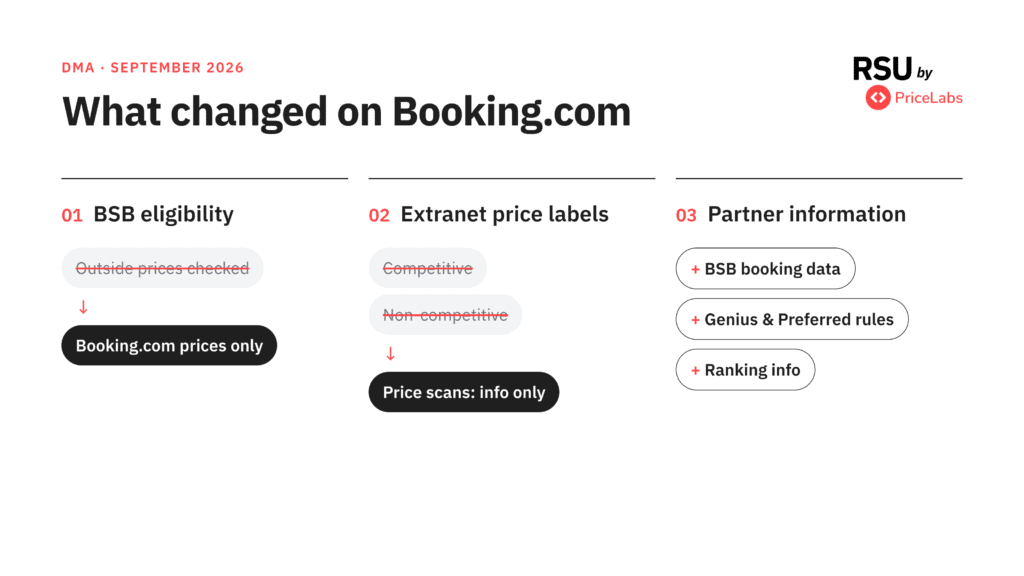
Three changes Booking.com made in September 2026 due to the DMA
Outside prices no longer decide BSB eligibility
Under BSB, Booking.com lowers the price the guest sees and covers the difference itself. According to the Commission, the property still receives the full rate it set, and its commission stays the same.

Until September, Booking.com checked prices outside its platform when deciding whether a property could get BSB. The factsheet says it “no longer looks at prices outside of Booking.com” for that decision.
The “competitive” price labels are gone from the Extranet
The Extranet (Booking.com’s partner back office) no longer tags properties as “competitive” or “non-competitive” on price. The Commission says the labels were removed “to avoid the perception that Booking.com expects price alignment across sales channels.”
The external price scans still appear in the Extranet. Booking.com now states they are “for information only” and are not used for default ranking or program eligibility.
More data and clearer rules for partners
Booking.com has added information to the Extranet, its Partner Hub and a new FAQ on DMA compliance. According to the factsheet, partners now get:
- BSB performance data, down to the reservation, showing how BSB affects their bookings
- Explanations of Genius, Preferred and Preferred Plus, including eligibility, the “performance score”, how properties are benchmarked against their area, and when participation can be suspended
- Ranking information confirming that outside prices are not an input, with an update to the ranking annex of the General Delivery Terms (Booking.com’s standard partner contract) due later this year
Rate parity clauses ended in Booking.com’s European terms in 2024
This follows a bigger change in July 2024. Booking.com removed rate parity clauses (contract rules that stop a property offering better prices or terms on other channels) across the EEA, effective July 1, 2024.
The Commission says the clauses came out of Booking.com’s General Delivery Terms and its partner agreements. Parity also stopped being an eligibility rule for Genius, Preferred and Preferred Plus, its programs that boost a property’s visibility.
According to the Commission, Booking.com already did not use outside prices for default ranking or for those programs before September. BSB was the exception, and that is what has now changed.
How BSB works in no-parity countries versus everywhere else
Booking.com’s own BSB help page splits properties into two groups. In “no parity” countries, which include every EEA country, your prices on other sites play no part in BSB. BSB can still apply to your listings, but you cannot opt in: only Booking.com decides.
Everywhere else, BSB can reach a property in two ways. Booking.com can apply it when it judges your prices “aren’t competitive”, or you can opt in through the Opportunity Center when they are. Booking.com doesn’t list which non-EEA countries count as no-parity, so outside prices likely still matter for BSB in some markets.
| BSB rule | No-parity countries (all of the EEA) | Other countries |
|---|---|---|
| Your prices on other sites, including your own website | Not used for BSB eligibility | Used: BSB may apply if your prices “aren’t competitive” |
| Opting in to BSB | Not possible: Booking.com decides eligibility itself | Possible through the Opportunity Center if your prices are competitive |
| Payments by Booking.com | Required for BSB | Required for BSB |
| Commission | Charged on the rate you set | Charged on the rate you set |
| When BSB applies | Booking.com’s algorithm decides, using factors such as length of stay and number of guests | Same |
The page also notes two country exceptions:
- Italy: price competitiveness plays no role in BSB.
- France: properties can opt out of BSB on free-cancellation rates that don’t require prepayment.
For the moment, the DMA parity ban covers Booking.com but not Vrbo or Airbnb
Vrbo, Expedia Group’s vacation rental platform, has just moved the other way. Its new host terms, which take effect on October 29 alongside a 12% commission, include a parity-style clause.
As RSU reported on September 30, Section 4.5.7 of those terms asks hosts to give Vrbo content that is “at least as complete, accurate, current, detailed, and favorable” as on other channels. That includes rates, discounts and fees.
Vrbo can do this because the DMA’s parity ban only binds platforms the Commission designates as gatekeepers. Vrbo is not one, and its footprint in Europe is far smaller than Booking.com’s. Airbnb is a major player in Europe but is also not on the list of designated gatekeepers, so it is exempt too.
Both are exempt for now, but rules like this tend to travel. EU consumer law had Airbnb showing total prices, fees included, by 2019, three years before it did the same in the US, as we reported at the time. In an industry professionalizing and consolidating as fast as ours, it is not unreasonable to surmise that parity rules could follow the same path.
What Booking.com’s DMA changes mean for STR managers in Europe
A price gap no longer costs BSB eligibility. According to the Commission, a lower rate on a direct site or another platform no longer counts against a property for BSB, ranking or Booking.com’s partner programs in the EEA.
No action is required from managers. The changes apply automatically to EEA properties, which cannot opt in to BSB in any case. BSB only runs on properties that use Payments by Booking.com, and commission is still charged on the rate the manager set.

Uvika Wahi is the Editor at RSU by PriceLabs, where she leads news coverage and analysis for professional short-term rental managers. She writes on Airbnb, Booking.com, Vrbo, regulations, and industry trends, helping managers make informed business decisions. Uvika also presents at global industry events such as SCALE, VITUR, and Direct Booking Success Summit.
Related Articles:
 Vrbo Takes on Cities with 1 million new listings while Booking.com’s rentals segment outshines hotels
 Cape Town To Impose Rental Tax, Booking.com Partners with Maldives, HomeToGo Launches 5 Localized Platforms
 New PriceLabs–Booking.com Integration Helps Hosts Gain Back Pricing Control
 Booking Holdings Is Almost as Big as Airbnb in Homes