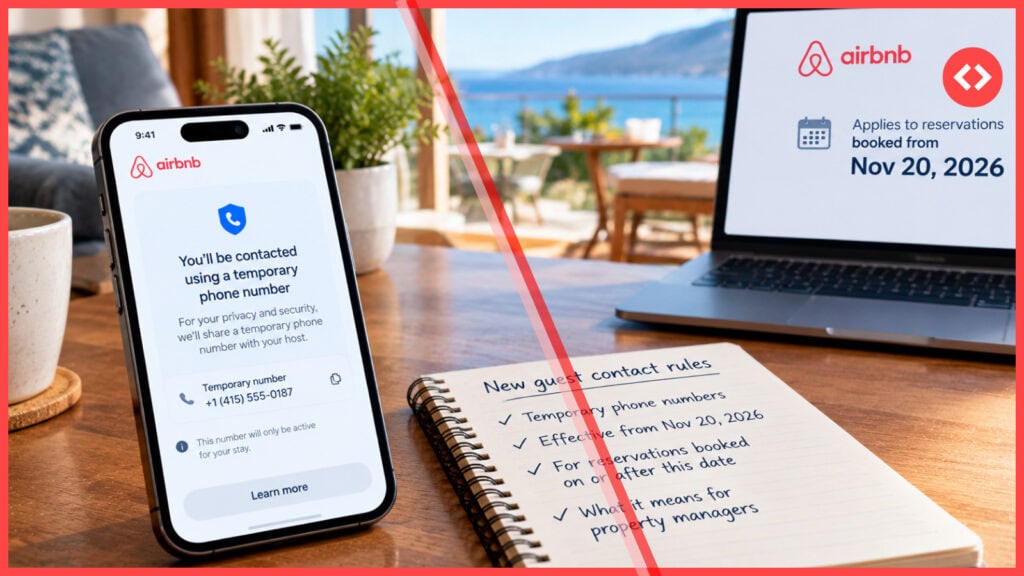
From November 20, Airbnb hosts will no longer be able to collect guest contact details. Airbnb is also masking guest phone numbers for a limited number of US and Canadian users, a step it describes as protecting personal contact information.
- What changed: Hosts can’t ask for contact details unless a law, a documented community association rule or an allowed contract requires it. Temporary numbers expire two days after checkout and don’t work on WhatsApp.
- Who it impacts: Property managers who send door codes or welcome messages by WhatsApp or text, require a check-in app or form, or contact guests after checkout.
- What to watch: Whether temporary numbers reach all domestic US and Canadian stays from December 1, and how a guest can choose another channel.
Airbnb is limiting the guest details property managers can get. For reservations booked from November 20, 2026, hosts worldwide can’t ask guests for a phone number, email or home address, except in limited cases. For a limited number of guests and hosts in the US and Canada, Airbnb also replaces each side’s real phone number with a temporary one. Airbnb describes the numbers as a proactive step to protect personal contact information.
Expedia Group and Booking Holdings both mask guest numbers to a degree. Of the three big booking platforms, Airbnb is the only one we found that pairs masking with a written ban on asking guests for the number.
For guests, this protects their privacy at a time when privacy concerns are growing. For managers, it means losing control over guest details they have long relied on.
How Airbnb’s Temporary Phone Numbers Work
Airbnb’s help page sets out the rules:

- Who gets them: a limited number of guests and hosts in the US and Canada. If either side is outside those countries, no temporary numbers are assigned. Airbnb says more markets will follow.
- What works: calls and texts. WhatsApp does not.
- How long they last: from booking until two days after checkout. After that, only Airbnb messaging remains.
Airbnb also blocks or replaces any real phone number shared through the platform, in messages, emails or listing text fields, when appropriate. So managers can’t simply ask for the number in an Airbnb message.
Sirvoy (a property management system) reports that domestic US and Canadian stays will get temporary numbers from December 1. Airbnb gives no date.
Airbnb cites privacy, and the risk behind it reaches well beyond Airbnb.
Phone Scams Are an Industry-Wide Problem
A real phone number plus booking details tells a scammer how to reach a guest, where they’ll stay and when. In one reported case, a US-based guest posted on LinkedIn on October 26 about a WhatsApp message asking her to confirm or cancel an upcoming Airbnb stay. It reached her real number and named the property and dates. She wrote that the property told her about 15 other guests got the same message, and that it blamed an Airbnb breach. Airbnb has not confirmed a breach, and the source of the data is unknown.
Similar risks show up across the industry:
- A platform breach: In April, Booking.com told guests that “unauthorized third parties may have been able to access certain booking information.”
- Taken-over property accounts: Action Fraud (the UK’s national fraud reporting center) received 532 reports between June 2023 and September 2024 of criminals messaging guests from hotels’ Booking.com accounts. UK victims lost £370,000. Action Fraud said phishing aimed at the properties was the likely cause.
- A third-party provider: In October, Cybernews reported a hacker’s claim to be selling records linked to Airbnb, Uber, Booking.com and others. Its researchers said the samples appear to come from one breached SMS provider, not the companies, and mostly show phone numbers in India and Oman.
Booking.com, the largest platform, draws much of the scrutiny, which RSU’s Booking.com investigation explores. But no large platform is immune.
That shared risk is why Airbnb isn’t alone in limiting guest numbers.
Guest Phone Numbers Are Getting Harder for Managers to Reach
Email Went First, Leaving the Phone Number
Platforms started masking guest emails more than a decade ago. Around 2013, HomeAway and VRBO began removing guest emails from inquiries, according to software vendor Bookerville. In 2020, Airbnb stopped sharing anonymized guest emails with hosts who hadn’t agreed to its off-platform rules, OwnerRez users reported.
That left the phone number as the one detail that reliably reached the guest directly. Managers have used it to text door codes, add guests to WhatsApp chats and send automated check-in messages, according to Smoobu and Guesty. That same direct line is what makes the number valuable to scammers.
Booking.com, Agoda and Expedia Now Mask Phone Numbers Too
Number masking isn’t a new practice, especially as privacy becomes a bigger concern. By April 2015, Uber was already masking rider and driver phone numbers in 13 countries, Stuff (a South African tech site) reported. This year, the booking platforms followed:
- Booking.com stopped sending guest phone numbers to property software worldwide on September 28, citing phishing, Smoobu (a vacation rental management platform) reports. Managers can still see the numbers in the Extranet and Pulse app.
- Agoda, also owned by Booking Holdings, followed on October 12, according to Sirvoy. Its partner help cites data protection law.
- Expedia replaced real numbers in new reservations with dummy, non-working numbers from March 26, citing phishing, Guesty (a property management platform) reported. Since October 12, it shares real numbers again from 14 days before check-in for properties that request it through their Market Manager, according to Sirvoy.
Given the scam risk, masking on its own is understandable. Combined with Airbnb’s new terms, it gets more complicated. None of the changes above, as far as we found, bars managers from asking guests for the number. Airbnb’s November 20 policy does.
From November 20, Hosts Can’t Ask Airbnb Guests for Contact Details
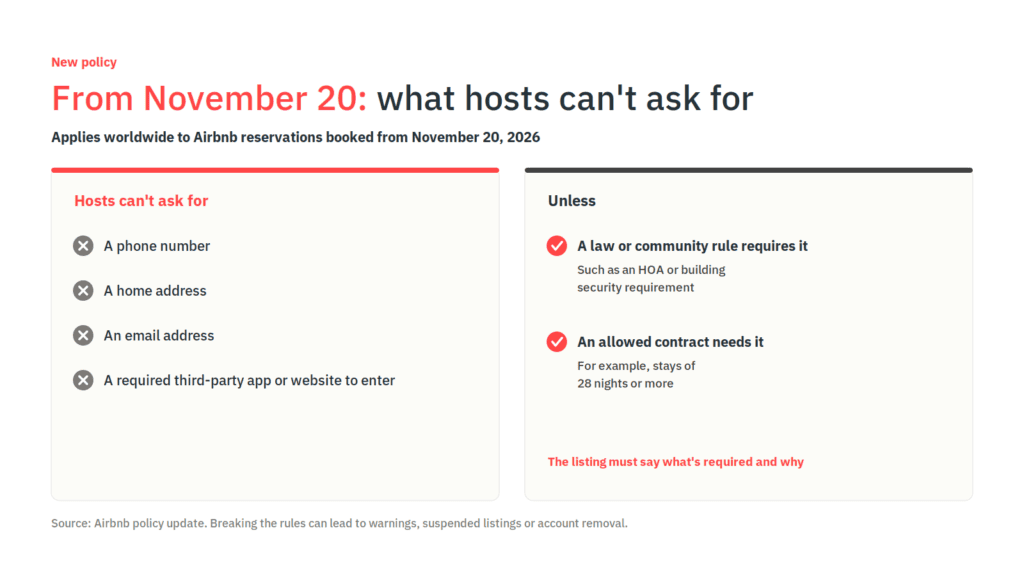
Under Airbnb’s updated policy, hosts can’t solicit a guest’s phone number, home address or email at any point during the booking or stay. That covers the pre-arrival message, the check-in form and the conversation on-site. Hosts also can’t require a third-party app or registration on another website to enter a listing. The rule applies worldwide.
There are two exceptions:
- Law or community rules: Hosts can collect data to comply with a law or a documented community association rule, such as a homeowners association (HOA) or building security requirement.
- Allowed contracts: Hosts can collect what’s needed for an allowed contract, for example on stays of 28 nights or more.
In both cases, the listing’s requests section must say what is required and why, as RSU covered in its look at Airbnb’s house rules.
The policy describes no application process. Hosts collect only what’s needed and store it securely, and Airbnb may ask for evidence. Breaking the rules can lead to warnings, suspended listings or account removal.
Together, the temporary numbers and the new rules change several daily routines.
What Breaks and What Still Works on Airbnb
What breaks
- WhatsApp messages: welcome messages and door codes sent there won’t reach temporary numbers.
- Texts after the stay: a lost-item follow-up three days after checkout goes to an expired number.
- Quick replies with the phone shortcut: Airbnb removed the shortcut, so these no longer send.
- Required check-in apps or forms: an app can’t be a condition of entry, and a form can’t ask for contact details outside the exceptions.
- WiFi login pages: portals that ask for an email or other personal data aren’t allowed, unless the listing is a hotel or resort or an exception applies.
What still works
- Door codes: Airbnb shows the last four digits of the guest’s real number on the reservation details page.
- Keyless entry apps: allowed, as long as guests can ask for another way in.
The biggest gap is what happens when a guest wants a direct line.
Can a Guest Still Choose to Share Their Number?
Airbnb hasn’t said. The older Off-Platform Policy, which still covers bookings made before November 20, lets hosts switch to a chat app when the guest asks. The new policy doesn’t repeat that exception, or say whether a guest who volunteers a number puts the host in breach.
The same gap affects software vendors. Hospitable (a short-term rental automation tool), for example, offers a check-in form where guests consent to share real contact details. How tools like these fit the November 20 rules is still unclear.
Until Airbnb answers, the balance of gains and costs looks like this.
Guests Gain Privacy, While Managers Lose Control Over Guest Details
Guests gain the most clearly. Their real number stays with Airbnb, and the one managers see stops working two days after checkout.
Airbnb gains too. Privacy is a genuine benefit. So is keeping every conversation, and potentially the next booking, on its own platform.
Direct bookings take a hit, since fewer real numbers make it harder to turn an Airbnb guest into a direct one. That isn’t the problem this change solves, though, and Airbnb’s older rules already barred using guest contact details for marketing. Direct-booking advocates have a fair concern about losing contact with guests. Direct bookings are also their business.
Property managers carry most of the day-to-day cost, and their frustration is legitimate. None of these changes was their doing, yet the work of rebuilding routines falls on them.
Within the rules, managers can move door codes and arrival details into Airbnb’s scheduled messages. They can ask Airbnb support how the policy applies to a specific setup. They can also add a line to the welcome message saying the property never asks for payment off-platform.
The open question is the guest who wants a direct line. Airbnb’s answer will decide whether WhatsApp check-in on Airbnb survives as a guest’s choice or disappears.
Frequently Asked Questions
Why is Airbnb using temporary guest phone numbers? Airbnb says temporary numbers are a proactive step to protect guests’ and hosts’ personal contact information.
Can hosts ask guests for their phone number on Airbnb? Not on reservations booked from November 20, 2026, unless a law or documented community association rule requires it, or it’s needed for an allowed contract. The listing must disclose what is required and why.
Do Airbnb temporary phone numbers work on WhatsApp? No. They work for calls and texts only, and expire two days after checkout.
Can I still use a guest’s phone number for door codes? Yes. Airbnb shows the last four digits of the guest’s real number on the reservation details page.
Can I collect guest emails or phone numbers through a WiFi login page? Not on Airbnb bookings made from November 20, 2026, unless the listing is a hotel or resort, or a legal or community association exception applies.
Does Booking.com still share guest phone numbers? Not with property software. Since September 28, 2026, managers can only find them in the Booking.com Extranet and Pulse app.
Subscribe to the RSU newsletter for weekly analysis for professional short-term rental managers.

Related Articles:
 Spain Investigates Airbnb for Unlicensed Rentals, Ex-Vacasa CEO Launches ‘Fairly’, Marriott Partners with Postcard Cabins & Trailborn
 Airbnb Makes Total Price Display Global—Here’s What It Means for Short-Term Rental Managers
 Athens Bans New Rentals Until 2026, Airbnb–FIFA Deal, New Fund to Support Advocacy
 Airbnb Earnings Protection Insurance: The Paid Fix for a Problem Airbnb Built