
Airbnb launched Earnings Protection Insurance on June 3, 2026, a paid, optional plan that pays small US hosts when a disaster or serious damage forces a listing offline. If a covered event makes your place unrentable, the plan replaces lost income based on what that listing normally earns. It is sold to the smallest hosts only, and it protects Airbnb bookings and nothing else. There is no flat price: each quote is built from your own listing’s earnings history. The plan also arrived on the same day Airbnb handed guests another way to cancel.
How Airbnb Earnings Protection Insurance works
The plan runs as one sequence, from sign-up to payout:
- Sign up. Request a quote through Airbnb’s Earnings Protection sign-up, pick cover worth one, two, or three months of your average monthly earnings, and pay the annual premium.
- A qualifying event happens. For a major hurricane, earthquake, or wildfire, Airbnb opens a claim for you automatically, reading outside data such as recorded wind speeds and seismic readings. For any other covered event, like an extended outage, loss of access, or structural damage, you file online and complete a short form confirming the loss.
- Airbnb reviews the claim. Airbnb says you get a quick response. In its own published example, a California host was paid within two weeks of filing.
- You get paid. The money lands in your bank account within a few days of approval, with no deductible.
Who qualifies, and where you can buy it
Eligibility is narrow by design, built for small, independent hosts:
- Five or fewer listings. More than that and you do not qualify.
- A listing with more than 50 nights booked through Airbnb in the past year.
- An active listing on the platform.
- Annual enrollment, with a 30-day window at the start to back out.
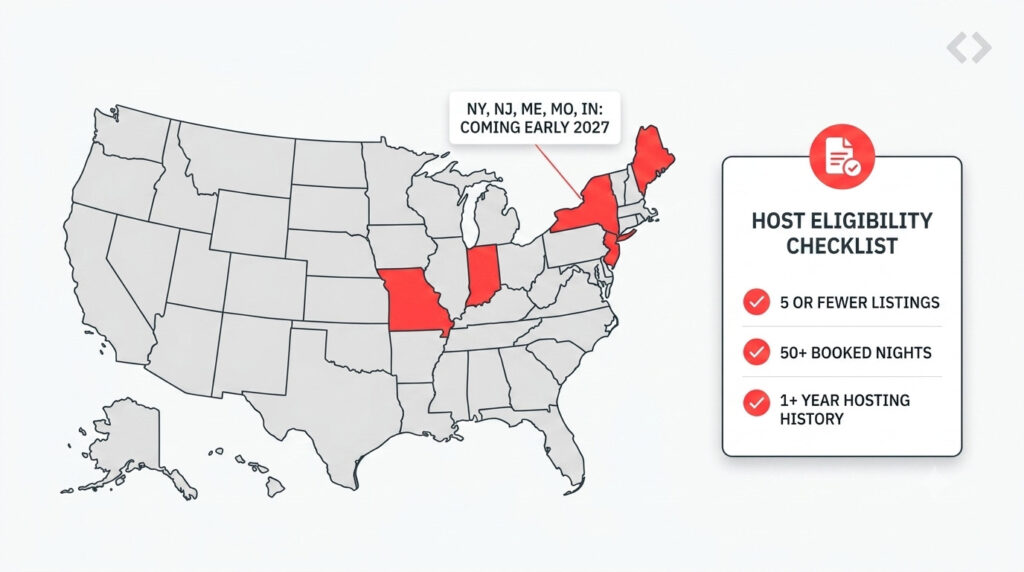
The plan is live in 45 states plus Washington, DC. Hosts in New York, New Jersey, Maine, Missouri and Indiana cannot buy it yet, with Airbnb pointing to early 2027 for those five. The reach stops at the US border, and Airbnb has not announced any plan to offer it abroad.

How much Airbnb Earnings Protection Insurance will cost you
There is no published price. Airbnb quotes each listing off its earnings history and says premiums vary by location. The payout side is fixed, though: cover equals your chosen months multiplied by your average monthly earnings, with no deductible. The numbers below are illustrative, for a host averaging $4,000 a month.
| Coverage level you pick | How the cap is set | Maximum payout |
|---|---|---|
| 1 month | 1 × average monthly earnings | $4,000 |
| 2 months | 2 × average monthly earnings | $8,000 |
| 3 months | 3 × average monthly earnings | $12,000 |
Offline longer than the cap you picked and you carry the rest alone. Your real figure comes from your own Earnings Protection quote.
What “parametric” actually means
The automatic track runs on parametric insurance, and the word explains both the appeal and the catch.
Parametric insurance pays on a trigger, not a loss. There is no claim to argue and no adjuster to convince. When an outside measurement crosses a set line, a recorded wind speed or a quake magnitude, the payout releases on its own. That beats traditional cover, where hosts wait on an assessor’s verdict about how bad the damage “really” was.
Airbnb did not invent this. Vrbo runs the same machinery through WeatherPromise, which reads NASA and NOAA data and pays out when rainfall passes a property-specific threshold. The difference is who it serves. Vrbo points its product at guests, to settle nerves about a rained-out trip. Airbnb points Earnings Protection at hosts, to replace lost income. Same trigger logic, opposite beneficiary.
What it covers, and what it leaves out
Airbnb lists a short set of covered events, each tied to a hard threshold.
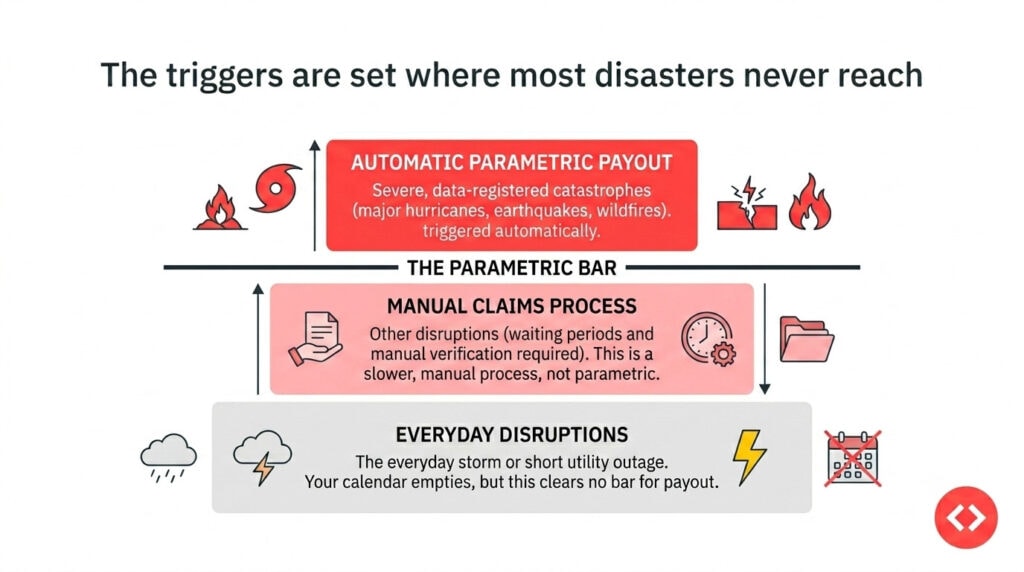
- Severe weather: a named storm or hurricane at Category 4 or higher.
- Earthquake: magnitude 7.5 or stronger.
- Wildfire: a named fire of 15,000 acres or more reaching your property.
- Unexpected damage: repairs that will take at least four days.
- Power outage: no electricity for at least three consecutive days.
- Loss of access: roads or restrictions cutting off your place for seven days straight.
First, Earnings Protection only covers Airbnb income. Your Vrbo stays and direct bookings sit outside it, which fits Airbnb’s logic, since it has no claim on income you earn elsewhere. The takeaway: if you sell across channels, this plan covers one slice of your revenue, and the rest needs its own arrangement.
Second, look at how high those triggers sit. A Category 3 hurricane is a serious storm, and it clears nothing here. The same goes for a magnitude 7 quake or a 12,000-acre fire. Each can shut a listing for weeks and trigger no automatic payout, because the bar is written for the catastrophe that makes national news, not the everyday disaster that quietly empties a calendar.
Why Airbnb is selling this now
Earnings Protection went live the same week Airbnb’s Major Disruptive Events Policy was already doing the thing this plan cleans up after. Under that policy, when a big weather crisis hits, a guest can cancel and get a full refund even if your cancellation policy says otherwise. Airbnb’s own guidance is clear on who pays. The guest gets their money back. You get nothing.
Put the two side by side. One policy takes your income during a disaster and hands the guest a free refund. The other sells you a way to win that income back, for a fee, from the same company.
Airbnb built the leak. Now it is selling you the bucket.
The Extended Cancellation Option, launched on June 3 too, sharpens it. It lets a guest pay Airbnb a fee to cancel up to 24 hours before check-in. Airbnb keeps that fee. And if a Major Disruptive Event then overrides the booking, you still get no payout, even though the guest paid for the option. Money goes to the platform on the way in. Risk lands on you on the way out.
The risk moved to the host. The goodwill stayed with Airbnb.
Step back and the design is easy to see.
A storm hits. The guest gets a fast, free refund and walks away happy with Airbnb. You lose the booking. Then Airbnb offers you a paid plan, run by an outside insurer, to recover the money its own policy just cost you. Airbnb keeps the guest. You pay to insure against Airbnb’s own refund. The free protection, AirCover, still covers damage and liability at no charge. The paid plan covers lost income, the exact thing the Major Disruptive Events Policy takes away.
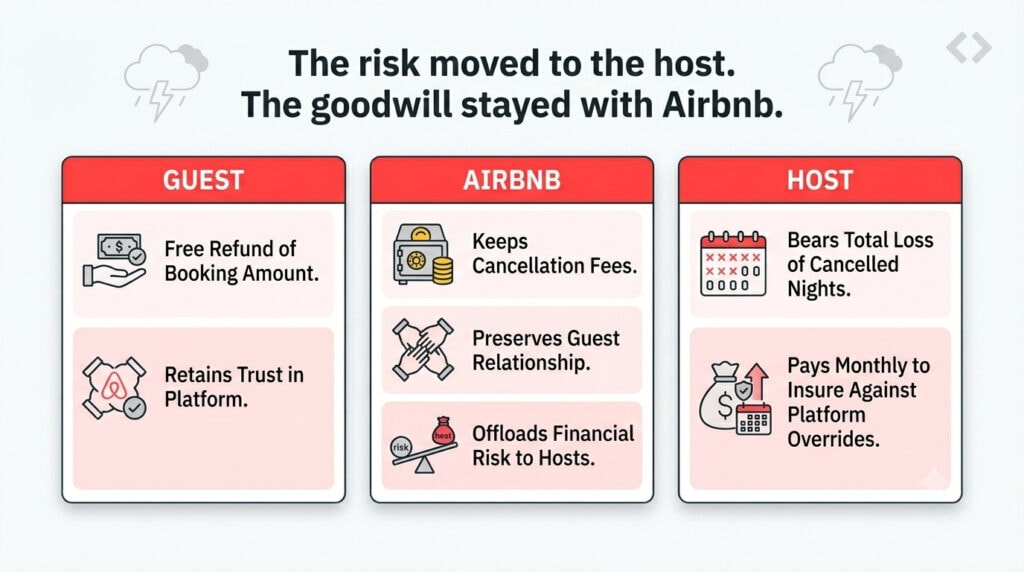
Run the numbers on that $4,000-a-month host. Two-month cover pays back up to $8,000 when a qualifying storm hits. A storm that falls just short of the parametric bar pays nothing, while the guest still collects a full refund. The premium left your account either way. Skip the plan and one bad season can wipe out your income with no recourse, because Airbnb refunded your guest and your firm cancellation policy counted for nothing. Buy it and you pay every year to guard against a refund Airbnb chose to give. Either way, the cost of Airbnb keeping guests happy lands on you.
And the plan only pays if a covered event clears its bar. Those bars are set for the disasters that make the news, which leaves the everyday storm that still empties a calendar on the wrong side of the line. The trigger is only half the risk. The other half is the cancellation rule that lets a guest walk off with your payout in the first place, which we break down in our guide to Airbnb’s Extended Cancellation Option.

Guneet has spent five years working at PriceLabs, developing deep expertise in short-term rental operations and hospitality technology. She brings that practitioner’s lens to her writing at RSU, covering platform updates and making sense of market data for property managers.