
Last-minute bookings bring in little revenue, managers’ own websites are losing bookings, and most teams still use AI only as a helper.
- What changed: If your rates look lower close to arrival, it’s mostly because the homes still booking that late are studios and one-bedrooms, which cost less to begin with. Guests aren’t simply waiting for deals.
- Who it impacts: Managers with many small homes, managers who rely on their own booking website, and teams still deciding how far to take AI.
- What to watch: Whether managers can grow 2027 revenue by filling more nights, since only 55% expect to charge more per night.
If your nightly rates look lower close to arrival, guests holding out for deals are probably not the reason. According to KeyData (a vacation rental data and benchmarking company), the homes still getting booked that late are mostly studios and one-bedrooms, which cost less to begin with. Sally Henry, KeyData’s VP of Market Intelligence and Insights, took that finding to both of this fall’s major vacation rental conferences.
RSU by PriceLabs hosted “What VRMA and VRWS Revealed: Booking Trends, AI and What to Plan for in 2027” on October 28, 2026. Thibault Masson, founder of RSU by PriceLabs and head of product marketing at PriceLabs (a revenue management and dynamic pricing platform), joined Henry to recap the Vacation Rental Management Association (VRMA) International Conference in Nashville and the Vacation Rental World Summit (VRWS) in Lyon. KeyData’s figures draw on reservation data from around 17,000 professional property managers, as of September 3.
This article pulls out the highlights for managers who couldn’t watch the full 45 minutes, along with what each finding means for their business.
European guests are booking later. US guests mostly aren’t (yet)
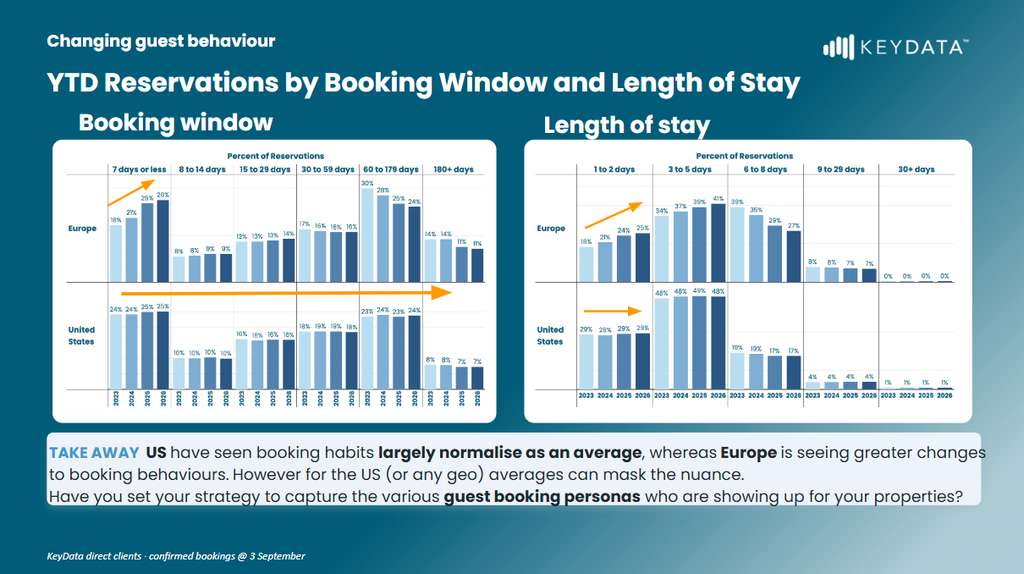
In Europe, more guests now book in the final week before their stay. That share rose from 18% of bookings in 2023 to 26% this year. Fewer guests are planning far ahead: the share booking two to six months out fell from 30% to 24% over the same period.

Stays are getting shorter as well. One- and two-night stays rose from 18% to 25% of European bookings. For managers in Europe, where listing growth halved this year, calendars are likely to fill later and in smaller pieces than they did a few years ago.
US guests haven’t shifted the same way. About a quarter of US bookings have come in the final week for four years running. Henry’s caution was that a steady number can still hide change. If a portfolio gets more bookings both a few days out and six months out, the overall pattern looks the same, even though the calendar fills very differently.
Last-minute bookings are common, but they bring in little of the revenue
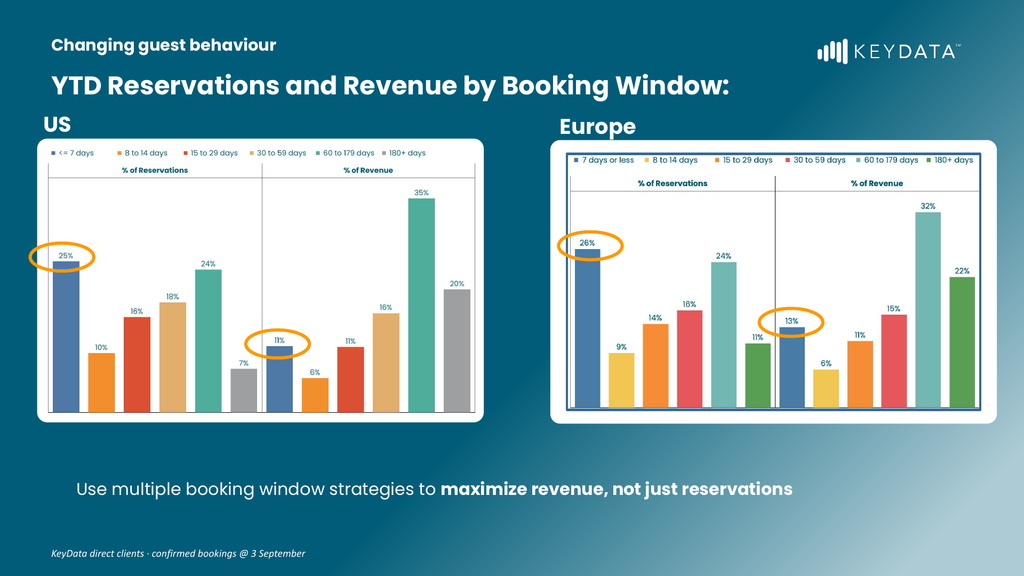
In the US, a quarter of bookings were made within a week of arrival, but they brought in only 11% of revenue. Europe looked similar: 26% of bookings, 13% of revenue.
The reason is price. US guests who booked within a week paid an average of $191 a night. Guests who booked six months or more ahead paid $536, nearly three times as much. The bookings that carry the year come two to six months out, which produced 35% of US revenue and 32% in Europe.
So a price drop aimed at filling the last week is aimed at a small slice of the year’s revenue. Most of the money is booked months earlier.
That gap is why Henry thinks an early-booking discount for direct guests can pay off. Taking 10% off a rate booked months ahead usually still beats the nightly rate available a week before arrival. Property managers at the conference round tables also told her many guests value flexibility, such as early check-in or late checkout, as much as a discount.
Rates look lower close to arrival because small homes book last
When KeyData split the data by home size, the explanation was simple. The homes still getting booked a week out are mostly small, lower priced ones. Large homes book months earlier, at higher rates.
- Small homes book late. In the US, more than a third of studio and one-bedroom stays (36% and 37%) were booked in the final week.
- Large homes book early. For homes with four or more bedrooms, only 15% were booked in the final week, and about a third were booked more than three months ahead.
- Europe shows the same pattern, even stronger. 72% of studio stays were booked less than a month out, while about half of four-plus-bedroom stays were booked more than three months ahead.
- Rates are still rising for most homes. US nightly rates were up 2.9% to 3.5% from last year for every home size except studios, which fell 1.5%.
So a lower average rate in the final week mostly means a different mix of homes is booking, not that prices are falling. Henry put it plainly on her slide: “It’s not a race to the bottom with your rates.” In her view, a studio still open a week out is often right on schedule, while a large home still open a week out is a real problem. That gives managers different options by home size: holding rates on smaller city units, competing harder on large homes that haven’t booked, and explaining the difference to owners worried about open calendars.
Masson added a related check. Many pricing tools compare a portfolio against every listing in the market by default. A manager with mostly large homes, compared against a market full of studios, can look behind when they’re actually on pace. Filtering the comparison by bedroom count or neighborhood gives a fairer picture.
Airbnb and Booking.com are taking more of the bookings that pay the most
Booking sites have always picked up most last-minute guests. Henry estimated that more than 80% of bookings made within a week come through booking sites. What’s new is that they are also winning more of the guests who book months ahead, the ones who pay the most.
- In the US, three in four stays now come through booking sites, up from 70% in 2024. Airbnb alone went from 42% to 48%. Bookings through managers’ own websites fell from 29% to 24%. Vrbo, which has just moved hosts to a single 12% commission, slipped from 22% to 20%.
- In Europe, managers’ own websites still win the early planners. 69% of stays booked six months or more ahead came direct, while most last-minute guests came through Booking.com (48%) and Airbnb (34%).
- But direct is slipping everywhere. This year, a smaller share of bookings came through managers’ own websites, whether guests booked a week out or six months out. That was true in both the US and Europe.
That matters because the two-to-six-month window, where direct is losing ground, is where a third of the year’s revenue is earned. Henry’s summary of the booking sites’ growth: “less trend and more reality.”
Where a booking comes from also changes how likely it is to cancel. Henry said Booking.com has the highest cancellation rates and Airbnb among the lowest. About half of canceled stays get rebooked, but a large home canceled a week out is much harder to fill again. Masson suggested offering at least two cancellation policies on the same listing, such as a cheaper non-refundable rate next to a flexible one, so guests who are sure of their dates can pay less for that certainty.
Managers expect more revenue in 2027, but not due to higher rates
KeyData’s 2027 Vacation Rental Industry Outlook surveyed 396 US managers with more than 113,000 properties between them.
- 77% expect revenue to grow next year, but only 55% expect to charge more per night. Henry’s read is that most of that growth has to come from filling more nights, not from raising prices.
- 25% plan to lean more on booking sites next year, compared with 18% who plan to rely on them less. More managers are moving toward Airbnb, Booking.com and Vrbo than away from them, even as their own websites lose bookings.
- 89% already use AI for at least one task, and Henry said the smallest managers use it most.
Masson linked the caution on rates to rising costs, from platform fees to software and inflation, and said smaller managers feel that squeeze most. In the PriceLabs Global Property Manager Report 2026, about one in four of the 753 managers surveyed, all running five to 50 units, said they are building their business to sell it. For larger managers, that could mean more portfolios coming up for sale.
Most management teams use AI as a helper, not to run tasks on its own
At VRMA, PriceLabs and Renjoy (a vacation rental management company) ran a workshop called “Map Your Team Against AI.” About 100 property managers scored their own companies on a scale of one to four across six areas, from bringing on new homes and guest messaging to owner reporting, finance and pricing.
Most rated themselves a two: AI helps, but a person still starts and finishes every task. Nobody rated themselves a four, where the work runs on its own and a person only sets the rules and fixes what goes wrong. In practice, that means even teams using AI every day are mostly saving time on parts of tasks, not handing whole tasks over.
Masson suggested running the same exercise internally at year-end. Each department head scores their own area alone, and the CEO scores all six. Where the two scores differ, leaders and their teams see AI differently, and that gap shows where to start. The AI scorecard and team guide are available on RSU. PriceLabs also used VRMA to launch Athena, an AI revenue analyst now in beta.
Your 2027 plan starts with your own homes, not the market average
Across the market, the picture is clear. In Europe, guests are booking later. Only about half of managers expect to raise rates next year. And Airbnb and Booking.com are winning bookings that used to come through managers’ own websites, including the ones that pay the most.
But a studio booked four days out and a five-bedroom home booked in February work like different businesses. They fill at different times, through different sites, with different cancellation risks. Henry’s closing advice was to split the portfolio by home size, location and local competition before setting rates. She also suggested setting summer 2027 rates now rather than waiting for the new year. A portfolio that looks behind the market may simply be filling on its own schedule.
The market average is where a 2027 plan starts. It is rarely where the revenue is.
Subscribe to the RSU newsletter for weekly analysis for professional short-term rental managers.

Related Articles:
 How Vacation Rental Managers Can Tackle 2025’s Toughest Challenges
 Why the Vacation Rental World Summit 2025 (VRWS) in Rome Is a Must-Attend Event
 Will AI Destroy the Revenue Manager? What I Heard at Scale UK 2026
 SCALE France turns five: three days that tell you where the French short-term rental market is heading